Municipality
Economic Overview and Business Opportunities in Årdal
An in-depth analysis of industrial concentration, municipal employment trends, local commercial centers, and entrepreneurship opportunities.
Executive Summary
Årdal represents one of Vestland county's most specialized heavy-industrial hubs. Historically anchored by energy-intensive manufacturing and heavy engineering, the local economy revolves around high-capacity process industry, hydropower generation, and associated specialized technical maintenance services.
Key highlights of the local commercial ecosystem include:
- Industrial Powerhouse: Process manufacturing and hydropower generation generate the bulk of corporate turnover, with major employers like Hydro Aluminium AS Årdal Metallverk driving extensive sub-contracting ecosystems.
- Concentrated Commercial Centers: Business activity is overwhelmingly partitioned between two primary geographic nodes: Øvre Årdal (the main industrial core) and Årdalstangen (the administrative and logistics center).
- Substantial Supply-Chain Base: Specialized industrial service providers—including Bilfinger Norway AS Avd Årdal, HMR Hydeq AS, and Impec AS—demonstrate strong revenue figures and maintain high workforce engagement in industrial machinery repair and metal product fabrication.
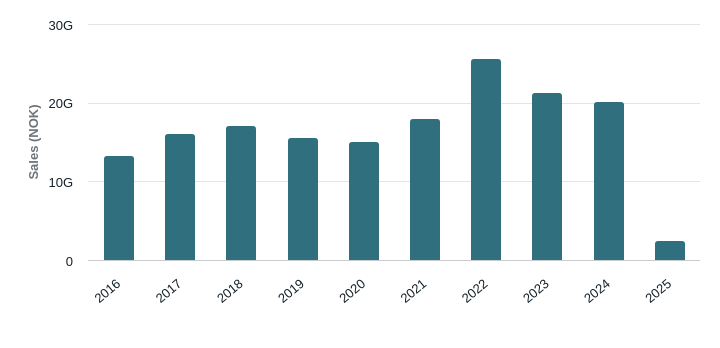
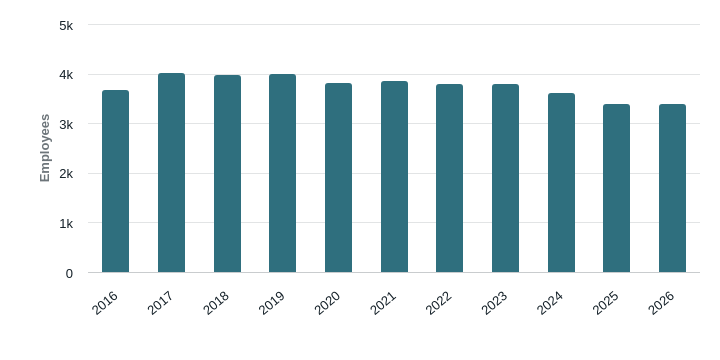
- Market Realignment: While corporate revenues peaked in 2022 alongside global energy and commodity surges, total reported employment has moderated from roughly 4,000 workers in 2017 to approximately 3,391 in recent projections, signaling structural efficiency gains and shifting staffing requirements.
Economic Overview
The macro-economic profile of Årdal is strongly influenced by international commodity prices, energy markets, and large-scale industrial output. Total company sales revenue in the municipality reached a historic peak of NOK 25.51 billion in 2022, driven by worldwide increases in industrial prices, before normalizing to NOK 21.23 billion in 2023 and NOK 20.04 billion in 2024.
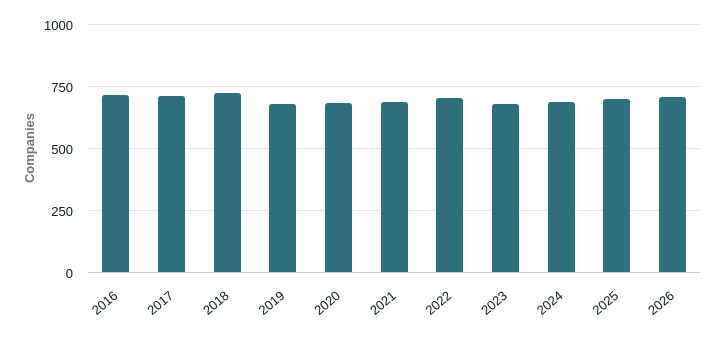
Employment trends reflect steady multi-year consolidation across primary industrial and public sector operations:
| Year | Reported Total Sales (NOK) | Total Local Employees | YoY Employee Change |
|---|---|---|---|
| 2016 | 13.25 Billion | 3,660 | — |
| 2017 | 16.05 Billion | 4,012 | +9.6% |
| 2018 | 17.05 Billion | 3,970 | -1.0% |
| 2019 | 15.46 Billion | 3,986 | +0.4% |
| 2020 | 15.05 Billion | 3,809 | -4.4% |
| 2021 | 17.86 Billion | 3,853 | +1.2% |
| 2022 | 25.51 Billion | 3,784 | -1.8% |
| 2023 | 21.23 Billion | 3,783 | -0.0% |
| 2024 | 20.04 Billion | 3,606 | -4.7% |
| 2025 | 2.39 Billion* | 3,391 | -6.0% |
| 2026 | — | 3,391 | 0.0% |
*Note: 2025 sales data reflects partial calendar year reporting and annualization shifts.
Industry Structure
Årdal's private sector is focused heavily on industrial technology, power generation, technical contracting, and local trade. Beyond manufacturing, public services (education, municipal administration, and healthcare) account for a substantial proportion of overall local headcounts.
Key sectoral clusters across registered local operating businesses include:
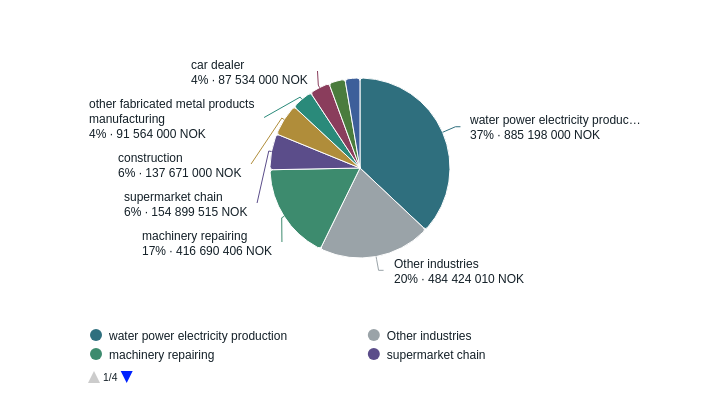
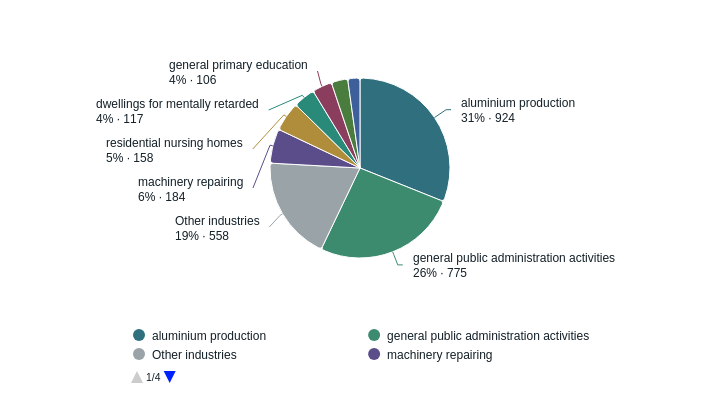
- Power Generation & Heavy Industry: Water power electricity production (2 companies generating NOK 885.2 million in operating income with an EBITDA margin of 31%) and aluminium production (2 companies, 924 employees) form the fundamental bedrock of the community.
- Industrial Engineering & Maintenance: Specialized mechanical support plays a critical role. Machinery repairing (3 companies, 184 employees, NOK 416.9M operating income) and fabricated metal products manufacturing (1 company, 38 employees, NOK 91.6M operating income) represent primary secondary drivers.
- Construction & Infrastructure: Construction and civil engineering activities—represented by site preparation (3 companies, 44 employees, NOK 54.2M) and general building contractors (3 companies, 51 employees, NOK 140.7M)—maintain robust cash generation.
- Retail & Local Services: Trade is anchored by supermarket chains (4 companies, 63 employees, NOK 162.0M operating income), building supplies stores (NOK 63.6M operating income), and automobile dealerships (NOK 87.7M operating income).
Corporate Structure Mix
Limited liability companies (AS) represent the dominant vehicle for private enterprise in Årdal, holding 89 active entities employing 1,855 workers and delivering NOK 2.55 billion in combined operating income. Public organizational structures (ORGL and KOMM) manage public administration, local schools, and healthcare facilities across the municipality.
Business Geography
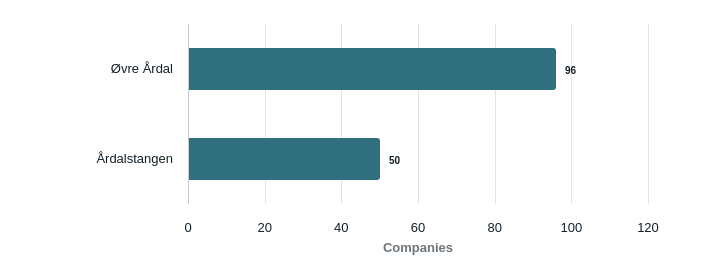
Commercial and industrial activity in Årdal is distributed across two primary settlements: Øvre Årdal and Årdalstangen. Both urban nodes serve distinct functions within the municipal economy.
| Location | Company Count | Registered Employees | Total Operating Income (NOK) | Total EBITDA (NOK) |
|---|---|---|---|---|
| Øvre Årdal | 96 | 2,084 | 2,227.6 Million | 424.8 Million |
| Årdalstangen | 50 | 1,394 | 496.8 Million | 90.0 Million |
Spatial Characteristics
- Øvre Årdal: Represents the heavy industrial powerhouse of the municipality. Housing 96 registered companies and over 2,000 employees, this location hosts the major metal production plants, main engineering workshops, and heavy equipment operations. It generates the vast majority of local corporate revenue and operational profits.
- Årdalstangen: Serves as the municipal seat and administrative centre, hosting 50 registered companies and nearly 1,400 employees. Operations here center around public governance, primary health infrastructure, port facilities, civil construction, and consumer commerce.
Largest Employers
The employer landscape in Årdal is led by a combination of global industrial players, local public sector authorities, and specialized engineering contractors.
Major companies and entities operating within the municipality include:
- Hydro Aluminium AS Årdal Metallverk: The largest private industrial employer in the region, operating in metal production with 919 registered employees at Øvre Årdal.
- Årdal Kommune: The central municipal organization employing 752 personnel in public administration and civic services, complemented by specialized units such as Årdal Kommune Heimetenestene (62 employees), Årdal Sjukeheim (61 employees), and Årdal Kommune Bu Og Miljøtenesta Grandane (57 employees).
- Bilfinger Norway AS Avd Årdal: A major industrial maintenance contractor situated in Øvre Årdal with 99 employees, delivering NOK 183.0 million in annual sales.
- HMR Hydeq AS: Headquartered at Øyni in Øvre Årdal, specializing in heavy machinery repair and engineering, employing 84 workers with NOK 229.7 million in operating income.
- Educational Facilities: Key primary education establishments include Farnes Skule (64 employees) and Tangen Skule (42 employees).
- Impec AS: Prominent metal fabricator and industrial equipment manufacturer in Øvre Årdal with 38 employees and NOK 91.6 million in revenue.
- Olav O. Hæreid AS: Major local civil engineering and site preparation firm employing 38 people with NOK 54.2 million in operating income.
- Kleiven Sogn AS: General building contractor based in Årdalstangen employing 35 people with NOK 114.7 million in operating income.
Business Dynamism
Business turnover and corporate insolvencies in Årdal remain relatively low, consistent with established, capital-intensive industrial economies where enterprise survival is closely tied to supply-chain partnerships with dominant local plants.
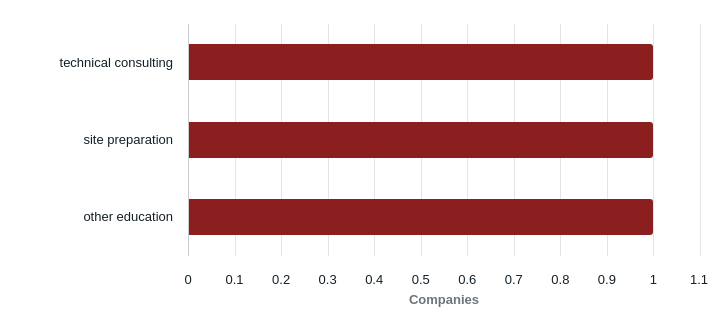
Recent corporate liquidations demonstrate limited systemic distress and are confined to isolated micro-operations:
- Technical Consulting & Specialized Services: A recorded insolvency in technical consulting (Årdal Rør & Sanitær AS, Torget 5, Årdalstangen) previously generated NOK 8.0 million in sales with operating profits of NOK 352.0 thousand.
- Site Preparation: A civil work company (Skjerven AS, Sandgota 1, Årdalstangen) recorded NOK 7.4 million in sales alongside negative EBITDA (-NOK 562.0 thousand) prior to proceedings.
- Early-Stage/Inactive Entities: Minor insolvencies include small holding or dormant entities (Reglowing AS, Storøyni 1A, Øvre Årdal) with zero reported turnover.
Overall, the low total number of bankruptcies (3 recorded in recent tracking) underscores a resilient vendor ecosystem supported by multi-year industrial support contracts.
Opportunities for Founders
For new business founders and expanding companies, Årdal presents specific strategic niches anchored by high median industrial wages and steady demand for B2B sub-contracting.
Promising commercial entry points include:
- Green Industrial Technology & Decarbonization Services: Given the high density of aluminum manufacturing and hydro-power production, specialized start-ups offering circular energy solutions, emissions monitoring, and waste recovery find a mature customer base.
- Advanced Industrial Automation & Robotics Support: High labor productivity across specialized machinery repair firms (generating over NOK 2.3M per employee) opens space for niche technology vendors specializing in predictive maintenance, sensors, and B2B software.
- Consumer & Hospitality Services: With specialized hotels currently producing NOK 32.2 million in annual income and strong local employment, opportunities exist for high-quality food services, tourism experiences around the Sognefjord landscape, and retail innovation.
- Commercial & Residential Sub-Contracting: Specialized electrical, HVAC, and civil contracting businesses benefit from strong demand generated by both industrial facility updates and municipal public works.
Founders exploring potential commercial locations and target industries in Årdal can utilize tools like SmartGrunder to analyze local market dynamics and identify emerging sector opportunities.
Conclusion
Årdal maintains a strong foundation within Norway's industrial landscape. Built upon reliable hydropower resources, advanced primary metal manufacturing, and a highly skilled technical workforce, the municipal economy exhibits substantial commercial stability.
While global macroeconomic cycles directly influence overall top-line revenue figures, the core industrial supply chain—comprising machinery engineering, metal fabrication, civil work, and energy generation—continues to generate solid cash flows. For founders, investors, and local decision-makers, Årdal offers a clear strategic setting: an established industrial community with high purchasing power and clear demand for modern technology, clean energy solutions, and specialized support services.