Municipality
Åseral Economic Snapshot: Hydroelectric Wealth, Rural Cooperatives, and Tourism Opportunities
An in-depth economic analysis of Åseral's commercial structure, employment trends, and regional enterprise landscape for entrepreneurs and policy-makers.
Executive Summary
Åseral represents a unique inland municipal economy within Agder county, characterised by massive hydroelectric revenue generation, strong cooperative agricultural employment, and a thriving mountain tourism footprint centered around Bortelid and Ljosland.
While the municipality maintains a small permanent population base, its economic output is substantial. Driven by power production facilities in locations like Fossdal (notably Skjerka Kraftstasjon under Å Energi Vannkraft AS), municipal revenue spikes during favorable power market cycles. Concurrently, sector employment is heavily anchored by regional administrative and agricultural cooperative entities such as Landbrukstjenester Sør SA, as well as municipal health and education services.
For entrepreneurs and prospective founders, Åseral offers low local overhead, strong industrial liquidity in core niches, and steady seasonal demand from cabin owners and winter sports enthusiasts. Navigating the municipality requires understanding its geographic concentration and distinct sector dynamics.
Economic Overview: Sales & Employment Trends
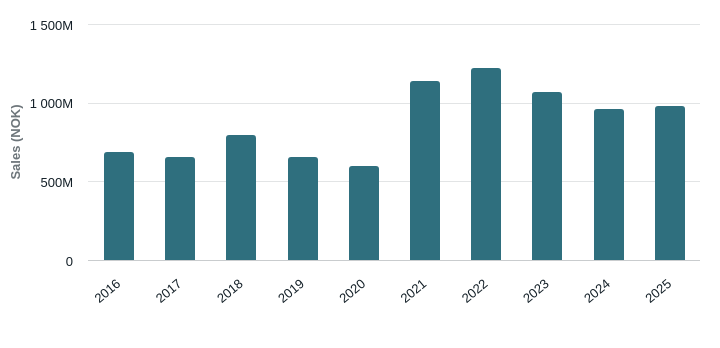
The macro-economic trajectory of Åseral reflects the influence of energy markets alongside steady baseline commercial activity. Total commercial sales revenue across local enterprises reached NOK 1.22 billion at its peak in 2022, before normalizing to NOK 957.6 million in 2024 and rebounding slightly to NOK 979.5 million in 2025 (+2.3% YoY).
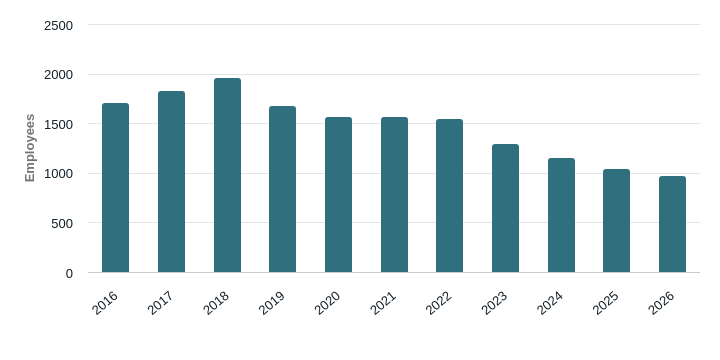
Total reported corporate and institutional headcount has adjusted down over recent years, shifting from 1,959 reported employees in 2018 to 1,041 in 2025 and a projected 966 in 2026. This reflects national reporting realignments as well as structural shifts in localized agricultural staffing models.
| Year | Commercial Sales (NOK) | Sales Growth YoY | Reported Employees | Employee Growth YoY |
|---|---|---|---|---|
| 2016 | 685.4M | - | 1,702 | - |
| 2017 | 652.3M | -4.8% | 1,827 | +7.3% |
| 2018 | 791.9M | +21.4% | 1,959 | +7.2% |
| 2019 | 653.7M | -17.4% | 1,672 | -14.7% |
| 2020 | 598.1M | -8.5% | 1,562 | -6.6% |
| 2021 | 1,135.0M | +89.8% | 1,563 | +0.1% |
| 2022 | 1,219.1M | +7.4% | 1,547 | -1.0% |
| 2023 | 1,069.8M | -12.2% | 1,295 | -16.3% |
| 2024 | 957.6M | -10.5% | 1,145 | -11.6% |
| 2025 | 979.5M | +2.3% | 1,041 | -9.1% |
| 2026 | - | - | 966 | -7.2% |
Industry Structure & Organizational Forms
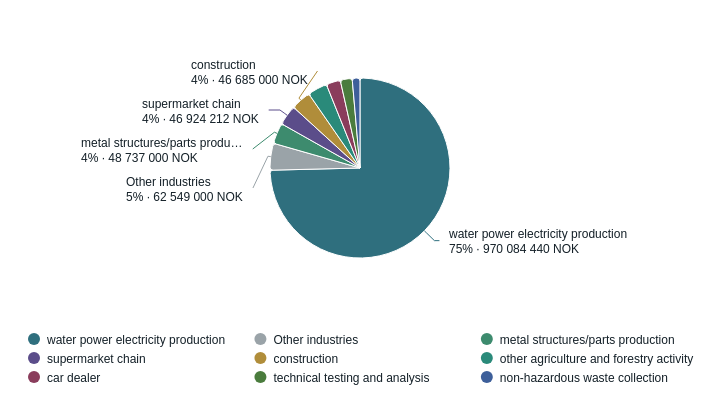
Åseral's commercial economy is structured around five primary pillars:
- Water Power Electricity Production: Concentrated in 2 major power plants yielding over NOK 985.0 million in operating income with an EBITDA margin of 54% and an operating margin of 49%.
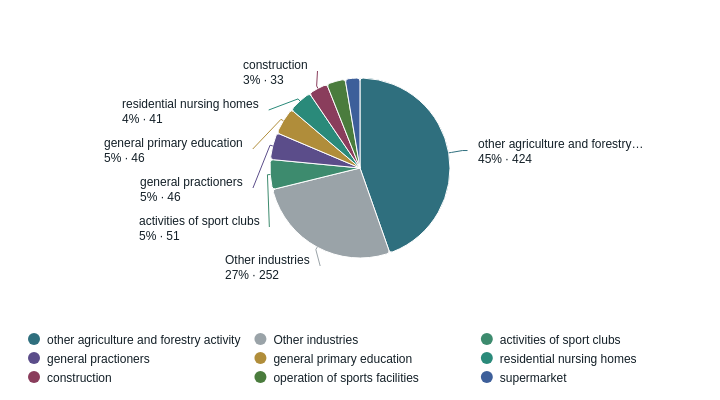
- Agriculture & Cooperative Services: Dominated by Landbrukstjenester Sør SA, which accounts for 424 employees and NOK 46.5 million in operating income.
- Manufacturing & Technical Services: Metal structures production (Fasseland Mekaniske Verksted AS, NOK 49.0 million operating income) and technical testing/analysis (West Inspection AS, NOK 27.7 million operating income).
- Construction & Site Preparation: 6 construction companies generating NOK 47.8 million alongside 3 site preparation specialists generating NOK 16.0 million.
- Tourism & Retail Trade: Alpine resort operating entities (Bortelid Skisenter AS, Ljosland Skisenter AS), local supermarkets (Bortelid Mat AS, supermarket chains), and accommodation services.
Legal Entity Distribution
| Legal Form | Number of Entities | Total Employees | Operating Income (NOK) | Key Characteristic |
|---|---|---|---|---|
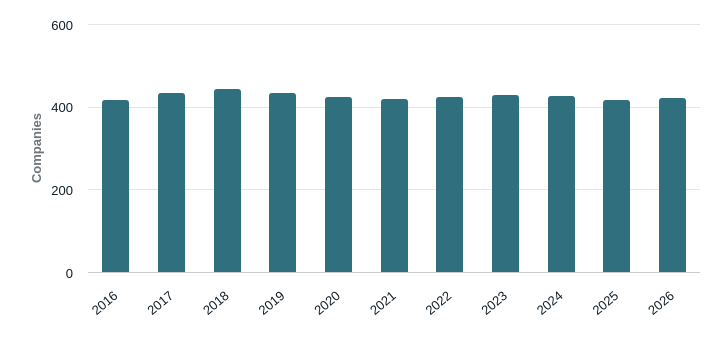
| AS (Aktieselskap) | 29 | 278 | 1,213.0M | High profitability; includes power, manufacturing, & tech |
| SA (Samvirke) | 2 | 436 | 94.2M | Primary agricultural & forestry labor cooperative |
| KOMM (Kommunal) | 13 | 258 | 0.0M | Public primary school, healthcare, and infrastructure units |
| IKS (Interkommunalt) | 1 | 14 | 18.5M | Regional waste management (HÅR IKS) |
| ENK (Enkeltpersonforetak) | 4 | 8 | 3.0M | Sole proprietorships in local trade & craft |
| KIRK (Kirkelig) | 1 | 8 | 0.0M | Local parish administrative functions |
Business Geography: Åseral Core vs. Fossdal
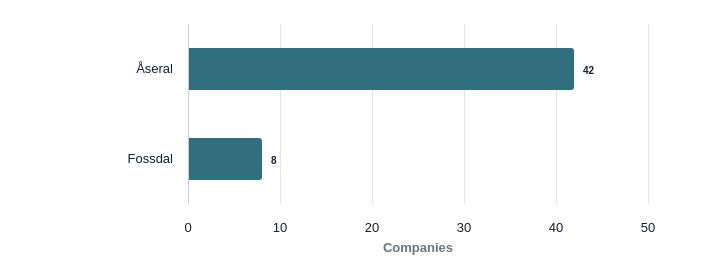
Commercial activity inside Åseral municipality is geographically concentrated into two main areas: the main municipal corridor (Åseral) and the hydroelectric energy center at Fossdal.
- Åseral (Village & Valley Hub): Houses 42 registered commercial and public entities with 950 employees. Total sales revenue stands at NOK 337.4 million, with an average EBITDA margin of 14%. This area contains the municipal administration, local schools, agricultural services, retail stores, and mountain resorts at Bortelid and Ljosland.
- Fossdal (Hydro Power Hub): Contains 8 registered corporate entities employing 52 staff members. Despite its small worker footprint, Fossdal generates NOK 980.3 million in operating income and NOK 962.7 million in sales revenue, delivering an extraordinary EBITDA margin of 52% and an operating margin of 47% due to power generation assets like Skjerka Kraftstasjon.
| Location Area | Active Entities | Total Employees | Operating Income | Sales Revenue | EBITDA Margin |
|---|---|---|---|---|---|
| Åseral | 42 | 950 | NOK 348.5M | NOK 337.4M | 14% |
| Fossdal | 8 | 52 | NOK 980.3M | NOK 962.7M | 52% |
Largest Employers & Core Companies
Employment in Åseral is driven by a mix of cooperative networks, municipal institutions, energy producers, and specialized industrial firms.
Top Commercial & Public Employers
- Landbrukstjenester Sør SA (Hovedkontor): 424 employees. Headquartered in Åseral, providing agricultural relief and forestry labor services across the region (NOK 46.5 million operating income).
- Bortelid Skisenter AS: 51 employees. Operates winter recreation facilities in Bortelid (NOK 6.2 million operating income).
- Åseral Barne og Ungdomsskule: 46 employees. Municipal primary and lower secondary school.
- Åseral Kommune Helse og Velferd: 46 employees. Local general practitioner and health services.
- Åseralsheimen: 41 employees. Municipal residential nursing home care.
- Ljosland Skisenter AS: 32 employees. Winter sports and slope operations at Ljosland (NOK 3.4 million operating income).
- Bortelid Mat AS: 25 employees. Supermarket catering to cabin residents and visitors (NOK 8.6 million operating income).
- Åseral Barnehage & Kommune Stab: 24 employees each. Early childhood education and municipal executive administration.
- Fasseland Mekaniske Verksted AS: 21 employees. High-value metal fabrication firm with NOK 49.0 million operating income and a 16% EBITDA margin.
- Å Energi Vannkraft AS (Avd Skjerka Kraftstasjon): 19 employees. Major regional power generation unit producing NOK 937.6 million in operating income with a 54% EBITDA margin.
- West Inspection AS (Avd Hareid): 15 employees. Technical testing and industrial inspection services delivering NOK 27.7 million operating income and a 20% EBITDA margin.
- Hægebostad og Åseral Renovasjonsselskap HÅR IKS: 14 employees. Inter-municipal waste management company generating NOK 18.5 million in operating income.
Business Dynamism & Financial Resilience
Åseral exhibits high overall financial stability, grounded in heavy capital reserves within power generation, manufacturing, and municipal infrastructure.
- Capital Strength: Corporations registered as Limited Companies (AS) maintain over NOK 616 million in total equity against NOK 1.62 billion in debt, reflecting capital-intensive energy infrastructure.
- Operational Margins: The local commercial ecosystem achieves an aggregated operating margin of 41% across AS entities, insulated heavily by hydroelectric cash flows.
- Insolvency Risk: Current reporting indicates zero active bankruptcies among registered entities in the municipality. The presence of long-standing family and cooperative enterprises fosters high credit stability.
Opportunities for Founders & Entrepreneurs
Åseral presents specific strategic openings for entrepreneurs willing to build around the municipality's core assets:
- Cabin Economy & Tourism Services: With large holiday home communities in Bortelid and Ljosland, high demand exists for specialized property management, craft trades, seasonal catering, and outdoor recreation equipment services.
- Industrial Sub-Contracting & Maintenance: Strong manufacturing bases like Fasseland Mekaniske Verksted and energy installations at Skjerka require ongoing electrical, mechanical, and logistical support services.
- Rural Labor & Tech Solutions: Given the success of Landbrukstjenester Sør SA, software or tech-enabled coordination platforms targeting agricultural and forestry staffing represent scalable market entries.
- Green Energy Support Services: Local expertise in water power creates opportunities for environmental consulting, specialized maintenance, and drone-based inspection services.
Founders evaluating specific commercial addresses or market entry opportunities in Åseral can utilize tools like SmartGrunder to analyze local registration patterns, demographic trends, and sector-specific demand.
Conclusion
Åseral presents an encouraging landscape for specialized business initiatives. The municipality combines the solid economic backstop of national energy production with active regional cooperative organizations and expanding alpine tourism hubs.
For investors, founders, and civic leaders, Åseral's commercial future lies in leveraging its energy wealth to support high-quality local services, expanding winter and summer tourism offerings, and attracting technical skillsets that complement its established manufacturing and engineering industries.