Municipality
Aurland Economic Report: Hydropower Strength and Tourism Dynamism in Vestland
An in-depth economic analysis of Aurland's revenue structure, employment clusters, geographical hubs, and entrepreneurial potential.
Executive Summary
Aurland municipality, situated along the UNESCO World Heritage-listed Nærøyfjord in Vestland county, features a highly specialized local economy anchored by two massive industrial pillars: renewable hydropower production and world-class international tourism. Despite its modest residential population, Aurland generates substantial corporate revenue and maintains a strong employment base driven by high-capital infrastructure and heavy visitor footfall.
The commercial landscape is concentrated across two main focal points: the administrative center of Aurland, which benefits from large-scale hydro generation profits via Hafslund Kraft As Avd Aurland, and the tourism nexus of Flåm, home to the iconic Flåmsbana railway, major hotel properties, and fjord transport operators. While the economy faced extreme volatility during global travel restrictions in 2020, it demonstrated rapid post-pandemic recovery, exceeding NOK 2.6 billion in total municipal sales in 2023.
For entrepreneurs and prospective founders, Aurland offers a market with high seasonal purchasing power, exceptional visitor volume, and strong public-private infrastructure. However, economic activity is sensitive to global travel flows and seasonal fluctuations, creating prime opportunities for businesses offering off-season diversification, eco-tourism innovation, and specialized local services.
Economic Overview
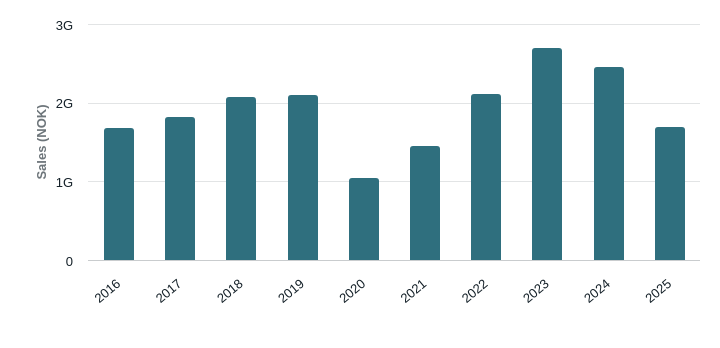
Aurland's financial trajectories illustrate both the resilience of its core industrial baseline and the sharp cyclical nature of its hospitality sector. Between 2016 and 2019, corporate sales steadily expanded from NOK 1.68 billion to NOK 2.10 billion. The onset of the COVID-19 pandemic in 2020 reduced commercial sales by 50.5% to NOK 1.04 billion, underscoring the municipality's high reliance on international leisure travel.
The post-2020 recovery was remarkably swift. Sales surged by 38.7% in 2021, 46.2% in 2022, and peaked at NOK 2.70 billion in 2023. As travel patterns normalized, corporate revenue stood at NOK 2.45 billion in 2024 and NOK 1.69 billion in 2025 reporting datasets.
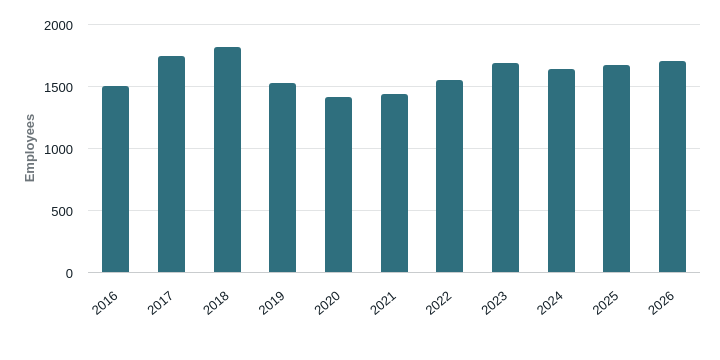
Employment figures exhibit a similar structural baseline. Employment reached 1,817 in 2018, adjusted during the 2020–2021 period down to 1,410 employees, and rebounded to 1,682 in 2023. Forecasts indicate steady workforce stabilization around 1,673 to 1,702 personnel between 2025 and 2026.
| Year | Total Municipal Sales (NOK) | YoY Sales Change | Total Employment | YoY Employee Change |
|---|---|---|---|---|
| 2016 | 1,677.1M | — | 1,503 | — |
| 2017 | 1,817.3M | +8.4% | 1,738 | +15.6% |
| 2018 | 2,066.4M | +13.7% | 1,817 | +4.5% |
| 2019 | 2,102.8M | +1.8% | 1,527 | -16.0% |
| 2020 | 1,040.8M | -50.5% | 1,410 | -7.7% |
| 2021 | 1,443.6M | +38.7% | 1,438 | +2.0% |
| 2022 | 2,110.5M | +46.2% | 1,549 | +7.7% |
| 2023 | 2,698.4M | +27.9% | 1,682 | +8.6% |
| 2024 | 2,449.0M | -9.2% | 1,635 | -2.8% |
| 2025 | 1,689.7M | -31.0% | 1,673 | +2.3% |
| 2026 | — | — | 1,702 | +1.7% |
Industry Structure & Legal Forms
Aurland's industry mix is sharply bifurcated between ultra-high-margin capital-intensive utilities and labor-intensive service industries.
Primary Industry Clusters
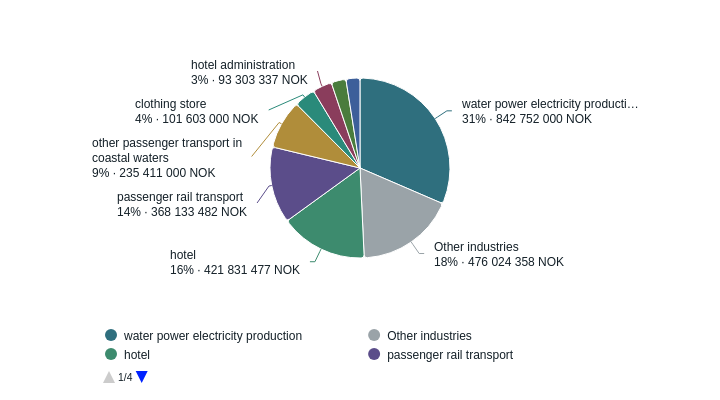
- Water Power Electricity Production: Led by Hafslund Kraft As Avd Aurland, this single industry code generates NOK 849.5 million in operating income with an impressive 83% EBITDA margin, acting as the primary fiscal powerhouse of the municipality.
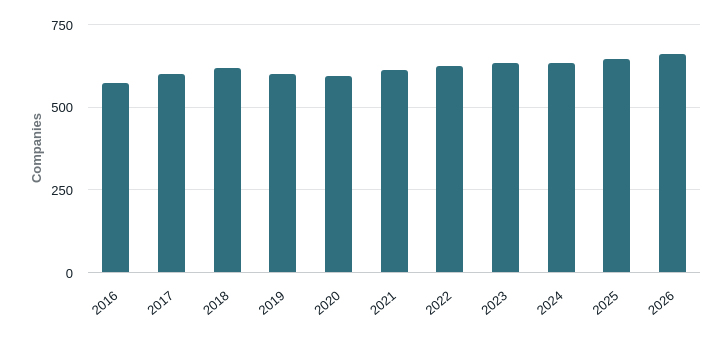
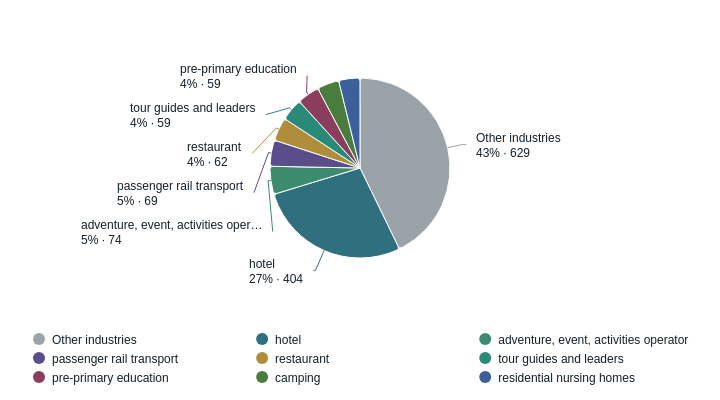
- Hotels & Hospitality: With 8 corporate entities employing 404 workers, hotels represent the largest private-sector workforce. Operating income reaches NOK 437.1 million, though operating margins average 1% due to high labor costs and seasonal overhead.
- Passenger Rail & Maritime Transport: Flåmsbana As dominates rail transport with NOK 368.3 million in operating income and a 46% EBITDA margin. Coastal fjord transport, led by The Fjords Da, adds another NOK 235.4 million in turnover.
- Experiential Tourism & Retail: Specialized sub-sectors such as tour guides (+1234% growth, NOK 34.2M sales), souvenir retail (Saga Souvenir As, NOK 105.7M sales), bus charters, and outdoor adventure operators constitute a vibrant experiential economy.
| Industry Sector | Companies | Employees | Operating Income (NOK) | EBITDA Margin |
|---|---|---|---|---|
| Water Power Electricity | 1 | 47 | 849.5M | 83% |
| Hotels & Lodging | 8 | 404 | 437.1M | 4% |
| Passenger Rail Transport | 2 | 69 | 368.3M | 46% |
| Coastal Water Transport | 1 | 54 | 235.4M | 18% |
| Retail Clothing / Souvenirs | 1 | 46 | 105.7M | 22% |
| Hotel Administration | 1 | 50 | 98.2M | 7% |
| Tour Guides & Excursions | 3 | 59 | 34.2M | 19% |
| Adventure & Events | 4 | 74 | 45.8M | 17% |
Legal Forms Structure
Limited liability companies (AS) represent the core of commercial activities, encompassing 97 registered firms, 1,351 employees, and NOK 2.59 billion in turnover. Municipal enterprise entities (Komm and KF) handle essential healthcare, education, and port management, while general partnerships (DA) account for key joint ventures in marine passenger transport.
Business Geography
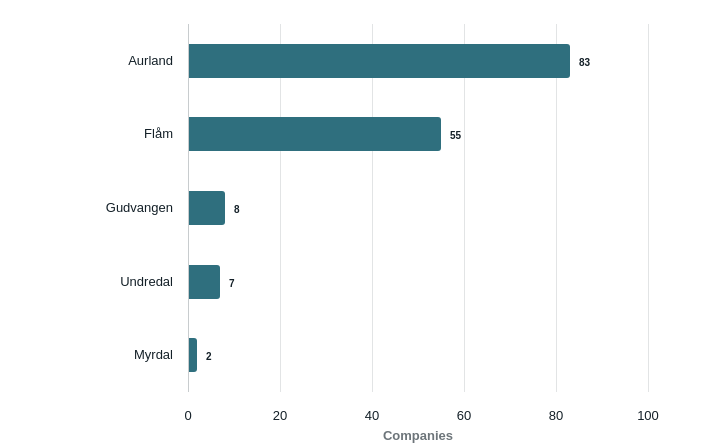
Economic activity within Aurland municipality is distributed across five distinct geographical nodes, each fulfilling a specialized role in the local economy:
- Aurland (Municipal Center): Serves as the administrative seat and industrial energy hub. While hosting 83 companies and 906 employees, its financial metrics—NOK 1.22 billion operating income and 61% EBITDA margin—are anchored by hydro generation facilities based in Vassbygdi.
- Flåm (International Tourism Hub): The commercial gateway for cruise ships, fjord sightseeing, and rail travel. Flåm accounts for 55 companies and 882 employees, generating NOK 1.47 billion in operating revenue with strong 19% top-line growth.
- Gudvangen (Fjord & Cultural Center): Positioned at the head of the Nærøyfjord, Gudvangen registers 8 companies and 182 employees. It generates NOK 158.9 million in sales, driven by fjord hotels and Viking-themed cultural tourism experiences.
- Undredal: Renowned for goat cheese production and historic fjord architecture, housing 7 small businesses and 24 employees with NOK 15.8 million in revenue.
- Myrdal: The high-mountain junction connecting the Bergen Line to the Flåm Railway, supporting specialized transport and hospitality units (2 companies, 8 employees).
| Area / Settlement | Companies | Employees | Operating Income (NOK) | Revenue Growth | EBITDA Margin |
|---|---|---|---|---|---|
| Aurland | 83 | 906 | 1,219.9M | 5% | 61% |
| Flåm | 55 | 882 | 1,465.3M | 19% | 21% |
| Gudvangen | 8 | 182 | 158.9M | 12% | 13% |
| Undredal | 7 | 24 | 15.8M | 13% | 7% |
| Myrdal | 2 | 8 | 1.9M | 5% | 20% |
Largest Employers
The employer landscape in Aurland consists of high-revenue transport and energy corporations, large destination hotels, and essential public municipal institutions.
Key Commercial Employers
- Hafslund Kraft As Avd Aurland: Operating from Vassbygdvegen, it is the highest revenue contributor (NOK 849.5M operating income, 47 employees) and the foundation of local industrial tax generation.
- Flåmsbana As: Operating the world-famous steep railway, employing 66 staff and generating NOK 365.7M in operating income with an outstanding operating profit of NOK 168.4M.
- Fretheim Hotel: Aurland's largest single hotel employer located in Flåm, featuring 132 employees and NOK 239.2M in operating income.
- The Fjords Da Avd Aurland: Major maritime operator running battery-electric passenger vessels on the fjord, employing 54 workers with NOK 235.4M in revenue.
- Flåmsbrygga Hotell As: Hospitality complex in Flåm employing 102 staff with NOK 98.7M in revenue.
- Saga Souvenir As: High-volume retail business in Flåm generating NOK 105.7M in revenue with 46 employees.
- Norway S Best Administrasjon Flåm: Destination management and marketing firm handling hotel operations and tourism logistics (50 employees, NOK 98.2M revenue).
- Gudvangen Fjordtell As & Gudvangen Utvikling As: Core hospitality and event operators in Gudvangen, employing a combined 121 workers.
Public & Educational Employers
Public infrastructure is anchored by Aurland Helsetun (56 employees) and Heimebaserte Tenester (35 employees) in healthcare, Aurland Barne Og Ungdomsskule (42 employees) in basic education, and Sogn Jord Og Hagebruksskule (49 employees), Norway's premier organic agriculture vocational college.
Business Dynamism & Growth Trends
Aurland exhibits extraordinary top-line momentum in experiential and activity-based tourism sub-sectors. As international travelers returned to Western Norway, specialized operators experienced rapid double- and triple-digit revenue growth.
High-Growth Operators
- Fjordsafari Norway As: Guided RIB-boat and wilderness excursion company in Flåm expanded sales by 100%, generating NOK 30.4M in operating income with 38 employees.
- Østerbø Fjellstove As: Mountain lodge along the Aurlandsdalen hiking trail recorded 77% revenue growth, reaching NOK 11.3M in revenue.
- Gudvangen Utvikling As: Cultural attraction and activity operator grew sales by 31% to NOK 20.3M.
- Charters & Cableway Transport: Local cableway operations (+37%) and charter bus operators (+34%) posted strong operational gains, reflecting high overall visitor activity.
Formal bankruptcy statistics for the region remain negligible in official reporting periods, indicating that local tourism operators navigated post-pandemic adjustments without significant corporate distress.
Opportunities for Founders
Aurland offers compelling opportunities for entrepreneurs who can build upon the municipality's high footfall and natural assets while addressing seasonal volatility.
Priority Entrepreneurial Avenues
- Off-Season & Shoulder-Season Concepts: With heavy tourism concentrated between May and September, ventures offering winter experiences, dark-sky tourism, or year-round wellness facilities can capture underutilized demand.
- Local Food & Artisan Products: Inspired by Sogn Jord Og Hagebruksskule and Undredal's artisan cheese heritage, founders can establish farm-to-table dining, organic food production, or premium regional retail brands targeting high-spending tourists.
- Eco-Tech & Maritime Services: Given Aurland's leadership in green fjord transport (electric vessels on Nærøyfjord), opportunities exist in zero-emission maritime support, charging tech, and sustainable outdoor equipment rentals.
- B2B Hospitality Support Services: High-volume operators like Fretheim Hotel and Flåmsbrygga frequently require specialized facility management, digital marketing, staffing services, and eco-certified supply chains.
Founders evaluating business addresses, sector statistics, or commercial opportunities across Aurland, Flåm, and Gudvangen can leverage SmartGrunder to explore hyper-local address data, industry statistics, and market positioning.
Conclusion
Aurland stands out as one of Vestland's most economically dynamic rural municipalities. Its dual-engine economy—driven by multi-million kroner hydro production in Aurland and global tourism in Flåm and Gudvangen—provides an exceptional revenue base far exceeding typical rural demographics.
For business leaders, investors, and founders, Aurland provides a well-funded municipal environment with high consumer traffic and world-renowned natural infrastructure. By focusing on sustainability, shoulder-season attraction, and premium service delivery, new ventures can successfully capitalize on Aurland's unique position in the Norwegian economy.