Municipality
Bergen Business Economy Analysis: Growth Drivers, Industry Mix, and Founder Opportunities
An in-depth economic evaluation of Vestland's administrative and commercial capital for entrepreneurs, investors, and civic leaders.
Executive Summary
Bergen serves as the premier economic engine of Western Norway and the administrative center of Vestland county. The municipality combines a massive public sector anchor with world-leading industrial, energy, marine, and financial clusters. With a workforce exceeding 247,000 employees and total corporate sales hovering near NOK 595 billion annually, Bergen offers an exceptionally broad and resilient economic base for business founders and expanding corporate enterprises.
The commercial ecosystem is characterized by strong geographic specialization: high-revenue energy and engineering clusters in Sandsli and Kokstad, heavy financial and insurance headquarters in Solheimsviken and Fyllingsdalen, and a dense retail, tourism, and professional services hub in the historical city center. Supported by major research and educational institutions such as the University of Bergen (UiB), Western Norway University of Applied Sciences (HVL), and the Institute of Marine Research (Havforskningsinstituttet), Bergen provides founders with direct access to top-tier talent, specialized industrial supply chains, and substantial regional capital.
Economic Overview
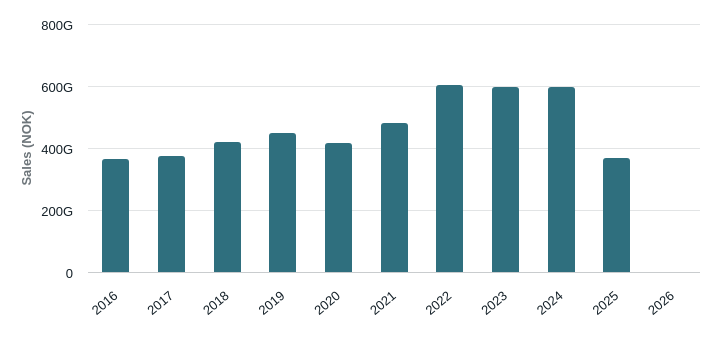
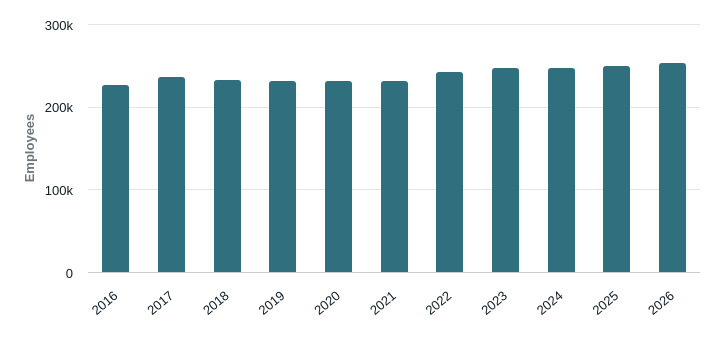
Bergen's macro economy has demonstrated robust long-term expansion over the past decade. Between 2016 and 2024, local employment expanded from 225,736 to 247,215 employees, reflecting steady growth driven by healthcare, public administration, IT, and specialized engineering services. Total business sales surged from NOK 363.07 billion in 2016 to a peak of NOK 604.08 billion in 2022, maintaining strong baseline revenues around NOK 595 billion through 2023 and 2024.
Note: Figures for 2025 and 2026 represent partial reporting year accounting data and projected indicators rather than complete annual financial returns.
| Year | Total Employees | YoY Employee Change | Total Sales (NOK) | YoY Sales Change |
|---|---|---|---|---|
| 2016 | 225,736 | - | 363.07B | - |
| 2017 | 236,314 | +4.7% | 375.49B | +3.4% |
| 2018 | 232,174 | -1.8% | 420.44B | +12.0% |
| 2019 | 230,959 | -0.5% | 449.16B | +6.8% |
| 2020 | 231,318 | +0.2% | 415.82B | -7.4% |
| 2021 | 231,259 | -0.0% | 482.09B | +15.9% |
| 2022 | 242,056 | +4.7% | 604.08B | +25.3% |
| 2023 | 246,473 | +1.8% | 595.49B | -1.4% |
| 2024 | 247,215 | +0.3% | 595.28B | -0.0% |
The stability of employment alongside elevated revenue figures underlines Bergen's role as a primary regional buffer during national and global market fluctuations.
Industry Structure & Legal Organization
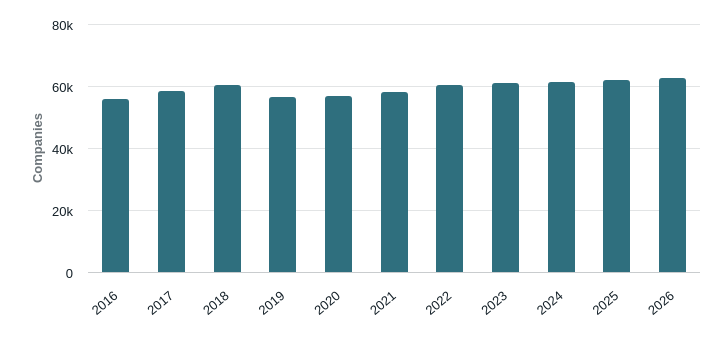
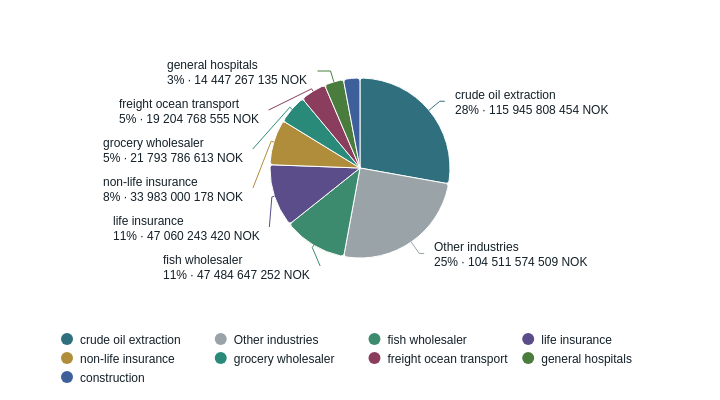
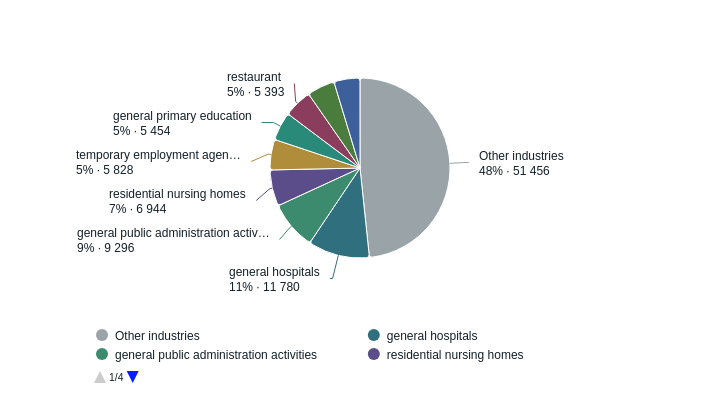
Bergen's economy is highly diversified, spanning heavy healthcare infrastructure, energy extraction, subsea tech, banking, education, and consumer trade. The largest single employment category is general hospitals, led by Helse Bergen HF, accounting for 11,780 employees across 12 registered entities with revenues exceeding NOK 16.07 billion. Public administration (9,296 employees) and residential care facilities (6,944 employees) form the foundational public-sector spine.
In the private commercial sector, petroleum extraction support (4,971 employees, NOK 13.13 billion revenue) and direct crude oil extraction (3,806 employees, NOK 134.09 billion revenue) generate immense value. Technical consulting (3,864 employees), construction (4,116 employees), IT services (2,676 employees), and financial intermediation (2,729 employees) constitute high-yield B2B pillars.
| Organization Form | Companies | Employees | Total Operating Income (NOK) |
|---|---|---|---|
| Limited Company (AS) | 7,642 | 130,751 | 431.86B |
| Public Entity / Unit (ORGL) | 662 | 49,484 | - |
| Statutory Enterprise (SÆR) | 52 | 14,531 | 19.24B |
| Public Limited Company (ASA) | 20 | 5,911 | 155.21B |
| Foreign Branch (NUF) | 53 | 2,026 | 33.24B |
| Savings Banks (SPA) | 10 | 711 | 6.88B |
The standard limited company (Aksjeselskap / AS) remains the dominant vehicle for private enterprise, hosting over 130,000 workers, while public limited companies (ASA) account for massive top-line operating revenues due to major energy and banking listings.
Business Geography & District Breakdown
Economic activity within Bergen is geographically structured around core commercial zones, each possessing distinct industrial characteristics:
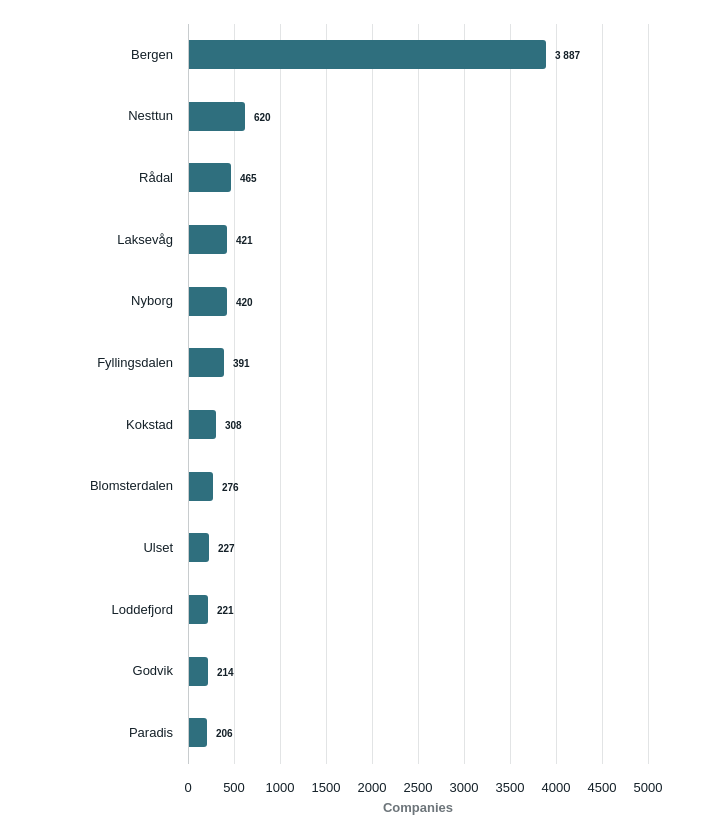
- Bergen City Center (Bergen sentrum): The primary center for public administration, university research, culture, law, finance, and consumer commerce, housing 3,887 companies and 119,840 workers with NOK 312.63 billion in operating income.
- Sandsli & Kokstad: The high-tech, energy, and subsea engineering heartbeat of the region. Sandsli alone generates NOK 147.85 billion in operating income with an average per-employee operating income of NOK 21.8 million. Kokstad contributes NOK 53.81 billion with 11,068 workers at a high average EBITDA margin of 26%.
- Fyllingsdalen: A major administrative and financial services center, dominated by insurance headquarters such as Tryg Forsikring, generating NOK 41.63 billion across 391 companies.
- Nesttun & Blomsterdalen: Sub-regional retail and trade hubs supporting over 19,000 combined employees.
- Nyborg, Laksevåg & Rådal: Key trade, logistics, light manufacturing, and retail districts serving the northern and southern corridors of the municipality.
| District / Location | Companies | Employees | Operating Income (NOK) | EBITDA Margin |
|---|---|---|---|---|
| Bergen (City Center) | 3,887 | 119,840 | 312.63B | 11% |
| Sandsli | 103 | 8,868 | 147.85B | 14% |
| Kokstad | 308 | 11,068 | 53.81B | 26% |
| Fyllingsdalen | 391 | 10,560 | 41.63B | 14% |
| Blomsterdalen | 276 | 8,514 | 22.70B | 11% |
| Nyborg | 420 | 7,551 | 17.77B | 8% |
| Laksevåg | 421 | 6,917 | 12.87B | 7% |
| Nesttun | 620 | 10,783 | 14.93B | 8% |
Largest Employers & Anchor Institutions
Bergen's employment landscape is anchored by massive public bodies and world-class commercial headquarters. Public healthcare and civil administration represent the largest employer groups:
- Bergen Kommune: 30,963 employees managing municipal public services and infrastructure.
- Helse Bergen HF (Haukeland Universitetssjukehus): 9,461 employees delivering specialized medical care with NOK 12.41 billion in operating income.
- Vestland Fylkeskommune: 6,980 employees overseeing county-level secondary education, public transit, and regional development.
- Høgskulen på Vestlandet (HVL) & Universitetet i Bergen (UiB): Combined higher education workforce exceeding 7,500 academic and research staff.
Key private sector and corporate employers include:
- Equinor ASA (Bergen Division, Sandsli): 3,687 employees generating NOK 132.52 billion in operating income.
- Deep Sea Management AS (Kokstad): 1,407 employees specializing in petroleum extraction support.
- Beerenberg Services AS (Kokstad): 1,396 employees providing industrial insulation, scaffolding, and surface maintenance.
- DNB Bank ASA (Solheimsviken): 1,310 employees delivering commercial and retail financial services with NOK 18.17 billion operating income.
- Haraldsplass Diakonale Sykehus AS: 1,281 employees in private non-profit specialized hospital care.
- Tryg Forsikring (Fyllingsdalen): 1,172 employees managing Nordic non-life insurance operations generating NOK 28.48 billion operating income.
- Aker Solutions AS (Sandsli): 894 employees in energy infrastructure engineering generating NOK 8.13 billion.
Business Dynamism & Insolvency Analysis
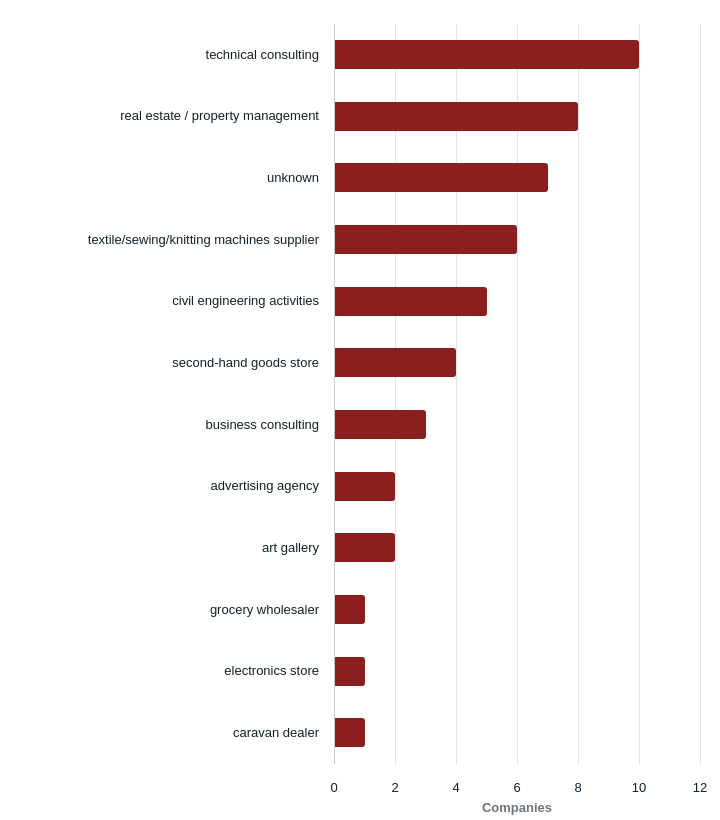
Bergen displays a highly dynamic market environment where business creation and corporate restructuring occur continuously. Across the municipality, 156 total insolvencies were recorded in the reference dataset, representing a normal churn rate within a business population of over 6,000 active commercial entities.
A sector breakdown of bankruptcies reveals specific cyclical pressures rather than broad systemic weakness:
- Technical Consulting & Engineering: 10 companies filed for insolvency, though aggregate sector revenues remained high. Pressures stem from tight labor costs and shifting project timelines.
- Real Estate & Property Management: 8 entries recorded, reflecting high interest rate environments and debt servicing costs during recent macroeconomic adjustments.
- Civil Engineering & Construction: 5 entities affected, impacted by raw material inflation and residential project delays.
- Second-hand Goods & Niche Retail: 4 companies recorded bankruptcies, influenced by changing consumer discretionary spending.
Overall, the low proportion of bankruptcies relative to total active firms highlights strong underlying commercial health and effective risk management across Bergen's core industries.
Opportunities for Founders & Entrepreneurs
Bergen offers high-potential avenues for new business venture creation, particularly where technology intersects with traditional ocean industries and public infrastructure:
- Green Maritime & Ocean Tech: Building software, clean propulsion tech, and aquaculture solutions tailored to West Norway's marine cluster.
- B2B Engineering & Tech Services: Providing niche AI, cybersecurity, and automation tools to energy giants in Sandsli and Kokstad.
- Healthtech & Medtech Solutions: Partnering with or supplying Haukeland University Hospital and UiB's medical research community.
- Urban Commercial Services: Launching specialized food, beverage, hospitality, and retail offerings in high-footfall corridors like Bergen Sentrum, Nesttun, and Nyborg.
Founders evaluating entry strategies, commercial space, or market saturation across Bergen's neighborhoods can use SmartGrunder to explore targeted business addresses, local competitive density, and sector statistics.
Conclusion
Bergen stands out as a balanced, high-performing economy capable of generating immense commercial value while maintaining structural stability through its robust public institutional framework. The concentration of top-tier talent, world-leading energy and ocean-tech clusters, and strong regional financial institutions makes Bergen an ideal landscape for founders and corporate investors looking to establish a lasting presence in Western Norway.