Municipality
Economic Landscape and Business Opportunities in Bindal Municipality
A data-driven overview of industry dynamics, employment trends, and commercial potential for founders and local stakeholders
Executive Summary
Bindal municipality, located in Nordland county, possesses an economic structure characterized by a dual foundation: a strong public sector providing stable community employment and an extraordinarily profitable, capital-intensive commercial sector centered on aquaculture and value-added manufacturing.
While the municipality's overall headcount and reported aggregate sales have adjusted over recent years, key commercial hubs—most notably Terråk—demonstrate notable financial productivity. Fish farming and marine aquaculture serve as the primary economic engines, driving strong operating margins and generating significant value per employee. For prospective entrepreneurs, local leaders, and investors, Bindal offers a focused industrial ecosystem with opportunities to serve established supply chains in aquaculture, local construction, and community services.
Economic Overview
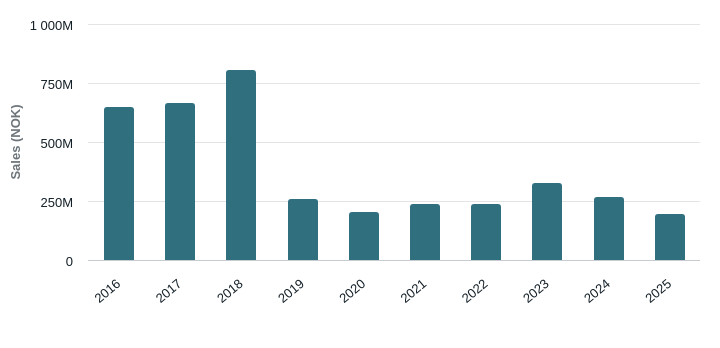
Bindal's macro-economic profile shows significant revenue generation concentrated in specific industries alongside a gradually stabilizing labor force. Aggregate enterprise sales reached a historical peak of NOK 803.9M in 2018 before recalibrating to lower baseline figures in subsequent years, recording NOK 267.2M in 2024 and NOK 197.0M in 2025.
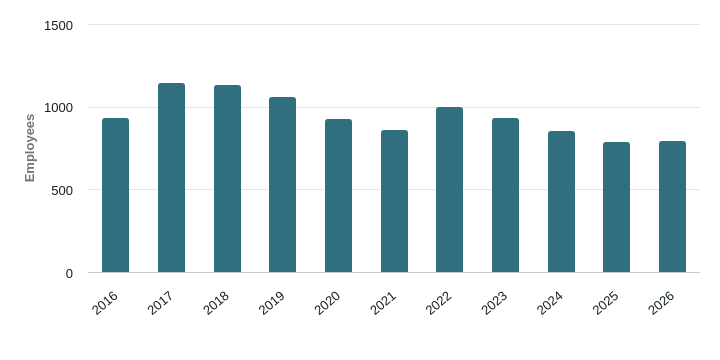
Employment levels have experienced shifts over the past decade, tapering from 1,141 employees in 2017 to 854 in 2024, before projecting a modest stabilization around 793 employees by 2026.
| Metric | 2018 | 2020 | 2022 | 2024 | 2025 / 2026 |
|---|---|---|---|---|---|
| Total Sales Revenue | NOK 803.9M | NOK 204.2M | NOK 238.8M | NOK 267.2M | NOK 197.0M |
| Total Employees | 1,129 | 928 | 995 | 854 | 793 (2026) |
| Sales YoY Change | +20.7% | -21.2% | +1.4% | -18.1% | -26.3% |
| Employee YoY Change | -1.1% | -12.3% | +15.8% | -8.6% | +1.1% (2026) |
The substantial variation in historical sales figures reflects structural realignments and commodity cycle fluctuations typical of primary industries like aquaculture, rather than a broad-based decline across all domestic enterprise categories.
Industry Structure & Legal Forms
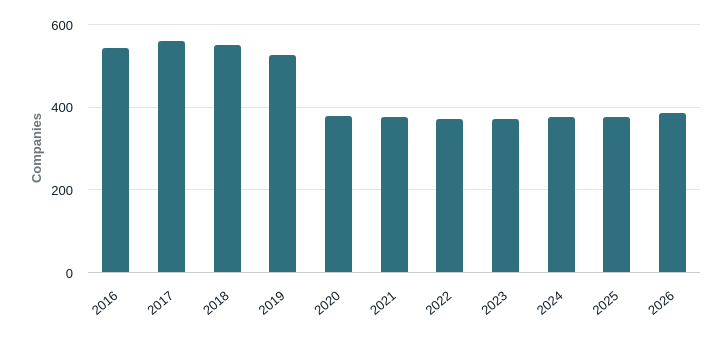
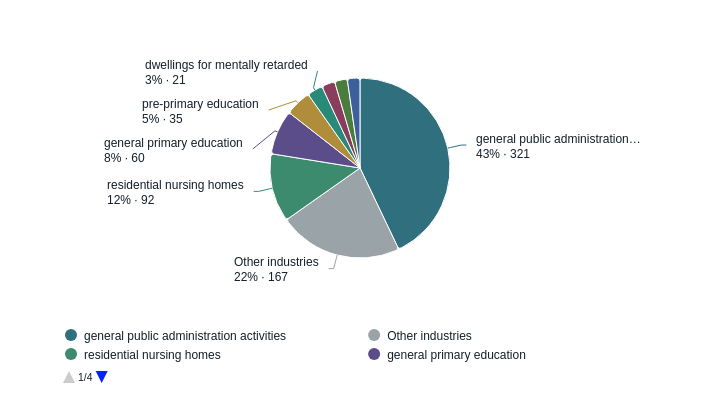
The industry mix in Bindal is heavily anchored by public services in terms of employment, while commercial revenue is concentrated in marine biology, building production, and infrastructure.
Primary Industry Sectors
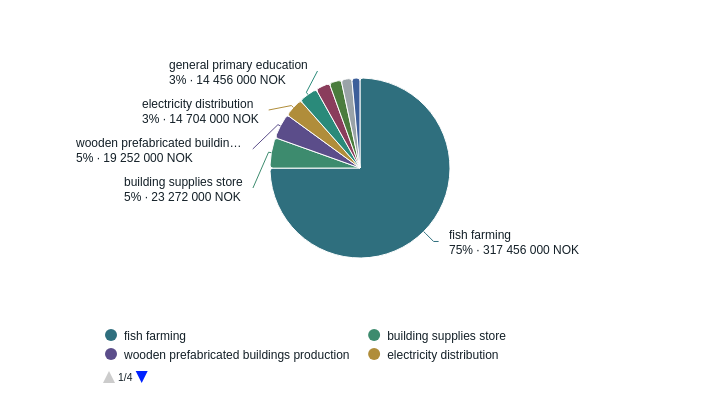
- Fish Farming: Represents the single largest value driver. Generating NOK 317.7M in operating income across reported facilities, the industry achieves an EBITDA margin of 49% and an impressive operating income per employee of NOK 8.8M.
- Public Sector & Health: General public administration (321 employees across 2 organizations) and residential nursing homes (92 employees across 2 facilities) represent the primary employment base.
- Building & Manufacturing: Prefabricated wooden buildings production (Talgø Agrobygg AS) generates NOK 19.3M in operating income, while building supply retail adds NOK 23.3M.
- Utilities & Retail: Electricity distribution delivers NOK 16.2M in revenue, supported by local retail, gas stations (NOK 9.2M operating income), and transport services.
Legal Organization Structure
| Organization Form | Count | Total Employees | Operating Income | EBITDA Margin |
|---|---|---|---|---|
| Aktieselskap (AS) | 20 | 109 | NOK 397.3M | 40% |
| Organisasjonsledd (ORGL) | 23 | 306 | NOK 0.0M | 0% |
| Kommune (KOMM) | 1 | 308 | NOK 0.0M | 0% |
| Samvirkeforetak (SA) | 5 | 58 | NOK 31.1M | 12% |
| Enkeltpersonforetak (ENK) | 10 | 19 | NOK 0.0M | 0% |
Standard limited companies (AS) account for virtually all commercial revenue and operating profits (NOK 121.1M operating profit), while public entities (KOMM, ORGL) and cooperative structures (SA) maintain vital social and utility services.
Business Geography & Regional Hubs
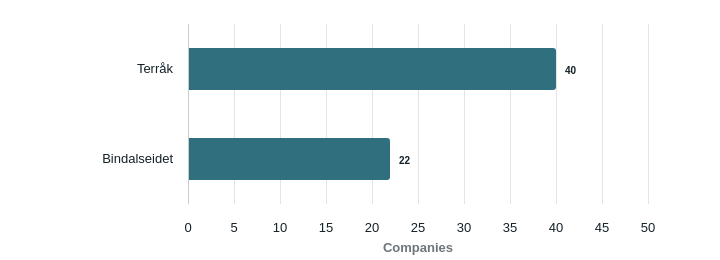
Economic activity in Bindal is primarily distributed between two geographic centers: Terråk and Bindalseidet.
| Location | Registered Companies | Total Employees | Operating Income | EBITDA | Debt Level |
|---|---|---|---|---|---|
| Terråk | 40 | 666 | NOK 380.1M | NOK 163.2M | NOK 663.0M |
| Bindalseidet | 22 | 150 | NOK 48.3M | NOK 2.2M | NOK 11.0M |
Key Takeaways by Location
- Terråk: Serves as the administrative and economic center of Bindal. It holds over 80% of local enterprise employment and the vast majority of commercial cash flow, driven by municipal administration, aquaculture headquarters, and primary retail.
- Bindalseidet: Functions as an important secondary industrial and educational node, hosting specialized manufacturing, local schools, and community healthcare housing.
Largest Local Employers
Bindal's corporate environment is led by public administration alongside specialized commercial operations in aquaculture and building materials.
Top Employers & Key Commercial Entities
- Bindal Kommune (General Public Administration): The municipality's central body employs 308 people across administrative and civic functions.
- Bindal Sykehjem (Residential Nursing Care): Employs 79 staff members providing local elderly care.
- Bindalseidet Skole SA (Primary Education): Operates as a cooperative school employing 30 staff with NOK 14.9M in operating income.
- Terråk Skole (Primary Education): Municipal primary school employing 30 staff members.
- Bindalssmolt AS Avd Saglifossen (Fish Farming): The key private commercial engine in Terråk, employing 14 staff and generating NOK 316.7M in operating income with an EBITDA of NOK 158.3M.
- Talgø Agrobygg AS (Prefabricated Wooden Buildings): Located in Bindalseidet, employing 13 people with NOK 19.3M in revenue.
- Bindal Kraftlag SA (Electricity Distribution): Employs 11 people in utility delivery, generating NOK 16.2M in operating income.
- AS Bindalsbygg (Building Supplies Store): Based in Terråk, employing 10 staff with NOK 23.3M in operating income.
Business Dynamism & Market Stability
Bindal displays a low level of market turnover and corporate insolvency, indicating a stable environment for established operations.
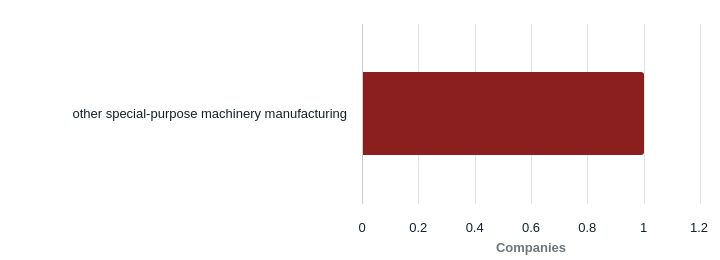
Bankruptcy activity remains minimal. Data shows 1 registered insolvency in recent records: Norseaqua AS (located at Sørfjordveien 5, Terråk), operating in other special-purpose machinery manufacturing. The firm reported NOK 11.9M in sales revenue and an EBITDA of NOK -596.0K before liquidation.
The low frequency of bankruptcies highlights the reliance on stable municipal employment and resilient, well-capitalized marine infrastructure enterprises, though it also reflects a conservative startup landscape with fewer high-risk business formations.
Opportunities for Founders
Entrepreneurs considering establishing a business in Bindal can leverage specific structural strengths in the local economy:
- Aquaculture Supply & Technical Services: With fish farming generating over NOK 315M locally at strong margins, specialized maintenance, marine logistics, technology installation, and environmental monitoring present viable B2B niches.
- Crafts & Infrastructure Maintenance: Active utility networks (Bindal Kraftlag SA) and specialized manufacturing (Talgø Agrobygg AS) create ongoing demand for sub-contractors, electrical installation, and industrial maintenance.
- Local Service Supply: As Terråk maintains a stable workforce of over 600 employees, opportunities exist in specialized retail, personal services, and local tourism/leisure offerings.
Founders looking to analyze specific commercial properties, zoning options, or industry statistics across Bindal can use SmartGrunder to explore local market dynamics and identify emerging business locations.
Conclusion
Bindal municipality represents a focused coastal economy where high-margin marine production complements a stable municipal service core. Terråk stands out as the primary commercial hub, benefiting from substantial industrial output and capital efficiency.
For prospective business creators and stakeholders, Bindal offers an established industrial foundation with low corporate failure rates. By targeting B2B services aligned with aquaculture, local construction, and community utility demands, new ventures can find sustainable market niches within the municipality.