Municipality
Bodø Municipality Economic Overview & Founder Guide
An in-depth analysis of employment trends, sector structure, regional commerce, and startup dynamics in Bodø
Executive Summary
Bodø serves as the primary administrative, educational, medical, and aviation hub of Nordland county. Its regional economy combines a foundation of public sector institutions with a commercial landscape driven by passenger air transport, technical consulting, construction, and specialized retail.
Key economic characteristics of Bodø include:
- Institutional Stability: High concentration of public administration, regional healthcare (Nordlandssykehuset HF), and higher education (Nord Universitet), providing strong baseline demand for consumer and commercial services.
- Commercial Strength: Key private sector pillars include regional aviation (Widerøe's Flyveselskap AS), electrical installation, engineering, and supermarket retail.
- Geographic Concentration: Economic activity is heavily concentrated in the central city of Bodø, supported by surrounding communities such as Tverlandet, Saltstraumen, Kjerringøy, and Breivik I Salten.
- Entrepreneurial Environment: A steady business dynamic with moderate insolvency rates focused mostly in cyclical construction, property development, and retail segments.
Economic Overview
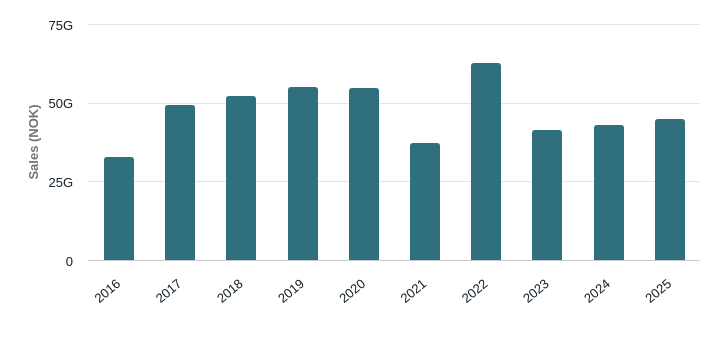
Bodø's macro-economic trajectory over the past decade reflects both structural expansion and fluctuations linked to broader regional and national market conditions. Aggregate sales revenue generated by companies in the municipality peaked at NOK 62.51 billion in 2022 before stabilizing around NOK 41.41 billion in 2023. Revenue expanded to NOK 42.86 billion in 2024 (+3.5%) and reached NOK 44.89 billion in 2025 (+4.8%).
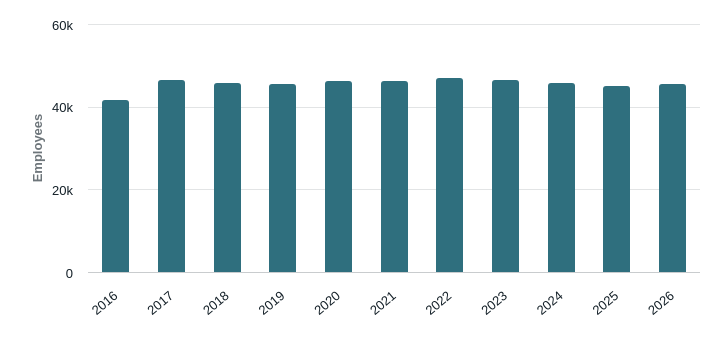
Total workforce engagement in Bodø has remained high, hovering between 44,900 and 46,900 employees over the recent decade. After reaching 46,916 employees in 2022, workforce figures moderated slightly to 45,699 in 2024 and 44,932 in 2025, with projections indicating a return toward 45,479 employees in 2026.
| Indicator | 2022 | 2023 | 2024 | 2025 | 2026 (proj.) |
|---|---|---|---|---|---|
| Total Sales Revenue (NOK) | 62.51B | 41.41B | 42.86B | 44.89B | N/A |
| YoY Revenue Growth | +68.8% | -33.8% | +3.5% | +4.8% | N/A |
| Total Employees | 46,916 | 46,448 | 45,699 | 44,932 | 45,479 |
| YoY Employee Change | +1.8% | -1.0% | -1.6% | -1.7% | +1.2% |
Industry Structure
Bodø's industrial composition is defined by public sector administration and health services alongside commercial transportation, trade, and engineering services.
Primary Sectors & Employment
Public sector activities dominate employment totals:
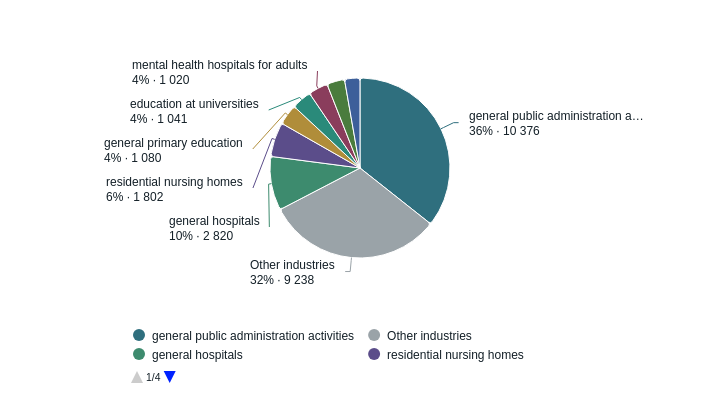
- General Public Administration: 14 entities employing 10,376 people.
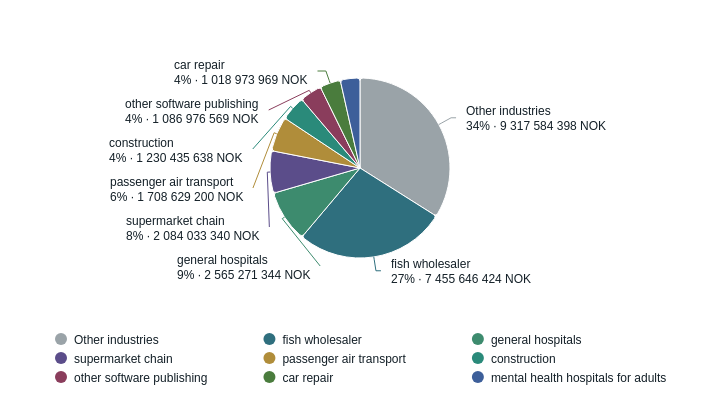
- Healthcare & Hospitals: General hospitals account for 2,820 employees across 6 companies (generating NOK 2.68B in operating income), with adult mental health hospitals employing an additional 1,020 people across 4 entities. Residential nursing homes employ 1,802 workers across 17 units.
- Education: Primary education accounts for 1,080 employees across 26 entities, while university education employs 1,041 workers across 2 entities.
Key Commercial Sectors
Commercial enterprise in Bodø features several high-revenue and high-employment industries:
| Industry Sector | Companies | Employees | Operating Income | EBITDA Margin |
|---|---|---|---|---|
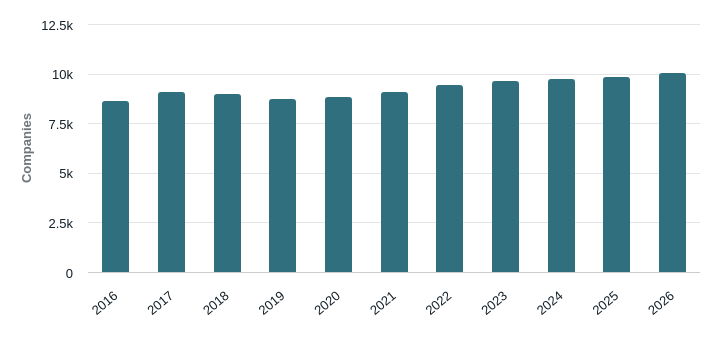
| Passenger Air Transport | 6 | 803 | NOK 2,574.2M | 11% |
| Supermarket Chains | 38 | 783 | NOK 2,153.6M | 3% |
| Restaurants | 36 | 631 | NOK 352.4M | 8% |
| Electrical Installation | 24 | 555 | NOK 910.2M | 7% |
| Construction | 56 | 537 | NOK 1,237.0M | 8% |
| Technical Consulting | 46 | 479 | NOK 538.3M | 6% |
| Sports Club Activities | 16 | 442 | NOK 855.3M | 26% |
| Air Transport Support Services | 9 | 407 | NOK 911.8M | 20% |
Legal Forms
In terms of corporate structure, private limited companies (AS) account for 1,455 entities, employing 18,651 workers and generating NOK 37.73 billion in operating income. State and regional public entities (ORGL, KOMM, FYLK, and SÆR) represent the vast majority of remaining employment, underlining Bodø's dual economic role as a municipal authority hub and a commercial center.
Business Geography
Commercial and industrial activity in Bodø is heavily concentrated in the central urban area, with distinct economic roles played by suburban and rural settlements across the municipality.
City Center & Key Localities
| Location | Active Companies | Total Employees | Operating Income (NOK) | Operating Margin |
|---|---|---|---|---|
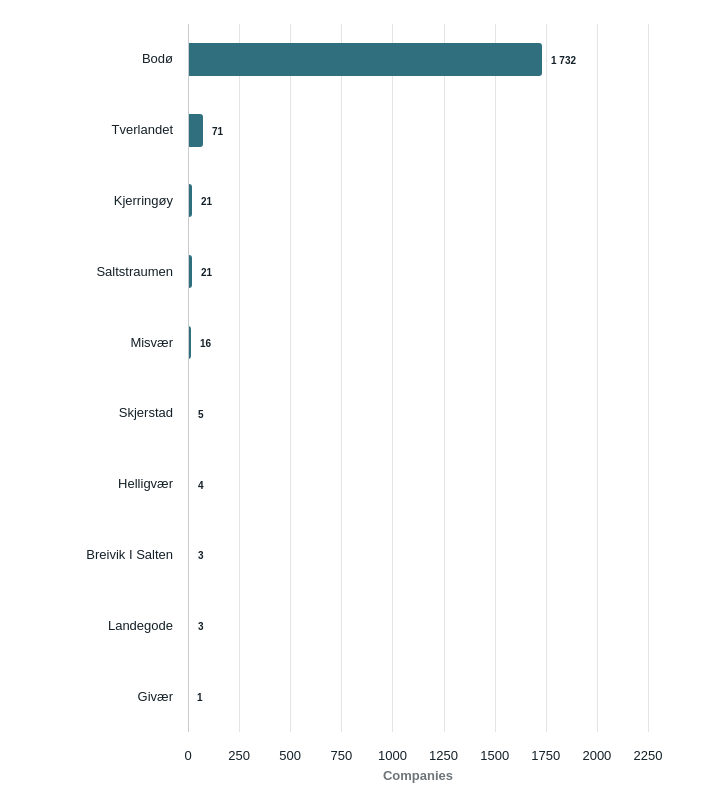
| Bodø (City) | 1,732 | 44,976 | 61,976.6M | 4% |
| Tverlandet | 71 | 773 | 618.9M | 2% |
| Saltstraumen | 21 | 258 | 199.5M | 4% |
| Misvær | 16 | 184 | 25.4M | -27% |
| Kjerringøy | 21 | 101 | 28.5M | 6% |
| Breivik I Salten | 3 | 36 | 206.0M | 13% |
| Helligvær | 4 | 24 | 8.9M | 7% |
| Landegode | 3 | 20 | 13.3M | 5% |
- Bodø City: The main urban nucleus houses over 95% of all companies and workforce activity, encompassing major public services, retail centers, the regional airport, and port infrastructure.
- Tverlandet & Saltstraumen: Key residential and commercial sub-centers supporting commuter populations, local service businesses, and tourism around the famous Saltstraumen maelstrom.
- Kjerringøy & Rural Islands: Destinations focused on tourism, culture, localized agriculture, and coastal industries. Breivik I Salten stands out with high revenue density relative to its workforce, yielding a 30% EBITDA margin across its 3 registered companies.
Largest Employers
Bodø's employment landscape is dominated by large public sector bodies and regional infrastructure operators. These anchor organizations generate substantial economic stability and sustained local demand.
Major Public Employers
- Bodø Kommune: 6,235 employees managing local municipal infrastructure, schools, and social care.
- Nordland Fylkeskommune: 3,458 employees handling county-level administration, secondary education, and regional development.
- Nordlandssykehuset HF: Major health trust divisions including Somatikk Bodø (2,058 employees), Voksenpsykiatri Bodø (872 employees), Foretaksstab/Støttetjenester (403 employees), and Røntgen/Laboratorier (257 employees).
- Nord Universitet Bodø: 1,026 academic and administrative staff supporting regional higher education and research.
- Politiet I Bodø: 395 employees in public safety and law enforcement.
- Luftfartstilsynet (Civil Aviation Authority): 233 employees in national aviation regulation.
Major Commercial Employers
- Widerøes Flyveselskap AS: Operates major regional facilities, including its aircraft maintenance workshop (Flyverksted Bodø, 363 employees) and flight crew/administration hub (Crew Og Administrasjon Bodø, 345 employees, generating NOK 2.06 billion in operating income).
- Educational & Care Facilities: Bodø Videregående Skole (324 employees) and local nursing homes such as Sentrum Sykehjem (283 employees), Stadiontunet Sykehjem (250 employees), and Sølvsuper Helse Og Velferdssenter (239 employees).
Business Dynamism & Insolvency Trends
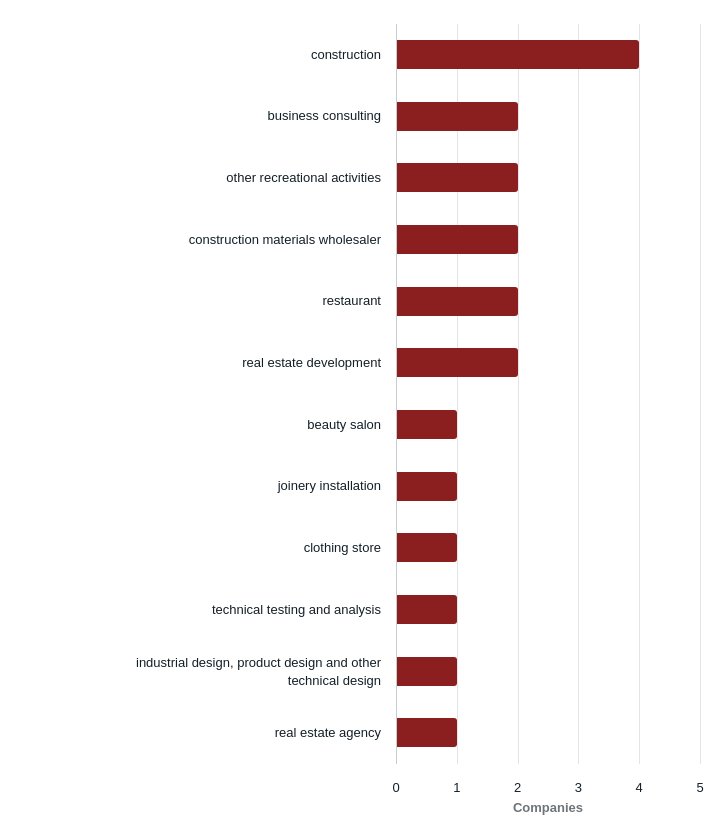
Understanding business turnover and sector stress provides valuable context for new market entrants. A total of 27 bankruptcies were registered in Bodø across recent reporting periods.
Sectoral Bankruptcy Breakdown
Insolvencies are concentrated in cyclical, consumer-facing, and capital-intensive industries:
- Construction & Building Trades: 4 construction companies, 1 joinery installer (Jensvold Snekkerservice AS), and 1 painting/glazing business.
- Real Estate & Property Development: 2 real estate development firms (including Bremnes Eiendom AS), 1 real estate agency, and investment firms (Bbj Invest AS).
- Wholesale & Retail Trade: 2 construction materials wholesalers, 1 car trailer dealer, 1 boat equipment store (Helala Marine AS), 1 china/glassware wholesaler (Allright AS), and 1 ethnic grocery store (Brødrene Khalaf AS).
- Hospitality & Leisure: 2 restaurants, 1 hostel (Bodø Vandrerhjem AS), 1 amusement park entity (Bodø Actionhall 2 AS), and 1 sports goods manufacturer.
- Professional Services & Others: 2 business consulting businesses, 1 technical testing firm, and 1 freight coastal transport firm (Bts Shipping AS).
Analysis for Founders
Most bankruptcies reflect general market pressures in real estate, building contractor margins, and discretionary hospitality spend rather than structural decline in the regional economy. Profit margins in technical consulting, specialized contracting, and aviation services remain healthy.
Opportunities for Founders
Bodø's role as Nordland's urban hub creates diverse openings for innovative startups and service providers.
High-Potential Sectors
- Aviation & Logistics Technology: With Widerøe's maintenance and flight operations centered in Bodø alongside the Civil Aviation Authority (Luftfartstilsynet), opportunities exist for B2B aviation software, drone technology, green aviation supply chains, and specialized maintenance support.
- Engineering & Technical Consulting: Strong demand from regional construction and public infrastructure projects supports expansion in environmental engineering, digitalization, and project management (where technical consulting currently generates NOK 538.3M annually).
- Hospitality & Experience Economy: Steady growth in tourism around Saltstraumen and Kjerringøy creates demand for modern accommodation, outdoor activity concepts, and premium food and beverage offerings.
- Healthcare & Elder Care Services: Given the concentration of major healthcare institutions (Nordlandssykehuset HF) and municipal nursing facilities, health-tech startups and specialized care support services have a direct local market.
Founders evaluating potential site locations, commercial lease opportunities, or target demographics in Bodø can utilize SmartGrunder's suite of data tools to analyze hyper-local market context.
Conclusion
Bodø presents a solid macroeconomic landscape for entrepreneurs and business leaders. The municipality's economy is anchored by massive public sector institutions—including municipal administration, regional healthcare trusts, and Nord Universitet—which provide steady employment and purchasing power.
Combined with high-performing commercial sectors in aviation, electrical engineering, sports management, and retail, Bodø offers the market depth required for new commercial ventures to scale. By identifying underserved niches in technical consulting, hospitality, and specialized B2B services, new founders can position themselves effectively within Northern Norway's central growth corridor.