Municipality
Economic Landscape and Entrepreneurial Opportunities in Bykle Municipality
An analytical overview of industry composition, employment dynamics, and geographic activity in Upper Setesdal
Executive Summary
Bykle municipality, located at the northern tip of the Setesdal valley in Agder, represents a distinct economic model within rural Norway. Driven by a powerful combination of renewable hydroelectric power generation and a premier regional winter sports resort hub, Bykle generates significant economic output relative to its permanent population.
The municipal economy maintains a baseline workforce of roughly 1,200 to 1,300 reported employees across public services, infrastructure, site preparation, manufacturing, and alpine tourism. In peak revenue years, local enterprise sales exceed NOK 1.5 billion, heavily anchored by energy generation, civil engineering, and resort management.
Key takeaways for entrepreneurs and civic decision-makers include:
- Dual Core Economy: Hydroelectric power delivers exceptional capital productivity, while Hovden's tourism ecosystem drives high volume in hospitality, trade, and construction.
- Strong Civil & Site Infrastructure: Large contractors like Hovden Hytteservice AS underpin local site preparation and cabin infrastructure development.
- Geographic Division of Labor: Bykle village serves as the municipal administration and heavy energy center, whereas Hovden serves as the tourist, commercial, and service capital.
Economic Overview
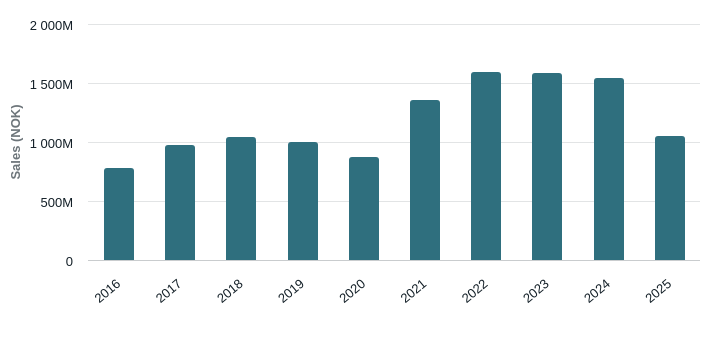
Bykle's corporate sales trajectory reflects both macro energy price cycles and tourism trends. Total reported sales reached a peak of NOK 1.589 billion in 2022 and NOK 1.581 billion in 2023, up significantly from NOK 873.1 million in 2020. This trajectory demonstrates the outsized influence of power generation revenues during periods of elevated European energy prices.
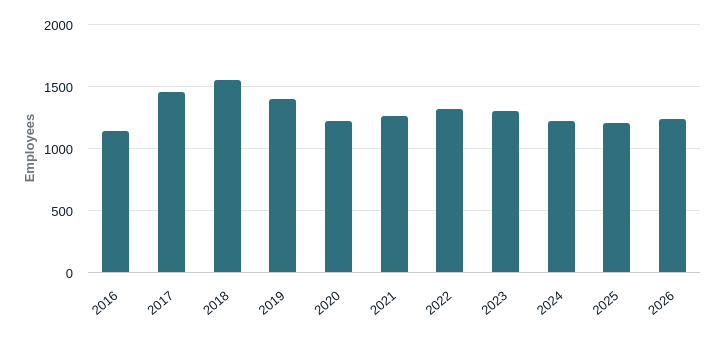
Employment figures have remained structurally stable over the past decade, fluctuating within a predictable band between 1,200 and 1,550 workers. Following a peak in 2018 (1,549 employees), the total workforce stabilized around 1,200–1,300 in recent years, with projected employment reaching 1,231 in 2026.
| Year | Reported Sales (NOK) | YoY Sales Change | Reported Workforce | YoY Employee Change |
|---|---|---|---|---|
| 2018 | 1,043.8M | +7.6% | 1,549 | +6.5% |
| 2019 | 1,002.1M | -4.0% | 1,399 | -9.7% |
| 2020 | 873.1M | -12.9% | 1,217 | -13.0% |
| 2021 | 1,359.5M | +55.7% | 1,255 | +3.1% |
| 2022 | 1,589.1M | +16.9% | 1,317 | +4.9% |
| 2023 | 1,581.4M | -0.5% | 1,298 | -1.4% |
| 2024 | 1,540.5M | -2.6% | 1,218 | -6.2% |
| 2025 | 1,049.6M | -31.9% | 1,200 | -1.5% |
| 2026 | — | — | 1,231 | +2.6% |
Note: Fluctuations in total sales reflect underlying volatility in electricity markets and regional construction contract cycles.
Industry Structure
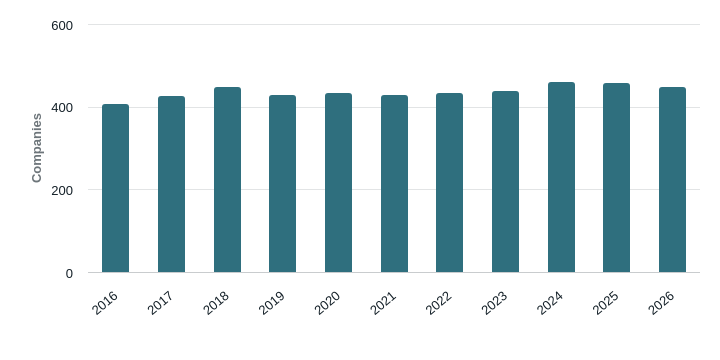
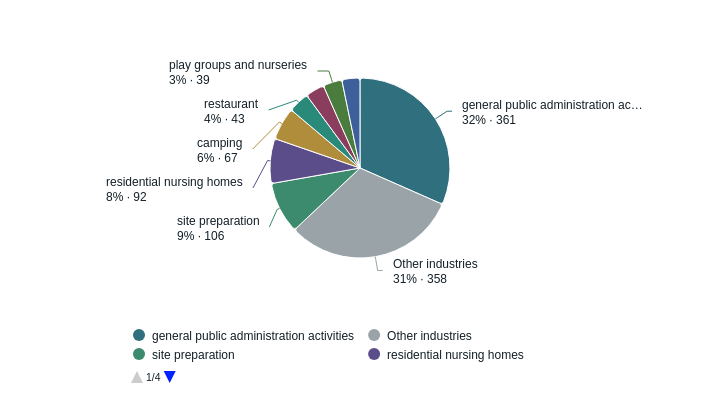
Private enterprise in Bykle is dominated by joint-stock companies (Aksjeselskap / AS), which represent 47 active corporations generating NOK 1.726 billion in combined operating income and employing 547 people. Municipal administration and municipal corporate entities (KOMM and ORGL) account for the majority of remaining employment.
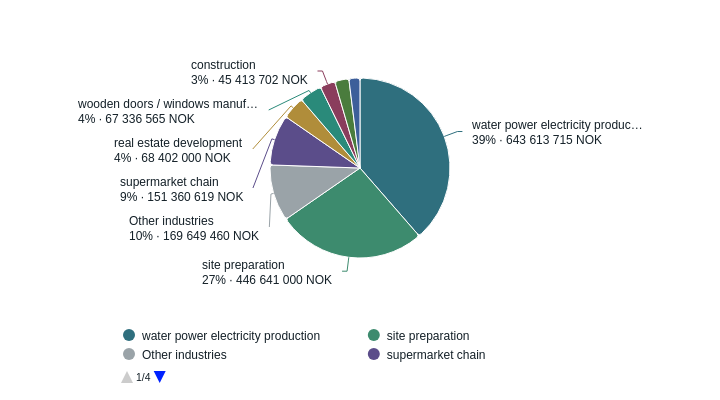
From a revenue and value-added perspective, three major pillars define the local industrial spectrum:
- Hydroelectric Power Generation: With an operating income of NOK 653.5 million generated by 12 employees, water power production delivers an operating margin of 49% and an EBITDA margin of 54%. Revenue per employee in this sector reaches an extraordinary NOK 53.2 million.
- Site Preparation & Construction: Supporting the extensive holiday home (hytte) market, site preparation companies generate NOK 453.8 million across 106 employees, operating at an EBITDA margin of 16%.
- Tourism, Leisure & Accommodation: Encompassing sports facilities (NOK 52.2M income, 39% EBITDA margin), hotels, camping, restaurants, and mountain retail. Together, these service industries account for the majority of private service jobs in Hovden.
- Specialized Manufacturing: Represented by wood products manufacturing (Bykle Vindu AS), producing windows and doors with NOK 68.5 million in revenue and 34 employees.
Business Geography
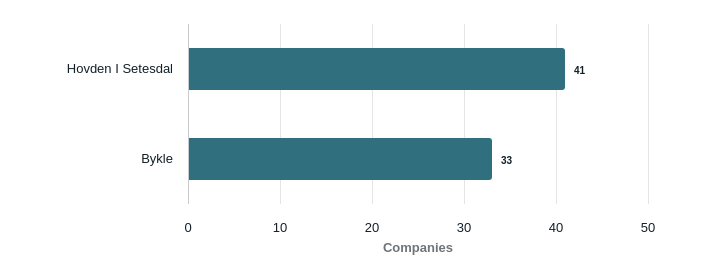
Commercial activity in the municipality is concentrated in two primary population centers: the administrative center of Bykle and the mountain resort destination of Hovden I Setesdal.
| Metric | Bykle (Village) | Hovden I Setesdal |
|---|---|---|
| Active Companies | 33 | 41 |
| Total Employees | 743 | 486 |
| Operating Income | NOK 819.3M | NOK 930.8M |
| Revenue Growth | 9% | 12% |
| EBITDA Margin | 45% | 12% |
| Primary Focus | Hydro power, Public Admin, Manufacturing | Alpine tourism, Hospitality, Site Prep, Retail |
While Bykle village registers higher average operating margins (45%) due to hydro power installations and municipal operations, Hovden leads in private commercial diversity, total enterprise count (41 companies), and overall sales revenue (NOK 865.8M).
Largest Employers
The public sector is the single largest employer in Bykle, led by Bykle Kommune (324 employees) alongside dedicated municipal operational branches such as Bykle Sjukeheim (50 employees), home care services (42 employees), and technical maintenance (37 employees).
In the commercial sector, major corporate employers drive regional supply chains:
| * Hovden Hytteservice AS: 72 employees | Operating Income: NOK 422.1M | Industry: Site preparation |
|---|---|---|
| * Hovden Alpint Overnatting: 51 employees | Operating Income: NOK 38.8M | Industry: Camping and accommodation |
| * Bykle Vindu AS (Avd Bykle): 34 employees | Operating Income: NOK 68.5M | Industry: Window and door manufacturing |
| * Hovden Alpinsenter AS: 28 employees | Operating Income: NOK 52.2M | Industry: Operation of sports facilities |
| * Bykle Hotell AS: 24 employees | Operating Income: NOK 13.2M | Industry: Hotel operations |
| * Hovden Alpin Servering AS (Furumo): 24 employees | Operating Income: NOK 29.5M | Industry: Restaurant operations |
| * Hovden Fjellhandel AS: 24 employees | Industry: Supermarket | |
| * Hovden Fjellbad AS: 22 employees | Operating Income: NOK 11.7M | Industry: Amusement park / water park |
Business Dynamism & Financial Health
The financial performance of Bykle's business community reflects high equity buffers in core capital-intensive sectors, alongside tight operating margins in hospitality.
Corporate balance sheets among Aksjeselskap (AS) firms show total equity of NOK 773.9 million against debt of NOK 1.771 billion. Profitability varies significantly by industry group: energy production achieves operating margins near 49%, site preparation maintains healthy operating margins around 10%, while food service and retail face tighter margins ranging between 1% and 4%.
Recent corporate formations—such as Hovden Fjellhandel AS (founded in 2025)—demonstrate ongoing commercial renewal in Hovden's retail district. Insolvency risks remain low in core utility and infrastructure sectors, though hospitality operators face seasonal revenue compression that requires disciplined working capital management.
Opportunities for Founders
For prospective founders and expanding companies, Bykle offers specific niches aligned with its high-purchasing-power visitor economy and strong municipal balance sheet:
- Year-Round Tourism & Activity Services: Leveraging Hovden's established winter infrastructure to expand summer and shoulder-season outdoor experiences, wellness, and mountain recreation.
- Craft Building Services & Smart Hytte Tech: Complementing major contractors like Hovden Hytteservice AS with specialized trades, energy-efficiency retrofits, and automated cabin management services.
- Specialized Retail & Local Gastronomy: Serving both affluent second-home owners (hyttagjester) and permanent residents with premium food, local crafts, and niche retail.
- Professional & Technical Services: Expanding local accounting, engineering, and digital support services to serve growing alpine SMEs.
Founders interested in establishing a presence in Upper Setesdal can utilize platform services like SmartGrunder to evaluate available commercial addresses, analyze industry statistics, and explore market gaps across Hovden and Bykle center.
Conclusion
Bykle municipality presents a compelling economic profile characterized by extreme capital generation from hydroelectric assets and constant commercial velocity driven by Hovden's mountain resort economy.
For municipal planners and new business creators, the main strategic goal is diversifying local service offerings and building shoulder-season economic activity. With strong local infrastructure, robust civil engineering capabilities, and high per-capita value creation, Bykle remains a strong vantage point for targeted commercial ventures in Agder.