Municipality
Engerdal Municipal Economy: Strategic Analysis for Founders and Investors
An in-depth evaluation of industry structure, geographic centers, commercial trends, and enterprise opportunities in Engerdal municipality.
Executive Summary
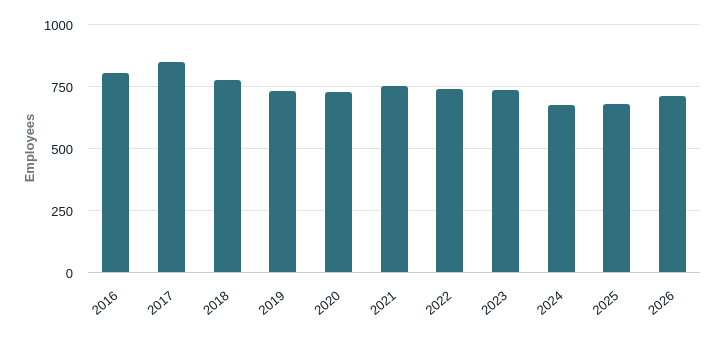
Engerdal municipality, located in the eastern corner of Innlandet county along the Swedish border, presents a rural, resource-anchored economy defined by a strong municipal public sector, specialized craft and cabin construction, local retail, and outdoor tourism. With a local workforce hovering around 670 to 700 employees across registered enterprises, Engerdal functions as a compact yet resilient community market.
The commercial foundation is centered around two primary population and commercial hubs—Engerdal and Drevsjø—supported by smaller active settlements in Sømådalen and Elgå. While public administration and healthcare services provide foundational employment stability, private sector activity is spearheaded by building construction, joinery installation tailored to the regional leisure cabin market, grocery retail, and nature-based hospitality.
Economic Overview
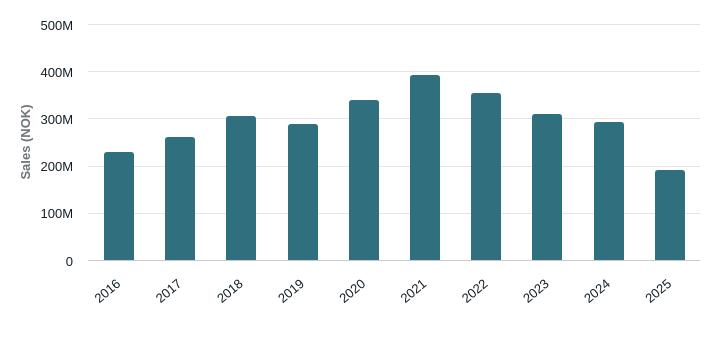
Over the past decade, Engerdal's commercial aggregate sales revenue experienced a significant expansion phase between 2016 and 2021, followed by a period of revenue consolidation and structural recalibration. Total corporate revenues climbed from NOK 228.8M in 2016 to a peak of NOK 391.8M in 2021, driven by heightened demand in construction, local trade, and domestic leisure markets during the pandemic period.
Subsequent years saw market normalization, with total reported sales adjusting to NOK 353.1M in 2022, NOK 309.0M in 2023, and NOK 293.4M in 2024. (Note: Figures for 2025 reflect partial year accounting and reporting lags rather than a structural collapse). Total registered workforce figures reflect a similar trajectory, declining slightly from 804 employees in 2016 to 674 in 2024, before showing early signs of recovery toward 679 in 2025 and an estimated 708 in 2026.
| Indicator | Peak Value | Recent Baseline (2024) | Primary Economic Engines |
|---|---|---|---|
| Annual Corporate Sales | NOK 391.8M (2021) | NOK 293.4M | Construction, Joinery, Retail |
| Registered Workforce | 848 employees (2017) | 674 employees | Municipal Services, Health, Craft Industries |
| Core Commercial Hubs | Engerdal, Drevsjø | Engerdal (359 emp), Drevsjø (341 emp) | Local Commerce & Services |
Industry Structure & Legal Forms
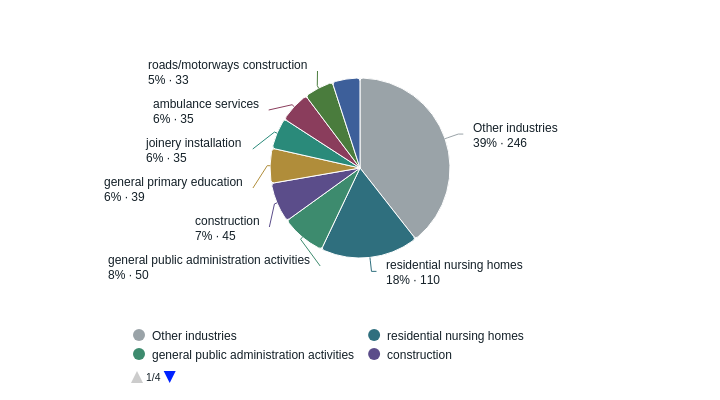
The industrial layout of Engerdal is divided between public institutional services and commercial micro-enterprises. Public sector activities, including residential nursing care (110 employees across 2 entities) and general administration (50 employees), anchor stable payrolls.
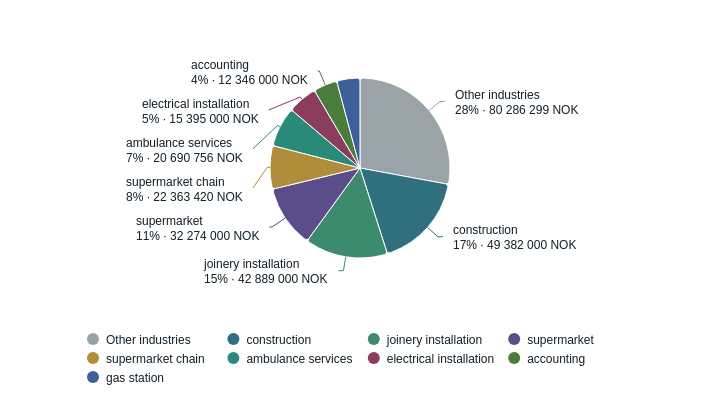
In the competitive private marketplace, construction and joinery installation form the main industrial cluster, driven by building and maintaining leisure homes surrounding Lake Femund and local wilderness areas. Joinery installation alone generated NOK 42.9M in operating income with a strong 21% annual growth rate. Tourism-related sectors, including hotels and camping sites, demonstrate remarkable operating margins—camping operators report EBITDA margins around 23%, while hotel operators generate 22% EBITDA margins.
Sector Highlights & Performance
- Joinery & Craft Services: 5 companies employing 35 people, producing NOK 42.9M in operating income.
- General Construction: 5 companies employing 45 people, generating NOK 49.6M in operating income.
- Grocery Retail (Supermarkets): 2 companies employing 19 people, delivering NOK 32.5M in operating income with a 7% EBITDA margin.
- Hospitality (Camping & Hotels): 4 combined entities employing 26 people, operating with profit margins between 16% and 23%.
Legal Forms Distribution
Corporate structure in Engerdal is dominated by limited liability companies (AS), accounting for 45 companies, 244 private sector employees, and NOK 229.4M in total operating income. Municipal entities (KOMM) encompass 13 operational units accounting for 322 public sector employees. Cooperatives (SA) also maintain an active role, comprising 4 entities with 33 employees and NOK 38.7M in operating income.
Business Geography & Regional Nodes
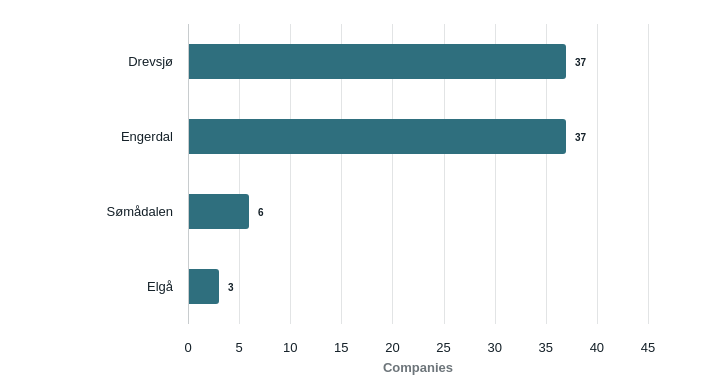
Economic activity within Engerdal municipality is tightly clustered into four distinct geographic settlements. The municipal center of Engerdal and the eastern crossroad hub of Drevsjø together account for over 90% of local jobs and corporate income.
Engerdal Hub (359 employees | NOK 159.5M operating income)
 ├── Drevsjø Hub (341 employees | NOK 126.1M operating income)
 ├── Sømådalen (28 employees | NOK 13.8M operating income)
 └── Elgå (9 employees | NOK 4.6M operating income)
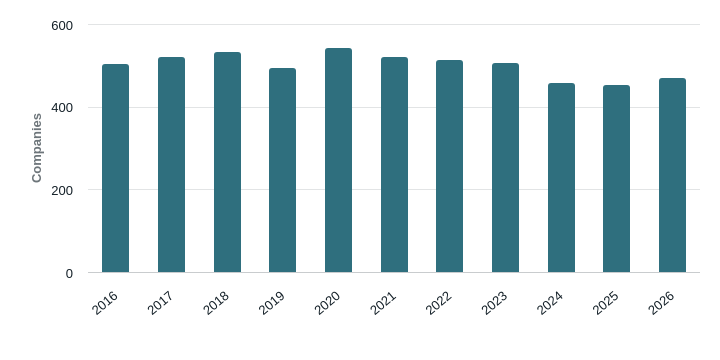
| Location | Registered Companies | Employees | Operating Income | Revenue Growth | Key Commercial Features |
|---|---|---|---|---|---|
| Engerdal | 37 | 359 | NOK 159.5M | +8% | Municipal administrative seat, primary school, cabin construction |
| Drevsjø | 37 | 341 | NOK 126.1M | -2% | Healthcare, nursing homes, ambulance base, supermarket trade |
| Sømådalen | 6 | 28 | NOK 13.8M | +5% | Local agricultural support, small craft & transport activities |
| Elgå | 3 | 9 | NOK 4.6M | +14% | Lake Femund gateway, tourism, local hospitality (18% EBITDA margin) |
Both Engerdal (+8% growth) and Elgå (+14% growth) show positive revenue trajectories, capitalizing on residential construction and nature-based tourism respectively.
Largest Employers
Employment in Engerdal features a balance of public healthcare and administrative units alongside established private commercial firms.
Key Public & Institutional Employers
- Engerdal Sykehjem (Drevsjø) – 66 employees; municipal residential nursing home.
- Engerdal Kommune Hjemmesykepleie (Drevsjø) – 44 employees; home nursing service.
- Engerdal Barne Og Ungdomsskole (Engerdal) – 39 employees; primary education.
- Sykehuset Innlandet HF Ambulanse Drevsjø (Drevsjø) – 35 employees; emergency medical services generating NOK 21.8M in operating income.
- Engerdal Kommune Plan/Næring/Teknikk (Engerdal) – 33 employees; municipal infrastructure and planning.
- Engerdal Kommune Habilitering (Drevsjø) – 31 employees; specialized care facility.
Leading Private Enterprises
- Femund Hytter AS (Engerdal) – 27 employees; specialized cabin builder generating NOK 37.5M in operating income with 17% revenue growth.
- Femund Bygg AS (Engerdal) – 14 employees; joinery installation and general carpentry posting NOK 19.7M in operating income and strong 30% revenue growth.
- Gløtvold Handel AS (Drevsjø) – 14 employees; primary supermarket and local retail store producing NOK 29.1M in operating income and 7% EBITDA margin.
- Økoråd Engerdal Trysil SA (Drevsjø) – 14 employees; regional accounting and business advisory cooperative delivering NOK 12.3M in operating income.
Business Dynamism & Risk Profile
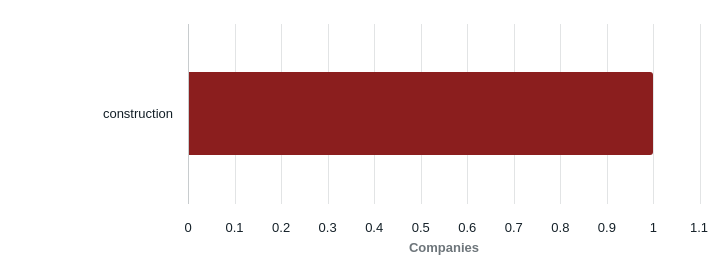
Engerdal demonstrates an exceptionally stable business climate characterized by low corporate turnover and minimal insolvency risk. Data on local bankruptcies indicates only 1 recorded bankruptcy in the construction sector involving a sole proprietorship with zero registered employees and no active revenue.
The municipal market is insulated from extreme volatility due to the large presence of public payrolls and long-established local businesses like Gløtvold Handel AS and Femund Bygg AS. However, private sector firms operate in a tight labour pool, making workforce recruitment and retention the primary operational constraint rather than capital availability or competitive displacement.
Opportunities for Founders & Entrepreneurs
For new business founders, Engerdal offers focused market opportunities in high-margin service niches and tourism infrastructure:
- Outdoor & Destination Tourism: Hospitality businesses in Elgå and surrounding areas demonstrate strong profitability, with short-stay cabins and camping operations yielding EBITDA margins between 16% and 23%.
- Leisure Home & Craft Services: Continued investment in regional cabins creates demand for niche trade services, specialized carpentry, property maintenance, and energy retrofit solutions.
- Local Business & Tech Services: Accounting and administrative consulting (e.g., Økoråd Engerdal Trysil SA) highlight a steady demand for professional business services serving local sole proprietorships and micro-enterprises.
- Value-Added Food & Rural Services: Micro-retail and seasonal dining concepts targeting tourists visiting Femundsmarka National Park.
Founders evaluating prospective commercial locations or exploring industry density across Engerdal can utilize SmartGrunder's analytical tools to inspect local addresses, map industry competitors, and evaluate market feasibility.
Conclusion
Engerdal municipality provides a secure, close-knit rural market defined by strong public infrastructure, stable consumer demand in Drevsjø and Engerdal center, and profitable opportunities in tourism and leisure construction. While aggregate sales have stabilized following peak post-pandemic building activity, high margins in hospitality and craft services point to robust underlying profitability for targeted micro-enterprises.
For entrepreneurs and municipal planners alike, sustainable growth in Engerdal relies on expanding high-value tourism services, supporting local craft contractors, and leveraging the stability of municipal healthcare and administrative infrastructure.