Municipality
Economic Landscape and Entrepreneurial Opportunities in Færder
An in-depth analysis of industry performance, employment trends, geographic hubs, and founder opportunities in Færder municipality
Executive Summary
Færder municipality, situated in Vestfold Og Telemark, presents an economic profile characterized by a robust public healthcare and education sector, specialized manufacturing, high-yield agricultural operations, and seasonal tourism. Formed by the unification of Nøtterøy and Tjøme, Færder bridges island communities with mainland commerce centered around the neighbouring city of Tønsberg.
While public administration and municipal services form the bedrock of employment—accounting for thousands of jobs—private enterprise drives revenue generation. Flagship operations in chemical manufacturing (such as Wilhelmsen Chemicals As) and advanced vegetable production (such as Bjertnæs & Hoel As) generate substantial operating revenues per employee. Overall corporate sales have experienced contraction in recent years following peak levels in 2019 and 2022, signaling a transition toward leaner, efficiency-driven business models.
Key structural takeaways for stakeholders and entrepreneurs include:
- Stable Employment Base: Corporate and municipal employment remains resilient at approximately 12,200 to 12,600 positions.
- Geographic Specialization: Nøtterøy serves as the administrative and service core, whereas Kjøpmannskjær dominates industrial output and Hvasser/Tjøme lead in tourism and hospitality margins.
- High-Value Micro-Sectors: Technical consulting, specialized manufacturing, and premium agriculture show strong profitability margins compared to broader service sectors.
Economic Overview
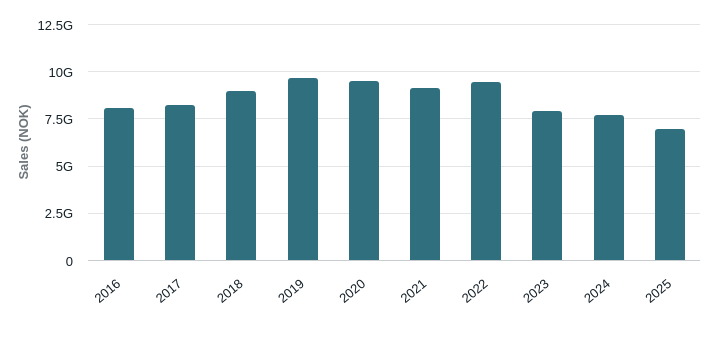
Færder's commercial turnover and employment trends reflect both national macroeconomic shifts and local structural realignments. After reaching peak sales revenues of NOK 9,624.2 million in 2019 and NOK 9,437.5 million in 2022, corporate turnover experienced a contraction, settling near NOK 7,678.1 million in 2024 and projected at NOK 6,961.6 million for 2025.
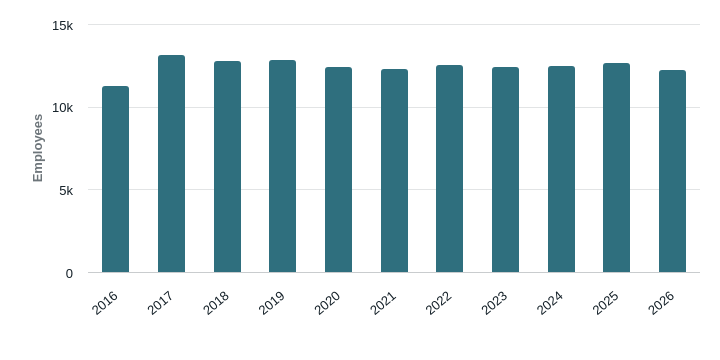
Despite shifts in gross revenues, employment numbers have maintained notable stability over the past decade, hovering consistently above 12,200 active positions across all organization types.
| Year | Total Sales (NOK) | YoY Sales Change | Total Employees | YoY Employment Change |
|---|---|---|---|---|
| 2016 | 8,048.8M | — | 11,234 | — |
| 2017 | 8,208.9M | +2.0% | 13,124 | +16.8% |
| 2018 | 8,952.1M | +9.1% | 12,770 | -2.7% |
| 2019 | 9,624.2M | +7.5% | 12,842 | +0.6% |
| 2020 | 9,465.5M | -1.6% | 12,425 | -3.2% |
| 2021 | 9,135.0M | -3.5% | 12,298 | -1.0% |
| 2022 | 9,437.5M | +3.3% | 12,517 | +1.8% |
| 2023 | 7,883.4M | -16.5% | 12,379 | -1.1% |
| 2024 | 7,678.1M | -2.6% | 12,489 | +0.9% |
| 2025 | 6,961.6M | -9.3% | 12,616 | +1.0% |
| 2026 | — | — | 12,201 | -3.3% |
This balance between fluctuating total sales and stable headcount highlights a resilient local workforce, with companies retaining talent while optimizing cost structures in response to shifting market conditions.
Industry Structure
Færder's economy operates across three main pillars: public infrastructure and care, industrial manufacturing and technical consulting, and consumer-facing retail and hospitality.
Sector Highlights
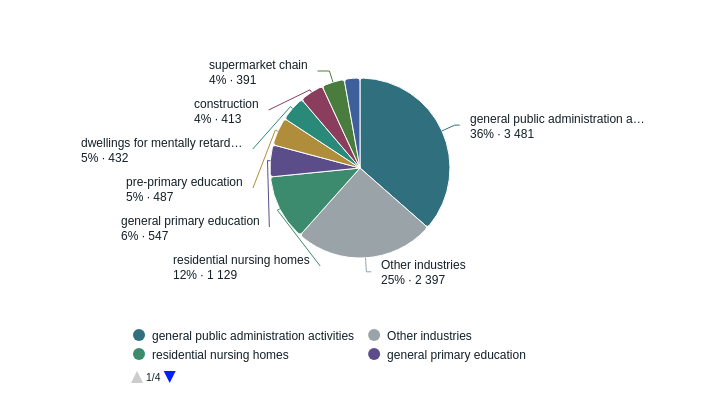
- Public Sector and Healthcare Services: General public administration, residential nursing homes, and primary education account for the single largest share of employment. Municipal entities and health trusts maintain high headcount to serve the growing residential population.
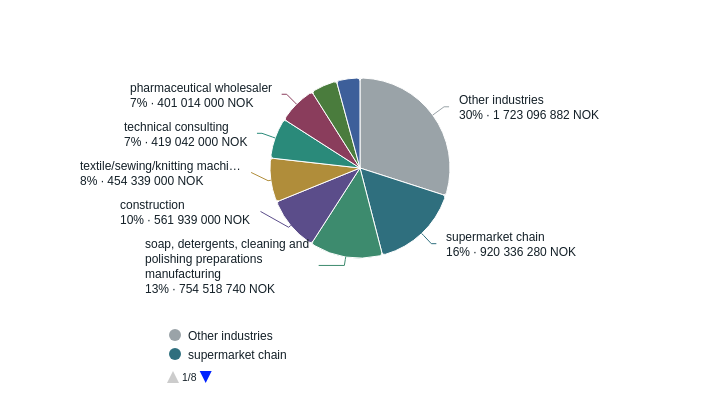
- Chemicals & Manufacturing: Anchored by specialized production in Kjøpmannskjær, chemical manufacturing generates over NOK 757.4 million in operating income with exceptional labor productivity (NOK 7.1M operating income per employee).
- Agriculture & Agro-Tech: Vegetable production is a high-performing agricultural niche in Færder, generating NOK 264.0 million across 3 main operations, boasting a 16% EBITDA margin and NOK 289.0K EBITDA per employee.
- Technical Consulting & B2B Services: Technical consulting spans 27 companies with 228 employees, generating NOK 421.6 million in operating income and an impressive 10% EBITDA margin.
- Retail & Supermarket Chains: Supermarket retail generates NOK 943.9 million across 12 businesses, maintaining key local supply chains across Nøtterøy and Tjøme.
Legal Organization Forms
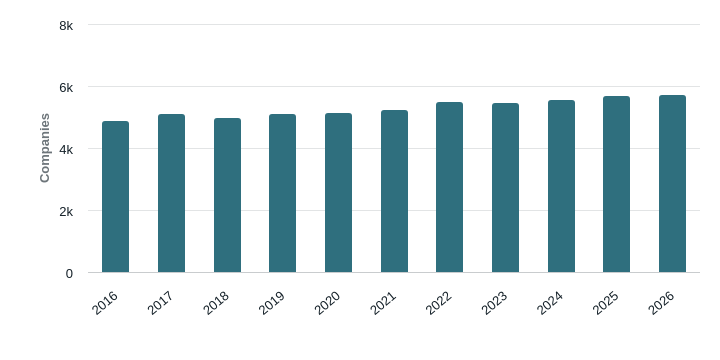
Limited liability companies (Aksjeselskap / AS) dominate commercial activity, representing 557 companies, 4,142 employees, and NOK 6,870.2 million in combined operating income. Public municipal entities (ORGL / KOMM) employ over 6,800 workers combined, establishing the baseline economic stability of the island municipality.
Business Geography
Commercial activity in Færder is distributed across several key sub-regions, each demonstrating distinct economic traits and industrial strengths.
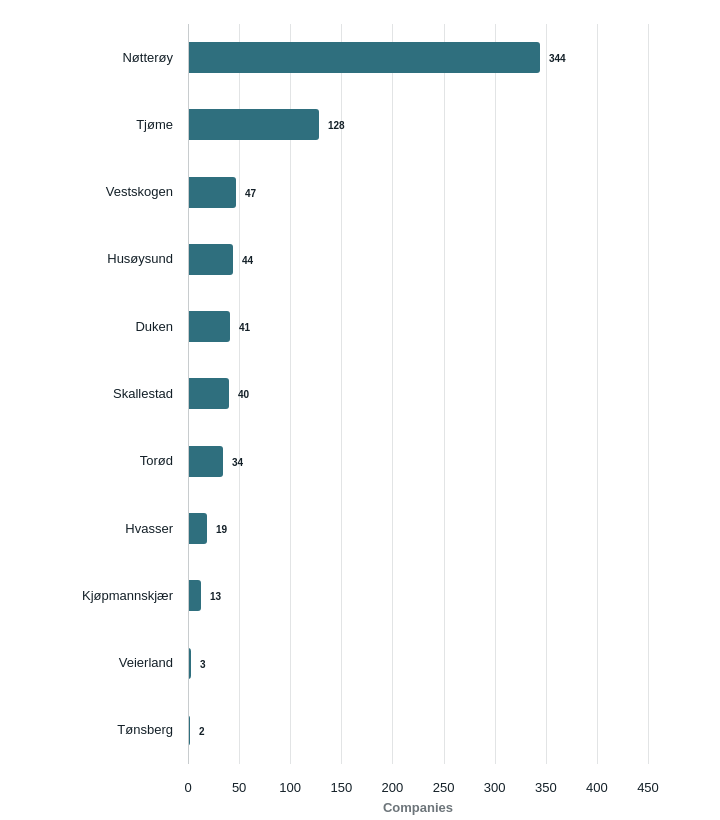
| Area / Place | Companies | Employees | Operating Income (NOK) | Revenue Growth | Key Characteristics |
|---|---|---|---|---|---|
| Nøtterøy | 344 | 8,662 | 3,479.0M | +6% | Administrative hub, public health facilities, primary retail centers |
| Tjøme | 128 | 1,248 | 1,138.4M | +5% | Commercial retail, seasonal tourism, hospitality, local services |
| Kjøpmannskjær | 13 | 200 | 996.9M | -2% | Industrial powerhouse; high productivity (NOK 6.2M income/employee) |
| Vestskogen | 47 | 605 | 759.4M | +7% | Education, commercial services, residential service clusters |
| Skallestad | 40 | 660 | 730.8M | +8% | Logistics, craft services, residential care hubs |
| Husøysund | 44 | 271 | 209.8M | +5% | Maritime services, local trades, small enterprise |
| Duken | 41 | 266 | 117.1M | +15% | Fast-growing local trade center; 11% EBITDA margin |
| Torød | 34 | 154 | 91.4M | +6% | Local trades, consulting, real estate services |
| Hvasser | 19 | 99 | 52.4M | 0% | Premium tourist destination; top margin area (20% EBITDA) |
Nøtterøy serves as the high-density urban core, while Kjøpmannskjær drives industrial efficiency. Places like Hvasser and Tjøme showcase strong seasonal profitability driven by summer residency and tourism.
Largest Employers
Employment in Færder is led by a mix of municipal administration, regional health trusts, specialized industrial manufacturers, and agricultural leaders.
Key Employers in Færder
- Færder Kommune: The largest municipal employer, providing general public administration, municipal operations, and social care across the archipelago (3,407 employees).
- Bjønnesåsen Bo Og Aktivitetssenter & Smidsrød Helsehus: Key residential care and nursing facilities located on Nøtterøy, employing 300 and 266 personnel respectively.
- Sykehuset i Vestfold HF (Specialist Health Units): Operating adult mental health and addiction recovery units on Nøtterøy, employing over 360 combined medical and support staff.
- Wilhelmsen Chemicals AS (Avd Produksjon): Based in Kjøpmannskjær, this chemical manufacturer generates NOK 757.4 million in revenue with 116 employees, serving maritime and industrial markets.
- Bjertnæs & Hoel AS: A leading agricultural producer operating from Øvre Smidsrødvei, generating NOK 188.2 million in income with 126 employees (22% annual revenue growth).
- Engø Gård AS: A historic luxury hotel and restaurant destination on Tjøme, employing 102 staff members and generating NOK 55.6 million in operating turnover.
- Olaf B Terjesen AS: A prominent technical consulting and engineering firm in Teie with 92 employees and NOK 146.9 million in annual turnover.
Business Dynamism and Insolvencies
Business turnover and entry/exit dynamics in Færder reflect realistic market recalibrations, particularly within consumer-facing, construction, and service-oriented sectors.
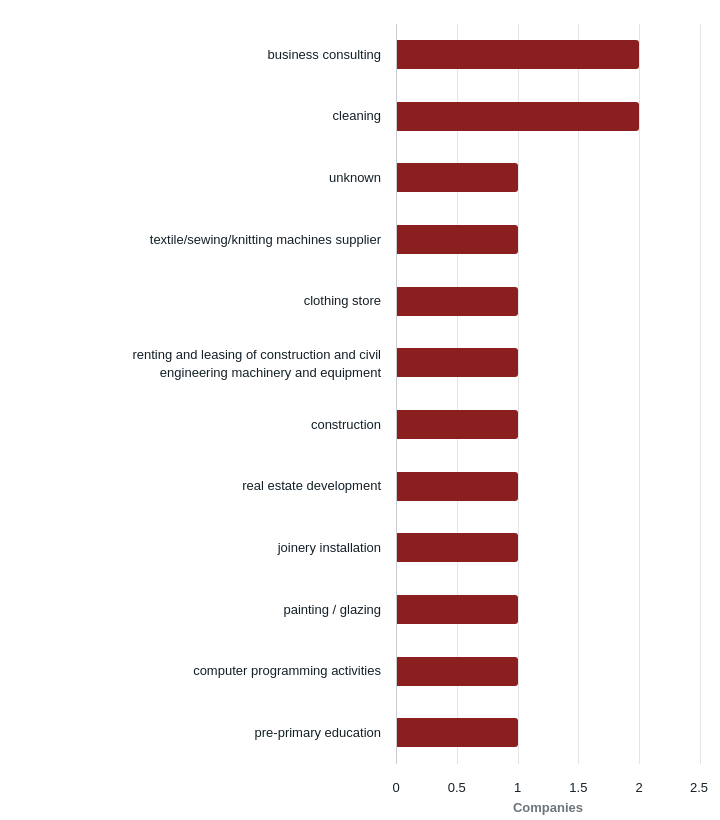
Recent bankruptcy data lists 14 recorded court filings across various sectors in Færder. The insolvencies were predominantly concentrated among smaller local contractors, boutique retail, and service providers face-to-face with rising operational costs:
- Pre-Primary Education: Brattås Barnehage AS represented a major structural insolvency (NOK 35.4M turnover), reflecting systemic cost pressures in private childcare facilities.
- Equipment Rental & Civil Engineering: Gausetangen AMB AS (NOK 6.7M revenue) encountered financial restructuring challenges.
- Retail & Personal Services: Boutiques like Sirocco AS (clothing store, NOK 4.9M turnover) and small cleaning firms (such as Vipada Renhold AS and Dream Clean AS) faced tight margins and reduced discretionary consumer spending.
- Construction & Real Estate: Individual contracting entities (e.g., Kjæmperud Entreprenør, Engers Malerfirma AS, Oslo Syd Utvikling AS) experienced liquidity bottlenecks typical of recent interest rate increases in housing and renovation.
These closures highlight the importance of prudent capital management for early-stage companies entering capital-intensive or discretionary retail segments.
Opportunities for Founders
Despite broader macroeconomic headwinds, Færder offers compelling opportunities for entrepreneurs who target specific economic niches and leverage local demographics.
Strategic Growth Arenas
- Agro-Tech and Sustainable Food Supply: Færder boasts top-tier agricultural producers achieving EBITDA margins above 16%. Opportunities exist in sustainable packaging, automated harvesting tech, and local food processing.
- Maritime and Cleantech Services: Given Kjøpmannskjær's industrial chemical footprint and Færder's extensive coastline, maritime technology, green chemical solutions, and boat care services have an established industrial base.
- Professional & Technical Services: Technical consulting exhibits strong profitability (10% EBITDA margin, NOK 421.6M total market income). High-skilled remote professionals and specialized engineering startups can thrive here.
- Experiential Tourism and Premium Hospitality: Locations like Tjøme and Hvasser yield strong profit margins (up to 20% EBITDA in Hvasser). High-end eco-tourism, culinary concepts, and niche leisure services benefit from high summer spending power.
Founders evaluating location strategies and demographic density across Færder can utilize business intelligence platforms like SmartGrunder to analyze localized economic indicators, commercial zoning, and market activity across Nøtterøy, Tjøme, and adjacent commercial hubs.
Conclusion
Færder municipality offers a well-balanced economic ecosystem combining municipal stability with high-value industrial and agricultural niches. While macro-level turnover has adjusted downwards from historical peaks, employment figures remain solid, and key geographic areas like Nøtterøy, Kjøpmannskjær, and Tjøme continue to demonstrate resilient commercial activity.
For business leaders and entrepreneurs, Færder presents an attractive blend of high quality of life, skilled talent, and proximity to regional markets in Vestfold. Success in this market requires targeted positioning—aligning product offerings with the high purchasing power of residents and visitors or delivering specialized B2B services to the municipality's established technical and manufacturing sectors.