Municipality
Fjord Municipal Economy Analysis: Strategic Report for Founders and Decision-Makers
An in-depth analysis of industry structure, revenue dynamics, regional clusters, and entrepreneurial opportunities in Fjord kommune
Executive Summary
Fjord municipality, situated in Møre og Romsdal, presents a distinct economic topology characterized by highly capital-intensive natural resource exploitation, strong civil engineering and construction capabilities, and deeply rooted agricultural and healthcare traditions. Anchored by the major local centers of Valldal, Stordal, and Tafjord, the municipality generates over NOK 2.0 billion in annual commercial turnover, supported by a workforce across private and municipal sectors.
The commercial foundation of Fjord rests on three principal economic pillars:
- High-Yield Energy & Aquaculture: Power generation in Tafjord (Tafjord Kraftproduksjon As) and fish farming (Hofseth Aqua As) deliver massive revenue-per-employee figures and serve as the region's core wealth generators.
- Heavy Civil Engineering & Industrial Services: Contracting firms such as Busengdal As in Stordal provide foundational employment and substantial revenue growth in infrastructure and site preparation.
- Community Healthcare, Agriculture, & Tourism: Valldal functions as the primary population and service node, supporting specialized health institutions (Muritunet As), extensive fruit production, and seasonal hospitality.
Economic Overview
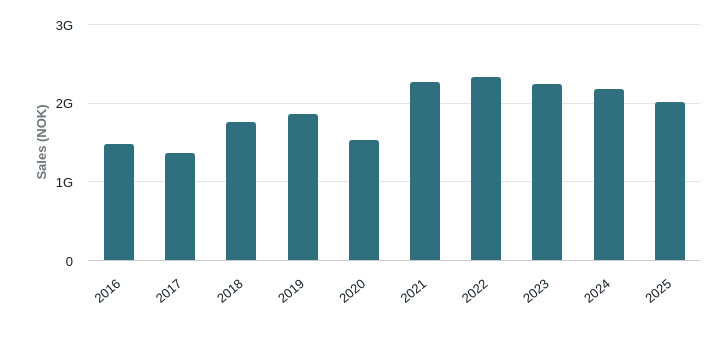
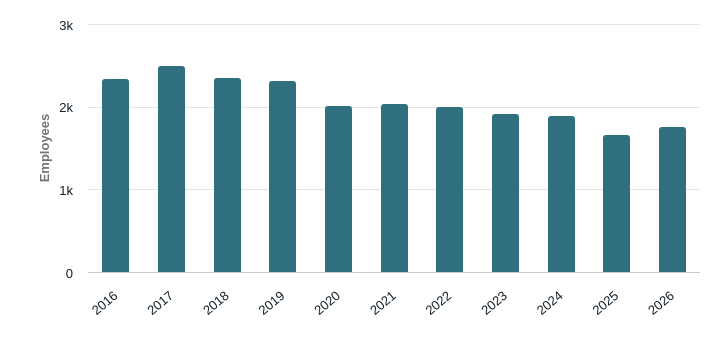
Fjord's corporate sector experienced significant revenue expansion between 2016 and 2022, reaching a historic high of NOK 2.32 billion in 2022 before stabilizing around NOK 2.00 billion in 2025. Employment in registered enterprise statistics has adjusted from 2,335 in 2016 down to 1,660 in 2025, with positive momentum projected into 2026 reaching 1,748 employees (+5.3%).
Historical Revenue and Employment Trajectory
| Year | Operating Revenue (NOK M) | Revenue YoY Change | Workforce (Employees) | Workforce YoY Change |
|---|---|---|---|---|
| 2016 | 1,474.9 | — | 2,335 | — |
| 2017 | 1,360.6 | -7.7% | 2,496 | +6.9% |
| 2018 | 1,751.0 | +28.7% | 2,346 | -6.0% |
| 2019 | 1,861.2 | +6.3% | 2,313 | -1.4% |
| 2020 | 1,529.7 | -17.8% | 2,003 | -13.4% |
| 2021 | 2,261.3 | +47.8% | 2,037 | +1.7% |
| 2022 | 2,321.3 | +2.7% | 1,994 | -2.1% |
| 2023 | 2,231.0 | -3.9% | 1,909 | -4.3% |
| 2024 | 2,170.4 | -2.7% | 1,885 | -1.3% |
| 2025 | 2,004.6 | -7.6% | 1,660 | -11.9% |
| 2026 | — | — | 1,748 | +5.3% |
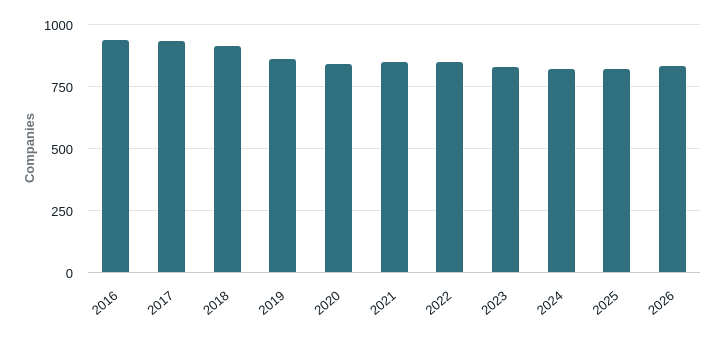
Revenue swings in Fjord are heavily driven by commodity pricing in energy and salmon farming, alongside major infrastructure contracting cycles. While aggregate headcount has contracted over the decade, labor productivity in key commercial sectors remains exceptionally high.
Industry Structure & Organizational Forms
Fjord's industry mix spans traditional primary production, public sector services, and industrial infrastructure. Standard limited liability companies (Aksjeselskap / AS) account for the majority of financial turnover, generating NOK 2,100.7M across 87 companies with an overall EBITDA margin of 22%.
Key Industry Sectors
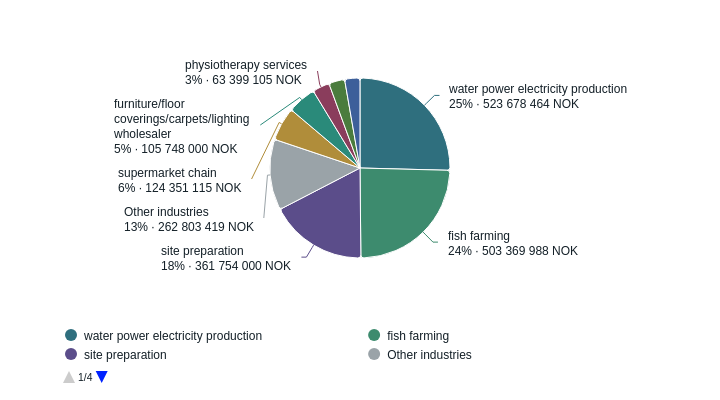
- Water Power Electricity Production: A single hyper-efficient facility context in Tafjord yields NOK 527.6M in operating income, maintaining a 56% EBITDA margin and an operating margin of 50%.
- Fish Farming: 3 active enterprises generate NOK 504.9M with an average operating income per employee of NOK 10.7M and an EBITDA margin of 14%.
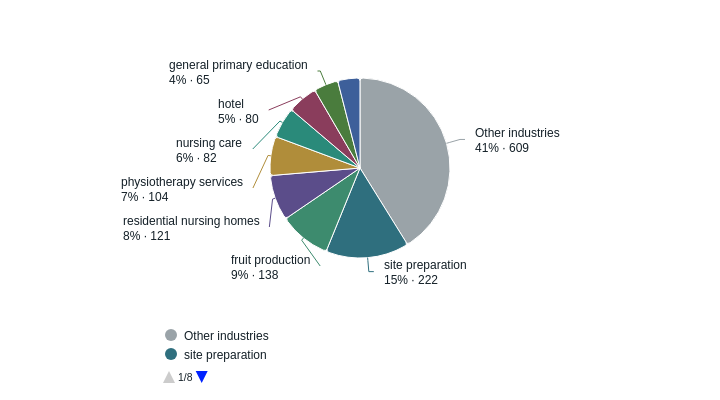
- Site Preparation & Heavy Construction: 6 companies employ 222 workers, generating NOK 367.7M with strong 11% revenue growth.
- Retail & Wholesale: Supermarket chains, local groceries, and building supply stores (e.g., Valldal Høvleri As, NOK 50.6M revenue, +37% growth) provide stable retail liquidity.
- Physiotherapy & Rehabilitation: Institutional care led by Muritunet As generates NOK 66.5M in revenues across 104 personnel.
Legal Structure Distribution
| Legal Structure | Company Count | Registered Employees | Operating Income (NOK M) | EBITDA Margin |
|---|---|---|---|---|
| Limited Liability (AS) | 87 | 1,050 | 2,100.7 | 22% |
| Municipal Entities (KOMM) | 25 | 598 | 0.0 | N/A |
| Sole Proprietorships (ENK) | 33 | 264 | 0.0 | N/A |
| Cooperatives (SA) | 3 | 25 | 81.7 | 2% |
| State/Public Acc (SPA) | 1 | 7 | 29.0 | 66% |
Sole proprietorships (ENK) play an indispensable role in fruit production and localized agriculture around Valldal, providing structural rural employment that is not always fully captured in corporate revenue metrics.
Business Geography & Regional Clusters
Economic activity in Fjord is distributed across five main settlements along the fjords and valleys, each fulfilling a distinct economic function:
Local Micro-Economies
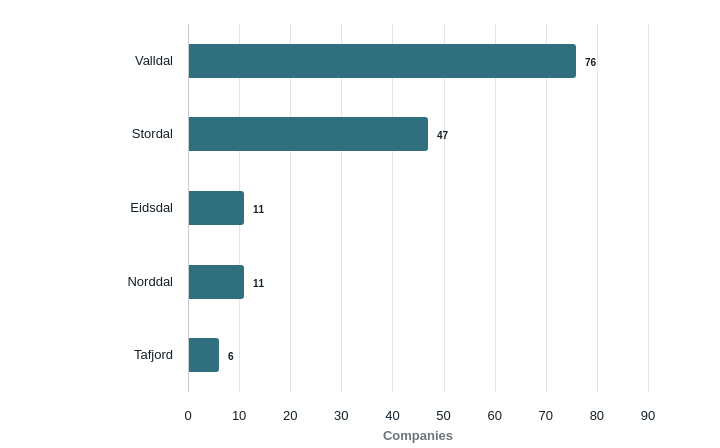
- Valldal: The municipal hub for administration, commerce, tourism, and healthcare. Hosting 76 registered businesses and 984 employees, Valldal produces NOK 599.6M in operating income with a gross margin of 21%.
- Stordal: The primary industrial center. With 47 companies and 748 employees, Stordal drives NOK 693.2M in operating income, anchored by heavy contracting and manufacturing activity.
- Tafjord: An energy and aquaculture powerhouse. Despite having only 6 registered enterprise listings, Tafjord generates NOK 851.6M in operating income and NOK 297.2M in operating profit, achieving a 34% operating margin.
- Eidsdal: A rural transit and agricultural cluster with 11 companies and 68 employees, generating NOK 57.8M in revenue (+4% growth).
- Norddal: A growing community enterprise hub of 11 companies and 60 employees, delivering NOK 11.0M in turnover with strong 20% year-over-year revenue growth.
Comparative Geographical Metrics
| Location | Companies | Employees | Operating Income (NOK M) | Operating Margin | EBITDA Margin |
|---|---|---|---|---|---|
| Valldal | 76 | 984 | 599.6 | 9% | 12% |
| Stordal | 47 | 748 | 693.2 | 2% | 9% |
| Tafjord | 6 | 91 | 851.6 | 34% | 40% |
| Eidsdal | 11 | 68 | 57.8 | 1% | 4% |
| Norddal | 11 | 60 | 11.0 | 9% | 11% |
Largest Local Employers
The employer landscape in Fjord features a balance of major private industrial operations, specialized healthcare institutions, and municipal administrative units.
Top Commercial Employers
- Busengdal As (Stordal): 197 employees. A major heavy construction and site preparation contractor generating NOK 343.6M in operating income with an EBITDA of NOK 46.8M.
- Muritunet As Avd Valldal (Valldal): 104 employees. A premier rehabilitation and physiotherapy center generating NOK 66.5M in turnover.
- Tafjord Kraftproduksjon As Avd Tafjord (Tafjord): 45 employees. Hydroelectric energy generator reporting NOK 527.6M in revenue and NOK 300.0M EBITDA.
- Valldal Fjordhotell Drift As (Valldal): 37 employees. Central hospitality actor generating NOK 16.3M in revenue (+7% growth).
- Valldal Høvleri As (Valldal): 34 employees. Building supplier generating NOK 50.6M in revenue (+37% growth) with an 11% EBITDA margin.
- Hofseth Aqua As Avd 18 Tafjord Klekkeri (Tafjord): 32 employees. Fish farming and hatchery operations generating NOK 316.4M in turnover.
Key Agricultural & Public Sector Employers
- Håkon Myklebust & Hegelin Waldal (Valldal): Leading fruit production sole proprietorships employing 68 and 28 workers respectively.
- Fjord Kommune Administrative & Health Units: Municipal institutions including Valldal Sjukeheim (62 employees), Fjord Kommune Teknisk Adm. (59 employees), Stordalstunet (59 employees), Fjord Kommune Bu/habiliteringsteneste Stordal (51 employees), and Fjord Kommune Bu/habiliteringsteneste Valldal (50 employees) form the backbone of local public employment.
Business Dynamism & Financial Resilience
Fjord demonstrates solid balance-sheet fundamentals in its capital-intensive sectors, alongside tighter operating conditions in competitive service niches.
Capital Structure & Sector Profitability
- High Financial Leverage in Heavy Infrastructure: Site preparation firms manage NOK 153.4M in total debt against NOK 48.2M equity, reflecting ongoing equipment investment cycles.
- Substantial Asset Base in Power & Aquaculture: Hydroelectricity holds NOK 643.1M in equity against NOK 743.4M debt, while fish farming firms maintain NOK 129.6M in equity.
- Service Sector Margins: Hospitality and food service operate on narrower margins. For instance, hotel operations aggregate an operating margin of -3%, whereas local restaurants maintain positive operating margins near 8% with 34% revenue growth.
In current dataset records, major bankruptcy spikes are absent, indicating relative structural stability among primary employers, though seasonal businesses face ongoing cost pressures.
Opportunities for Founders & Innovation Focus
For prospective entrepreneurs and expanding businesses, Fjord offers strategic entry points in several high-potential niches:
Promising Entrepreneurial Angles
- Agri-Tech & Fruit Product Processing: Valldal's established fruit production legacy offers unmapped potential for high-value food innovation, organic processing, and direct-to-consumer distribution.
- Eco-Tourism & Year-Round Hospitality: Given the seasonal intensity at facilities like Valldal Fjordhotell, there is clear demand for off-peak activity services, guided fjord experiences, and premium culinary concepts.
- B2B Industrial & Logistics Services: Supporting large operators like Busengdal As and Hofseth Aqua As creates opportunities in specialized equipment maintenance, green transport solutions, and sub-contracting.
- Energy Transition & Resource Efficiency Services: With massive hydro-power output in Tafjord, local startups focusing on energy management, smart grid technology, and sustainable aquaculture support stand to gain traction.
Founders interested in analyzing localized demand, commercial real estate locations, or specific industry clusters across Fjord municipality can utilize platforms like SmartGrunder to explore address data and refine business models.
Conclusion & Strategic Outlook
Fjord municipality possesses an unusually rich balance of high-margin natural resource generation and solid industrial contracting capabilities. While its geographic profile requires targeted logistics and seasonal adaptability, its key hubs—Valldal, Stordal, and Tafjord—provide resilient economic foundations.
By leveraging existing infrastructure, expanding local value addition in agriculture and tourism, and catering to the specialized needs of its large industrial anchors, Fjord remains a compelling environment for targeted business investment and long-term venture growth.