Municipality
Economic Analysis of Flakstad Municipality
A detailed evaluation of local industry structure, commercial geography, and business opportunities in Lofoten
Executive Summary
Flakstad municipality, located in the heart of the Lofoten archipelago in Nordland, represents a high-yield coastal economy defined by strong seafood production, specialized maritime logistics, and an expanding high-margin hospitality sector. Despite a modest population footprint, companies operating within Flakstad generate substantial economic value, with enterprise sales exceeding NOK 1.33 billion in 2025.
The commercial landscape is characterized by extreme productivity per employee in primary and secondary industries. Industrial nodes such as Sund I Lofoten yield over NOK 10.6 million in operating income per employee, anchored by major seafood processing operations. Concurrently, Ramberg functions as the administrative and service hub, hosting retail, tourism, and public administration entities.
Key highlights of Flakstad's economic landscape include:
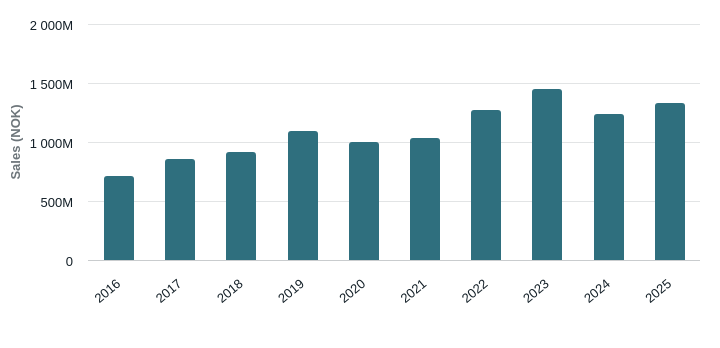
- High Revenue Productivity: Total commercial turnover reached NOK 1,446.5M at its 2023 peak, maintaining robust performance at NOK 1,334.2M in 2025.
- Dominant Seafood Sector: Fish processing and aquaculture generate over NOK 970 million in combined annual operating income.
- Tourism & Hospitality Expansion: High-performing camping and resort destinations deliver EBITDA margins exceeding 30%.
- Focused Geographic Clusters: Enterprise activity is highly concentrated across four core settlements: Ramberg, Napp, Fredvang, and Sund I Lofoten.
Economic Overview
Flakstad's macro-economic metrics reveal a business ecosystem that experienced significant revenue acceleration between 2016 and 2023, followed by stabilization. Commercial turnover grew from NOK 715.7M in 2016 to a peak of NOK 1,446.5M in 2023. Following a temporary market adjustment in 2024 (NOK 1,238.2M, -14.4%), total enterprise sales recovered sharply in 2025, expanding by +7.8% to NOK 1,334.2M.
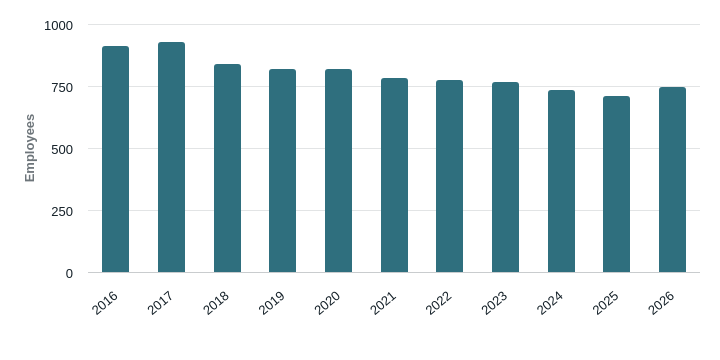
Employment figures reflect long-term structural efficiency improvements. Total commercial and public employment adjusted from 911 employees in 2016 to 711 in 2025, before rebounding to 746 employees in 2026 (+4.9% YoY change).
| Year | Total Sales (NOK) | Sales YoY Change | Total Employees | Employees YoY Change |
|---|---|---|---|---|
| 2016 | 715.7M | — | 911 | — |
| 2017 | 853.2M | +19.2% | 926 | +1.6% |
| 2018 | 913.0M | +7.0% | 839 | -9.4% |
| 2019 | 1,092.8M | +19.7% | 820 | -2.3% |
| 2020 | 998.4M | -8.6% | 819 | -0.1% |
| 2021 | 1,037.4M | +3.9% | 782 | -4.5% |
| 2022 | 1,274.3M | +22.8% | 776 | -0.8% |
| 2023 | 1,446.5M | +13.5% | 767 | -1.2% |
| 2024 | 1,238.2M | -14.4% | 733 | -4.4% |
| 2025 | 1,334.2M | +7.8% | 711 | -3.0% |
| 2026 | — | — | 746 | +4.9% |
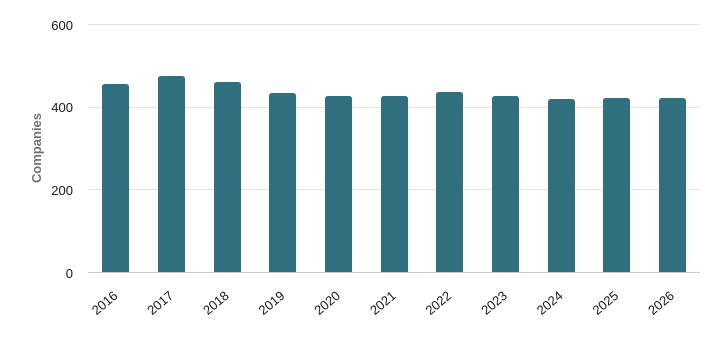
This trend highlights a transition toward higher revenue productivity per worker, particularly driven by automation and scale in seafood processing and capital-intensive aquaculture.
Industry Structure
Flakstad's economy relies on three main commercial pillars: seafood production, transport/logistics, and tourism/hospitality, complemented by municipal healthcare and education services.
Core Commercial Sectors
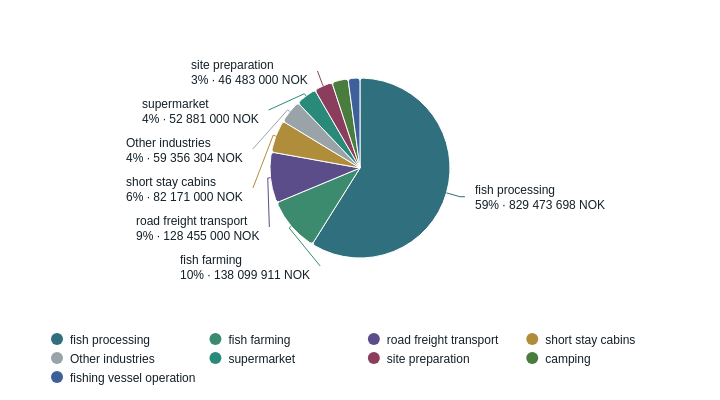
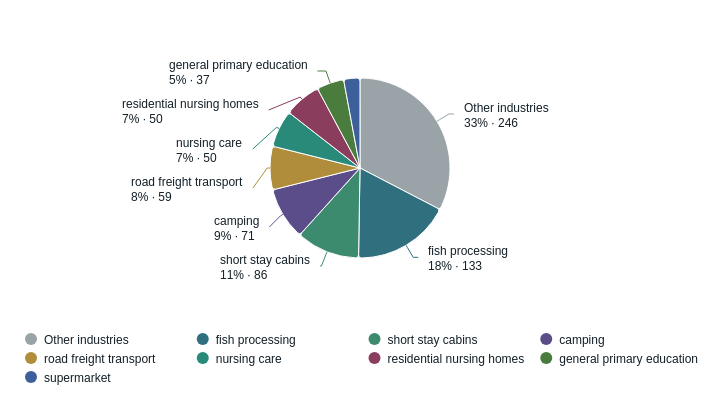
- Seafood Processing & Aquaculture: Fish processing is the largest revenue engine, generating NOK 836.6M in operating income across 5 companies employing 133 people, with a 33% revenue growth rate. Fish farming accounts for NOK 138.3M across 2 companies with an exceptional 35% EBITDA margin and NOK 8.0M operating income per employee.
- Logistics & Infrastructure: Road freight transport contributes NOK 128.7M (59 employees across 1 company), serving as a vital supply chain link for marine exports. Site preparation adds NOK 46.9M (22 employees).
- Hospitality & Accommodation: Short stay cabin operations yield NOK 83.6M (86 employees, 36% growth), while camping operations generate NOK 41.8M (71 employees) with an impressive 31% EBITDA margin.
- Retail & Food Services: Local retail (supermarkets) generates NOK 53.7M (22 employees), while dining establishments are emerging with strong revenue momentum.
| Industry Sector | Companies | Employees | Operating Income (NOK) | EBITDA Margin | Revenue Growth |
|---|---|---|---|---|---|
| Fish Processing | 5 | 133 | 836.6M | 9% | +33% |
| Fish Farming | 2 | 19 | 138.3M | 35% | +15% |
| Road Freight Transport | 1 | 59 | 128.7M | 6% | +3% |
| Short Stay Cabins | 1 | 86 | 83.6M | 1% | +36% |
| Supermarket | 1 | 22 | 53.7M | 5% | +4% |
| Site Preparation | 1 | 22 | 46.9M | 4% | -13% |
| Camping | 2 | 71 | 41.8M | 31% | +30% |
| Fishing Vessel Operation | 4 | 15 | 30.1M | 25% | +2% |
Legal Forms Structure
Incorporated limited liability companies (Aksjeselskap / AS) represent the vast majority of economic activity, comprising 39 enterprises, 540 employees, and NOK 1,420.9M in total operating income. Municipal administrative and healthcare entities (Komm) account for 9 reporting units and 222 employees, while sole proprietorships (Enkeltpersonforetak / ENK) maintain a presence across 9 registered entities.
Business Geography
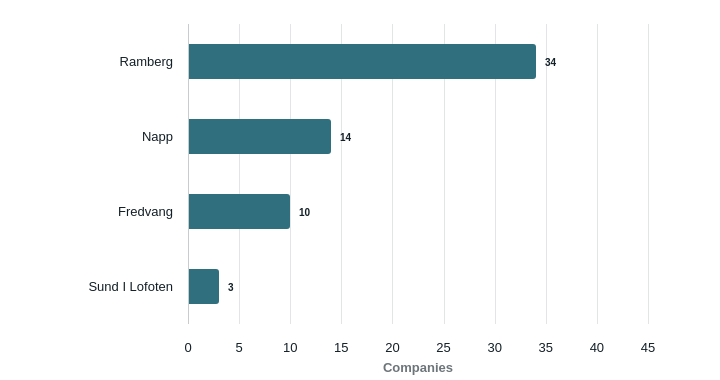
Economic activity in Flakstad is distributed across four principal geographical nodes along the European route E10 corridor:
- Sund I Lofoten: The municipality's industrial giant in terms of turnover. Host to major fish processing facilities, Sund records NOK 736.3M in operating income across just 3 companies with 82 employees. It achieves an extraordinary NOK 10.6M in operating income per employee and recorded 39% revenue growth.
- Ramberg: The municipal administrative, retail, and tourism hub. Ramberg supports 34 companies and 451 employees, generating NOK 378.1M in operating income with 19% growth. It holds NOK 420.8M in total equity.
- Napp: A crucial transport and innovation corridor near the Nappstraumen tunnel. Napp features 14 companies and 204 employees, producing NOK 223.3M in operating income. Key activities include heavy transport, civil construction, and marine biotech.
- Fredvang: Located across the Fredvang Bridges, hosting 10 companies and 85 employees. Fredvang yields NOK 93.5M in operating income with 8% revenue growth, centered on fish processing and local tourism.
| Location | Active Companies | Total Employees | Operating Income (NOK) | Sales Revenue (NOK) | Revenue Growth |
|---|---|---|---|---|---|
| Sund I Lofoten | 3 | 82 | 736.3M | 731.5M | +39% |
| Ramberg | 34 | 451 | 378.1M | 372.7M | +19% |
| Napp | 14 | 204 | 223.3M | 212.8M | -3% |
| Fredvang | 10 | 85 | 93.5M | 91.0M | +8% |
Largest Employers
The commercial ecosystem is anchored by established private firms in marine products, logistics, and tourism, along with public health and education services.
Key Commercial Employers
- Sufi As Avd Sund I Lofoten: The single largest commercial entity by revenue in Flakstad. Operating in fish processing at Sundveien, it employs 68 staff, generating NOK 589.8M in operating income with 31% revenue growth and an EBITDA of NOK 58.1M.
- Nusfjord Drift As: Located in historic Nusfjord near Ramberg, operating short stay accommodation. Employs 86 workers, bringing in NOK 83.6M in operating income (+36% growth).
- Rasmussen Transport As: Based at Napp, operating road freight services. Employs 59 staff with an operating income of NOK 128.7M.
- Lofoten Beach Camp As: Located at Ramberg beach, employing 40 staff in camping and activities. Generated NOK 24.1M in operating income with 29% growth and an impressive 36% EBITDA margin (NOK 8.7M EBITDA).
- Ramberg Resort As: Camping and hospitality at Ramberg, employing 31 staff with NOK 17.7M in operating income (+30% growth) and a 25% EBITDA margin.
- Bjørn Gjertsen As: Fish processing unit in Fredvang with 22 employees and NOK 70.2M in operating income (+12% growth).
- Ramberg Lavpris As: Local supermarket in Ramberg employing 22 staff, generating NOK 53.7M in operating income.
- Rasmussen Anlegg As: Civil site preparation contractor at Napp, employing 22 staff with NOK 46.9M in operating income.
- Lofoten Seaweed Company As: Innovative marine food producer in Napp, employing 25 staff with NOK 12.7M in operating income (+27% growth).
Public Sector Units
Public municipal services form a steady baseline of local employment, including Flakstad Kommune Hjemmebaserte Tjenester (50 employees), Solhøgda Bo Og Behandlingssenter in Napp (50 employees), Flakstad Barne Og Ungdomsskole in Ramberg (22 employees), and municipal administrative departments.
Business Dynamism
Flakstad exhibits strong business resilience, supported by high asset values in seafood and property sectors. Corporate insolvencies remain at low levels, reflecting stable long-term operations in core export industries.
Growth and Expansion Trends
Enterprise dynamic indicators demonstrate robust expansion in specialized consumer and experiential segments:
- Culinary & Tourism Startups: Establishments like Cafe Lille Martine As in Ramberg achieved 168% revenue growth (reaching NOK 1.8M), illustrating strong visitor demand during peak seasons.
- High Operating Margins in Hospitality: Camping and outdoor activity hubs generate EBITDA margins between 25% and 36%, demonstrating that lifestyle and eco-tourism ventures hold strong financial fundamentals in Lofoten.
- Marine Product Innovation: Companies such as Lofoten Seaweed Company As exemplify the shift toward high-value marine bioprocessing, expanding turnover by 27% to NOK 12.7M.
Capital structure across the municipality remains solid, with total enterprise equity exceeding NOK 746M against total debt of NOK 627M among limited liability companies.
Opportunities for Founders
Flakstad offers compelling commercial prospects for entrepreneurs who can build upon its established seafood infrastructure and international tourism reputation.
High-Potential Strategic Segments
- Marine Value Addition & Biotechnology: Building on raw material availability from processors like Sufi As and innovators like Lofoten Seaweed Company As, opportunities exist in side-stream utilization, specialized packaging, and marine health products.
- Year-Round Eco-Tourism & High-End Hospitality: While summer camping thrives at Lofoten Beach Camp As and Ramberg Resort As, there is unmet demand for shoulder-season experiences, winter stay infrastructure, guide services, and sustainable mobility rentals.
- Craft Food, Beverage & Dining: Fast-growing eateries indicate strong consumer spending among summer travelers and local residents. High-quality dining concepts and local craft food production have clear room to scale.
- Logistics & Business Support Services: With significant heavy freight traffic (Rasmussen Transport As) and coastal construction work (Rasmussen Anlegg As), founders offering equipment maintenance, specialized logistics software, or renewable energy transitions for maritime vessels can find a receptive B2B market.
For founders planning to establish a business in Flakstad, using platform tools like SmartGrunder can help explore available commercial addresses, evaluate neighborhood demographic profiles, and identify underserved industry niches across Ramberg, Napp, Fredvang, and Sund I Lofoten.
Conclusion
Flakstad municipality combines traditional maritime strength with a thriving modern visitor economy. Generating over NOK 1.33 billion in enterprise sales across a concentrated geographic area, the municipality offers a high-yield foundation for business operators.
For entrepreneurs and investors, Flakstad presents strong fundamental advantages: exceptional industrial productivity in seafood, high profit margins in tourism ventures, and strong local leadership in civil infrastructure. By tapping into existing marine supply chains or addressing year-round visitor demand, new ventures can establish profitable operations in one of Nordland's most dynamic coastal economies.