Municipality
Frosta Municipal Business and Economic Profile
An in-depth analysis of employment, industry specialization, and enterprise dynamics in Trøndelag's primary agricultural peninsula
Executive Summary
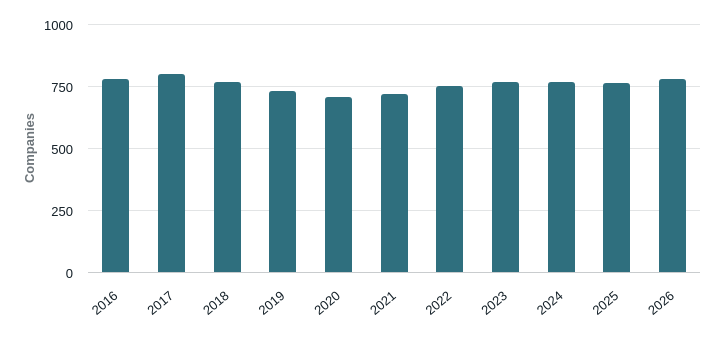
Frosta municipality, located in Trøndelag, holds a unique economic identity often described as the garden of Trondheimsfjorden. The municipal economy is defined by a dense concentration of commercial agriculture, vegetable packaging, agri-logistics, and public administration. According to local financial data, companies operating in Frosta generate total annual sales exceeding NOK 820 million to NOK 860 million, supported by a workforce of approximately 1,760 to 1,900 employees across corporate and municipal entities.
The commercial landscape is anchored by joint stock companies (Aksjeselskap / AS) and cooperative societies (Samvirkeforetak / SA), which together drive the bulk of private sector revenue. Notably, specialized agricultural operations, vegetable packaging, and food production—such as Frostagrønt AS and Produsentpakkeriet Trøndelag AS—form the backbone of industrial output. Concurrently, public services, led directly by Frosta Kommune, represent the largest single source of local employment.
For entrepreneurs and investors, Frosta offers a established industrial ecosystem centered on food supply chains, specialized transport, and local tourism. While overall employee counts have stabilized following peak levels in 2017, steady revenue recovery and solid corporate profit margins reflect a resilient, highly specialized local economy.
Economic Overview
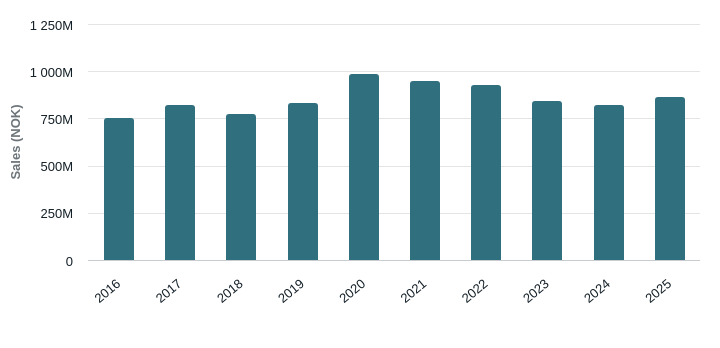
Frosta's corporate economy has experienced fluctuating macroeconomic cycles over the past decade. Local enterprise sales reached a historical peak in 2020 at NOK 987.7 million, driven by surge demand during global supply disruptions, before adjusting downward to NOK 822.8 million in 2024. Projections for 2025 point toward a rebound, with local sales rebounding to NOK 864.0 million (a 5.0% year-over-year growth rate).
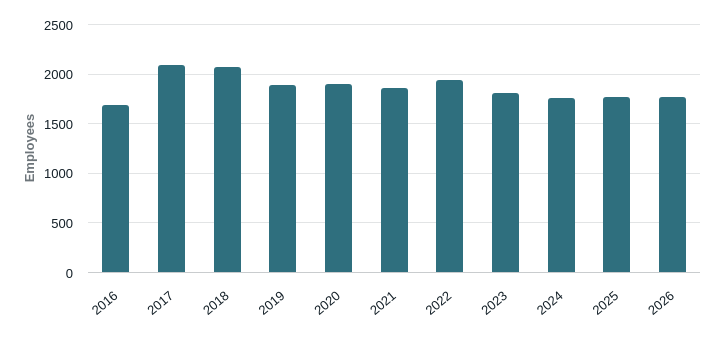
Employment patterns follow a parallel trend of consolidation. Total corporate and municipal employment expanded significantly from 1,688 workers in 2016 to a high of 2,085 workers in 2017. In recent years, workforce figures have stabilized around 1,757 to 1,769 employees, reflecting increased automation in industrial agricultural processing and logistics.
| Year | Total Sales (NOK) | Sales YoY Change | Total Employees | Employees YoY Change |
|---|---|---|---|---|
| 2016 | 751.6M | - | 1,688 | - |
| 2017 | 818.7M | +8.9% | 2,085 | +23.5% |
| 2018 | 775.7M | -5.2% | 2,064 | -1.0% |
| 2019 | 832.7M | +7.4% | 1,886 | -8.6% |
| 2020 | 987.7M | +18.6% | 1,891 | +0.3% |
| 2021 | 948.7M | -4.0% | 1,857 | -1.8% |
| 2022 | 925.8M | -2.4% | 1,936 | +4.3% |
| 2023 | 840.3M | -9.2% | 1,802 | -6.9% |
| 2024 | 822.8M | -2.1% | 1,757 | -2.5% |
| 2025 | 864.0M | +5.0% | 1,769 | +0.7% |
Overall, the municipality maintains an operating profit margin around 6% and an aggregated EBITDA of NOK 79.2 million across active enterprise units, demonstrating sustainable financial health despite shifting input costs in energy and agricultural consumables.
Industry Structure & Legal Forms
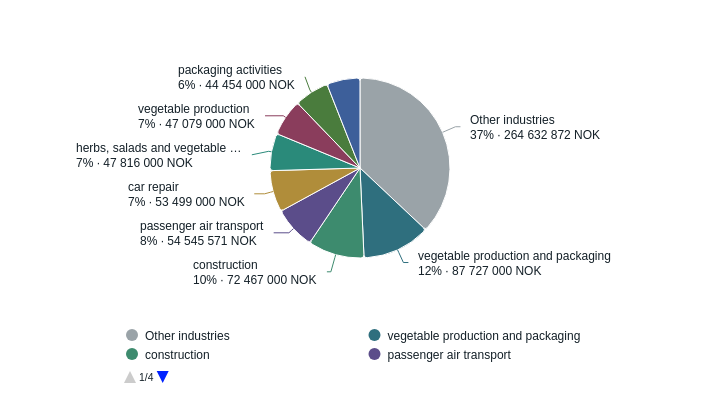
The industry composition in Frosta is heavily tilted toward food production, agricultural supply chains, public administration, and supporting commercial services. The primary sectors generating private-sector turnover include vegetable production and packaging, road freight transport, construction, and specialized food processing.
Key Industry Sectors
- Vegetable Production & Packaging: Vegetable growing, herbs/salads, fibre crops, and packaging activities collectively yield well over NOK 200 million in annual revenues. The packaging sector alone boasts an impressive EBITDA margin of 18%.
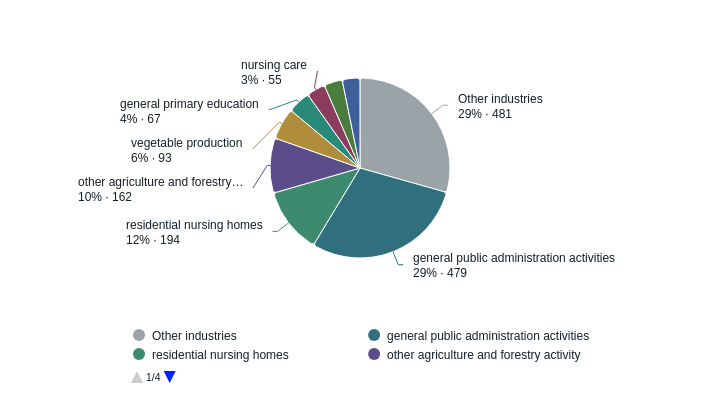
- Agriculture Support Services: Organizations such as agricultural labor pools (other agriculture and forestry activity) employ 162 workers, providing vital labor infrastructure across seasonal cultivation cycles.
- Freight Transport & Logistics: Road freight transport generates NOK 42.7 million across 3 main companies, ensuring direct trade links between Frosta's producers and national wholesale markets.
- Construction & Technical Services: General construction and floor/wall covering businesses represent 10 companies generating nearly NOK 95 million combined, benefiting from local commercial and residential facility development.
- Hospitality & Retail: Local hospitality (hotels, restaurants, camping) and supermarkets generate steady regional trade, supported by seasonal tourism.
Corporate Legal Form Distribution
The business sector exhibits a clear structure, split between commercial shareholding companies (AS), cooperative models (SA), and public municipal service bodies (KOMM / ORGL).
| Legal Form | Number of Entities | Total Workforce | Operating Income (NOK) | Gross Margin |
|---|---|---|---|---|
| AS (Aksjeselskap) | 80 | 709 | 732.3M | 1060% |
| KOMM (Kommune) | 1 | 463 | 0.0M | 0% |
| ORGL (Organisasjonsledd) | 22 | 461 | 0.0M | 0% |
| SA (Samvirkeforetak) | 8 | 218 | 76.0M | 65% |
| ENK (Enkeltpersonforetak) | 10 | 47 | 0.0M | 0% |
Business Geography
Frosta's economic geography is geographically consolidated. Because the municipality encompasses a compact peninsula, commercial and industrial activity is centered primarily around the municipal hub of Frosta.
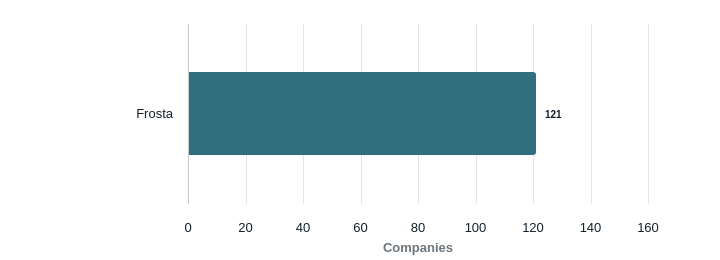
Across the single primary geographical designation recorded in the municipal register, active enterprises encompass 121 key business units employing 1,898 workers (including municipal public administration and regional assignments). The cluster around the municipal center along Vikaleirvegen, Fånesvegen, and Frostavegen brings key agricultural facilities, administrative headquarters, packaging plants, and retail infrastructure into close spatial proximity.
This geographical compactness facilitates efficient local logistical operations. Farmgate products move rapidly to central packaging facilities such as those on Vikaleirvegen before being dispatched onto main transport arteries connected to E6 transit routes toward Trondheim and Stjørdal.
Largest Employers
Employment in Frosta is distributed between major municipal welfare operations, agricultural cooperatives, and key private food-processing enterprises. Frosta Kommune is the largest overall employer, staffing central administrative services, primary schooling, and healthcare facilities.
In the private and cooperative sectors, agricultural support networks like Frosta Avløserlag SA and specialized produce hubs like Frostagrønt AS represent significant workforce centers.
Top Local Employers & Key Enterprise Metrics
- Frosta Kommune: Public administration and healthcare infrastructure, employing 463 staff members.
- Frosta Avløserlag SA: Agricultural assistance cooperative supplying specialized labor, with 161 employees and NOK 32.1 million in operating income.
- Frostatunet Institusjon & Local Care Units: Public and semi-public health institutions (including Frostatunet Omsorgsboliger and Hjemmebaserte Tjenester) collectively employ over 200 healthcare professionals.
- Frosta Skole: Primary educational institution employing 67 educators and staff.
- Frostagrønt AS: Leading vegetable production and packaging enterprise located at Nåvikvegen, reporting 48 employees, NOK 88.5 million in revenue, and an EBITDA margin of 6%.
- Viken Østre AS Avd Frostavegen: Major vegetable cultivation company with 37 employees.
- Produsentpakkeriet Trøndelag AS: Packaging and post-harvest facility with 32 employees, generating NOK 48.5 million in turnover and an 18% EBITDA margin.
- Ahl Distribusjon AS: Freight transportation firm employing 27 personnel, with NOK 42.7 million in revenue and 20% annual top-line growth.
- Nordfjæran Søndre Frilandspakkeri AS: Agriculture and crop processing company with 26 employees and NOK 21.2 million in turnover.
- Valberg Slektsgård AS: Regional hotel and event venue employing 23 workers, posting NOK 11.6 million in revenue with a 16% operating margin.
Business Dynamism & Financial Resilience
The enterprise dynamic in Frosta reflects high capital investments in specialized equipment, land development, and storage infrastructure. Total registered corporate debt among local active companies stands at NOK 359.6 million against total equity of NOK 218.5 million, indicating a solid debt-to-equity baseline appropriate for capital-intensive agricultural and industrial processing activities.
Revenue growth across active commercial entities averaged 5% in recent reporting periods. Several growth drivers stand out in the private sector:
- Logistics expansion: Ahl Distribusjon AS logged a 20% revenue expansion, driven by strong regional demand for fast-moving freight.
- Value-added food processing: Companies like Grøntfabrikken AS experienced rapid top-line growth (+40% to NOK 19.3M), though operational investments temporarily compressed net margins.
- Capital efficiency in packaging: Produsentpakkeriet Trøndelag AS generated an EBITDA of NOK 9.1 million (NOK 309.2k per employee), proving the value of shared industrial processing assets.
Business insolvency rates remain modest and well-managed. The cooperative structure utilized in agricultural labor and packaging spreads risk across primary producers, protecting the local economy from severe systemic shocks.
Opportunities for Founders & Entrepreneurs
For prospective founders and expanding business owners, Frosta presents distinct market openings rooted in its high agricultural output and scenic coastal location. Key opportunity areas include:
- AgTech and Post-Harvest Technology: High operating volumes in vegetable production create strong demand for automated sorting, smart greenhousing, and yield-optimization software.
- Agri-Tourism & Local Food Concepts: With heritage sites like Valberg Slektsgård drawing visitors, niche food experiences, farm-to-table dining, and boutique accommodation have clear growth potential.
- Circular Economy & Organic Waste Processing: Large-scale crop packaging creates substantial organic byproduct streams suitable for bio-energy production, composting, or eco-friendly packaging materials.
- B2B Agricultural Maintenance Services: Heavy reliance on specialized machinery, cold-storage equipment, and commercial transport creates ongoing demand for technical repair, electrical engineering, and refrigeration service providers.
Founders exploring potential commercial locations, industry trends, or incorporation strategies in Frosta can leverage tools like SmartGrunder to analyze street-level business density, demographic statistics, and registered enterprise profiles.
Conclusion
Frosta municipality demonstrates how specialized industry focus can create a stable, resilient local economy. By leveraging its fertile land, strong cooperative institutions, and modern packaging and distribution facilities, Frosta has secured its position as a primary food producer in Trøndelag.
For local decision-makers, maintaining efficient transport connections and offering flexible industrial zoning around main agricultural corridors remain priority areas. For entrepreneurs, Frosta offers a supportive business community, robust physical infrastructure, and clear opportunities to add value to an already thriving agri-industrial supply chain.