Municipality
Frøya Municipal Economy: An Analysis of Norway's Aquaculture Powerhouse
An in-depth study of industry dynamics, commercial hub geography, employment trends, and founder opportunities in Frøya.
Executive Summary
Frøya represents one of the most concentrated marine and aquaculture industrial clusters in Northern Europe. Located in the Trøndelag archipelago, the municipality's commercial ecosystem revolves around Atlantic salmon processing, fish farming, maritime logistics, subsea services, and specialized machinery manufacturing.
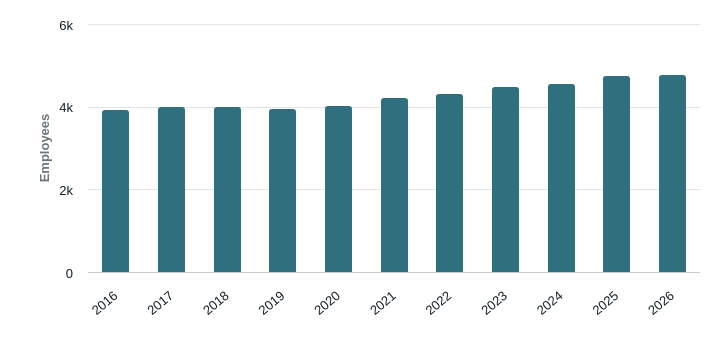
While corporate top-line revenues reflect macroeconomic shifts and fluctuating global seafood commodity prices, local employment has demonstrated consistent upward expansion, reaching an estimated 4,775 jobs by 2026. The municipal economy is anchored by industry giants like Salmar and Måsøval, alongside a highly developed supplier network spanning maritime transport, equipment technology, and industrial packaging.
Key structural highlights include:
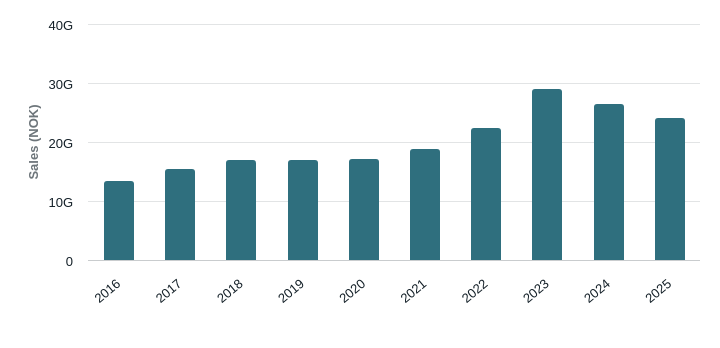
- High Revenue Concentration: Total local corporate sales reached NOK 29.0 billion at their peak in 2023, driven by fish processing and aquaculture.
- Substantial Labor Growth: Total employment grew from 3,927 in 2016 to over 4,700 in 2025/2026.
- Specialized Supply Chain: High demand for marine services, subsea engineering, logistics, and technology integration creates direct opportunities for specialized startups.
Economic Overview
Frøya's corporate turnover reflects the immense scale of its export-driven seafood and maritime industries. Corporate sales peaked at NOK 29.02 billion in 2023 before moderating to NOK 26.37 billion in 2024 and NOK 24.09 billion in 2025, largely due to shifts in global fish prices and ocean farming volumes.
In contrast to cyclical top-line revenues, employment figures in Frøya show uninterrupted long-term growth, reflecting sustained investments in processing infrastructure, service vessels, and technical support.
| Year | Total Sales (NOK) | Sales YoY Change | Total Employees | Employees YoY Change |
|---|---|---|---|---|
| 2016 | 13.38B | - | 3,927 | - |
| 2017 | 15.42B | +15.2% | 3,994 | +1.7% |
| 2018 | 16.96B | +10.0% | 3,988 | -0.2% |
| 2019 | 17.00B | +0.2% | 3,951 | -0.9% |
| 2020 | 17.17B | +1.0% | 4,024 | +1.8% |
| 2021 | 18.77B | +9.3% | 4,218 | +4.8% |
| 2022 | 22.37B | +19.2% | 4,315 | +2.3% |
| 2023 | 29.02B | +29.7% | 4,464 | +3.5% |
| 2024 | 26.37B | -9.1% | 4,543 | +1.8% |
| 2025 | 24.09B | -8.6% | 4,741 | +4.4% |
| 2026 | - | - | 4,775 | +0.7% |
This labor growth highlights Frøya's role as an employment magnet within Trøndelag, drawing both skilled technical workers and industrial labor to the island.
Industry Structure
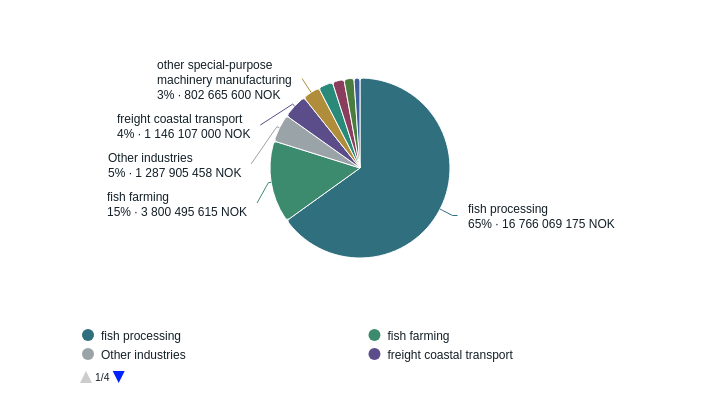
Frøya's industry structure is heavily concentrated in seafood value chains and supporting maritime services. Fish processing and ocean farming together generate the vast majority of local revenue, supported by specialised subsea work, coastal freight, packaging manufacturing, and equipment engineering.
Key Industry Sectors
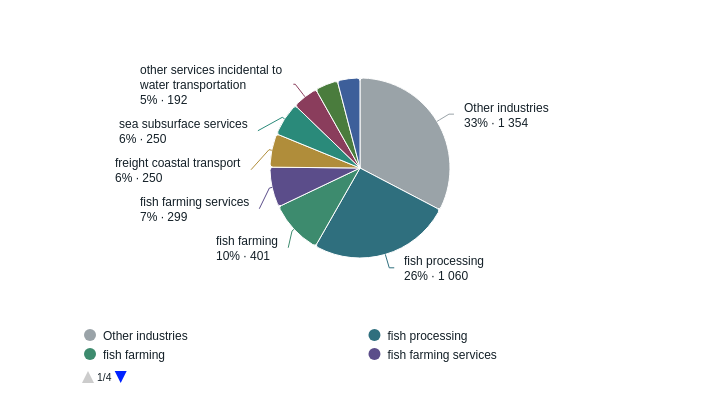
- Fish Processing: Generates NOK 16.79 billion in operating income across 8 companies, employing 1,060 people.
- Fish Farming: Encompasses 13 companies employing 401 people, with operating income of NOK 3.83 billion.
- Fish Farming Services: Fast-growing segment with 7 companies and 299 employees, generating NOK 478.7 million in operating income with a strong 30% EBITDA margin and 20% revenue growth.
- Freight Coastal Transport & Subsea Services: Combined operating income exceeding NOK 1.9 billion across 7 companies employing 500 professionals.
- Specialized Machinery & Packaging: Scale Aquaculture As and Bewi Packaging Norway As drive advanced manufacturing for cages, feed systems, and EPS packaging.
Business Structure by Legal Form
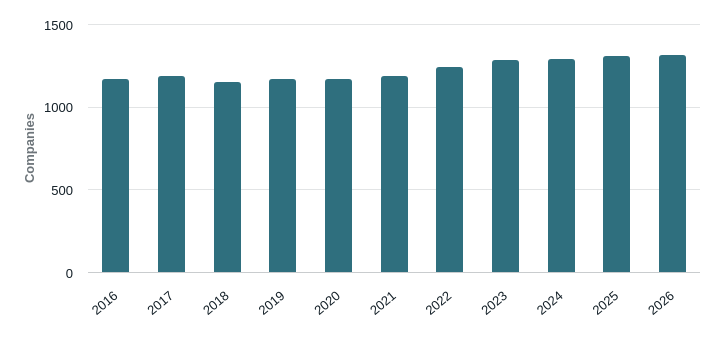
Limited liability companies (Aksjeselskap / AS) dominate the local economy, accounting for 155 active firms, 3,577 employees, and over NOK 26.0 billion in combined operating income. Municipal organizations (Kommune) represent the second-largest employer segment with 31 entities and 1,009 employees in public health, education, and infrastructure.
Business Geography
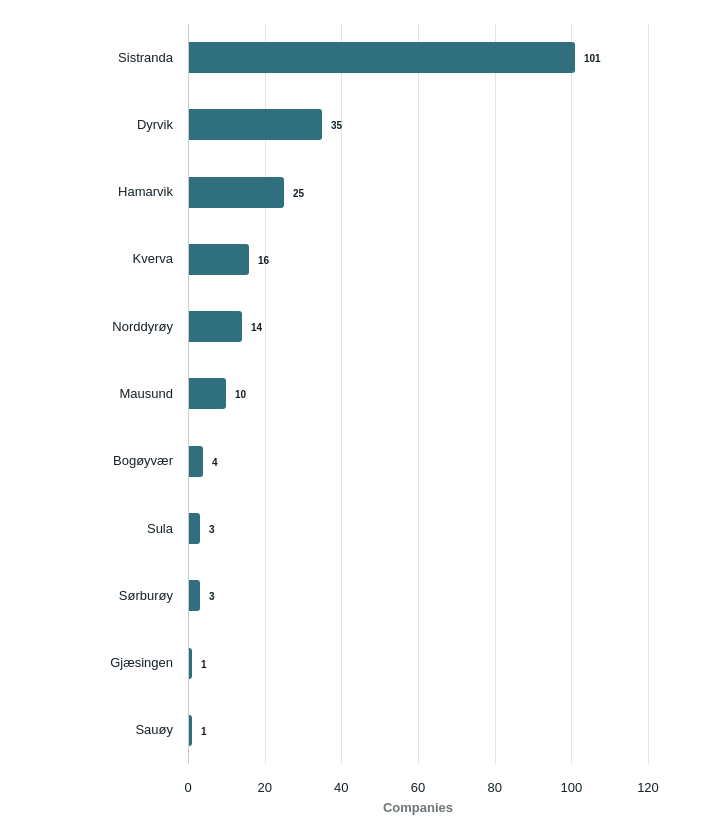
Commercial activity in Frøya is distributed across key coastal villages and industrial hubs, each playing a specialized role in the municipal economy.
| Location | Companies | Employees | Operating Income (NOK) | Key Economic Character |
|---|---|---|---|---|
| Sistranda | 101 | 2,384 | 2,951.2M | Administrative center, maritime service HQ, retail, and public services |
| Kverva | 16 | 1,265 | 19,451.9M | Major industrial hub housing primary processing operations (SalMar) |
| Hamarvik | 25 | 555 | 1,627.1M | Subsea services, maritime support, and industrial packaging |
| Dyrvik | 35 | 440 | 1,884.2M | Coastal shipping logistics and heavy marine transport |
| Norddyrøy | 14 | 119 | 318.6M | Local fishing and maritime operations |
| Mausund | 10 | 60 | 76.2M | Island fishing community with high growth (+110% YoY) |
Sistranda acts as the commercial and service nexus of Frøya, hosting the highest company count and service workforce. Kverva, despite having fewer registered entities, accounts for the overwhelming share of overall revenue due to mega-scale salmon processing facilities.
Largest Employers
The employer landscape in Frøya features global aquaculture leaders, dedicated maritime logistics providers, advanced equipment suppliers, and public sector health and education institutions.
Top Private Sector Employers
| - SalMar AS Avd Bearbeiding (Kverva): 955 employees | NOK 16.26B operating income. Major processing plant for farmed salmon. |
|---|---|
| - Abyss Akvaservice AS Avd Frøya (Hamarvik): 250 employees | NOK 753.0M operating income. Provider of underwater work, inspection, and ocean services. |
| - Frøy Crew AS (Sistranda): 188 employees | NOK 137.5M operating income. Maritime crewing and support services. |
| - Frøy Akvaressurs AS (Sistranda): 159 employees | NOK 451.2M operating income. Wellboat and aquaculture service vessel operations. |
| - Eidsvaag AS (Dyrvik): 133 employees | NOK 950.7M operating income. Major coastal transport company specializing in fish feed delivery. |
| - SalMar Farming AS Avd Frøya (Kverva): 117 employees | NOK 1.94B operating income. Sea-based aquaculture production. |
| - Måsøval Drift AS Avd Frøya (Sistranda): 104 employees | NOK 371.7M operating income. Established salmon farming group. |
| - Scale Aquaculture AS Avd Frøya (Sistranda): 83 employees | NOK 821.3M operating income. Infrastructure and tech supplier for ocean farming. |
| - Bewi Packaging Norway AS Avd Hamarvik: 58 employees | NOK 546.9M operating income. Industrial packaging manufacturer. |
Public Sector Anchorage
Public health and educational services are led by Frøya Kommune Hjemmebaserte Tjenester (145 employees), Frøya Helse og Omsorgssenter (122 employees), and Guri Kunna Videregående Skole (58 employees).
Business Dynamism & Risk Profile
Frøya's business environment exhibits strong stability and resilience, underpinned by long-term capital commitment from major seafood conglomerates. Corporate turnover figures are subject to global commodity pricing and biological cycles, but operating margins in service and logistics niches remain healthy.
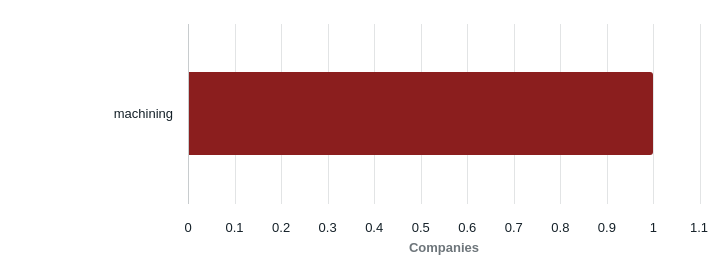
Bankruptcy activity in the municipality is remarkably low. Recent records show only isolated restructuring events, such as Kystteknikk Mechanical AS (machining sector, registered at Dyrvik with NOK 34.5M in revenues prior to liquidation). The broader industrial ecosystem retains high liquidity and strong capital backing, as demonstrated by total equity figures in the private sector exceeding NOK 16.4 billion across local limited companies.
Opportunities for Founders
For entrepreneurs and expanding businesses, Frøya offers a market with high purchasing power and dense technical expertise. Key opportunity areas include:
- Aquaculture Tech & Bio-Economy: Software, sensor tech, autonomous monitoring, and side-stream waste processing for modern salmon farming.
- Maritime Services & Maintenance: Specialist maintenance, net cleaning, electrical engineering, and vessel repair services.
- B2B Professional Services: Financial consulting, recruitment, specialized safety training, and IT infrastructure tailored to maritime industries.
- Local Retail & Hospitality: As the local workforce grows past 4,700 employees, demand for high-quality housing, commercial services, dining, and leisure facilities in Sistranda continues to rise.
Founders evaluating entry into Frøya can use platforms like SmartGrunder to explore commercial addresses, local industry statistics, and market demand across Frøya's distinct commercial hubs.
Conclusion
Frøya stands as an extraordinary export engine within Norway's ocean economy. Driven by world-class processing centers in Kverva and vibrant service hubs in Sistranda, Hamarvik, and Dyrvik, the municipality provides a stable foundation for industrial innovation.
For founders, decision-makers, and investors, Frøya presents a unique environment where startup opportunities are closely linked with international seafood value chains and maritime technology.