Municipality
Gildeskål Business Economy & Market Analysis
An in-depth study of industry dynamics, regional hubs, and entrepreneurial opportunities in Gildeskål
Executive Summary
Gildeskål municipality, situated along the coastal region of Nordland, features an economy powered by aquaculture, marine services, specialized manufacturing, and public health infrastructure. With total corporate sales exceeding NOK 2.5 billion at peak performance, the local economy exhibits remarkable capital intensity and revenue per employee, driven primarily by salmon farming, smolt production, and processing facilities.
While corporate top-line growth is subject to global seafood price fluctuations and biological cycles, employment in the private and public sectors has shown steady stabilization. Key economic pillars include primary aquaculture services, secondary processing, industrial plastic manufacturing tailored for aquaculture, and hydroelectric power generation. For entrepreneurs and local decision-makers, Gildeskål presents an environment characterized by strong marine supply-chain synergies, high value-addition, and distinct sub-regional activity hubs across its mainland and island communities.
Economic Overview
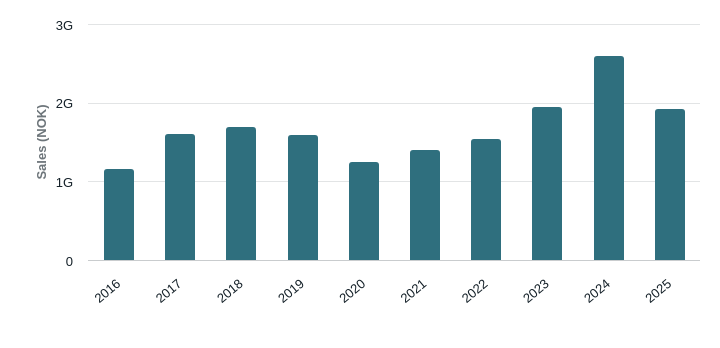
Gildeskål's commercial turnover is substantially driven by export-oriented marine industries. Total corporate revenues rose dramatically from NOK 1.15 billion in 2016 to a peak of NOK 2.59 billion in 2024, before adjusting to NOK 1.92 billion in 2025 due to market recalibrations in seafood prices and production volumes.
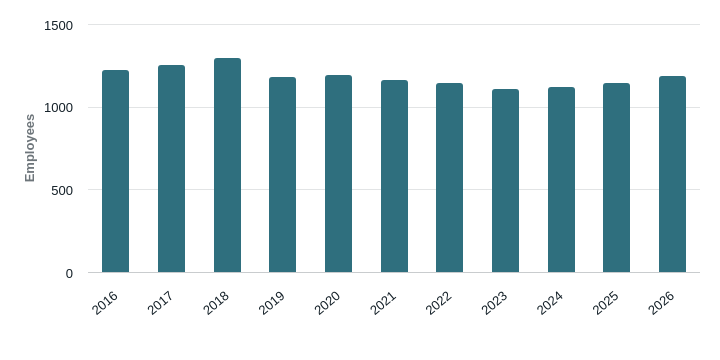
Employment dynamics reflect a resilient local workforce. After reaching 1,294 registered employees in 2018, workforce numbers settled into a stable corridor and are projected to grow steadily through 2026, supported by investments in aquaculture infrastructure and municipal services.
| Year | Corporate Revenue (NOK) | Revenue YoY Change | Registered Employees | Employees YoY Change |
|---|---|---|---|---|
| 2016 | 1,155.3M | — | 1,224 | — |
| 2017 | 1,596.6M | +38.2% | 1,252 | +2.3% |
| 2018 | 1,696.6M | +6.3% | 1,294 | +3.4% |
| 2019 | 1,591.4M | -6.2% | 1,179 | -8.9% |
| 2020 | 1,246.0M | -21.7% | 1,192 | +1.1% |
| 2021 | 1,393.4M | +11.8% | 1,161 | -2.6% |
| 2022 | 1,537.9M | +10.4% | 1,142 | -1.6% |
| 2023 | 1,943.1M | +26.3% | 1,107 | -3.1% |
| 2024 | 2,591.6M | +33.4% | 1,120 | +1.2% |
| 2025 | 1,920.0M | -25.9% | 1,141 | +1.9% |
| 2026 | 1,980.0M (est.) | +3.1% (est.) | 1,185 | +3.9% |
Note: Figures for 2026 revenue represent analytical projections based on baseline employment expansion assumptions.
Industry Structure & Legal Forms
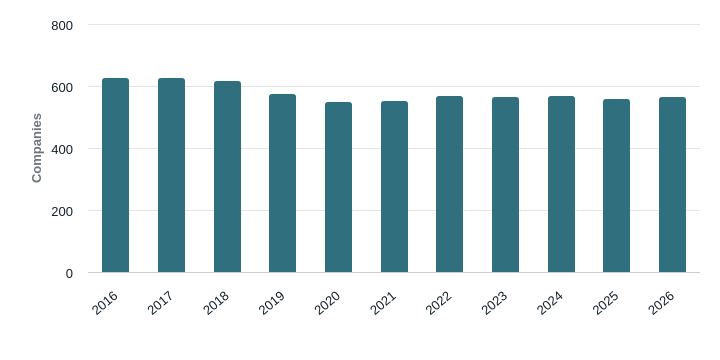
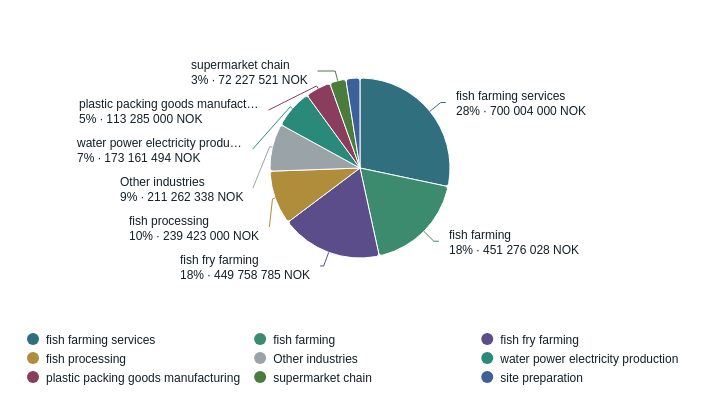
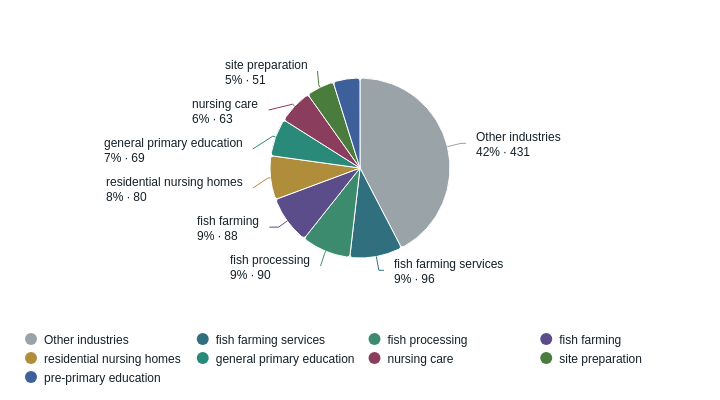
The private sector economy in Gildeskål is dominated by aquaculture value-chain segments, which generate extraordinarily high operating revenue per employee. Fish fry farming (smolt production) generates NOK 455.3 million across 33 employees, achieving an EBITDA margin of 52%. Fish farming services and fish processing generate combined operating revenues exceeding NOK 950 million and employ nearly 190 workers.
Industrial diversification is present in plastic packaging manufacturing—producing tanks and piping primarily for aquaculture—and hydroelectric power generation, which delivered NOK 181.5 million in revenue with a 46% EBITDA margin.
| Industry Sector | Companies | Employees | Operating Income (NOK) | EBITDA Margin |
|---|---|---|---|---|
| Fish Farming Services | 1 | 96 | 711.4M | 22% |
| Fish Processing | 1 | 90 | 243.9M | 11% |
| Fish Farming | 5 | 88 | 452.5M | 12% |
| Site Preparation & Contracting | 5 | 51 | 63.4M | 14% |
| Plastic Packing Manufacturing | 1 | 43 | 133.8M | 5% |
| Fish Fry Farming (Smolt) | 1 | 33 | 455.3M | 52% |
| Water Power Electricity | 1 | 18 | 181.5M | 46% |
| Supermarket Chains & Retail | 5 | 36 | 88.9M | 4-6% |
Corporate Ownership Structure
Limited liability companies (AS) account for 59 entities, 591 employees, and NOK 2.43 billion in operating income, representing the vast majority of commercial output. Municipal entities (KOMM) employ 390 workers in healthcare, education, and administrative services.
Business Geography & Regional Clusters
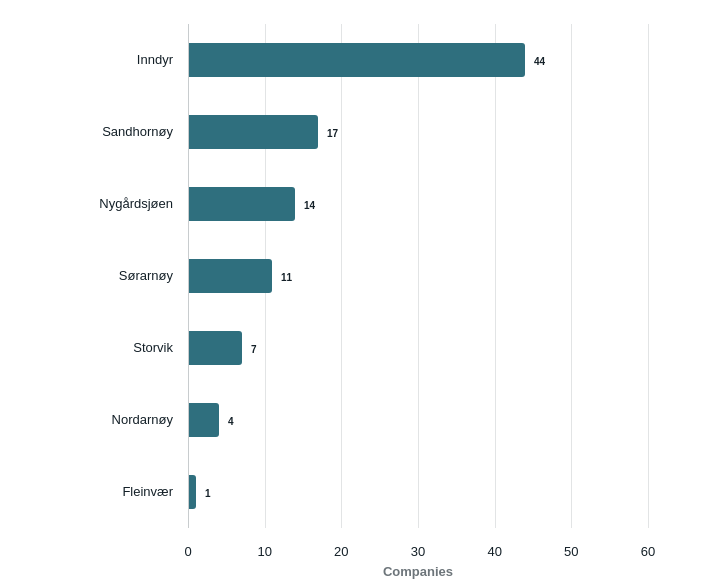
Gildeskål's economic geographic structure spans the administrative center on the mainland and several active island communities linked by ferry and bridge networks.
| Place / Location | Companies | Registered Employees | Operating Income (NOK) | EBITDA Margin |
|---|---|---|---|---|
| Inndyr | 44 | 731 | 1,028.6M | 17% |
| Nygårdsjøen | 14 | 138 | 1,017.0M | 36% |
| Sørarnøy | 11 | 144 | 270.5M | 11% |
| Nordarnøy | 4 | 35 | 194.3M | 10% |
| Sandhornøy | 17 | 114 | 50.1M | 10% |
| Storvik | 7 | 35 | 32.8M | 2% |
| Fleinvær | 1 | 5 | 2.2M | 0% |
- Inndyr: Serves as the municipal seat and administrative hub, hosting commercial services, secondary education, health administration, plastic packaging production, and marine research services.
- Nygårdsjøen: Driven by industrial smolt production (Helgeland Smolt AS in Sundsfjord) and farming enterprises (Organic Seafarm AS), yielding the highest profit margins in the municipality.
- Sørarnøy & Nordarnøy: Key centers for fish processing (Salten N950 AS) and coastal tourism/hospitality (Arnøy Brygge AS).
- Sandhornøy: A mix of primary aquaculture sites (Mowi Avd Gildeskål) and local trade, agriculture, and contractor services.
Largest Employers
The employer landscape in Gildeskål consists of major industrial seafood operations, municipal service divisions, and specialized technical providers.
Key Commercial & Public Employers
- Gildeskål Forskningsstasjon AS (Avd Øya, Inndyr): 96 employees; NOK 711.4M operating income. Leading marine research and experimental aquaculture station.
- Salten N950 AS (Sørarnøy): 90 employees; NOK 243.9M operating income. Modern salmon harvesting and processing plant.
- Gildeskål Kommune (Bo & Servicesenter / Hjemmebaserte Tjenester): 143 combined employees across residential nursing and home-based care.
- Mowi AS (Avd Gildeskål, Sandhornøy): 47 employees. Production facilities for global seafood leader Mowi.
- Nordlandssykehuset HF (Ambulanse Inndyr): 47 employees; NOK 40.9M operating income. Regional emergency health response unit.
- Polarplast AS (Inndyr): 43 employees; NOK 133.8M operating income. Manufacturer of heavy plastic products for marine industries.
- Helgeland Smolt AS (Avd Sundsfjord, Nygårdsjøen): 33 employees; NOK 455.3M operating income; NOK 237.2M EBITDA. High-tech smolt facility.
- Arnøy Brygge AS (Nordarnøy): 20 employees; NOK 12.0M operating income. Premium coastal resort, fishing, and hospitality operator.
- Organic Seafarm AS (Nygårdsjøen): 18 employees; NOK 276.2M operating income. Specialized organic salmon production enterprise.
Business Dynamism & Market Stability
Gildeskål exhibits high operational stability with relatively low corporate default rates. The corporate landscape is anchored by mature, heavily capitalized companies with high equity bases, particularly in aquaculture and energy infrastructure.
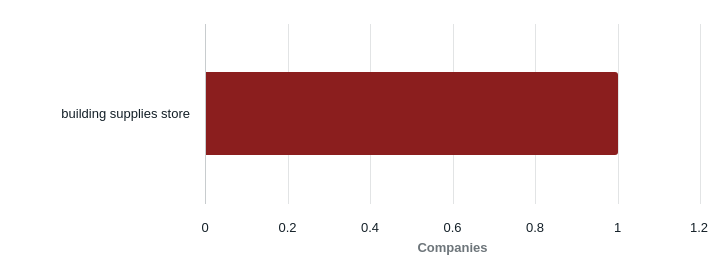
Recent bankruptcy data shows minimal distress across the local economy. A single corporate bankruptcy was recorded in the retail building supply sector (Bo Teknikk AS in Inndyr, operating income NOK 7.3M), with no recorded impact on wider industrial employment.
The overall low frequency of business defaults underscores the stability provided by long-term industrial anchors. However, new market entrants must plan carefully for supply chain logistics, transport connections, and workforce housing when establishing operations in island locations.
Opportunities for Founders & Investors
The structural profile of Gildeskål reveals several strategic niches for new businesses and expanding firms:
- Aquaculture Supply Chain & Technical Services: With over NOK 1.5 billion generated in local seafood activity, founders in maritime maintenance, automation, sensor technology, and net cleaning services find an established client base.
- Coastal Tourism & Eco-Hospitality: Driven by successful operators like Arnøy Brygge AS, there is growing demand for eco-tourism, sea kayaking, guided outdoor sports, and high-end dining experiences aimed at international travelers.
- Craft Trades & Commercial Contracting: Site preparation, electrical engineering, plumbing, and building maintenance services remain essential for supporting both industrial expansions and residential maintenance across mainland and island settlements.
- Green Energy & Circular Economy: Opportunities exist in handling organic byproducts, plastic waste recycling from farming equipment, and secondary maritime services.
Founders evaluating prospective business locations, zoning regulations, and local industry statistics across Gildeskål can softly explore platforms like SmartGrunder to identify suitable addresses and targeted market opportunities.
Conclusion
Gildeskål municipality offers an exceptional balance between high-value primary industry output and tight-knit community infrastructure. Driven by aquaculture giants, specialized manufacturing, and clean energy production, the region generates substantial economic output relative to its population size.
For entrepreneurs, local decision-makers, and investors, Gildeskål presents a fertile environment characterized by strong corporate balance sheets, low default rates, and clear growth vectors in marine services, eco-tourism, and industrial contracting.