Municipality
Gjesdal Municipal Economic Analysis
An in-depth evaluation of Gjesdal's industrial composition, employment dynamics, geographic centers, and enterprise opportunities
Executive Summary
Gjesdal, located in Rogaland county, stands as a strategic logistics, manufacturing, and commercial corridor serving both the Stavanger/Sandnes metropolitan region and internal southwest Norway. With a strong blend of private enterprise and municipal services, Gjesdal maintains a resilient local economy driven by major wholesale logistics, industrial manufacturing, food production, and regional tourism.
Key structural highlights of Gjesdal's economy include:
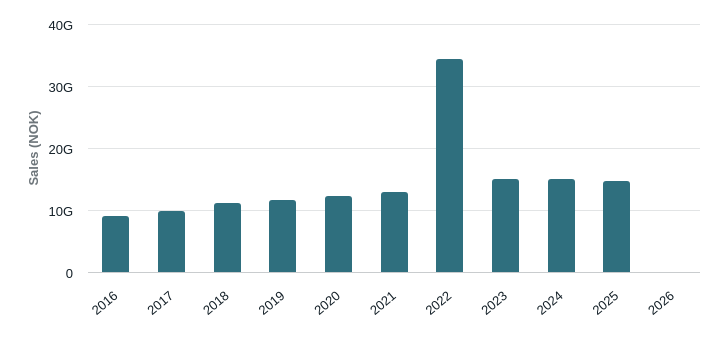
- High Commercial Revenue Base: Generating nearly NOK 15 billion in annual sales, driven heavily by wholesale distribution and food processing clusters.
- Dominant Business Hub: Ålgård serves as the primary economic engine, housing over 90% of local employment and corporate revenue.
- Anchors in Manufacturing & Logistics: Key enterprises such as Asko Rogaland As, Jæder As, and Gilje Tre As anchor supply chains across southern Norway.
- Stable Employment: Total municipal employment remains firm at over 6,400 to 6,700 jobs across public and private sectors.
Economic Overview
The economic trajectory of Gjesdal over the past decade demonstrates steady expansion in both overall sales revenues and total employment, reflecting its position as an attractive region for industrial investments and workforce settlement.
Annual sales revenue rose from NOK 9,014.1M in 2016 to NOK 14,970.3M in 2023 and NOK 14,967.8M in 2024. A notable anomaly occurred in 2022, where total reported annual sales spiked to NOK 34,364.9M, largely reflecting transient market adjustments or intra-group financial consolidated reporting before stabilizing back to the ~NOK 14.6B–15.0B baseline in 2023–2025.
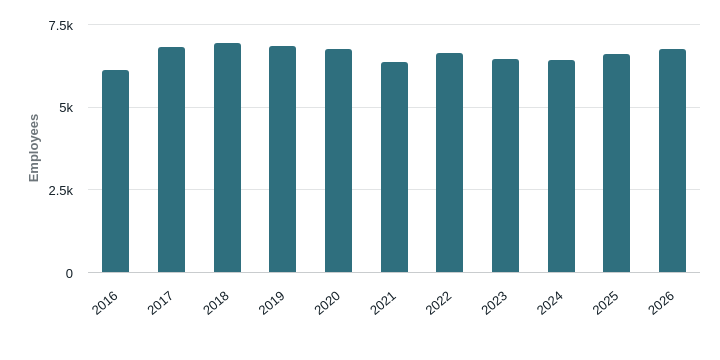
Employment levels have experienced measured growth, climbing from 6,110 workers in 2016 to 6,417 in 2024, with projections extending to 6,753 by 2026.
| Year | Total Sales Revenue (NOK) | YoY Sales Change | Total Employees | YoY Employee Change |
|---|---|---|---|---|
| 2016 | 9,014.1M | Baseline | 6,110 | Baseline |
| 2018 | 11,178.0M | +13.6% | 6,912 | +1.5% |
| 2020 | 12,338.3M | +6.0% | 6,738 | -1.2% |
| 2022 | 34,364.9M | +165.8% | 6,634 | +4.2% |
| 2023 | 14,970.3M | -56.4% | 6,447 | -2.8% |
| 2024 | 14,967.8M | -0.0% | 6,417 | -0.5% |
| 2025 | 14,643.8M | -2.2% | 6,590 | +2.7% |
Industry Structure
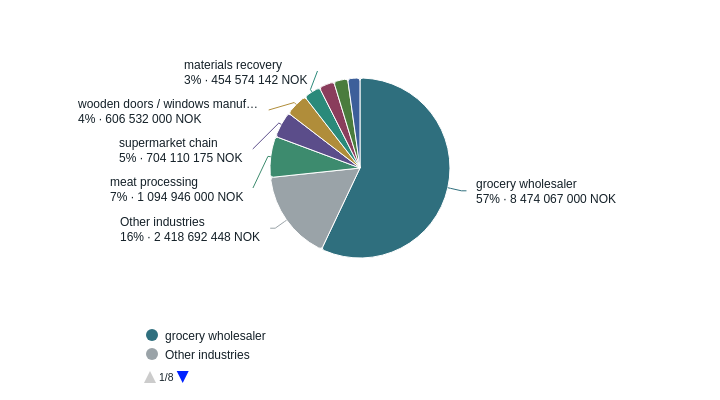
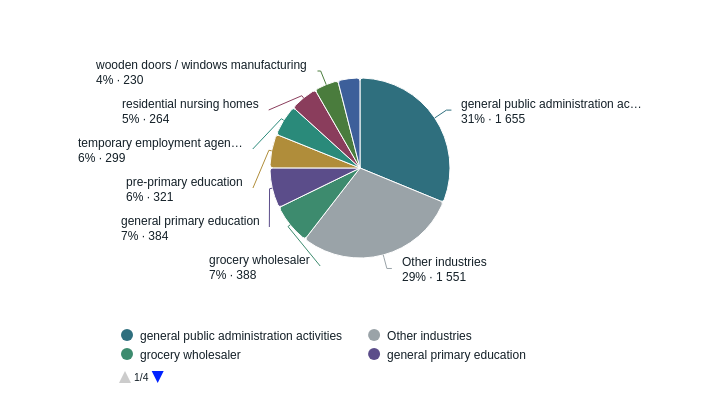
Gjesdal displays a highly specialized industrial profile where wholesale distribution and meat processing generate the vast majority of private sector revenue, while municipal administration and education account for large headcount shares.
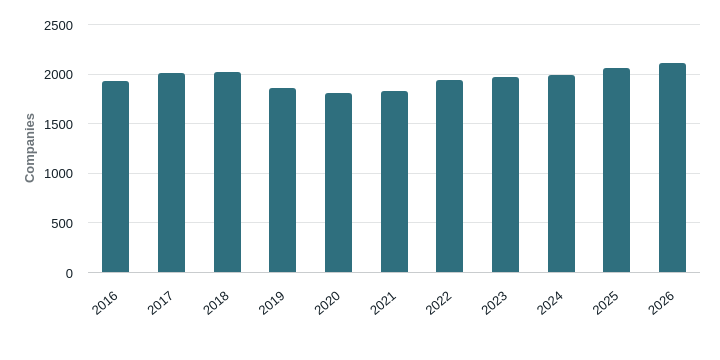
According to legal organization statistics, limited liability companies (AS) represent the overwhelming majority of commercial output, with 262 active AS entities accounting for NOK 15,710.9M in operating income and 3,405 employees. Cooperative forms (SA) also play an important role with 7 entities generating NOK 422.2M in operating income.
| Industry Sector | Companies | Employees | Operating Income (NOK) | EBITDA (NOK) | EBITDA Margin |
|---|---|---|---|---|---|
| Grocery Wholesaler | 4 | 388 | 8,519.3M | 152.6M | 1% |
| Meat Processing | 1 | 152 | 1,094.9M | 69.8M | 6% |
| Wooden Doors / Windows Mfg | 3 | 230 | 609.1M | 29.5M | 4% |
| Supermarket Chain | 8 | 209 | 716.9M | 21.4M | 2% |
| Printing | 1 | 68 | 324.7M | 26.6M | 8% |
| Clothing Wholesaler | 2 | 61 | 204.8M | 6.5M | 3% |
| Specialised Construction | 7 | 149 | 202.8M | 27.5M | 13% |
Business Geography
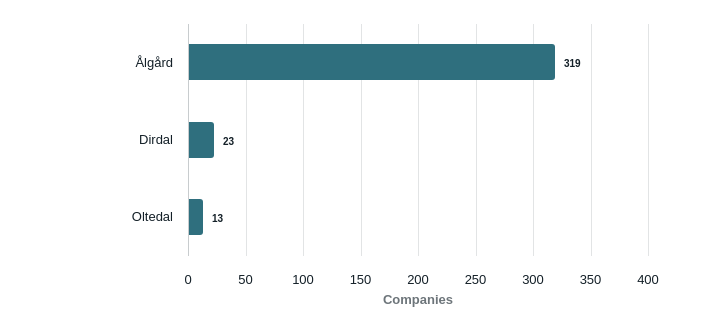
Economic activity within Gjesdal municipality is distributed across three main primary geographical areas: Ålgård, Dirdal, and Oltedal. Each area possesses distinct economic characteristics and industrial profiles.
- Ålgård: The commercial heart of the municipality. Situated along the E39 highway corridor, Ålgård hosts major logistics hubs (Skurve), commercial centers, regional tourist destinations (Kongeparken), and municipal headquarters.
- Dirdal: A specialized manufacturing hub in eastern Gjesdal, heavily defined by industrial building component manufacturing.
- Oltedal: A specialized district featuring light industry, hydropower-adjacent activities, and local service providers exhibiting strong profit margins.
| Place | Companies | Employees | Operating Income (NOK) | Sales Revenue (NOK) | Operating Margin |
|---|---|---|---|---|---|
| Ålgård | 319 | 6,410 | 14,494.5M | 14,268.4M | 2% |
| Dirdal | 23 | 475 | 1,208.4M | 1,105.6M | 0% |
| Oltedal | 13 | 182 | 572.4M | 570.8M | 7% |
Largest Employers
Gjesdal hosts several major industrial operators and municipal organizations that provide solid local workforce opportunities. Public sector employment is led by Gjesdal Kommune itself across administration, schools, and healthcare facilities.
Top private and public employers operating in Gjesdal include:
- Gjesdal Kommune: Primary public administrative employer with 1,615 staff across municipal management and public services.
- Asko Rogaland As: Major wholesale grocery distributor located at Skurvemarka in Ålgård, employing 372 people with operating revenues of NOK 8,367.1M.
- Kongeparken Drift As: Seasonal and regional recreation operator employing 299 people.
- Gilje Tre As: Door and window manufacturer located in Dirdal, employing 198 workers with operating income of NOK 543.6M.
- Jæder As: High-volume meat processing facility based in Ålgård, employing 152 staff with NOK 1,094.9M in operating revenue and NOK 69.8M in EBITDA.
- Åboas Omsorgsboliger & Solås Bo Og Rehabiliteringssenter: Municipal care units employing 129 and 106 staff members, respectively.
- Ålgård Offset As: Commercial printing enterprise employing 68 people with operating revenues of NOK 324.7M.
Business Dynamism & Risk
Gjesdal exhibits a remarkably stable business environment characterized by low bankruptcy rates relative to overall commercial volume. Recorded bankruptcy activity shows isolated instances across small service and sub-contracting operations rather than systemic distress in core export industries.
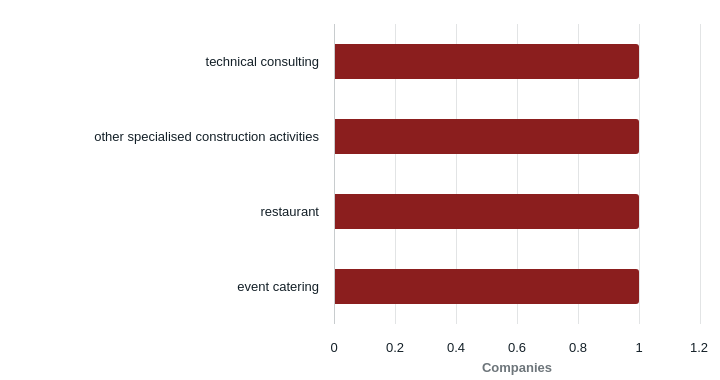
Recent bankruptcy data reflects 4 reported insolvencies in the municipality:
- Ef Betong As: Specialised construction activities with NOK 7.1M in revenue prior to filing.
- Mims Well As: Technical consulting with NOK 1.4M operating income.
- Skurvetunet As: Event catering facility with NOK 2.7M in operating revenue.
- Restaurantdrift Ålgård As: Local food service establishment with no active operations.
The minimal bankruptcy footprint underlines the financial resilience of local companies, particularly those linked to national grocery logistics, food processing, and specialized building components.
Opportunities for Founders
For entrepreneurs and expanding businesses, Gjesdal provides strategic geographical access to the broader Stavanger/Sandnes market without the urban real estate congestion. Key opportunities for new ventures include:
- Logistics & B2B Services: Capitalizing on the Skurve industrial park development along E39 to supply heavy transport maintenance, warehousing solutions, and technical servicing.
- Food Technology & Supply Chain Solutions: Building ancillary services around established food giants like Jæder As and Asko Rogaland As.
- Craft Trades & Construction Services: High demand for specialized sub-contractors, installation specialists, and facility maintenance teams.
- Commercial Services & Hospitality: Expanding niche food, leisure, and consumer service concepts in Ålgård to serve the growing residential population.
Founders evaluating location options, local site availability, and industry positioning in Gjesdal can leverage SmartGrunder to explore specific local addresses, property categories, and industry dynamics.
Conclusion
Gjesdal represents a powerhouse municipal economy in interior Rogaland. Supported by unmatched wholesale logistics infrastructure in Ålgård and established manufacturing roots in Dirdal and Oltedal, the municipality provides a balanced foundation of corporate anchors and growing residential communities.
With annual private sector turnover approaching NOK 15 billion and high employment stability, local decision-makers and incoming entrepreneurs benefit from a solid infrastructure base, strong industrial clusters, and strategic growth opportunities along major transport routes.