Municipality
Economic Landscape and Business Opportunities in Grong Municipality
An analytical report on industry composition, workforce dynamics, and strategic potential for entrepreneurs and local leaders
Executive Summary
Grong serves as a vital regional service hub in the Namdalen region of Trøndelag. Its economy combines a strong public sector base, highly profitable local financial and energy institutions, agricultural cooperatives, and key highway transit services along the E6 corridor.
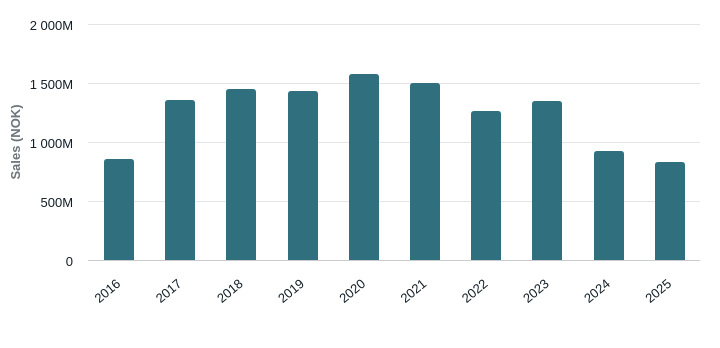
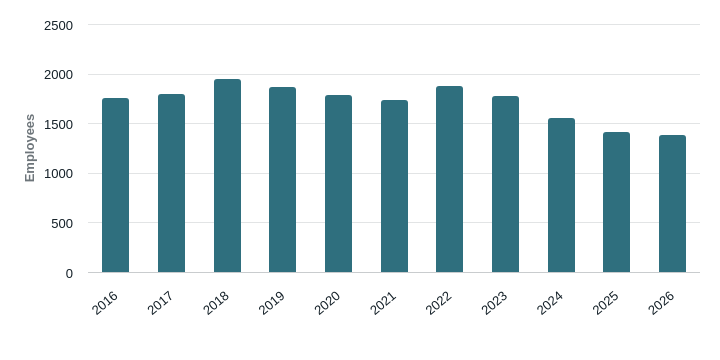
Recent financial data reflects a total business sales output of approximately NOK 829.6 million in 2025, down from a peak of NOK 1.58 billion in 2020. Local employment spans roughly 1,379 to 1,414 active positions, anchored heavily by primary education, municipal care, financial services, and agricultural management.
Key economic pillars in Grong include:
- Financial & Professional Services: Anchored by Grong Sparebank Hovedkontor, which generates high margins and provides substantial capital depth.
- Hydropower & Energy: Water power production exhibits strong profitability, generating over NOK 315 million in operating income across local assets.
- Agricultural & Forestry Support: Led by Namdal Landbrukstjenester SA, employing 183 workers across the region.
- Hospitality & Transport: Facilities like Grong Hotell AS and Heia Gjestegård AS capitalize on the municipality's position along national transportation routes.
Economic Overview & Historical Trends
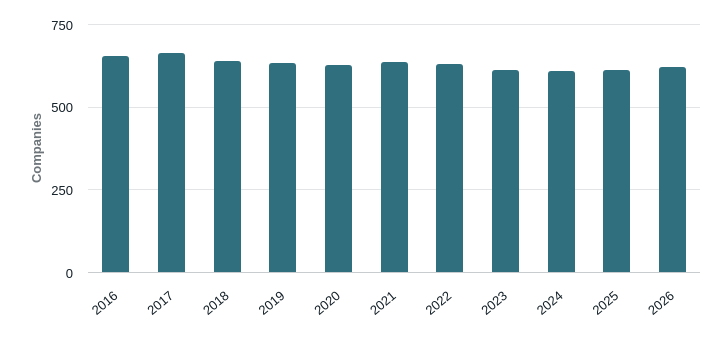
Over the past decade, Grong's commercial revenue and workforce figures have undergone significant realignment. Total local corporate turnover peaked in 2020 at NOK 1.58 billion before experiencing multi-year declines, settling at NOK 829.6 million in 2025. Employment numbers followed a similar downward shift from a peak of 1,948 employees in 2018 to 1,379 employees projected in 2026.
The table below details the year-over-year progression of registered business sales and workforce levels in Grong:
| Year | Total Sales Revenue (NOK) | Sales YoY Change | Total Employees | Employees YoY Change |
|---|---|---|---|---|
| 2016 | 860.2M | — | 1,754 | — |
| 2017 | 1,353.1M | +57.3% | 1,794 | +2.3% |
| 2018 | 1,447.2M | +7.0% | 1,948 | +8.6% |
| 2019 | 1,428.1M | -1.3% | 1,867 | -4.2% |
| 2020 | 1,577.3M | +10.4% | 1,784 | -4.4% |
| 2021 | 1,500.8M | -4.8% | 1,734 | -2.8% |
| 2022 | 1,263.3M | -15.8% | 1,871 | +7.9% |
| 2023 | 1,350.6M | +6.9% | 1,778 | -5.0% |
| 2024 | 920.3M | -31.9% | 1,555 | -12.5% |
| 2025 | 829.6M | -9.9% | 1,414 | -9.1% |
| 2026 | — | — | 1,379 | -2.5% |
This trend reflects broader structural consolidations in regional service delivery and macroeconomic adjustments across rural commerce. Nevertheless, high-margin sectors like energy and financial intermediation maintain a robust foundation for local economic resilience.
Industry Structure & Legal Forms
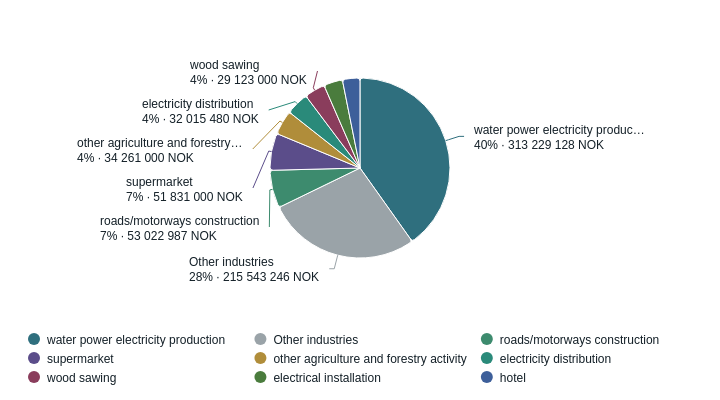
Grong's industrial landscape is divided between public administration/welfare functions, high-value specialized enterprises, and primary industry cooperatives.
Top Performing Industry Sectors
- Water Power Electricity Production: Generates NOK 315.2 million in operating income across 2 listed companies with 16 employees, yielding an operating profit of NOK 55.7 million and an EBITDA margin of 24%.
- Monetary Intermediation: Led by local banking institutions, generating NOK 217.7 million in operating income, employing 59 people, and achieving an impressive EBITDA margin of 54%.
- Agriculture & Forestry Services: Employing 185 workers across 2 entities, producing NOK 34.6 million in operating income.
- Hospitality & Lodging: Hotels and camping sites employ over 80 people across 5 facilities, bringing in over NOK 33 million in combined revenue.
- Construction & Electrical Installation: 8 local companies employ nearly 40 skilled workers, contributing NOK 40.4 million in combined income.
Distribution by Legal Structure
| Legal Form | Number of Entities | Total Employees | Key Revenue / Operating Income (NOK) | Profitability & Margin Notes |
|---|---|---|---|---|
| Komm (Municipal Units) | 25 | 552 | Public budget funded | Key employer in healthcare & schooling |
| AS (Limited Company) | 59 | 415 | 770.2M Operating Income | 17% EBITDA margin (131.1M EBITDA) |
| SA (Cooperative) | 4 | 193 | 34.6M Operating Income | Agriculture & forestry services focus |
| Spa (Savings Bank) | 2 | 59 | 217.7M Operating Income | 54% EBITDA margin (118.2M EBITDA) |
| Orgl / Anna / SF / Sti | 7 | 161 | Various | Schools, foundations, railway infrastructure |
| Enk (Sole Proprietorship) | 8 | 18 | Non-disclosed | Micro-enterprises and local trades |
Business Geography & Regional Clusters
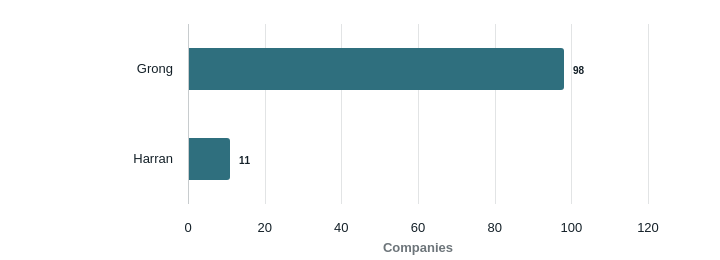
Commercial and civic activity within Grong municipality is concentrated primarily in two key geographic zones: the administrative center of Grong and the northern settlement of Harran.
| Location / Place | Active Companies | Total Employees | Operating Income (NOK) | Sales Revenue (NOK) | Operating Profit (NOK) | EBITDA Margin |
|---|---|---|---|---|---|---|
| Grong (Center) | 98 | 1,355 | 1,038.7M | 801.0M | 198.6M | 23% |
| Harran | 11 | 77 | 22.0M | 21.1M | 2.1M | 13% |
Spatial Characteristics
- Grong Center (Mediå/Sundspetvegen): Serves as the principal financial, educational, and commercial core. It houses Grong Sparebank, regional upper secondary education, municipal administration, and primary retail outlets.
- Harran: Functions as a localized hub along the E6 corridor, maintaining specialized agricultural, primary education, and local service activities.
Largest Employers
Employment in Grong is anchored by municipal welfare institutions, regional education facilities, financial institutions, and agricultural cooperatives.
Key Employers in the Municipality
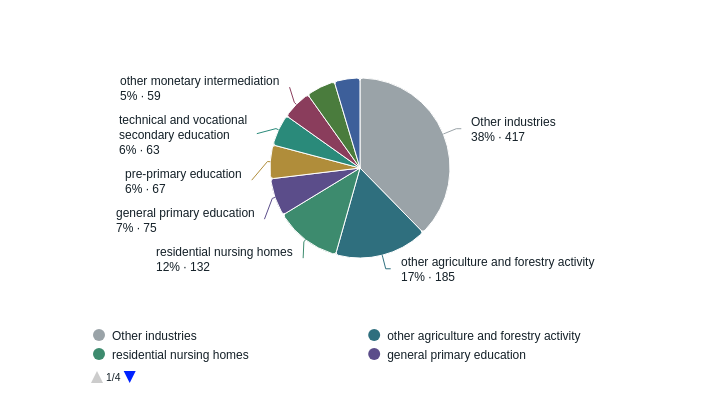
- Namdal Landbrukstjenester SA: 183 employees (Agriculture and forestry support services).
- Grong Sykeheim: 132 employees (Municipal nursing care facility).
- Grong Videregående Skole: 63 employees (Technical and vocational secondary education).
- Grong Barne Og Ungdomsskole: 59 employees (General primary education).
- Grong Sparebank Hovedkontor: 57 employees (Regional financial services, NOK 205.5M operating income).
- Grong Kommune Avd. Funksjonshemmede: 51 employees (Municipal care services).
- Namdal Brann Og Redningsvesen: 48 employees (Inter-municipal fire and rescue service).
- Indre Namdal Legetjeneste: 35 employees (General medical practice KO).
- Bane NOR Grong: 32 employees (State railway infrastructure operations).
- Grong Kommune Hjemmesykepleie: 32 employees (Home nursing services).
- Heia Gjestegård AS: 25 employees (Hotel and dining services along E6, NOK 6.3M operating income).
- Rønningen Barnehage: 25 employees (Pre-primary education).
- Grong Hotell AS: 22 employees (Hospitality services, NOK 14.5M operating income).
- Comfort Bjørn Seem AS: 21 employees (Technical consulting and trade services).
Business Dynamism & Market Stability
Grong displays remarkable corporate stability. Bankruptcy statistics show very low default rates, reflecting a resilient enterprise community dominated by established regional institutions.
Bankruptcy Overview
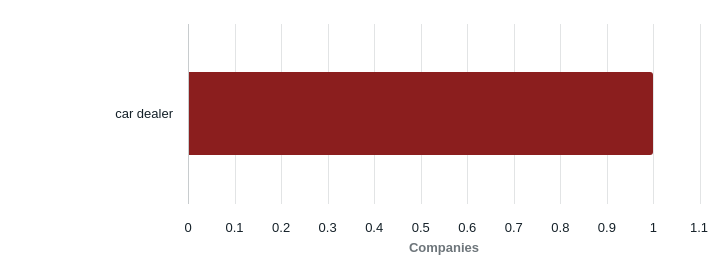
- Total Bankruptcies Recorded: 1 company (Grong Autosalg AS, car retail sector, registering NOK 23.0M in sales prior to closure).
- Market Impact: Low insolvency rates demonstrate that local businesses operate with conservative balance sheets and stable customer bases.
While the low rate of failure points to economic security, the ongoing contraction in overall employee headcount emphasizes the need for new business creation to replace retiring workforce capacity and diversify the private sector.
Opportunities for Founders & Investors
Despite workforce consolidation, Grong offers several targeted entry points for founders seeking established customer flows and regional infrastructure.
Strategic Growth Avenues
- E6 Highway & Tourism Services: Grong's location makes it a natural rest stop and regional hub. Opportunities exist in modern EV infrastructure, specialized food and beverage, outdoors tourism, and upgraded lodging amenities.
- Technical & Renewable Energy Contracting: With substantial hydropower generation assets (NOK 315M income) and infrastructure operations like Bane NOR, specialized technical, electrical, and engineering consulting services remain in high demand.
- Agri-Tech & Forestry Innovation: Building upon the presence of Namdal Landbrukstjenester SA (183 employees), entrepreneurs can introduce automation, bio-economy solutions, and equipment maintenance services.
- B2B Commercial & Professional Services: Strong local financial institutions like Grong Sparebank create a favorable environment for professional services, IT support, and business consultancy.
Founders looking to explore available commercial addresses, industry sub-segments, and market entry points in Grong can utilize SmartGrunder to analyze local market dynamics and pinpoint emerging business locations.
Conclusion
Grong municipality possesses a stable economic base backed by strong financial institutions, robust renewable energy generation, and indispensable public service headquarters.
For entrepreneurs and investors, Grong offers a dependable environment with low bankruptcy risk, established transportation connectivity, and strong institutional capital. By tapping into regional trade flows along the E6 and delivering specialized technical or tourism services, new ventures can find a sustainable home in this Namdalen hub.