Municipality
Economic Landscape and Entrepreneurial Opportunities in Grue Municipality
An in-depth analysis of industry structure, employment trends, geography, and enterprise dynamics in Grue, Innlandet
Executive Summary
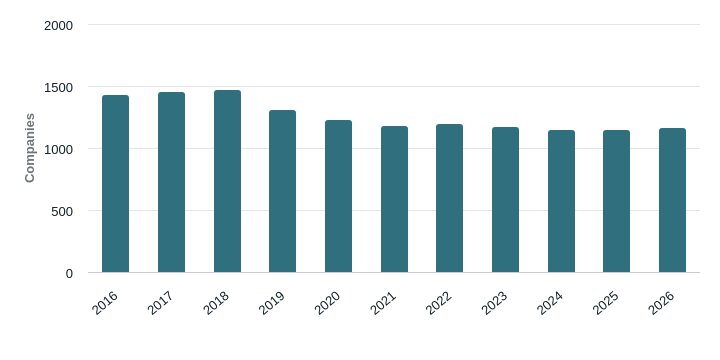
Grue municipality, situated in the traditional district of Solør in Innlandet county, presents a distinct economic profile characterized by a robust public and healthcare sector combined with high-value industrial and agricultural activities. With an estimated workplace population supporting around 2,800 to 2,900 employees across 1,170 registered business units, Grue functions as a key regional center for wood processing, specialized machinery supply, post-harvest crop processing, and health services.
The commercial heart of the municipality is concentrated in Kirkenær, which generates over NOK 1.5 billion in operating income, supplemented by high-revenue industrial pockets in Grinder and tourism asset clusters in Grue Finnskog. While overall corporate turnover experienced a cyclical adjustment in 2024–2025 following peak performance in 2021–2022, Grue maintains solid institutional stability and strong equity foundations among its major enterprise players.
Economic Overview
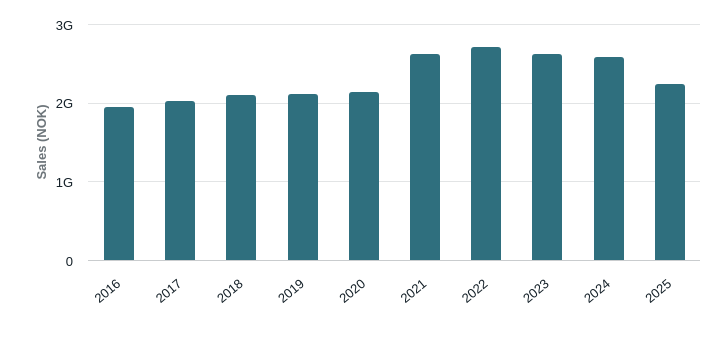
An analysis of year-over-year revenue and employment figures highlights both the growth spurts and macroeconomic realities affecting Grue over the past decade. Between 2016 and 2022, total business sales in Grue expanded from NOK 1.95 billion to a peak of NOK 2.70 billion, representing an overall turnover growth of nearly 38.6%. A significant surge occurred in 2021 (+23.2% YoY), driven by favorable market conditions in timber, agriculture, and machinery trade.
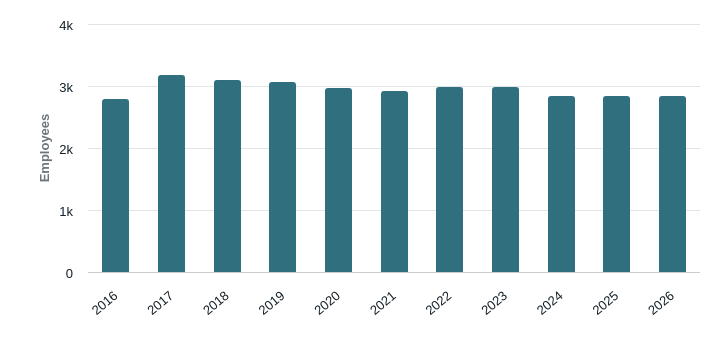
Following the peak in 2022, commercial revenues entered a period of correction, adjusting to NOK 2.59 billion in 2024 and projected at NOK 2.24 billion for 2025. Employment numbers have displayed strong structural resilience, moving from 2,797 employees in 2016 to a peak of 3,172 in 2017, and remaining exceptionally steady around 2,830 to 2,850 jobs between 2024 and 2026.
| Year | Total Sales (NOK) | Sales YoY Growth | Total Employees | Employees YoY Growth |
|---|---|---|---|---|
| 2016 | 1,950.0M | — | 2,797 | — |
| 2017 | 2,023.2M | +3.8% | 3,172 | +13.4% |
| 2018 | 2,102.4M | +3.9% | 3,091 | -2.6% |
| 2019 | 2,112.9M | +0.5% | 3,058 | -1.1% |
| 2020 | 2,129.8M | +0.8% | 2,970 | -2.9% |
| 2021 | 2,624.5M | +23.2% | 2,925 | -1.5% |
| 2022 | 2,702.2M | +3.0% | 2,979 | +1.8% |
| 2023 | 2,621.5M | -3.0% | 2,986 | +0.2% |
| 2024 | 2,586.6M | -1.3% | 2,845 | -4.7% |
| 2025 | 2,242.8M | -13.3% | 2,834 | -0.4% |
| 2026 | — | — | 2,842 | +0.3% |
Industry Structure & Organizational Forms
Grue's economy features a strong structural dualism: the public sector and state/municipal welfare services provide high employment volume, while private commercial firms generate heavy top-line turnover.
Sectoral Breakdown
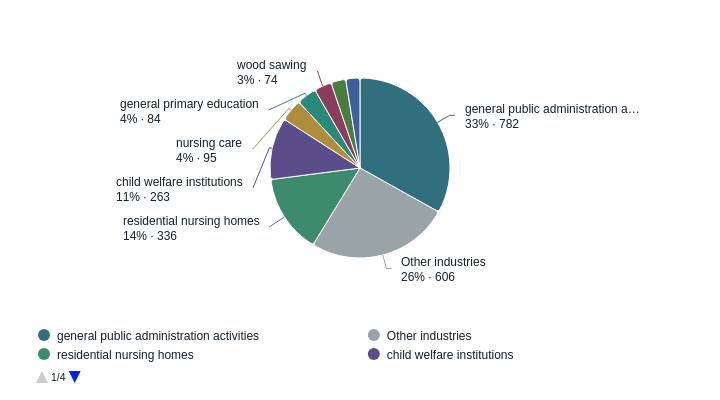
- Public Sector & Welfare Services: General public administration represents 782 employees across 3 entities. Specialized care services—including residential nursing homes (336 employees), child welfare institutions (263 employees across 7 facilities), and nursing care (95 employees)—form the bedrock of total municipal employment.
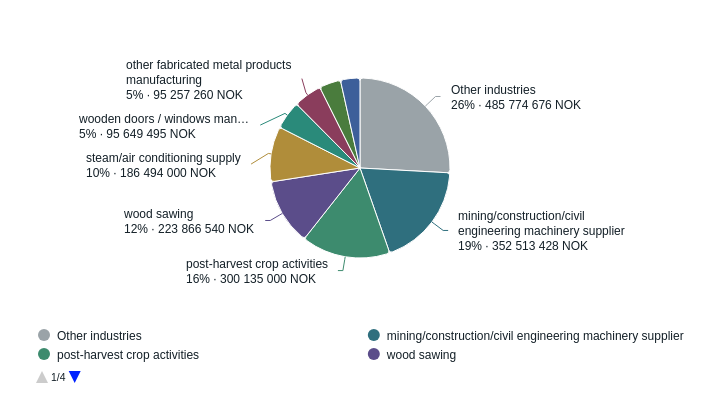
- Forestry & Timber Manufacturing: Sawmilling and wood processing (e.g., Bergene Holm AS) generate NOK 224.0M in turnover across 74 employees with a 19% revenue growth, while wooden doors and windows manufacturing accounts for NOK 95.7M.
- Machinery & Equipment Supply: Construction and mining machinery distribution (led by Entrack AS) is a major revenue engine, logging NOK 359.7M in operating income.
- Agriculture & Post-Harvest Processing: Post-harvest crop activities deliver NOK 303.1M in revenue with an EBITDA margin of 6% (NOK 18.2M EBITDA).
- Energy & Financial Services: District heating/steam supply generates NOK 216.6M with a high EBITDA margin of 28%, while local monetary intermediation (banking) contributes NOK 163.2M in operating income with an exceptional 42% EBITDA margin.
Legal Forms Distribution
Limited liability companies (AS) constitute the economic engine of private commercial output in Grue. The 113 registered AS units employ 914 people and generate NOK 2.07 billion in operating income with NOK 166.4M in total EBITDA.
- AS (Aksjeselskap): 113 companies, 914 employees, NOK 2,066.0M operating income, NOK 1,145.5M total equity.
- Orgl (Organisasjonsledd): 31 entities, 1,012 employees (public healthcare and state institutions).
- Komm (Kommune): 1 entity, 759 employees.
- Enk (Enkeltpersonforetak): 29 registered entities with reported staff (127 employees, NOK 15.2M operating income).
- Sa (Samvirkeforetak) & Sti (Stiftelse): 4 cooperatives and 2 foundations supporting agricultural, cultural, and community assets.
Business Geography & Local Hubs
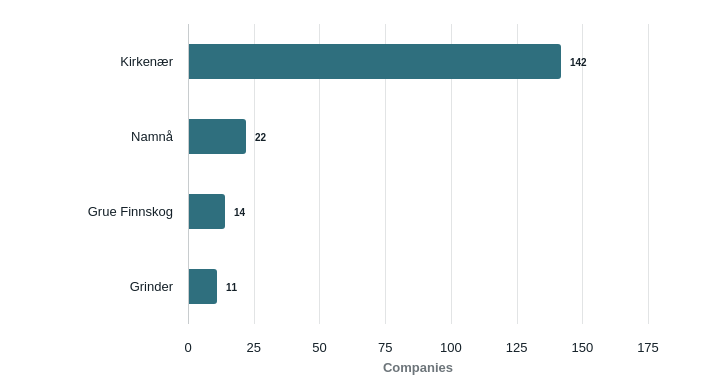
Economic activity in Grue is structured around four primary geographical locations, each serving distinct industrial and commercial functions:
| Area / Settlement | Companies | Employees | Operating Income (NOK) | Operating Margin |
|---|---|---|---|---|
| Kirkenær | 142 | 2,593 | 1,539.5M | 9% |
| Grinder | 11 | 138 | 672.9M | 2% |
| Namnå | 22 | 93 | 85.3M | 3% |
| Grue Finnskog | 14 | 142 | 54.2M | -3% |
Key Highlights by Location
- Kirkenær: The municipal center and economic dominant hub, housing nearly 90% of total municipal workforce. It anchors public governance, retail, banking, health services, and wood processing.
- Grinder: A specialized industrial pocket boasting exceptionally high turnover per employee (NOK 5.8M per employee), anchored by heavy equipment distribution and agricultural services.
- Namnå: A steady local service cluster generating NOK 85.3M across 22 business entities, showing positive revenue growth of 7%.
- Grue Finnskog: The cultural and eco-tourism heartland of Grue. Although recording negative aggregate operating margins due to non-profit foundation reporting, it holds major destination assets such as Finnskogtoppen Spa & Velværehotell AS and Stiftelsen Norsk Skogfinsk Museum.
Largest Employers
The employer landscape in Grue consists of large municipal and state welfare bodies alongside key private industrial operators.
Public Sector & Institutional Employers
- Grue Kommune: The largest employer with 759 employees, managing central public administrative functions.
- Grue Sykehjem: 161 employees providing municipal residential nursing care.
- Grue Barne Og Ungdomsskole: 84 employees dedicated to primary and lower secondary education.
- Grue Kommune Hjemmebaserte Tjenester: 83 employees in home-based care services.
- Bufetat Øst Kirkenær Facilities: Child welfare and administrative operations across multiple units in Kirkenær employing over 210 staff members combined (including administration, Frigg og Frydenlund, Snorre Ungdomshjem, and Furubo).
Major Commercial Companies
- Entrack AS (Avd Grinder): Heavy machinery supplier for mining and construction, employing 60 people with NOK 359.7M in operating income.
- Finnskogtoppen Spa & Velværehotell AS: Premier wellness hotel located in Grue Finnskog, employing 55 people with NOK 28.4M in operating income.
- Bergene Holm AS (Avd Kirkenær): Major sawmill and timber production plant with 48 employees, generating NOK 224.0M in operating income.
- Stiftelsen Norsk Skogfinsk Museum: Cultural heritage institution employing 40 staff in Grue Finnskog, experiencing 71% growth in total operating income (NOK 15.7M).
Business Dynamism & Bankruptcy Risk
Commercial dynamism in Grue is characterized by established, capital-intensive firms rather than high-turnover startup churning. Across reported fiscal statistics, default and bankruptcy levels remain negligible, reflecting stable balance sheets among key market participants.
Balance Sheet Strength
- Private AS corporations in Grue maintain total equity exceeding NOK 1.14 billion against total debt of NOK 2.39 billion, reflecting a healthy equity ratio above 30%.
- Key primary sectors—such as monetary intermediation (NOK 649.9M equity) and steam/energy supply (NOK 517.5M equity)—provide structural asset backing to the local economy.
While macroeconomic headwinds and fluctuating timber/construction demands have caused revenue contraction in timber manufacturing (-16% in window/door production), profit metrics in core utilities, banking, and specialized machinery remain positive, dampening broader economic stress.
Opportunities for Founders & Innovators
Grue's resource base, geographical location, and industry concentration create strategic openings for ambitious entrepreneurs in specific domains:
Strategic Growth Areas
- Bio-Economy & Wood Innovation: With Bergene Holm and local forestry assets established in Kirkenær, opportunities exist in timber byproduct utilization, wood tech, and sustainable building materials.
- Agricultural Tech & Value Addition: Given Grue's position in Solør's agricultural belt (NOK 303M+ post-harvest processing market), opportunities exist in agri-tech, cold-storage logistics, and organic crop processing.
- Eco-Tourism & Cultural Destination Services: Grue Finnskog presents opportunities in wellness, outdoor adventure tourism, and culinary concepts tied to Forest Finn heritage.
- B2B Industrial Support: Heavy machinery hubs like Grinder require specialized maintenance, logistics, and digital fleet management solutions.
Founders interested in exploring specific property locations, commercial zoned land, or demographic market gaps in Grue can utilize SmartGrunder to analyze street-level address profiles and local industry density.
Conclusion
Grue municipality offers a stable, resource-rich environment backed by solid public infrastructure and high-turnover industrial anchors. While corporate revenue has adjusted from post-pandemic highs, workplace employment has remained exceptionally consistent.
For local decision-makers and prospective founders, Grue provides an attractive combination of lower operational overhead, established industrial supply chains in timber and agriculture, and a receptive local market centered in Kirkenær.