Municipality
Economic Profile and Entrepreneurial Landscape of Hitra Municipality
An in-depth evaluation of industry concentration, geographic hubs, employment growth, and commercial opportunities in Trøndelag's aquaculture stronghold
Executive Summary
Hitra is one of Norway's most prominent coastal industrial municipalities, serving as a primary hub for seafood production and maritime industries in Trøndelag. The local economy is structurally centered around aquaculture, specifically salmon and crab farming, fish processing, marine logistics, and specialized technical support services.
Key takeaways from the economic baseline include:
- Aquaculture Dominance: Fish farming and fish processing together generate over NOK 2.5 billion in direct operating income, driving high labor demand and extensive capital investment.
- Service & Staffing Ecosystem: Due to seasonal volume fluctuations and processing demands, temporary staffing agencies form the second-largest employment category in the private sector.
- Geographic Clustering: Economic output is heavily concentrated in industrial nodes such as Sandstad (Jøsnøya) and Dolmøy, while administrative, retail, and public services are centered around Fillan/Hitra.
- Employment Recovery: After years of gradual workforce consolidation, projected employment figures demonstrate a positive trajectory, rising toward 3,643 employees by 2026.
For prospective founders and local policy planners, Hitra presents a high-volume industrial market with strong cash flows, creating fertile ground for specialized B2B suppliers, marine technology providers, and consumer-facing services.
Macroeconomic Performance and Employment Trends
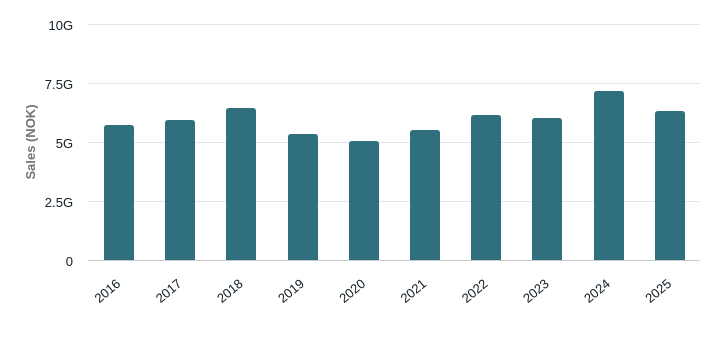
Hitra's macro performance reflects the cyclical yet high-margin nature of export-driven marine aquaculture. Between 2016 and 2025, aggregate sales revenues ranged between NOK 5.0 billion and NOK 7.16 billion annually. A peak was achieved in 2024 with total sales reaching NOK 7.16 billion, representing an 18.8% year-over-year expansion before settling to NOK 6.33 billion in 2025.
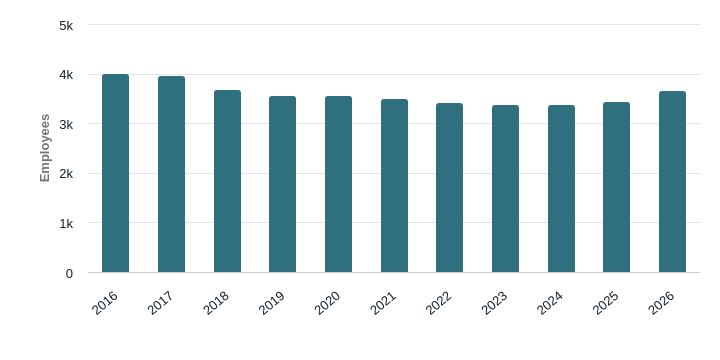
Employment trends over the past decade show a period of organizational restructuring followed by a strong multi-year recovery. Total registered employees fell from 4,001 in 2016 to a low of 3,368 in 2023. However, data indicates a sustained turnaround starting in 2024 (+0.2%), expanding by +1.7% in 2025, and accelerating by +6.1% in 2026 to reach 3,643 employees.
| Metric | 2018 | 2020 | 2022 | 2024 | 2025 | 2026 (Est.) |
|---|---|---|---|---|---|---|
| Total Sales (NOK M) | 6,437.9 | 5,021.2 | 6,124.3 | 7,159.0 | 6,334.0 | N/A |
| YoY Sales Growth | +8.3% | -5.8% | +11.4% | +18.8% | -11.5% | N/A |
| Total Employees | 3,673 | 3,543 | 3,410 | 3,376 | 3,434 | 3,643 |
| YoY Employee Growth | -7.0% | -0.2% | -2.3% | +0.2% | +1.7% | +6.1% |
Note: Year 2026 employment figures represent projected capacity based on current industry developments.
Industry Structure and Legal Form Distribution
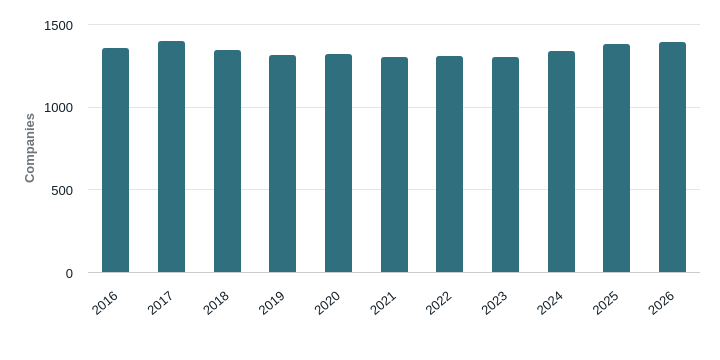
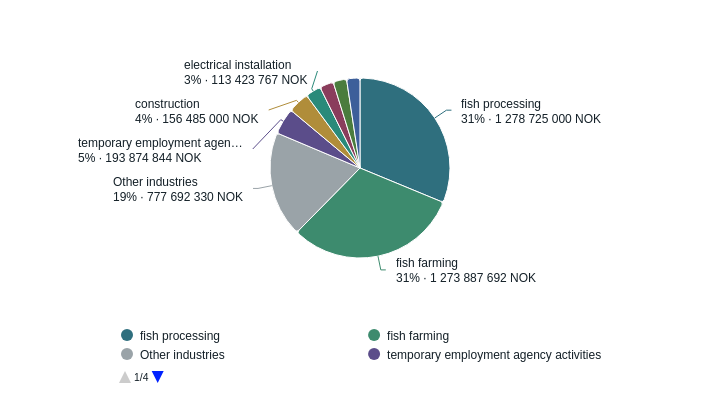
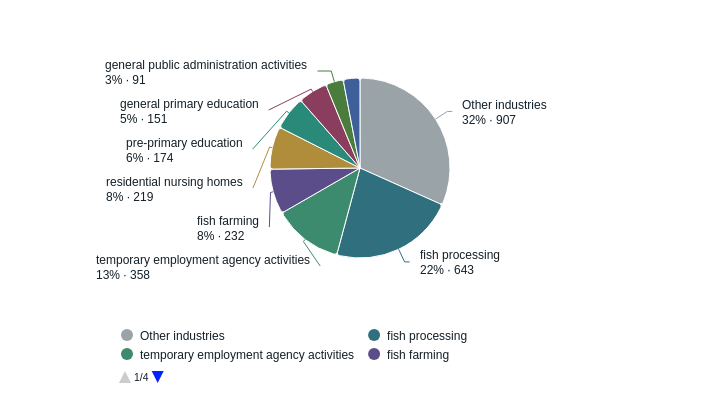
Hitra's commercial structure is dominated by seafood value chains. Fish processing accounts for 643 employees across 7 active companies, producing NOK 1.31 billion in operating income with an impressive average operating income per employee of NOK 6.3 million. Fish farming comprises 8 companies employing 232 people, yielding NOK 1.28 billion in operating income and an EBITDA margin of 16%.
To support high-capacity harvesting plants, temporary employment agencies employ 358 workers across 7 enterprises. Technical marine support is fortified by boat building and repair (59 employees, NOK 102.8M sales) and electrical installation (74 employees, NOK 113.4M sales).
Primary Industry Sectors
| * Fish Processing: 7 companies | 643 employees | NOK 1,307.8M operating income | EBITDA NOK 190.6M (14% margin) |
|---|---|---|---|
| * Fish Farming: 8 companies | 232 employees | NOK 1,275.6M operating income | EBITDA NOK 205.3M (16% margin) |
| * Temporary Staffing: 7 companies | 358 employees | NOK 193.9M sales | EBITDA NOK 6.5M |
| * Construction & Contracting: 7 companies | 86 employees | NOK 156.5M sales | 30% YoY growth |
| * Electrical Installation: 4 companies | 74 employees | NOK 113.4M sales | 16% YoY growth |
Legal Forms Profile
The private sector is built largely on standard private limited companies (AS), which account for 175 registered businesses, 2,324 employees, and NOK 3.25 billion in sales. Public joint-stock companies (ASA), representing major seafood corporations, employ 235 people across 4 registrations and generate NOK 1.14 billion in sales with an EBITDA margin of 16%.
Public services and municipal administration (KOMM) comprise 38 registered entities with 1,071 employees, ensuring robust civil infrastructure, schooling, and health services.
Business Geography and Commercial Hubs
Economic activity on Hitra is distributed across distinct coastal settlements, each specializing in administrative, industrial, or maritime functions.
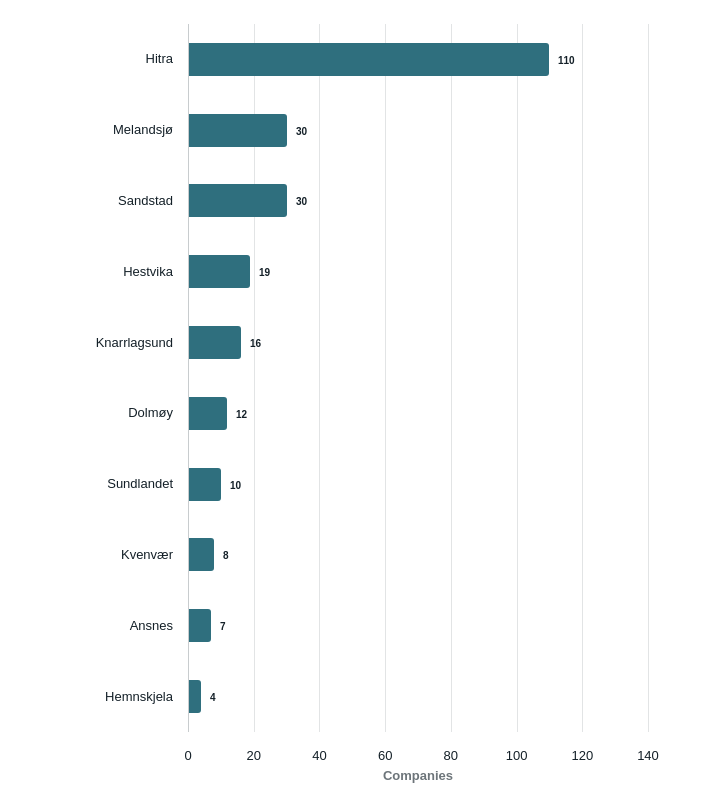
- Sandstad (Jøsnøya): The municipality's primary industrial power center. Sandstad hosts major industrial processing sites, producing NOK 2.11 billion in operating income across 30 companies and employing 792 workers. Average operating income per employee stands at NOK 4.9 million.
- Hitra (Fillan Area): The municipal and commercial center, hosting 110 companies and 1,730 employees. It concentrates municipal public services, administrative offices, retail, and general commercial trade, generating NOK 756.3M in operating income.
- Dolmøy & Hemnskjela: Highly productive maritime nodes. Dolmøy generates NOK 441.9M operating income with 109 employees and an EBITDA margin of 19%. Hemnskjela generates NOK 374.5M across just 4 companies (74 employees), yielding NOK 7.8M operating income per worker.
- Ansnes & Knarrlagsund: Key locations for crab and fish processing, marine service vessels, and growing coastal tourism.
| Location | Companies | Employees | Operating Income (NOK M) | EBITDA Margin | Key Focus |
|---|---|---|---|---|---|
| Sandstad | 30 | 792 | 2,114.7 | 14% | Primary industrial & processing hub |
| Hitra (Fillan) | 110 | 1,730 | 756.3 | 6% | Municipal center, retail & public services |
| Dolmøy | 12 | 109 | 441.9 | 19% | High-margin seafood & maritime operations |
| Hemnskjela | 4 | 74 | 374.5 | 15% | Industrial marine operations |
| Ansnes | 7 | 227 | 294.4 | 0% | Crab processing & tourism |
| Melandsjø | 30 | 325 | 200.1 | 6% | Local trade & supporting industries |
| Knarrlagsund | 16 | 284 | 177.1 | 6% | Aquaculture services & trade |
Key Industrial Actors and Largest Employers
Hitra's corporate landscape features major national seafood leaders alongside substantial public sector operations and specialized staffing agencies.
Top Commercial Employers
| 1. Din Bemannings Partner AS (Avd Hitra): 164 employees | Sandstad | Temporary employment activities | Operating income NOK 55.8M. |
|---|---|---|---|
| 2. Eterni Norge AS (Avd Hitra): 161 employees | Hitra | Temporary employment activities | Operating income NOK 64.6M. |
| 3. Hitramat AS: 148 employees | Ansnes | Specialized crab and shell fish processing | Operating income NOK 222.7M. |
- Lerøy Seafood Industri AS (Jøsnøya & Hestvika): Operating major primary processing and secondary processing plants at Jøsnøya (141 employees) and Hestvika (68 employees).
- Mowi ASA (Jøsnøya & Ulvan): Major industrial processing plants at Jøsnøya (135 employees, NOK 1.09B operating income, EBITDA NOK 195.5M) and Ulvan / Knarrlagsund (79 employees).
| 6. Måsøval Harvest AS: 63 employees | Knarrlagsund | Harvest and processing services. |
|---|
Major Public Employers
Public operations are primary employers in healthcare and education within the municipality:
- Hitra Demensomsorg & Miljøtjenesten: Combined 176 employees in residential healthcare.
- Fillan Skole & Fillan Barnehage: Primary education (81 employees) and pre-primary care (76 employees).
- Hitra Kommune Administration & HR: Municipal administration and apprentice training employing over 139 specialists.
- St. Olavs Hospital HF Ambulanse Hitra: 68 employees providing emergency medical services.
Business Dynamism and Corporate Turnovers
Hitra exhibits a highly stable dynamic overall, with low bankruptcy rates compared to urban centers. The presence of well-capitalized anchor firms in aquaculture provides market stability for sub-contractors.
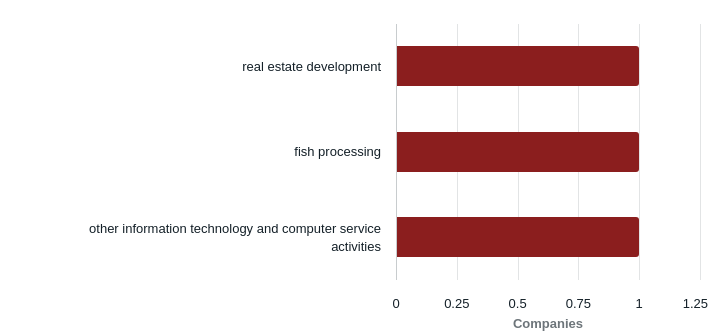
Recent bankruptcy data lists a total of 3 registered insolvencies in the area:
- Fisken Ko AS (Dolmøy): Fish processing enterprise (Sales NOK 5.5M, EBITDA NOK 1.4M prior to proceedings).
- Foxchain AS (Dolmøy): Early-stage IT services registration with no recorded revenues.
- Sandstadvika AS (Sandstad): Real estate development enterprise.
These statistics demonstrate that corporate distress remains isolated to small micro-entities, while the underlying core industrial sector retains strong equity buffers and liquidity.
Entrepreneurial Opportunities and Growth Sectors
Hitra's concentrated economic output creates multiple targeted entry points for prospective founders and expanding companies:
- Marine Technology & Automation: High volume processing plants require constant innovation in sensor technology, automated quality control, wastewater treatment, and bio-waste utilization.
- B2B Industrial Support: High turnover in heavy machinery creates demand for specialized hydraulic repair, automated equipment maintenance, and industrial cleaning services.
- Sub-Contracting for Construction: Site preparation and civil engineering recorded a 43% revenue surge (NOK 33.0M sales), reflecting continuous facility expansions around Jøsnøya and nearby harbors.
- Hospitality and Services for Foreign Personnel: With hundreds of seasonal workers and specialized consultants visiting Hitra, local housing, catering, and leisure services experience reliable demand.
Founders looking to identify suitable commercial addresses, industrial plots, or micro-market gaps across Sandstad, Fillan, or Dolmøy can utilize tools like SmartGrunder to analyze sub-industry footprints and local demographic trends.
Conclusion and Strategic Outlook
Hitra stands out as an economic powerhouse in Trøndelag, combining high-margin export production with strong local workforce demands. While the local economy is closely tied to global seafood market dynamics, the ongoing investments in modern harvesting infrastructure at Sandstad (Jøsnøya) and surrounding hubs provide strong long-term fundamentals.
For local decision-makers, maintaining housing supply, technical training facilities, and commercial land availability will be critical to supporting the projected workforce growth reaching 3,643 employees by 2026. For founders, Hitra offers an affluent, highly specialized industrial environment where innovation in support services and marine tech yields significant commercial rewards.