Municipality
Høyanger Business Economy Analysis: Industrial Roots and Coastal Growth
An in-depth economic evaluation of Høyanger municipality for entrepreneurs, investors, and local leaders.
Executive Summary
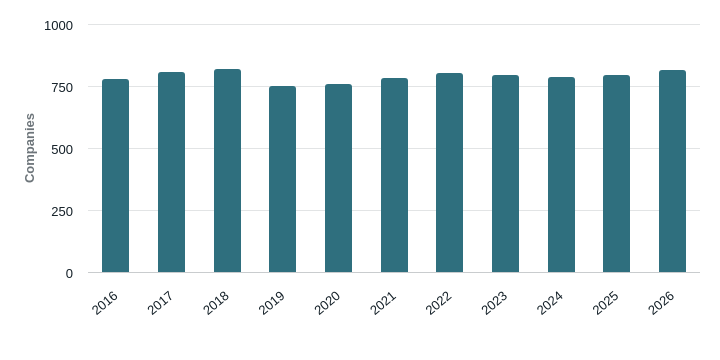
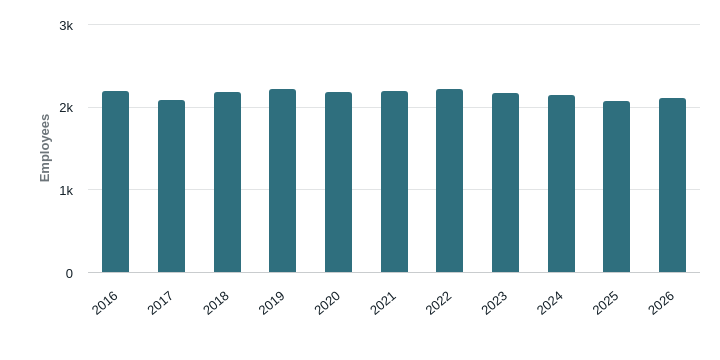
Høyanger municipality, situated along the Sognefjord in Vestland county, possesses a distinct economic identity defined by heavy manufacturing heritage, expanding aquaculture, and strong public sector involvement. The municipal economy supports over 2,100 active jobs across private enterprises and municipal services, anchored by major global and regional industry actors.
Key structural pillars of Høyanger's business community include:
- Heavy Industry & Manufacturing: Historically centered around industrial processing, including aluminium production (Hydro Aluminium) and specialized technical maintenance (Bilfinger Norway).
- Aquaculture & Coastal Services: A major revenue driver, with companies like Osland Havbruk As and Sordal Sea Service As driving significant operating income along the fjord.
- Plastics & Site Preparation: High-margin specialized manufacturing such as Nesseplast As and extensive civil engineering firms like Per A Øren Entreprenør As.
For prospective business founders, Høyanger presents a specialized industrial ecosystem with strong infrastructure, a skilled technical labor pool, and high turnover per employee in coastal and manufacturing nodes.
Economic Overview
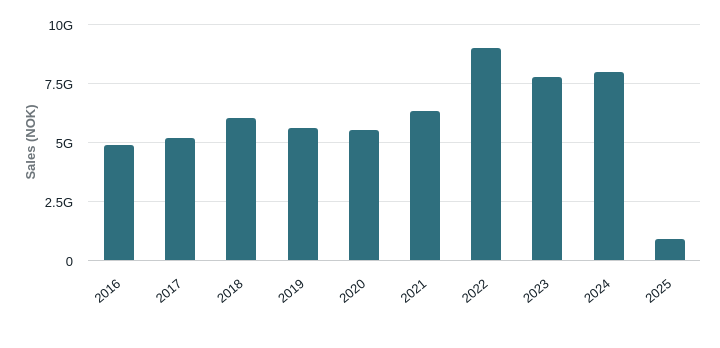
The overall revenue and employment dynamics in Høyanger reflect an export-oriented, resource-driven economy. Commercial turnover experienced a substantial expansion peaking in 2022 at NOK 9.0 billion before stabilizing near NOK 8.0 billion in 2024.
Historical Revenue & Employment Trends
| Year | Commercial Sales (NOK) | YoY Sales Change | Workforce (Employees) | YoY Employee Change |
|---|---|---|---|---|
| 2016 | 4,873.7M | — | 2,184 | — |
| 2017 | 5,163.8M | +6.0% | 2,081 | -4.7% |
| 2018 | 6,030.1M | +16.8% | 2,172 | +4.4% |
| 2019 | 5,590.9M | -7.3% | 2,213 | +1.9% |
| 2020 | 5,526.5M | -1.2% | 2,181 | -1.4% |
| 2021 | 6,314.8M | +14.3% | 2,191 | +0.5% |
| 2022 | 9,000.0M | +42.5% | 2,217 | +1.2% |
| 2023 | 7,765.6M | -13.7% | 2,161 | -2.5% |
| 2024 | 7,975.4M | +2.7% | 2,139 | -1.0% |
| 2025 | 907.0M* | -88.6%* | 2,070 | -3.2% |
| 2026 | — | — | 2,102 | +1.5% |
*Note: 2025 revenue figures reflect partial-year reporting or incomplete annual filings at the time of data collection, whereas total workforce remains relatively stable.
Workforce size in Høyanger has remained steady between 2,070 and 2,217 employees over the past decade, demonstrating resilience across global commodity cycles.
Industry Structure
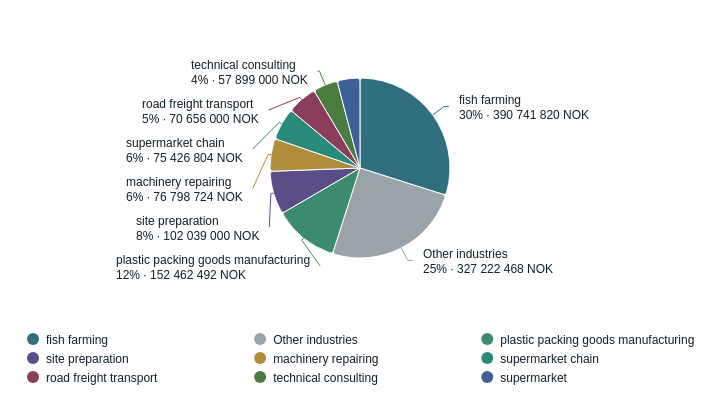
Høyanger's industry mix spans capital-intensive process manufacturing, high-value fish farming, construction services, and essential public sector services.
Sector Highlights
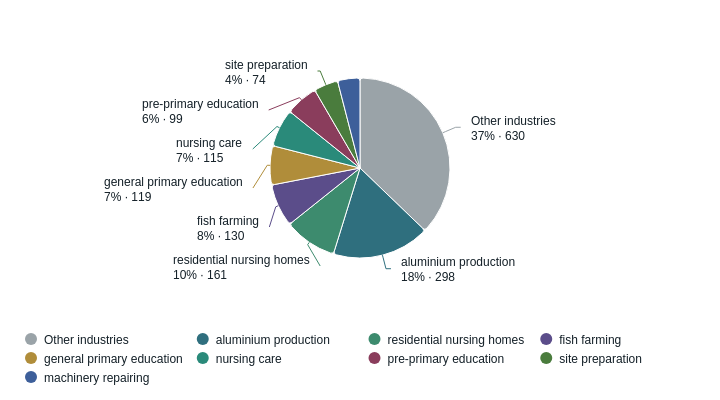
- Fish Farming: Generates over NOK 449.9 million in operating income across 6 companies employing 130 people. It boasts exceptional capital efficiency, with operating income per employee reaching NOK 8.6 million and an EBITDA margin of 18%.
- Plastic Packing Goods Manufacturing: Led by specialized manufacturing (such as Nesseplast As), accounting for NOK 152.5 million in operating income across 41 employees, with a strong EBITDA margin of 17%.
- Site Preparation & Construction: Civil site preparation (7 companies, 74 employees) generates NOK 105.1 million in operating income, supported by general construction activities.
- Industrial & Machinery Maintenance: Servicing the heavy industrial cluster, machinery repairing accounts for NOK 76.8 million in operating income across 68 employees.
Legal & Corporate Structures
Private limited liability companies (A/S) account for the majority of private revenue and employment in the municipality:
| Organization Type | Companies | Total Employees | Total Operating Income (NOK) |
|---|---|---|---|
| A/S (Aktieselskap) | 96 | 1,164 | 1,433.0M |
| Kommune (KOMM) | 40 | 871 | 0.0M (Public Service) |
| Organisasjonsledd (ORGL) | 5 | 55 | 0.0M |
| Enkeltpersonforetak (ENK) | 17 | 34 | 0.0M |
| Other Forms (SA, FLI, SÆR, STI, SPA) | 7 | 80 | 54.6M |
Business Geography
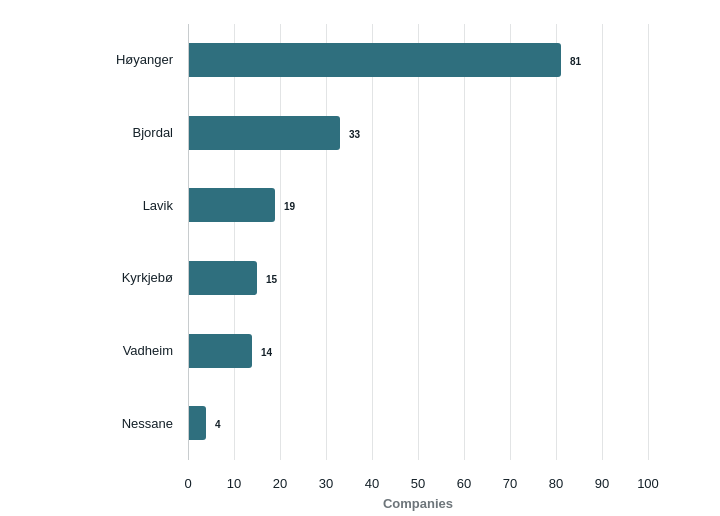
Commercial activity in Høyanger is distributed across several key population hubs and industrial sites along the fjord:
| Location | Active Companies | Employees | Total Operating Income (NOK) | Key Economic Driver |
|---|---|---|---|---|
| Høyanger | 81 | 1,362 | 521.2M | Heavy manufacturing, industrial services, municipal centre |
| Bjordal | 33 | 360 | 568.8M | Aquaculture, fjord maritime services |
| Nessane | 4 | 63 | 192.4M | Industrial plastic packaging manufacturing |
| Kyrkjebø | 15 | 156 | 100.3M | Local services, healthcare facilities, civil contracting |
| Lavik | 19 | 196 | 70.2M | Transport links, local commerce, healthcare |
| Vadheim | 14 | 65 | 34.7M | Local services, accommodation, secondary industry |
Høyanger urban center functions as the primary administrative and workforce center, accounting for over 60% of total municipal employment. Bjordal stands out for high financial output due to concentrated aquaculture activities, while Nessane displays extreme revenue productivity per worker.
Largest Employers
The local employer landscape is a balance between prominent private industrial firms and essential public sector healthcare and educational facilities.
Major Local Private Employers
- Hydro Aluminium As Høyanger Aluminiumsverk: The landmark industrial facility in Høyanger, employing 298 people in primary aluminium production.
- Osland Havbruk As: Headquartered in Bjordal, employing 67 workers in salmon aquaculture.
- Bilfinger Norway As Avd Høyanger: Employing 47 specialists delivering industrial repair, engineering, and maintenance services, generating NOK 76.8 million in revenue.
- Per A Øren Entreprenør As: A major regional civil earthworks and site preparation contractor employing 46 people with NOK 86.1 million in operating income.
- Sordal Sea Service As: Maritime and aquaculture support service provider located in Bjordal employing 46 people.
- Nesseplast As Avd Høyanger: Located in Nessane, employing 41 people in high-efficiency plastic packaging manufacturing generating NOK 152.5 million in operating income.
Key Public Sector Employers
- Høyanger Sjukeheim: 87 employees (Residential care)
- Kyrkjebø Sjukeheim: 65 employees (Residential care)
- Høyanger Skule: 61 employees (Primary education)
- Høyanger Kommune Open Omsorg Høyanger: 54 employees (Home care services)
- Høyanger Kommune Vaktmeister Og Reinhaldarar: 52 employees (Facility support)
- Høyanger Kommune Beredskap Og Forebygging: 47 employees (Emergency response)
Business Dynamism & Market Stability
Høyanger demonstrates high corporate stability, characterized by long-tenured companies and low insolvency rates.
Bankruptcy Analysis
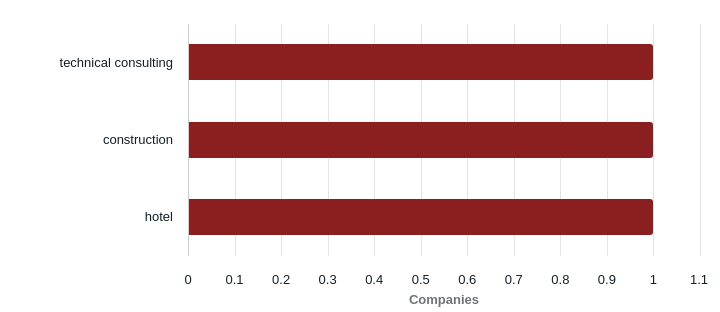
Recorded bankruptcies in Høyanger remain extremely low, with only 3 bankruptcies recorded in the recent sector tracking data:
- Qualitech Engineering As (Technical consulting, Høyanger) — NOK 0 reported turnover.
- Sogn Hotel As (Hotel accommodation, Vadheim) — NOK 1.9M sales revenue prior to insolvency.
- Spare Bygg Vest As (Construction, Kyrkjebø) — NOK 233.0K sales revenue prior to insolvency.
The low volume of bankruptcies underscores the stability of the core industrial ecosystem. Capital-intensive process industries and aquaculture act as shock absorbers for secondary suppliers and contractors.
Opportunities for Founders
For new entrepreneurs and expanding enterprises, Høyanger offers distinct niches created by its core industrial strengths:
- B2B Industrial & Technical Support Services: As Hydro Aluminium and Bilfinger anchor heavy industry in Høyanger town, opportunities exist for specialized mechanical maintenance, automation, sensor technologies, and green transition consulting.
- Aquaculture Supply Chain & Logistics: With Osland Havbruk As and Sordal Sea Service As driving significant coastal growth in Bjordal, service businesses focused on maritime net cleaning, environmental monitoring, feed logistics, and vessel support have an established local client base.
- Tourism & Fjord Hospitality: Small-scale eco-tourism, seasonal food services, and niche accommodation in hubs like Lavik, Vadheim, and Kyrkjebø remain underserved relative to regional fjord traffic.
- Civil Contracting & Transport Subcontracting: Strong civil activity from firms like Per A Øren Entreprenør As signals demand for specialized transport, heavy equipment repair, and site services.
Founders looking to analyze specific geographic nodes, industrial property availability, or sector niches in Høyanger can leverage SmartGrunder to explore granular company demographics and operational footprints across Vestland.
Conclusion
Høyanger is a resilient industrial and aquaculture hub in Vestland. Supported by established heavy industry like Hydro Aluminium, high-value aquaculture around Bjordal, and specialized manufacturing in Nessane, the municipality offers a strong backbone for prospective business owners.
While traditional process manufacturing provides foundational economic stability, upcoming opportunities lie in green industrial innovation, specialized maritime technology, and targeted commercial services along the fjord.