Municipality
Economic Landscape and Entrepreneurial Opportunities in Hvaler Municipality
An in-depth analysis of industry structure, revenue trends, geographic hubs, and commercial dynamics for business founders
Executive Summary
Hvaler is an island municipality in Viken defined by a distinct economic structure that balances public sector employment with a consumer and maritime-driven private sector. Dominated by public administration, healthcare, retail, and maritime services, the local economy reflects both its role as a coastal community and a major regional tourist destination.
While public sector entities account for a significant portion of total employment, private enterprise is grounded in supermarket networks, restaurant and hospitality services, water transport support, and specialized construction. While total commercial turnover has seen post-2021 adjustments, overall baseline employment has remained resilient, stabilizing at roughly 2,300 to 2,400 jobs across the municipality.
Key takeaways for prospective founders and local planners include:
- Dual Economic Anchor: High public sector stability alongside private sector dependence on retail, tourism, and marine activity.
- Geographic Concentration: Commercial turnover is heavily concentrated in Vesterøy, while employment density centers in Skjærhalden.
- Entrepreneurial Potential: Niche service gaps exist in year-round hospitality, technical services, maritime maintenance, and specialized trade.
Economic Overview: Sales Trends and Employment
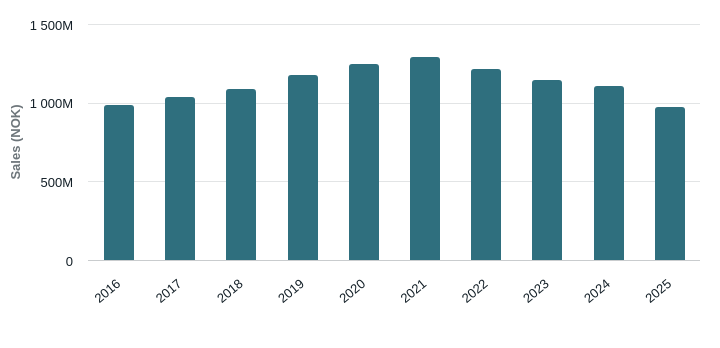
An analysis of year-over-year economic indicators highlights shifting revenue dynamics paired with long-term employment stability in Hvaler. Sales turnover across registered local businesses experienced sustained growth through the late 2010s, reaching a peak of NOK 1,293.3M in 2021. In subsequent years, commercial turnover shifted into a contraction phase, normalizing to NOK 970.2M by 2025.
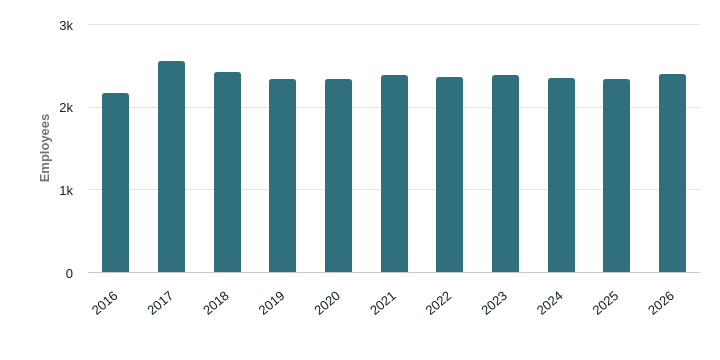
Despite fluctuations in top-line commercial sales, employment figures have remained exceptionally steady. Following an expansion between 2016 and 2017 (growing from 2,163 to 2,552 employees), workplace counts normalized around 2,300 to 2,400 personnel. Projections for 2026 indicate a modest uptick to 2,398 employees (+3.0% YoY).
| Indicator | Historic Baseline (2016) | Peak Revenue (2021) | Recent Performance (2025) | Projected (2026) |
|---|---|---|---|---|
| Total Sales Revenue | NOK 986.8M | NOK 1,293.3M | NOK 970.2M | N/A |
| Total Employment | 2,163 employees | 2,384 employees | 2,329 employees | 2,398 employees |
| YoY Sales Change | Base Year | +3.8% | -12.2% | N/A |
| YoY Employment Change | Base Year | +2.0% | -0.9% | +3.0% |
This trend illustrates that while retail and commercial spending patterns fluctuate—influenced by macroeconomic cycles and seasonal variation—the core labor force remains stable due to the foundational public health and municipal infrastructure.
Industry Structure and Business Types
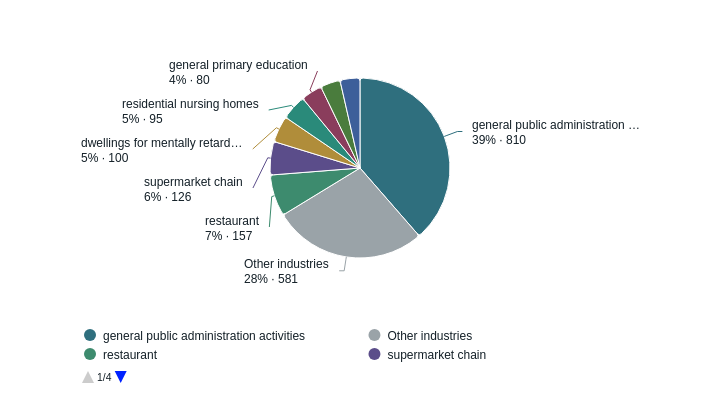
Hvaler’s industrial mix shows a clear division between community services and private commercial enterprise. Public administration represents the single largest employment segment (4 entities accounting for 810 workers), followed by residential nursing care, primary education, and specialized social assistance.
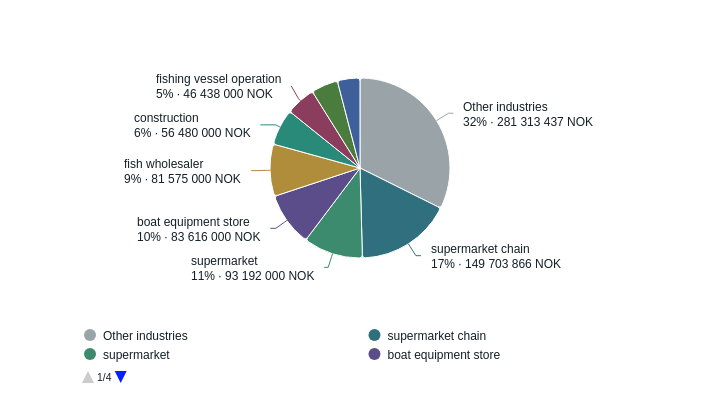
In the private market, commercial activity is dominated by supermarket chains, independent grocers, restaurant operations, marine services, and building materials:
- Supermarkets & Grocery: Supermarket chains (5 entities, 126 workers, NOK 156.2M operating income) and local supermarkets (2 entities, 75 workers, NOK 97.8M operating income) handle significant trade volumes.
- Maritime Services & Retail: Other services incidental to water transportation (4 companies, 75 employees, NOK 43.9M operating income, 14% EBITDA margin) and boat equipment stores (3 companies, 36 employees, NOK 83.6M operating income) showcase Hvaler's active coastal infrastructure.
- Hospitality & Food Services: Restaurants (6 companies, 157 employees) and hotels generate steady revenue, though seasonal pressure impacts year-round profit margins.
- Construction & Technical: Construction (9 companies, 42 employees, NOK 57.1M operating income) and technical consulting (5 companies, 22 employees, NOK 34.4M operating income) provide key infrastructure and maintenance capabilities.
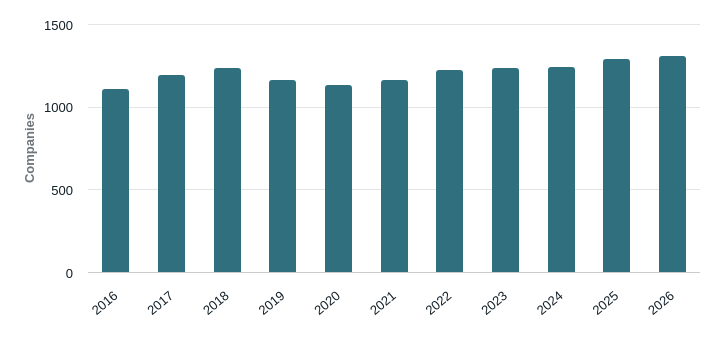
From a legal form perspective, limited liability companies (AS) generate the bulk of commercial turnover, totaling 126 entities, 985 employees, and NOK 936.9M in operating income. Public municipal forms (KOMM and ORGL) employ over 1,500 personnel collectively.
Business Geography: Key Hubs Inside Hvaler
Economic activity within Hvaler is distributed across distinct island centers, with Vesterøy and Skjærhalden serving as the primary commercial and operational focal points.
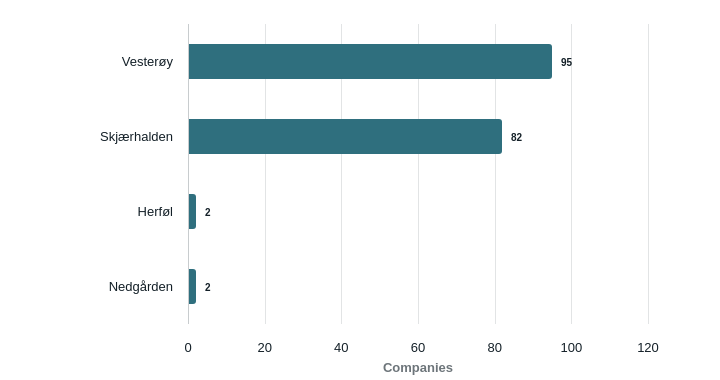
- Vesterøy: Represents the primary commercial turnover engine. With 95 registered companies and 1,009 employees, Vesterøy generates NOK 735.6M in operating income and NOK 712.7M in sales revenue. It hosts major grocery chains, healthcare facilities, and educational hubs.
- Skjærhalden: Serves as the administrative center and primary worker population hub, hosting 82 companies and 1,558 employees. While operating income stands at NOK 223.9M, it represents the heart of civic infrastructure, tourist traffic, and harbor activities.
- Herføl & Nedgården: Secondary maritime hubs with smaller populations and focused local trade. Herføl hosts 2 companies generating NOK 10.6M in operating income, while Nedgården records 2 registered companies with NOK 5.4M in operating income.
| Location / City | Number of Companies | Total Employees | Operating Income (NOK) | Sales Revenue (NOK) |
|---|---|---|---|---|
| Vesterøy | 95 | 1,009 | NOK 735.6M | NOK 712.7M |
| Skjærhalden | 82 | 1,558 | NOK 223.9M | NOK 209.1M |
| Herføl | 2 | 31 | NOK 10.6M | NOK 10.5M |
| Nedgården | 2 | 3 | NOK 5.4M | NOK 5.4M |
Largest Local Employers
The employer landscape in Hvaler is led by municipal service organizations, supplemented by major supermarket branches, hospitality providers, and marine service operators.
Primary Public Employers
- Hvaler Kommune: The central municipal organization employing approximately 780 personnel in public administration and civic services.
- Hvaler Kommune Sykehjem (Langtids- & Korttidsavdeling): Facilities in Vesterøy providing long-term and short-term nursing care, employing 89 and 43 workers respectively.
- Hvaler Barne Og Ungdomsskole: The primary municipal educational institution in Vesterøy, employing 80 staff members.
- Hjemmebaserte Tjenester & Specialized Care: Home care services (70 workers) and specialized residences such as Boveiledning Østerhaug (58 workers).
Notable Private Employers
- Cafecompagniet AS: Located in Skjærhalden, employing 63 personnel with NOK 13.0M in sales revenue in the restaurant sector.
- H.p. Pettersen Eftf. AS: A key grocery operator in Skjærhalden, employing 58 workers and generating NOK 89.7M in operating income.
- Brattestø Havn Og Båtservice AS: Operating in Vesterøy, employing 50 workers with NOK 10.1M in operating income, delivering water transportation services.
- NG Kiwi Øst AS Avd 403 Vesterøy: Supermarket chain branch employing 37 staff with NOK 99.3M in operating income.
- Hvaler Gjestgiveri AS: Hotel operator in Skjærhalden employing 32 workers with NOK 8.8M in operating income.
Business Dynamism and Bankruptcy Trends
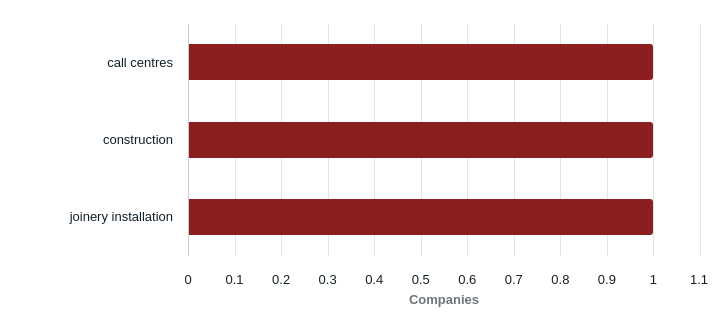
Business dynamic metrics indicate a controlled rate of market turnover. Over recent reporting periods, registered bankruptcies have remained minimal, totaling only 3 company insolvencies within the municipality.
The recorded bankruptcies were concentrated in small-scale service and trade sectors:
- Agris Byggtjeneste NUF (Vesterøy) – Joinery installation / construction services (NOK 3.8M turnover prior to filing).
- Consenta Øivind Kylstad (Vesterøy) – Call centre activities.
- Svingen Håndverk AS (Vesterøy) – Small-scale craft and construction services.
Because bankruptcies are extremely low in absolute terms and restricted to small specialty operations, the baseline market stability across Hvaler remains intact. However, small contractors and seasonal operators face thin operating margins, highlighting the importance of cash flow management during off-peak autumn and winter months.
Opportunities for Founders and Entrepreneurs
Despite post-2021 commercial revenue compression, Hvaler presents distinct niche market opportunities for entrepreneurial ventures that leverage local resident needs and seasonal visitor surges.
Identified High-Potential Sectors
- Year-Round & Experience Tourism: Expanding services beyond the summer surge into autumn/spring eco-tourism, wellness, and specialized events.
- Marine Maintenance & Technical Support: High demand exists for boat repair, marine electrics, and dock management, where existing operators like Brattestø Havn demonstrate strong 14%–20% EBITDA margins.
- Craft Construction & Property Maintenance: Skilled trades specializing in sustainable cottage maintenance, energy retrofit, and timber joinery.
- Specialized Local Logistics & Retail: Value-add food products, craft services, and direct-to-consumer delivery services catering to both full-time residents and cabin owners.
Founders evaluating property locations or market demand across Skjærhalden, Vesterøy, or surrounding areas can utilize tools like SmartGrunder to analyze localized address data, sectoral gaps, and business registration trends.
Conclusion and Strategic Outlook
Hvaler offers a stable economic foundation grounded in robust public sector healthcare and administration, balanced by commercial activity in grocery retail, maritime services, and hospitality. While commercial sales turnover has adjusted from peak post-pandemic levels, steady employment figures point to an underlying resilience.
For new business owners, success in Hvaler requires balancing seasonal peak revenues with sustainable year-round operational models. Entrepreneurs who establish strong ties with local hubs in Vesterøy and Skjærhalden while catering to long-term community requirements are well-positioned to build durable enterprises in this coastal municipality.