Municipality
Iveland Economic Analysis: Industrial Realities and Founder Opportunities
An in-depth review of revenue trends, sector dynamics, geographic hubs, and commercial possibilities in Iveland municipality
Executive Summary
Iveland municipality presents a dual-track economic landscape within Agder county. While public administration, healthcare, and primary education form the structural foundation for local employment, private commercial enterprise is heavily concentrated in specialized, high-yield manufacturing and natural resource exploitation.
The commercial economy is anchored by two geographic poles: the municipal center of Iveland, which hosts the majority of public service entities and small service businesses, and Vatnestrøm, an industrial site responsible for the vast majority of commercial revenue generated in the municipality. Led by global beverage manufacturing and wood processing, Vatnestrøm accounts for over 80% of total commercial turnover despite hosting a smaller share of overall company count.
Key takeaways for entrepreneurs and civic leaders include:
- Export-Driven Manufacturing: High capital intensity and strong revenue per employee in manufacturing, notably soft drinks and building components.
- Public Sector Employment Base: Over half of the active workplace positions reside within municipal administration, healthcare, and education.
- Targeted Founder Opportunities: Demand exists for local supply-chain support, technical consulting, specialized trade services, and niche tourism experiences.
Economic Overview
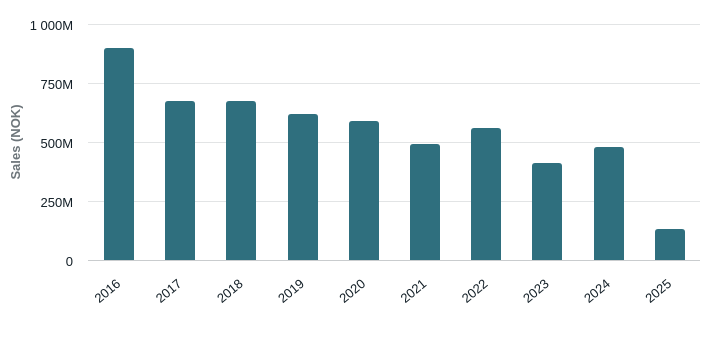
Iveland's macro revenue trajectory reflects the cyclical dynamics of high-volume industrial production located within a compact municipal economy. Total business revenue peaked in 2016 at NOK 896.5 million, stabilizing in recent years around NOK 412 million to NOK 478.7 million annually (2023–2024).
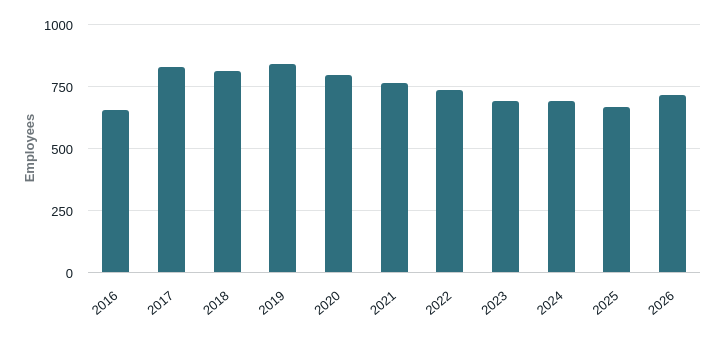
Employment levels have shown long-term resilience, transitioning from 652 employees in 2016 to a projected 714 employees in 2026, after maintaining a steady plateau around 690 to 733 between 2022 and 2024.
| Year | Commercial Revenue (NOK) | YoY Sales Change | Employee Count | YoY Employee Change |
|---|---|---|---|---|
| 2016 | 896.5M | — | 652 | — |
| 2017 | 675.5M | -24.7% | 825 | +26.5% |
| 2018 | 675.0M | -0.1% | 812 | -1.6% |
| 2019 | 618.2M | -8.4% | 840 | +3.4% |
| 2020 | 588.9M | -4.7% | 793 | -5.6% |
| 2021 | 490.6M | -16.7% | 762 | -3.9% |
| 2022 | 560.5M | +14.3% | 733 | -3.8% |
| 2023 | 412.4M | -26.4% | 691 | -5.7% |
| 2024 | 478.7M | +16.1% | 691 | +0.0% |
| 2025 | 132.8M* | -72.2%* | 665 | -3.8% |
| 2026 | — | — | 714 | +7.4% |
*Note: 2025 sales figures reflect partial reporting year data based on available filings.
Industry Structure & Legal Organization
The industry composition of Iveland is sharply divided between public service administration and highly productive private manufacturing.
Primary Industry Sectors
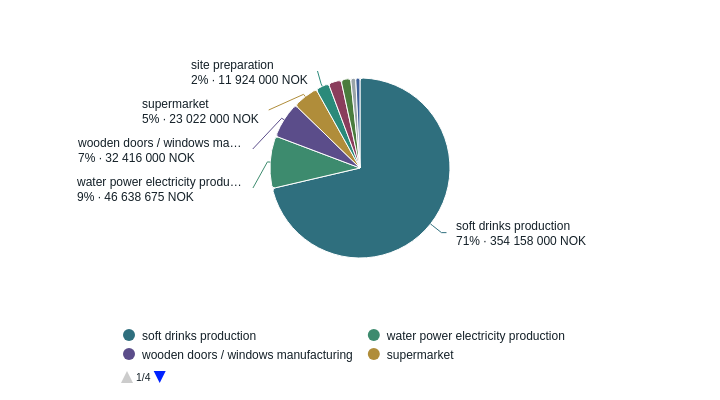
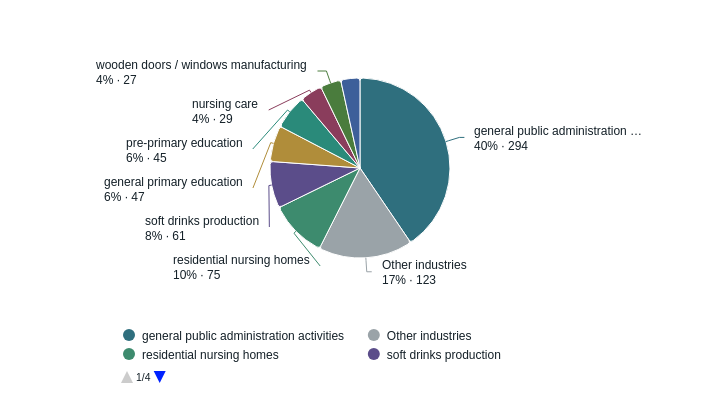
- Soft Drinks Production: Generating NOK 356.0 million in operating income across 2 entities with 61 employees. This sector yields an impressive NOK 7.2 million operating income per employee and an EBITDA margin of 13%.
- Wooden Doors & Windows Manufacturing: Accounts for NOK 32.7 million in operating income with 27 employees, supporting Agder's construction and building materials value chain.
- Construction & Civil Engineering: Encompasses site preparation (NOK 11.9M operating income, 8 employees) and road/motorway construction (NOK 11.5M operating income, 23 employees, 18% EBITDA margin).
- Retail & Grocery: Grocery stores generate NOK 23.5 million across 3 units with 25 employees.
- Public Services & Healthcare: General public administration (294 employees), residential nursing homes (75 employees), primary education (47 employees), and pre-primary education (45 employees) dominate total municipal employment.
Corporate Legal Structure
Commercial activity is predominantly organized under limited liability companies (AS).
| Legal Structure | Company Count | Employee Count | Operating Income (NOK) | Total Equity (NOK) |
|---|---|---|---|---|
| Aktieselskap (AS) | 18 | 157 | 499.4M | -289.3M |
| Organisasjonsledd (ORGL) | 15 | 283 | 0.0M | 0.0M |
| Kommune (KOMM) | 1 | 284 | 0.0M | 0.0M |
| Stiftelse (STI) | 1 | 3 | 2.1M | 3.1M |
| Enkeltpersonforetak (ENK) | 1 | 1 | 0.0M | 0.0M |
Business Geography
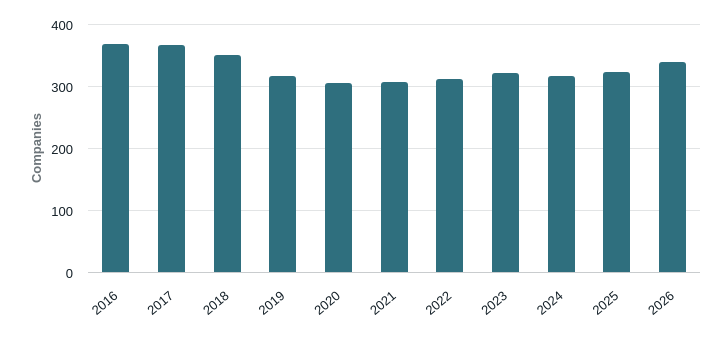
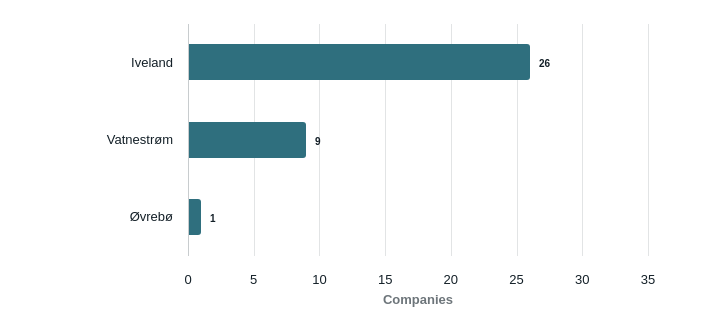
Commercial activity inside Iveland municipality is divided into two distinct economic zones and one minor rural enclave.
| Area | Active Companies | Employees | Operating Income (NOK) | EBITDA Margin | Key Profile |
|---|---|---|---|---|---|
| Vatnestrøm | 9 | 109 | 411.1M | 12% | Heavy manufacturing, export, mineral water production |
| Iveland | 26 | 616 | 88.5M | 32% | Municipal administration, local services, public healthcare |
| Øvrebø | 1 | 3 | 1.8M | 2% | Small rural trade |
Area Analysis
- Vatnestrøm: Serves as the high-revenue industrial heart of Iveland. Despite hosting only 9 registered corporate entities in this dataset, it produces NOK 411.1 million in operating income, driven by major industrial exporters.
- Iveland (Center): Serves as the community and administrative core. It hosts 616 employees, primarily in public administration, health services, local grocery trade, and craft services. Operating margins among commercial companies in Iveland center average a strong 28%.
Largest Employers
Employment in Iveland is led by public sector services, supplemented by key private employers in manufacturing and retail.
Top Public Employers
- Iveland Kommune: 284 employees (General public administration, civil services)
- Iveland Bygdeheim: 75 employees (Residential nursing care)
- Iveland Skole: 47 employees (Primary education)
- Skaiå Barnehage: 43 employees (Pre-primary education)
- Iveland Kommune Hjemmesykepleien: 29 employees (Home nursing services)
- Anleggstjenesten I Iveland: 18 employees (Road and public works maintenance)
Top Private Commercial Employers
- Voss Production AS: 60 employees. Operating income of NOK 356.0 million, revenue growth of 53%, and EBITDA of NOK 62.5 million. Represents the single largest commercial driver in the municipality.
- Dørfabrikken Vatnestrøm AS: 27 employees. Operating income of NOK 32.7 million, revenue growth of 10%, producing wooden doors and window components.
- Joker Skaiaa: 10 employees (Supermarket & local retail).
- Åkle Mat AS: 9 employees. Operating income of NOK 12.5 million (Supermarket & retail food).
- Viltgarden AS: 9 employees. Operating income of NOK 3.4 million, 59% revenue growth (Recreational activities and nature-based tourism).
Business Dynamism & Financial Resilience
Iveland’s business landscape displays high operational efficiency in specific private niches, alongside noticeable capital intensity.
High-Growth Segments
Several private companies demonstrated rapid top-line growth in recent reporting cycles:
- Electrical Installation: +93% revenue growth.
- Recreational Activities (Viltgarden AS): +59% revenue growth.
- Soft Drinks Production (Voss Production AS): +53% revenue growth.
Financial Characteristics
The private sector (AS companies) generates total revenues of NOK 499.4 million and EBITDA of NOK 78.8 million, representing a solid aggregate EBITDA margin of 15%. However, total debt across private limited companies stands at NOK 977.9 million, reflecting significant capital investment in heavy production machinery, facilities, and logistics infrastructure in Vatnestrøm.
Opportunities for Founders & Entrepreneurs
Given Iveland’s specialized economy, startup founders can find viable market entries by catering to existing industrial ecosystems or fulfilling regional consumer demand.
Recommended Founder Focus Areas
- Industrial Support & Logistics: Sub-contracting, technical maintenance, industrial automation, and freight logistics supporting Vatnestrøm's manufacturing hub.
- Specialized Trades & Craft Services: High local demand for electrical installation, joinery, and site preparation work linked to residential and industrial properties.
- Nature & Activity Tourism: Building on models like Viltgarden AS, leveraging Agder's inland topography for eco-tourism, outdoor sports, and regional experiences.
- Green Economy & Biomass: Opportunities in forestry management, wood product processing, and local renewable energy solutions.
Founders seeking to evaluate commercial plots, zoning, or specific industry statistics in Iveland can utilize tools like SmartGrunder to analyze location-level data and validate local business concepts.
Conclusion
Iveland municipality demonstrates how a small inland municipality can maintain a robust economic footprint by balancing a strong municipal service hub with dedicated industrial production. With Vatnestrøm serving as an export power engine and Iveland center providing stable public employment and community services, the municipality offers a predictable, highly focused environment for new business ventures.