Municipality
Karlsøy Municipal Economic Analysis
An in-depth review of business performance, aquaculture dominance, and entrepreneurial opportunities in Karlsøy
Executive Summary
Karlsøy municipality, situated in the coastal waters of Troms, presents a hyper-specialized economy driven by world-class aquaculture, seafood processing, and marine transportation. Despite a modest population base and a consolidation in traditional employment headcount, Karlsøy's corporate revenue generation has surged dramatically over the past decade, demonstrating extraordinary capital efficiency and productivity.
The administrative center of Hansnes serves as the municipal and public service hub, while outlying areas such as Vannvåg and Vannareid function as high-volume industrial seafood powerhouses. Public sector employment remains essential for community stability, but private enterprise—led by seafood processing giants and salmon farming operators—generates the vast majority of commercial value. For founders and investors, Karlsøy offers high operating revenue density, strong maritime infrastructure, and niche service demands across the aquaculture and marine value chains.
Economic Overview
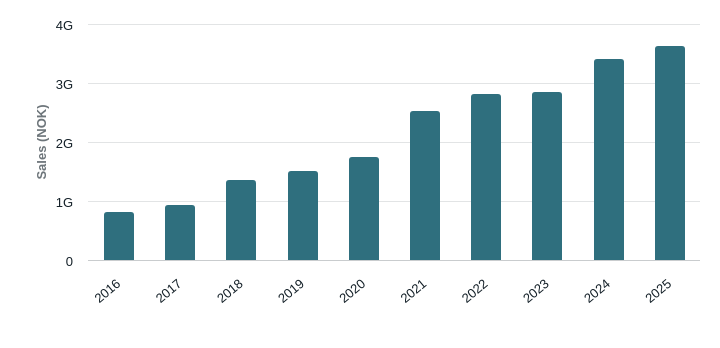
Karlsøy's macro-economic profile highlights a dramatic revenue trajectory over the past decade. Aggregate sales revenues from registered commercial entities increased from NOK 812.8M in 2016 to NOK 3,635.1M in 2025. Major growth spikes occurred in 2018 (+46.8%), 2021 (+45.0%), and 2024 (+19.4%), reflecting global demand and strong prices in the salmon and wild-catch seafood sectors.
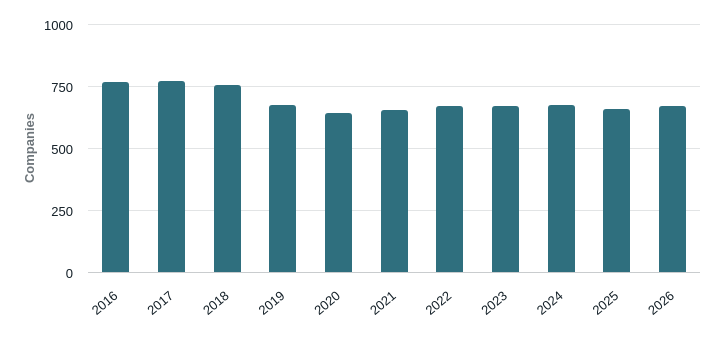
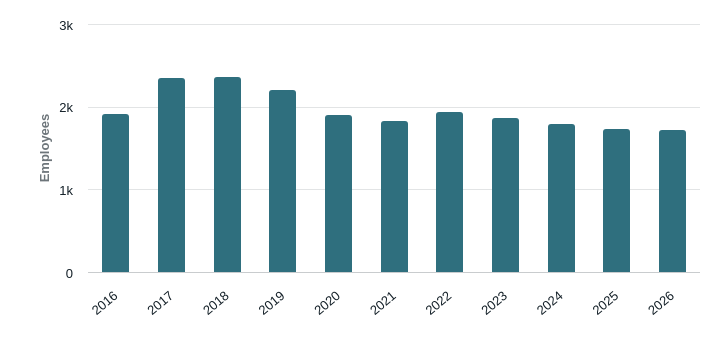
In contrast, overall employment figures within the municipality have experienced a gradual decline after peaking in 2017–2018 at over 2,300 employees. By 2024, headcount stood at 1,796, with projected figures reaching 1,715 in 2026. This divergence between surging sales and declining headcount underscores significant technological adoption, automation, and industrial scaling within the local economy.
| Year | Aggregate Sales (NOK) | YoY Sales Change | Municipality Employees | YoY Employee Change |
|---|---|---|---|---|
| 2016 | 812.8M | — | 1,916 | — |
| 2017 | 926.9M | +14.0% | 2,342 | +22.2% |
| 2018 | 1,360.3M | +46.8% | 2,357 | +0.6% |
| 2019 | 1,511.0M | +11.1% | 2,197 | -6.8% |
| 2020 | 1,737.6M | +15.0% | 1,903 | -13.4% |
| 2021 | 2,518.9M | +45.0% | 1,824 | -4.2% |
| 2022 | 2,809.5M | +11.5% | 1,937 | +6.2% |
| 2023 | 2,851.1M | +1.5% | 1,862 | -3.9% |
| 2024 | 3,403.5M | +19.4% | 1,796 | -3.5% |
| 2025 | 3,635.1M | +6.8% | 1,735 | -3.4% |
| 2026 | — | — | 1,715 | -1.2% |
Industry Structure
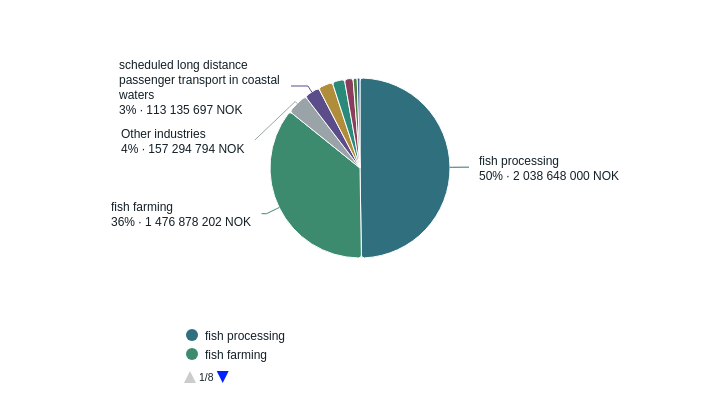
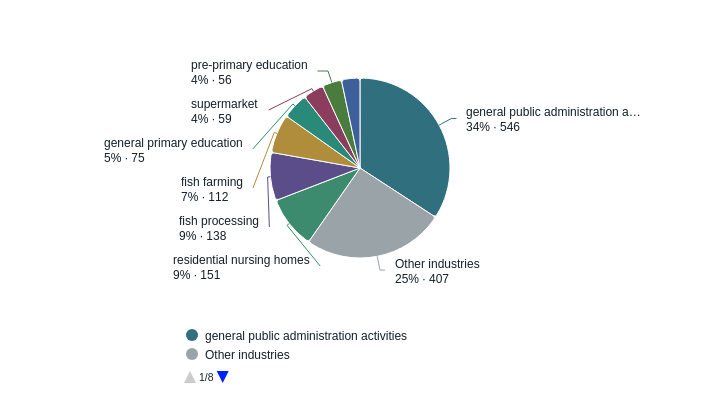
The commercial industry structure in Karlsøy is dominated by two primary economic pillars: public administration and health/education services on the public side, and seafood processing and fish farming on the private commercial side.
Fish processing accounts for NOK 2,042.1M in operating income across 3 active companies, delivering impressive revenue growth of 34% YoY. Fish farming contributes NOK 1,482.8M across 3 companies, generating an exceptional operating margin of 9% and an EBITDA margin of 14%. Combined, these two sectors generate over NOK 3.5B in top-line revenue with high average operating income per employee (NOK 11.5M in processing and NOK 11.3M in farming).
Other notable private sectors include scheduled maritime transport (NOK 116.7M operating income), civil construction and road building (NOK 108.2M operating income), and retail supermarkets.
| Industry Sector | Companies | Employees | Operating Income (NOK) | Revenue Growth | EBITDA Margin |
|---|---|---|---|---|---|
| General Public Administration | 3 | 546 | NOK 0.0M | 0% | 0% |
| Residential Nursing Homes | 2 | 151 | NOK 0.0M | 0% | 0% |
| Fish Processing | 3 | 138 | NOK 2,042.1M | +34% | 4% |
| Fish Farming | 3 | 112 | NOK 1,482.8M | +9% | 14% |
| General Primary Education | 2 | 75 | NOK 0.0M | 0% | 0% |
| Supermarkets | 4 | 59 | NOK 92.7M | -2% | 4% |
| Passenger Coastal Transport | 1 | 53 | NOK 116.7M | +8% | 24% |
| Roads & Motorways Construction | 2 | 34 | NOK 108.2M | -2% | 17% |
Legal Form Breakdown
Corporate structures reflect this industrial maturity. Limited liability companies (AS) represent 57 firms, employing 602 people and generating NOK 4,097.1M in total operating income. Municipal organs (KOMM) and public sector organizations (ORGL) account for over 1,000 employees, ensuring baseline stability across the municipality's islands.
Business Geography
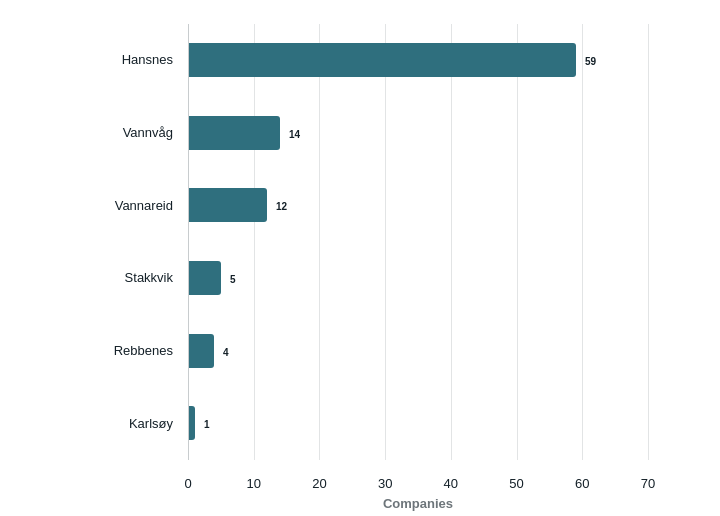
Karlsøy’s business activity is divided across several distinct settlements and islands, each filling a specific economic niche.
- Hansnes: The municipal capital and administrative heartland. It hosts 59 registered businesses and 1,398 employees, generating NOK 1,898.7M in operating income. It combines public services, primary education, ferry connections, and aquaculture regional offices.
- Vannvåg: Located on Vannøya, Vannvåg is an industrial seafood titan. With just 14 companies and 190 employees, it achieves NOK 2,016.2M in operating income, driven by major whitefish and pelagic processing operations.
- Vannareid: Positioned on Northern Vannøya, Vannareid holds 12 companies and 93 employees. Operating income reached NOK 177.4M, posting an outstanding 48% revenue growth rate.
- Stakkvik & Rebbenes: Smaller settlement hubs on Ringvassøya and Rebbenesøya focusing on local services, agriculture, and small-scale maritime operations.
| Location | Companies | Employees | Operating Income (NOK) | Sales Revenue (NOK) | Revenue Growth |
|---|---|---|---|---|---|
| Hansnes | 59 | 1,398 | NOK 1,898.7M | NOK 1,881.0M | +8% |
| Vannvåg | 14 | 190 | NOK 2,016.2M | NOK 2,009.0M | +30% |
| Vannareid | 12 | 93 | NOK 177.4M | NOK 176.5M | +48% |
| Stakkvik | 5 | 30 | NOK 32.7M | NOK 32.2M | +4% |
| Rebbenes | 4 | 8 | NOK 3.9M | NOK 3.6M | 0% |
| Karlsøy | 1 | 7 | NOK 0.0M | NOK 0.0M | 0% |
Largest Employers
The employer landscape in Karlsøy is a balanced mix of public institutions providing social safety nets and large private corporations operating in seafood and maritime logistics.
Karlsøy Kommune is the largest single employer with 519 staff members, followed by healthcare institutions such as Karlsøy Sykehjem (127 employees) and municipal education units. In the private sector, Karlsøybruket AS in Vannvåg leads with 88 employees and an operating income of NOK 1,881.2M, making it one of the most revenue-dense production facilities in Northern Norway.
| Company / Institution | Location | Form | Employees | Industry Sector | Operating Income (NOK) |
|---|---|---|---|---|---|
| Karlsøy Kommune | Hansnes | KOMM | 519 | Public Administration | NOK 0.0M |
| Karlsøy Sykehjem | Hansnes | ORGL | 127 | Nursing Care | NOK 0.0M |
| Karlsøybruket AS | Vannvåg | AS | 88 | Fish Processing | NOK 1,881.2M |
| Torghatten Nord AS (Avd Nord Troms) | Hansnes | AS | 53 | Coastal Transport | NOK 116.7M |
| Hansnes Barne Og Ungdomsskole | Hansnes | ORGL | 49 | Primary Education | NOK 0.0M |
| Lerøy Aurora AS (Avd Karlsøy) | Hansnes | AS | 40 | Fish Farming | NOK 777.1M |
| Salmar Farming AS (Avd Karlsøy) | Hansnes | AS | 39 | Fish Farming | NOK 705.7M |
| Torsvågbruket AS | Vannareid | AS | 33 | Fish Processing | NOK 137.1M |
| Salmar Dåfjord AS | Hansnes | AS | 33 | Fish Farming | NOK 0.0M |
| Handelshuset Ringvassøy AS | Hansnes | AS | 23 | Supermarket | NOK 31.1M |
Business Dynamism & Market Stability
Karlsøy exhibits high market stability rooted in long-standing corporate presence and heavy capital investment in coastal infrastructure. Commercial failure rates remain low, with minimal corporate bankruptcies reported across primary sectors.
Because the local market is heavily anchored by major industrial players like Lerøy, SalMar, and Torghatten Nord, small business growth tends to revolve around B2B contracting, specialized trades, and local retail support. High revenue per employee figures—exceeding NOK 14M per worker at Karlsøybruket AS and NOK 12M at SalMar Farming AS—indicate mature, efficient operational models that provide steady economic pull for subcontractors and service vendors.
Opportunities for Founders
For prospective entrepreneurs and founding teams, Karlsøy offers compelling niche opportunities created by its booming industrial seafood base and unique island geography:
- Aquaculture & Maritime Support Services: Technical maintenance, net cleaning, subsea inspections, maritime logistics, and specialized equipment repair for fish farming sites.
- Tourism & Short-Stay Hospitality: Capitalizing on arctic nature, sea fishing, and aurora travel. Small-scale operators offering short-stay cabins and excursion services recorded high profit margins (EBITDA margin of 37%).
- Craft Trades & Technical Contracting: Subcontracting in site preparation, electrical work, plumbing, and machinery service for both residential and commercial projects.
- Local Food & Retail Logistics: Value-added seafood processing, specialized food services, or supply transport serving workers on outer islands like Vannøya and Rebbenesøya.
Founders interested in establishing a presence in Karlsøy can leverage platforms like SmartGrunder to explore specific postal codes, municipal property zoning, and sector statistics across Hansnes, Vannvåg, and surrounding islands.
Conclusion
Karlsøy municipality stands out as a high-output coastal economy where strategic seafood investments generate billions in export revenue. While overall population and direct employment numbers face demographic headwinds, productivity per worker is exceptional.
For local decision-makers and incoming business founders, the priority is clear: build support infrastructure, housing, and specialized services that complement the heavy industrial operations in Vannvåg, Vannareid, and Hansnes. Entrepreneurs who tap into the aquaculture supply chain, maritime transport, or northern hospitality will find a resilient and financially potent local economy.