Municipality
Kristiansand Municipal Economy: Commercial Analysis for Founders and Decision-Makers
An in-depth evaluation of Kristiansand's corporate growth, industry composition, geographical hubs, and entrepreneurial climate
Executive Summary
Kristiansand stands as the primary economic and commercial engine of Agder county in Southern Norway. Combining strong public sector administration, a major regional hospital system, high-tech manufacturing, and a booming tourism industry, the municipality offers a diversified and resilient market foundation for business creators and investors.
Key highlights from the corporate data include:
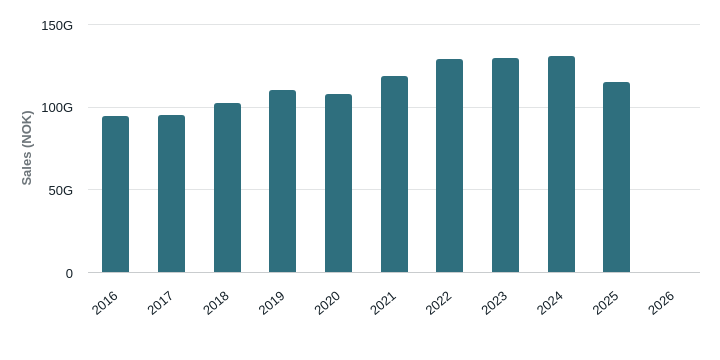
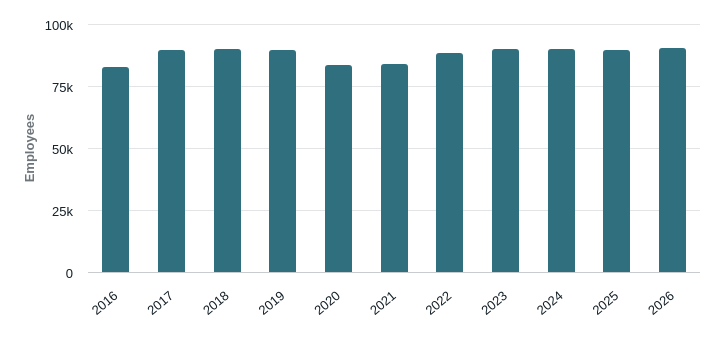
- Robust Commercial Scale: Local enterprise turnover reached NOK 130.4 billion in 2024, supporting an active workforce of over 90,000 employees across corporate, public, and healthcare organizations.
- Industrial & Technological Strength: Heavy industrial and equipment manufacturing—represented by leaders such as National Oilwell Varco Norway AS, Glencore Nikkelverk AS, and Mhwirth AS—drives high export value and technological innovation.
- Substantial Service & Regional Draw: Anchor institutions like Kristiansand Dyrepark AS and Universitetet i Agder drive strong year-round consumer demand, regional tourism, and talent pipelines.
- Geographic Concentration: While Kristiansand city center commands over 85,000 employees, surrounding sub-centers including Søgne, Nodeland, and Hamresanden provide specialized commercial, logistics, and industrial spaces.
Economic Overview: YoY Growth & Revenue Trends
Over the past decade, Kristiansand has demonstrated sustained top-line sales growth. Total enterprise sales revenue rose from NOK 94.2 billion in 2016 to NOK 130.4 billion in 2024, representing an overall expansion of nearly 38.5% over the period.
The municipal labor market expanded from 82,621 employees in 2016 to reach 90,037 employees in 2024, holding steady around the 90,000 mark. Note that sales figures for 2025 and 2026 represent incomplete annual reporting cycles rather than structural market contractions.
Historical Revenue & Workforce Indicators
| Year | Sales Revenue (NOK) | YoY Sales Change | Employees | YoY Employment Change |
|---|---|---|---|---|
| 2016 | 94.18 B | — | 82,621 | — |
| 2017 | 95.23 B | +1.1% | 89,343 | +8.1% |
| 2018 | 102.51 B | +7.6% | 90,014 | +0.8% |
| 2019 | 110.15 B | +7.4% | 89,439 | -0.6% |
| 2020 | 107.56 B | -2.3% | 83,594 | -6.5% |
| 2021 | 118.81 B | +10.5% | 83,815 | +0.3% |
| 2022 | 128.88 B | +8.5% | 88,241 | +5.3% |
| 2023 | 129.44 B | +0.4% | 90,050 | +2.1% |
| 2024 | 130.42 B | +0.8% | 90,037 | -0.0% |
This macroeconomic stability reflects Kristiansand's position as a regional epicenter capable of absorbing economic fluctuations through its balance of heavy manufacturing, retail, and public sector employment.
Industry Structure & Organizational Breakdown
Kristiansand's industrial structure is characterized by high diversity, ranging from advanced heavy manufacturing to high-density retail, healthcare, and professional consulting services.
Sector Highlights by Employment & Output
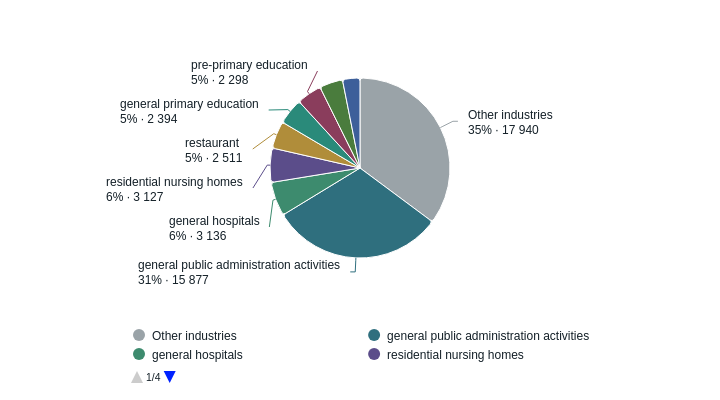
- Public Administration & Healthcare: General public administration activities employ 15,877 workers, while general hospitals (3,136 employees; NOK 3.79 billion operating income) and residential nursing facilities (3,127 employees) form a major healthcare nexus.
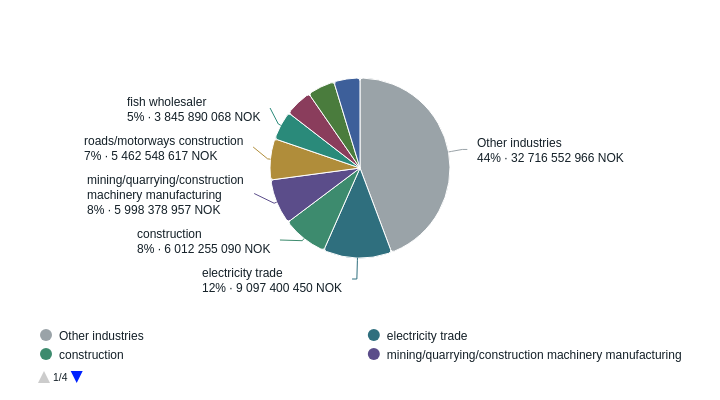
- Industrial Machinery Manufacturing: Mining, quarrying, and construction machinery manufacturing is one of the highest-yield commercial sectors, producing NOK 6.00 billion in operating income across 3 companies with 1,325 employees, maintaining a 10% EBITDA margin.
- Retail & Consumer Commerce: Supermarket chains (1,278 employees; NOK 3.06 billion revenue) and clothing stores (946 employees; NOK 1.46 billion revenue) underline Kristiansand's role as Agder's retail regional center.
- Construction & Technical Consulting: The local construction sector includes 163 companies employing 2,138 workers with NOK 6.17 billion in operating income. Technical consulting accounts for 144 companies employing 1,203 skilled professionals.
- Hospitality & Leisure: Restaurants (2,511 employees; NOK 794.8 million revenue) and hotels (1,040 employees; NOK 829.0 million revenue) benefit directly from domestic and international tourism.
Legal Forms & Business Structure
Limited liability companies (Aksjeselskap / AS) are the primary driver of corporate commercial activity in Kristiansand:
- AS (Aksjeselskap): 3,275 active companies employing 48,542 individuals, generating NOK 116.99 billion in operating income.
- SÆR (State/Regional Health Enterprises): 29 entities accounting for 5,385 employees and NOK 6.68 billion operating income.
- ORGL & KOMM (Municipal/Public Entities): Account for over 33,000 public and administrative positions.
- SA / STI / ENK: Cooperatives, foundations, and sole proprietorships round out the local enterprise mix, serving specialized community and professional needs.
Business Geography & Regional Sub-Markets
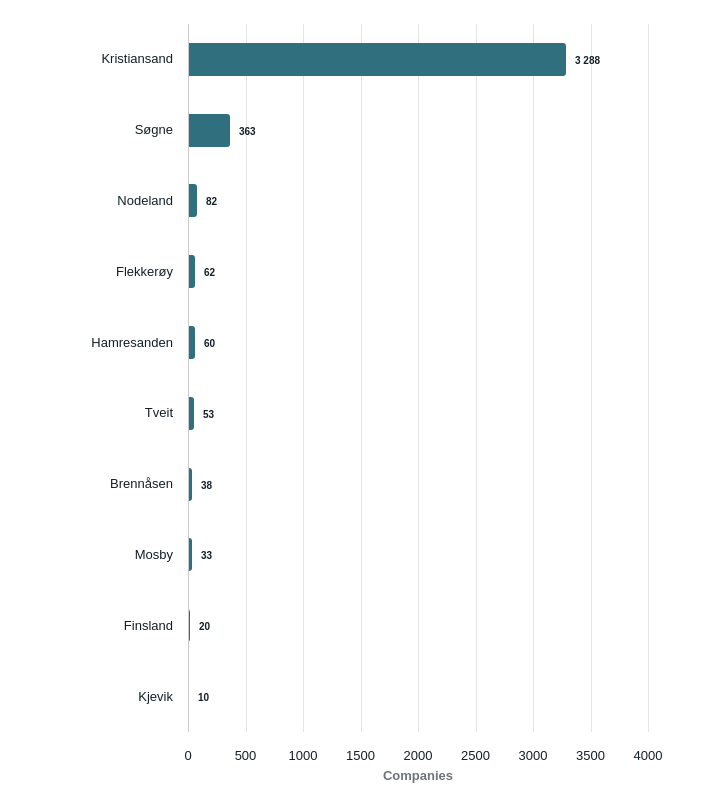
Commercial activity in Kristiansand municipality is distributed across several key geographical districts, each fulfilling distinct functional roles.
Key Geographic Hubs
| Location | Active Companies | Employees | Operating Income (NOK) | Primary Character |
|---|---|---|---|---|
| Kristiansand (City Center/Urban) | 3,288 | 85,809 | 133,445.5 M | Regional administrative, financial, retail, and industrial core |
| Søgne | 363 | 5,014 | 4,972.1 M | Residential, commercial service, and light industrial hub |
| Nodeland | 82 | 1,146 | 1,148.3 M | Inland industrial and local commercial center |
| Hamresanden | 60 | 648 | 942.4 M | Airport-adjacent commercial, logistics, and service cluster |
| Flekkerøy | 62 | 537 | 530.1 M | Maritime, fishing, and coastal service operations |
| Mosby | 33 | 330 | 605.1 M | Industrial and manufacturing sub-district |
| Kjevik | 10 | 218 | 301.8 M | Aviation logistics and airport infrastructure |
| Finsland | 20 | 183 | 30.8 M | Rural agricultural and niche local service center |
Kristiansand's city core holds over 95% of total municipal revenue, while districts like Søgne and Nodeland offer expanding commercial space for light manufacturing, trade services, and logistics.
Largest Employers & Anchor Companies
Kristiansand hosts major public health institutions, municipal bodies, and global industrial businesses that anchor the local economy.
Leading Municipal Employers
- Kristiansand Kommune: The largest overall employer in the region, with 14,850 employees delivering administrative, educational, and public services.
- Sørlandet Sykehus HF (Somatikk & Related Divisions): The somatic hospital unit employs 2,256 healthcare workers with NOK 2.73 billion in operating income, alongside specialized psychiatric (559 employees) and diagnostic divisions (431 employees).
- Universitetet i Agder: A central academic institution employing 1,594 faculty and staff, serving as the regional pipeline for technology, business, and education talent.
- Kristiansand Dyrepark AS: Scandinavia's flagship amusement and zoo destination, employing 1,337 people and generating NOK 530.5 million in operating income with an 18% EBITDA margin.
- National Oilwell Varco Norway AS (Kristiansand Branch): Heavy machinery and offshore technology manufacturer employing 800 workers, with NOK 3.87 billion in operating income.
- Glencore Nikkelverk AS: A global nickel refinery operation employing 626 specialists, recording NOK 2.06 billion in operating income and a robust 25% EBITDA margin.
- Mhwirth AS (Kristiansand Branch): Offshore drilling equipment manufacturer employing 520 employees with NOK 2.12 billion in operating income.
- Hennig Olsen Is AS: Iconic national ice cream manufacturer headquartered in Kristiansand, employing 324 workers and achieving NOK 1.20 billion in operating income.
Business Dynamism & Bankruptcy Statistics
Business turnover and market restructuring remain normal aspects of Kristiansand's corporate lifecycle. Across the municipality, 84 total bankruptcies were registered in the overall area.
Bankruptcy Distribution by Sector
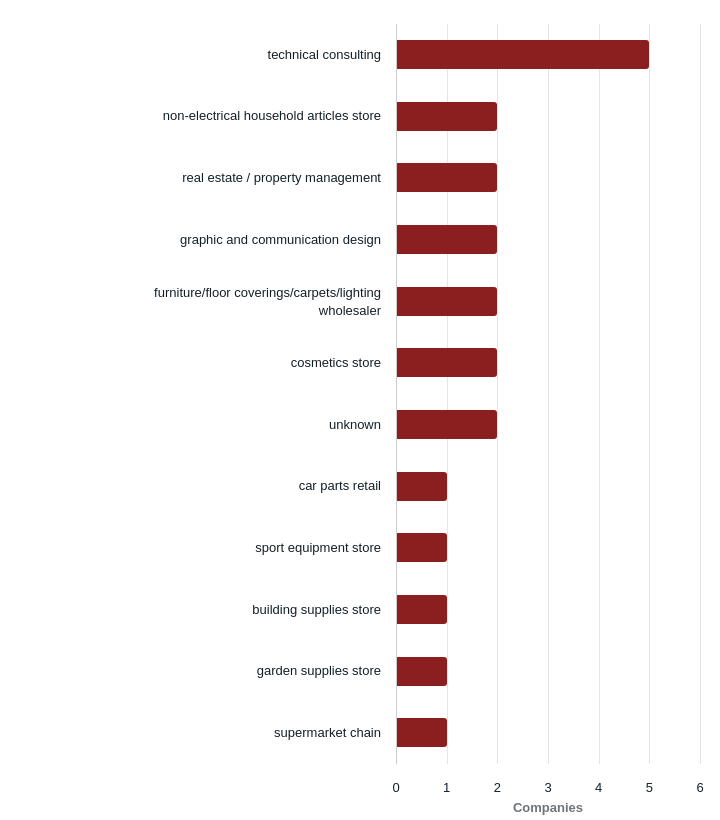
Detailed breakdown of bankrupt entities shows that failures are spread lightly across small retail, specialized consulting, and consumer services:
- Technical Consulting: 5 small entities recorded bankruptcies, reflecting shifting demand cycles in specialized engineering contracts.
- Furniture & Floor Wholesale: 2 companies involved in wholesale trade recorded insolvency.
- Graphic & Communication Design: 2 small entities registered bankruptcies.
- Cosmetics & Retail Stores: Niche retail shops (2 cosmetics stores, 1 building supply store, 1 garden store) experienced insolvencies, influenced by changing consumer purchasing habits and pressure on retail margins.
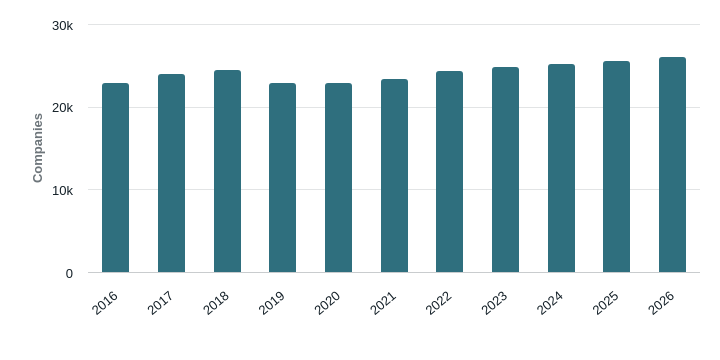
Overall, the low proportion of bankruptcies relative to Kristiansand's 26,000+ registered business entries demonstrates strong corporate resiliency across the regional economy.
Opportunities for Founders & Business Leaders
For prospective entrepreneurs, Kristiansand provides a well-rounded platform with opportunities across multiple sectors:
- Green Tech & Industrial Services: Suppliers and technology developers can leverage proximity to industrial giants like Glencore, National Oilwell Varco, and Mhwirth for B2B contracts, decarbonization solutions, and industrial automation.
- Tourism & Visitor Economy Ecosystem: With Kristiansand Dyrepark drawing hundreds of thousands of visitors annually, complementary opportunities exist in seasonal hospitality, food innovation, experiences, and digital tourism services.
- Professional & IT Consulting: High demand remains for specialized engineering, software development, financial consulting, and digital transformation capabilities to support both local SME growth and major corporate operations.
- Healthcare & Biotech Innovation: Proximity to Sørlandet Sykehus HF and Universitetet i Agder creates strong conditions for health tech startups, care technologies, and specialized research services.
Founders looking to establish operations in the area can utilize SmartGrunder to explore address distributions, industry concentrations, and competitive landscapes across Kristiansand's commercial zones.
Conclusion
Kristiansand's economy combines structural stability with commercial innovation. Its status as Southern Norway's central city guarantees high public sector baseline employment, while its world-class industrial cluster, thriving university, and regional retail footprint offer attractive growth avenues for ambitious business founders.
With NOK 130+ billion in annual corporate revenues and a skilled workforce of over 90,000 employees, Kristiansand remains one of Norway's most promising locations for establishing and expanding business enterprises.