Municipality
Larvik Municipal Economic Analysis: Business Landscape & Entrepreneurial Opportunities
An in-depth review of industry structure, workforce trends, regional hubs, and market dynamism in Larvik
Executive Summary
Larvik is a principal commercial, industrial, and maritime hub in Vestfold county, serving as a vital logistical gateway between eastern Norway and mainland Europe. The municipal economy is characterized by a strong industrial backbone, major wholesale and distribution operations, a robust construction sector, and a thriving coastal tourism and wellness industry. Public health and social services also form a major part of local employment.
According to municipal market data, business activity in Larvik generates upwards of NOK 40 billion in annual enterprise revenue, anchored by over 24,000 active positions across private and public entities. Key enterprise anchors such as Asko Vestfold Telemark AS, Veidekke Entreprenør AS, Jotron AS, and Farris Bad Hotelldrift AS highlight the diversity of the local economic base—spanning grocery distribution, heavy construction, high-tech communications manufacturing, and premium hospitality.
For prospective founders, investors, and local policymakers, Larvik offers a balanced economic environment. While macroeconomic cost pressures have introduced selective friction in construction trades and consumer retail, the municipality's geographic advantages, diverse rural-urban centers, and deep logistics networks present attractive growth opportunities.
Economic Overview
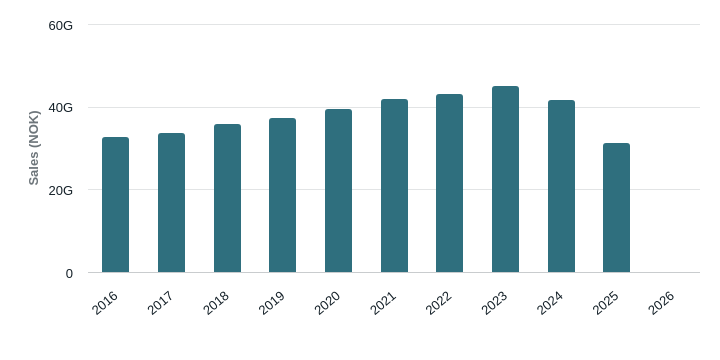
Larvik's corporate top-line revenue experienced steady growth over the past decade, climbing from NOK 32.59 billion in 2016 to a peak of NOK 45.05 billion in 2023. This expansion represents a overall sales increase of over 38% across the period, driven by expansion in wholesale distribution, civil engineering, and specialized technical manufacturing.
| Year | Total Sales Revenue (NOK) | YoY Change (%) | Total Employees | Employee YoY Change (%) |
|---|---|---|---|---|
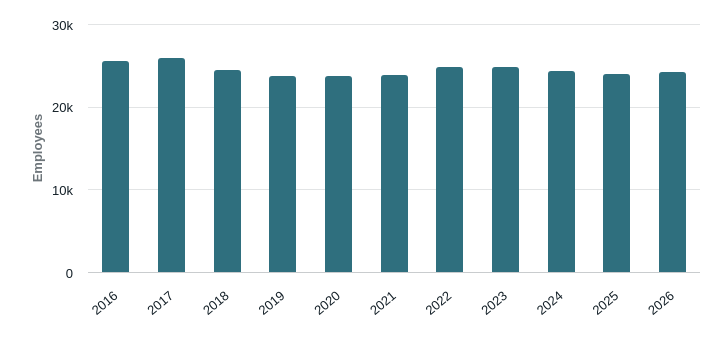
| 2016 | 32,590.0M | — | 25,571 | — |
| 2017 | 33,705.3M | +3.4% | 25,836 | +1.0% |
| 2018 | 35,850.7M | +6.4% | 24,457 | -5.3% |
| 2019 | 37,218.4M | +3.8% | 23,720 | -3.0% |
| 2020 | 39,524.1M | +6.2% | 23,678 | -0.2% |
| 2021 | 41,857.0M | +5.9% | 23,826 | +0.6% |
| 2022 | 42,994.9M | +2.7% | 24,752 | +3.9% |
| 2023 | 45,045.9M | +4.8% | 24,800 | +0.2% |
| 2024 | 41,636.0M | -7.6% | 24,374 | -1.7% |
| 2025 | 31,223.7M* | -25.0%* | 23,990 | -1.6% |
*Note: Figures for 2025 and 2026 reflect partial registry filings at the time of data collection and represent incomplete annual totals rather than a structural economic contraction.
Total employment in the municipality has stabilized between 24,000 and 25,000 reported positions over the last five years. The plateau in employee headcount alongside rising total revenues reflects increased labor productivity and capital intensity, particularly in high-volume logistics and heavy contracting industries.
Industry Structure
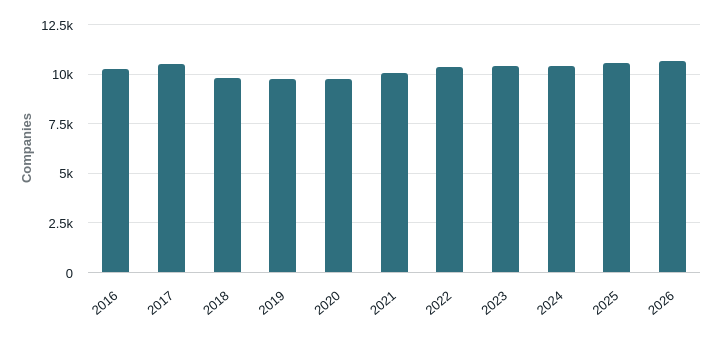
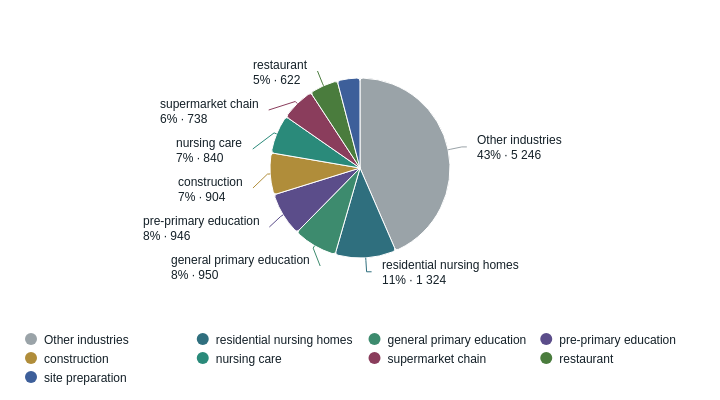
Larvik's business structure features a powerful mix of private corporations (Aksjeselskap - AS), extensive municipal welfare services (Kommune - KOMM), and specialized state/regional health institutions (Særbedrift - SÆR). Private limited companies (AS) account for over 15,200 employees and NOK 40.08 billion in annual sales across 1,295 registered firms.
Key Private Industry Sectors
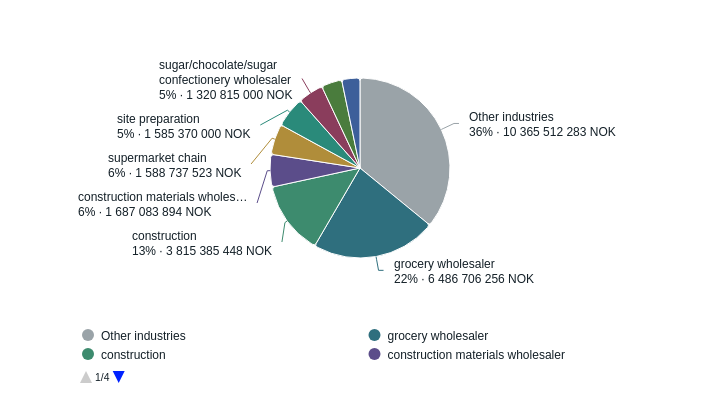
- Grocery & Wholesale Trade: Dominated by large distribution facilities such as Asko Vestfold Telemark AS, grocery wholesaling generates over NOK 6.48 billion in revenue with high capital throughput per employee.
- Construction & Civil Engineering: General construction and specialized site preparation account for 119 companies and nearly 1,400 employees, generating over NOK 5.4 billion in combined revenue.
- Manufacturing & Technology: Technology firms like Jotron AS (communication equipment) deliver high-margin export products, generating NOK 837.5M in revenue with strong EBITDA margins (~12%).
- Hospitality & Retail: Supermarket chains, clothing stores, restaurants, and hotels employ over 2,000 workers across Larvik, serving both permanent residents and a substantial summer tourist population.
Legal Form Breakdown
| Organisation Form | Number of Entities | Total Employees | Sales Revenue (NOK) | Operating Margin |
|---|---|---|---|---|
| Private Limited Company (AS) | 1,295 | 15,236 | 40,081.6M | 3% |
| Municipal Entities (KOMM) | 145 | 6,500 | 0.0M | — |
| State/Regional Entities (SÆR) | 6 | 581 | 717.2M | 3% |
| Sole Proprietorship (ENK) | 117 | 461 | 20.6M | 33% |
| Cooperatives (SA) | 19 | 352 | 493.3M | 2% |
| Inter-Municipal Companies (IKS) | 2 | 52 | 161.6M | 28% |
Business Geography
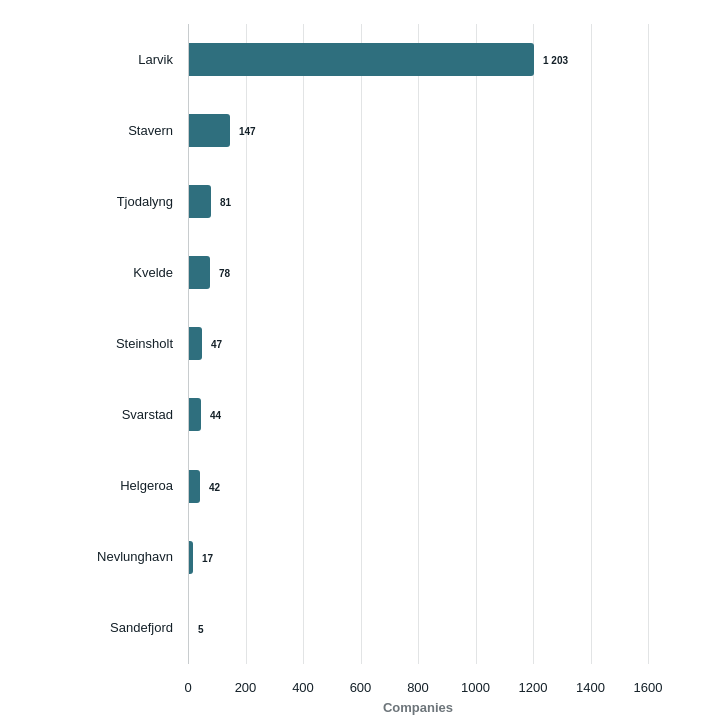
Larvik municipality spans a diverse geography, combining an urban coastal center with coastal resort towns and inland agricultural/industrial villages. Business activity concentrates primarily in the central city of Larvik, supported by strong economic sub-centers.
| Place / City | Companies | Employees | Sales Revenue (NOK) | Revenue Growth | Operating Margin |
|---|---|---|---|---|---|
| Larvik (Urban Core) | 1,203 | 19,415 | 36,608.4M | 1% | 3% |
| Stavern | 147 | 2,116 | 1,262.5M | 6% | 7% |
| Steinsholt | 47 | 480 | 1,234.6M | 7% | 3% |
| Helgeroa | 42 | 549 | 884.6M | 5% | 2% |
| Svarstad | 44 | 563 | 695.4M | 17% | 1% |
| Kvelde | 78 | 652 | 557.2M | 11% | 4% |
| Tjodalyng | 81 | 968 | 527.3M | 4% | 1% |
| Nevlunghavn | 17 | 156 | 81.6M | 6% | 9% |
Spatial Dynamics
- Larvik City: The central economic engine hosting over 80% of municipal employment and revenues. It encompasses major industrial estates (e.g., Hegdal, Elveveien, Bommestad) alongside port operations and downtown retail.
- Stavern: A high-margin coastal town combining health services (Kysthospitalet) with high-end hospitality, cultural tourism, and residential services.
- Steinsholt & Svarstad: Inland industrial hubs in Lågendalen exhibiting strong top-line revenue growth (+7% and +17% respectively), supported by specialized rock protection (Nordisk Fjellsikring AS) and forestry/agriculture.
- Coastal Outposts (Helgeroa & Nevlunghavn): Seasonal retail, maritime commerce, and local service providers with healthy profit margins.
Largest Employers
Employment in Larvik is anchored by a mix of major public welfare providers and substantial commercial enterprises in logistics, construction, healthcare, and electronics manufacturing.
Top Reported Employers in Larvik
| Employer Name | Sector / Industry | Employees | Reported Sales / Revenue |
|---|---|---|---|
| Larvik Kommune Hjemmetjenester | Home Healthcare Services | 745 | Public Sector |
| Veidekke Entreprenør AS Fo Øst | General Construction | 502 | NOK 2,841.6M |
| Thor Heyerdahl Videregående Skole | Secondary Education | 342 | Public Sector |
| Farris Bad Hotelldrift AS | Hospitality & Wellness | 268 | NOK 207.8M (Op. Income) |
| Furuheim Sykehjem | Nursing Care | 257 | Public Sector |
| Jotron AS | Communication Equipment Mfg. | 224 | NOK 837.5M |
| Larvik Kommune Helsehuset | Residential Healthcare | 224 | Public Sector |
| Asko Vestfold Telemark AS | Grocery Wholesale | 219 | NOK 6,440.1M |
| Redgo Norway AS Avd Larvik | Transport Assistance / Support | 208 | NOK 495.7M |
| Sykehuset i Vestfold HF (Kysthospitalet) | General Rehabilitation Hospital | 203 | NOK 241.7M |
| Nordisk Fjellsikring AS Avd Svarstad | Specialized Rock Protection | 147 | NOK 532.6M |
| Nasta AS Avd Larvik | Construction Machinery Wholesale | 139 | NOK 842.4M |
These enterprise anchors create deep local supply chain links. For example, Nasta AS and Veidekke drive demand for sub-contractors, equipment service shops, and logistics partners, while Jotron AS supports a network of engineering and technical suppliers.
Business Dynamism
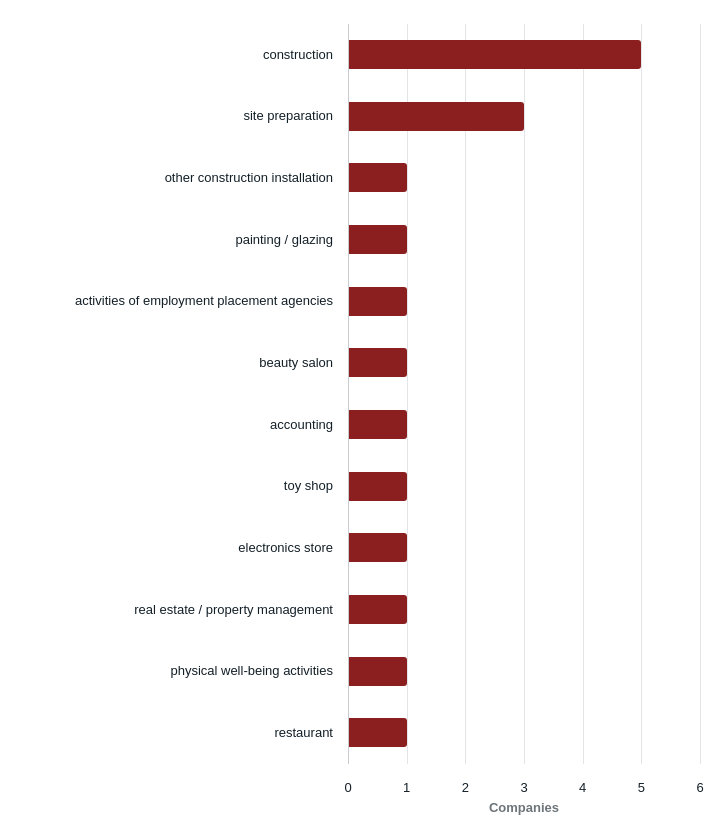
Larvik maintains an active business creation environment, though macro cost adjustments have triggered insolvencies in cost-sensitive sub-sectors. Official statistics record 23 bankruptcies in the recent area sample, representing isolated structural pressure rather than broader economic distress.
Sectoral Insolvency Analysis
Insolvencies are primarily concentrated in small-scale, labor-intensive sectors facing rising input costs and squeezed consumer discretionary spending:
- Construction & Finishing Trades: 5 general construction firms and specialized sub-trades such as painting/glazing (e.g., Malermester Skalleberg AS) faced margin pressure, reflecting broader national headwinds in residential building.
- Consumer Retail & Hospitality: Isolated bankruptcies occurred among specialized retail (toy shops, electronics) and small food service operators (e.g., Bistro Istanbul AS, Cornerlarvik AS).
- Technical Services & Automotive: Minor insolvencies hit independent car repair shops (Byens Bilvask AS) and small employment placement startups.
Despite these localized insolvencies, core industries in Larvik—such as logistics, maritime tech, wholesale, and civil engineering—continue to report stable operating margins and steady growth.
Opportunities for Founders
Larvik's combination of industrial infrastructure, strategic logistics links (E18 highway, port facilities, rail access), and scenic coastal tourism creates clear market gaps for innovative startups and expanding SMEs.
Prime Strategic Growth Focus Areas
- Logistics & Green Transport Supply Services:
Given Larvik's role as a primary distribution hub (exemplified by Asko and Redgo), there is growing demand for fleet electrification support, last-mile logistics technology, depot maintenance, and cold-chain innovation.
- Specialized Industrial & Marine Engineering:
The presence of global technology exporters like Jotron AS offers opportunities for specialized sub-suppliers, software developers, quality assurance labs, and high-tech maintenance providers.
- Seasonal & Year-Round Wellness Tourism:
Building on the international reputation of Farris Bad and Stavern's cultural draws, opportunities exist for premium eco-tourism, experiential travel, local food concepts, and health technology services.
- Sustainable Construction & Site Services:
With heavy civil engineering projects across Vestfold, circular construction materials, recycling solutions, and equipment automation represent scalable avenues.
Founders evaluating commercial site locations, market density, and sectoral competition across Larvik can use analytical mapping tools like SmartGrunder to explore postal code performance and municipal industry clusters before launching.
Conclusion
Larvik represents a well-diversified municipal economy that balances large-scale industrial distribution with specialized manufacturing, health services, and coastal tourism. While macroeconomic conditions require discipline in consumer-facing and residential construction sectors, the municipality's top-line revenue capacity—surpassing NOK 40 billion—underpins long-term commercial stability.
With strong anchor employers, excellent transport infrastructure, and active regional centers from Stavern to Lågendalen, Larvik remains a compelling base for entrepreneurs and established companies looking to expand in southern Norway.