Municipality
Lyngdal Municipal Economy: Economic Profile and Commercial Opportunities
An in-depth analysis of industry structure, employment trends, regional geography, and entrepreneurship opportunities in Lyngdal
Executive Summary
Lyngdal serves as a vital commercial and industrial engine in Western Agder. The municipality combines a strong manufacturing backbone—particularly in wood-based building materials and component fabrication—with a robust regional retail sector, civil construction, technical services, and coastal tourism.
Key economic highlights for Lyngdal include:
- Substantial Industrial Base: Key industrial producers such as Fibo AS, Alloc AS, and Nordic Door AS generate billions in turnover and provide steady employment, anchoring the regional supply chain.
- Regional Commercial Hub: The town center of Lyngdal attracts significant consumer activity across supermarket retail, car dealerships, and specialty trade, drawing customers from surrounding municipalities.
- Diverse Micro-Geographies: While the primary urban center of Lyngdal accounts for over 90% of total revenue, outer areas like Konsmo, Kvås, and Byremo sustain distinct local economies in agriculture, local services, and specialised manufacturing.
- Resilient Employment Market: Total municipal corporate turnover reached NOK 8.0 billion in 2024, supported by a workforce hovering around 6,200 to 6,300 employees across private and public entities.
Economic Overview
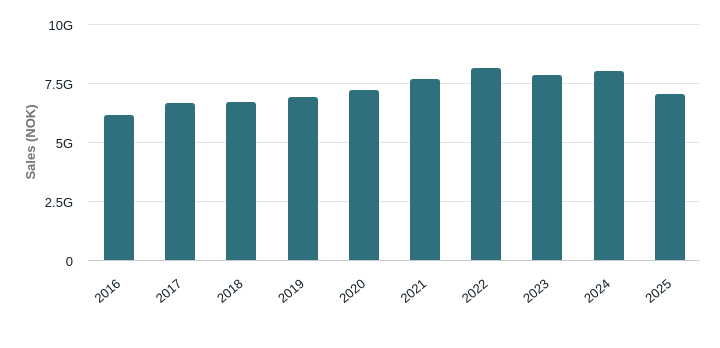
Lyngdal's economy has demonstrated strong expansion over the past decade, growing from NOK 6.13 billion in aggregate corporate sales revenue in 2016 to a peak of NOK 8.11 billion in 2022. Following a slight market correction in 2023, turnover recovered to NOK 8.01 billion in 2024.
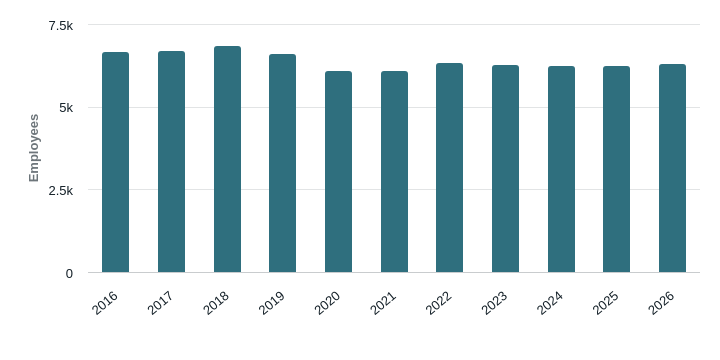
Employment levels have remained comparatively stable over the same timeframe. After reaching a high of 6,837 workforce positions in 2018, total employment recalibrated around 6,200 to 6,300 employees in recent years, with 2026 projections indicating approximately 6,276 active positions.
The table below summarizes the multi-year trajectory of company sales revenue and total workforce inside Lyngdal municipality:
| Year | Aggregate Sales Revenue (NOK) | Total Employees | Sales YoY Change | Employee YoY Change |
|---|---|---|---|---|
| 2016 | 6,128.0M | 6,645 | — | — |
| 2018 | 6,698.9M | 6,837 | +0.9% | +2.2% |
| 2020 | 7,214.3M | 6,074 | +4.2% | -7.7% |
| 2022 | 8,114.6M | 6,311 | +5.8% | +3.7% |
| 2024 | 8,005.0M | 6,218 | +2.2% | -0.8% |
| 2025 | 7,041.4M | 6,224 | -12.0% | +0.1% |
| 2026 | N/A | 6,276 | N/A | +0.8% |
Note: 2025 figures represent early reporting or adjusted market baselines, while 2026 employee figures represent preliminary municipal tracking.
Industry Structure & Organizational Forms
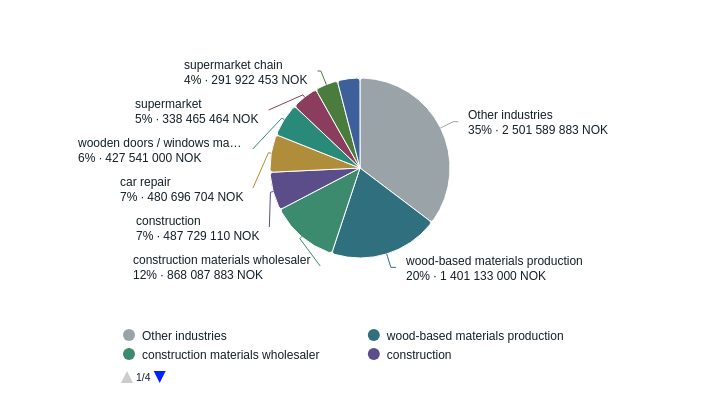
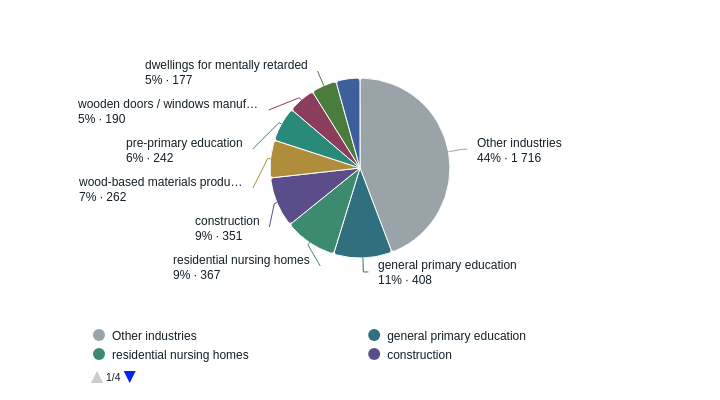
Lyngdal's private sector is structured around advanced manufacturing, heavy construction, trade, and technical services. The wood products manufacturing segment generates over NOK 1.4 billion in annual operating income alone across key industrial sites.
Primary Industry Sectors
- Wood-Based Materials & Component Manufacturing: Led by wall panel and flooring manufacturers, generating NOK 1.40 billion with 262 employees, alongside window and door manufacturing generating NOK 427.5M (190 employees).
- Construction & Site Preparation: Civil engineering, general construction, and site preparation account for 36 registered companies employing nearly 500 workers and generating over NOK 769 million in combined revenue.
- Retail & Automotive Trade: Supermarkets, clothing stores, and car dealerships represent a major pillar of local employment, with car dealerships bringing in NOK 289.0M and general supermarkets generating NOK 344.6M.
- Technical Consulting & Services: Technical engineering, consulting, and electrical installation firms (15 companies, 123 employees) deliver NOK 169.1M in revenue.
- Hospitality & Tourism: Hotels (e.g., Rosfjord Strandhotel AS) and recreational facilities (such as Sørlandsbadet AS) support over 200 seasonal and permanent jobs.
Organizational Form Distribution
Standard limited liability companies (AS) dominate the corporate revenue and employment footprint, while municipal structures (KOMM) anchor public welfare and primary education.
- AS (Aksjeselskap): 336 companies, 3,932 employees, NOK 8.40B operating income.
- KOMM (Kommune): 47 organizational units, 1,777 employees (nursing homes, primary schools, home care).
- SA (Samvirkeforetak): 5 entities, 134 employees, NOK 631.1M operating income (including major cooperative retail centers like Obs Lyngdal).
- ENK (Enkeltpersonforetak): 23 registered sole proprietorships with employees.
Business Geography
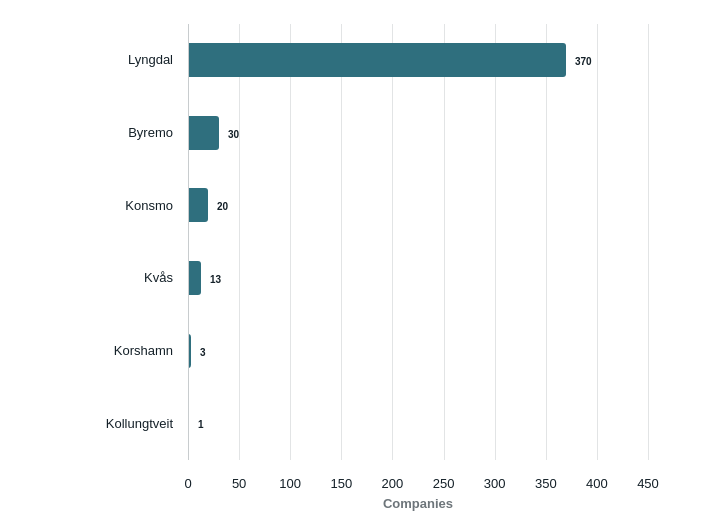
Economic activity in Lyngdal is concentrated in the main municipal center, complemented by active secondary hubs along key transport corridors and inland valleys.
| Area / Place | Number of Companies | Total Employees | Operating Income (NOK) | EBITDA Margin |
|---|---|---|---|---|
| Lyngdal | 370 | 5,522 | 7,803.1M | 6% |
| Konsmo | 20 | 287 | 585.3M | 5% |
| Kvås | 13 | 136 | 439.8M | 1% |
| Byremo | 30 | 430 | 161.3M | 9% |
| Korshamn | 3 | 25 | 82.4M | 49% |
| Kollungtveit | 1 | 14 | 11.7M | 11% |
Geographic Characteristics
- Lyngdal Urban Core: Houses the commercial centers, major industrial parks (Fiboveien, Industriveien, Travveien), regional shopping malls, and hospitality resorts along Rosfjorden.
- Konsmo & Kvås: Key inland centers with strong industrial and contracting activity, recording substantial turnover relative to their workforce sizes.
- Byremo: Serves as a local service center in the northern part of the municipality, hosting healthcare facilities like Byremo Omsorgssenter and local trade.
- Korshamn: Coastal community showing exceptional profitability driven by specialized marine and maritime operations, achieving a 49% EBITDA margin.
Largest Employers
Lyngdal's employment market is backed by large manufacturing enterprises, regional infrastructure contractors, major retail outlets, and public sector health and education institutions.
Top Private Sector Employers
- Nornebygg AS: Construction firm operating out of Industriveien, reporting 184 employees.
- Nordic Door AS: Leading door and window manufacturer located at Travveien, employing 176 workers with NOK 415.8M in revenue.
- Alloc AS: Major wood-based wall panel and flooring producer located at Fiboveien, employing 150 people with NOK 640.5M in turnover.
- Fibo AS: Global supplier of waterproof wall panel systems based at Industriveien, employing 112 people with NOK 762.6M in operating income and strong profitability (EBITDA NOK 81.7M).
- Erv Teknikk AS: Technical consulting and engineering firm with 86 employees generating NOK 138.6M in sales.
- Rosfjord Strandhotel AS: Premier coastal hotel complex with 84 employees and NOK 47.9M in revenue.
- Sørlandsbadet AS: Waterpark and recreation center employing 83 staff members.
- Obs Lyngdal Avd 300: Major supermarket hub employing 82 staff members, generating NOK 254.6M in income.
- Lindland Maskin AS: Site preparation and earthmoving contractor employing 72 staff with NOK 203.5M in revenue.
Key Public Sector Employers
- Lyngdal Helsehus Avd Institusjon: Residential nursing home facility employing 207 care workers.
- Lyngdal Kommune Habilitering Bergsaker: Residential and care services employing 177 workers.
- Lyngdal Kommune Hjemmetjenester: Home care services employing 129 personnel.
- Byremo Omsorgssenter: Northern healthcare center employing 98 workers.
- Primary Schools: Local schools including Berge Barneskole (73 employees) and Lyngdal Ungdomsskole (73 employees).
Business Dynamism & Market Stability
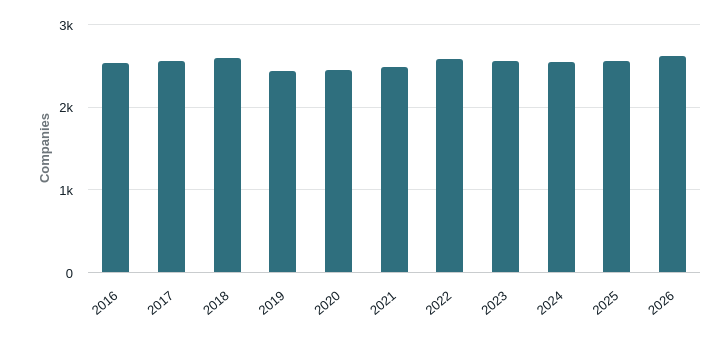
The commercial ecosystem in Lyngdal exhibits high stability, supported by well-capitalized industrial anchors and constant local consumer demand. Insolvencies remain low relative to the overall volume of 2,636 registered corporate entities in the area.
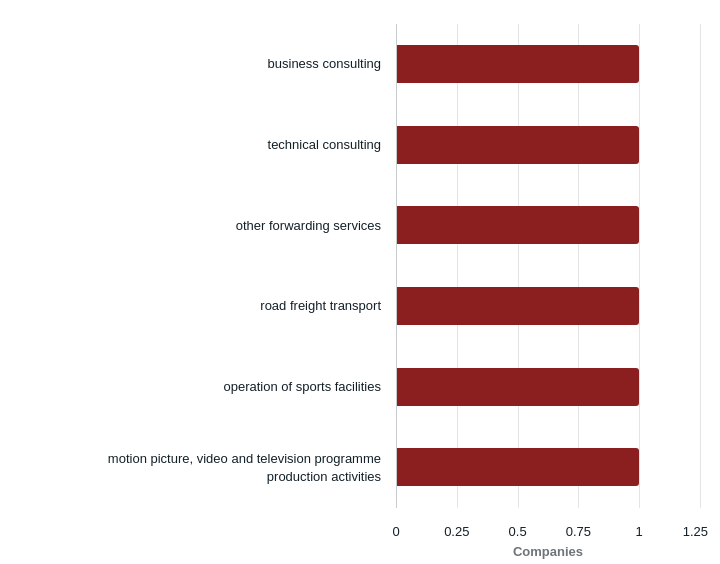
Recent bankruptcy data reflects isolated adjustments in small service businesses and specific venture-backed projects rather than broad-based systemic distress:
- Cadens AS: Business consulting (NOK 1.8M turnover).
- Just Padel Lyngdal AS: Indoor sports facility operator (NOK 1.0M revenue).
- Petru Distribusjon AS: Local freight distribution (NOK 1.2M revenue).
- Modalsli Rør Lister AS, Petru Byggtjenester AS, Media Sør Productions AS: Pre-revenue or holding entities with limited employee impact.
Overall, the low insolvency volume confirms that Lyngdal's core manufacturing, trade, and engineering clusters maintain stable credit profiles and resilient market positions.
Opportunities for Founders & Entrepreneurs
Lyngdal offers compelling advantages for new business ventures due to its role as Western Agder's regional trade node and its dense industrial supply chain.
Key Venture Opportunities
- Industrial Sub-Contracting & Technical Services: With high-tech manufacturing giants like Fibo, Alloc, and Nordic Door operating in the area, specialized service providers in robotics, automation maintenance, logistics, and industrial packaging can find eager B2B clients.
- Green Building & Renewable Energy Solutions: Given the concentration of prefabricated building and wood manufacturing companies, innovations in sustainable materials, circular waste management, and energy-efficient retrofitting fit naturally into the local economy.
- Tourism & Commercial Experience Services: Rosfjorden and the surrounding coastal area attract thousands of seasonal visitors. Opportunities exist for year-round gastronomy concepts, outdoor recreation rentals, and digital hospitality management.
- Professional & Digital Services: As technical consulting firms like Erv Teknikk thrive, there is growing demand for specialized IT, compliance, marketing, and HR consulting services tailored to SME manufacturers.
Entrepreneurs exploring potential business locations, commercial properties, or market niches across Lyngdal municipality can utilize SmartGrunder's analytics tools to evaluate local demographics, industry density, and neighborhood commercial patterns.
Conclusion
Lyngdal combines the strength of an established industrial manufacturing hub with the vitality of a regional retail and tourism destination. With over NOK 8 billion in annual corporate turnover and a well-balanced mix of private enterprise and public infrastructure, the municipality offers a reliable and scalable environment for business growth.
For founders, investors, and local decision-makers, Lyngdal presents strong fundamentals: stable employment, high industrial productivity, and a supportive regional market across Agder.