Municipality
Måsøy Economic Analysis: Commercial Growth, Seafood Supremacy, and Entrepreneurial Landscape
An in-depth evaluation of industry structure, employment trends, and regional business dynamics in Måsøy municipality
Executive Summary
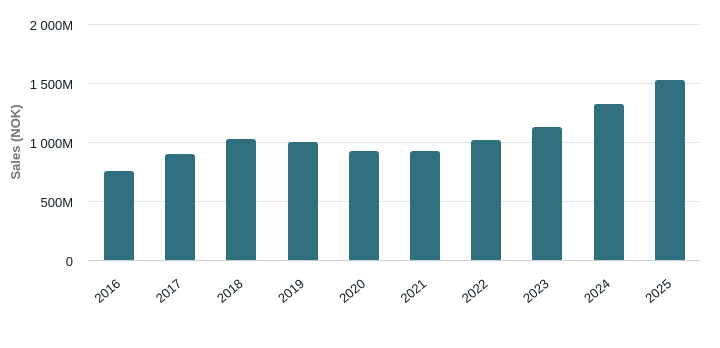
Måsøy municipality, located in Troms og Finnmark county, represents a key Arctic coastal economy strongly anchored by marine industries, aquaculture, public administration, and specialized maritime services. Despite its remote geographical location, Måsøy generates substantial economic value, with total municipal business revenues rising from NOK 754.0 million in 2016 to an impressive NOK 1.53 billion in 2025.
Key structural highlights of the local economy include:
- Surging Commercial Sales: Corporate revenues have experienced strong double-digit growth in recent years (+17.3% in 2024 and +15.5% in 2025).
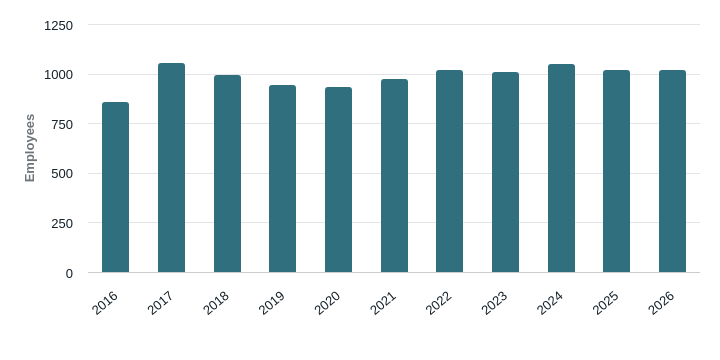
- Stable Labor Base: Total workforce figures remain firmly above 1,000 employees, balanced between public service operations and high-value private enterprise.
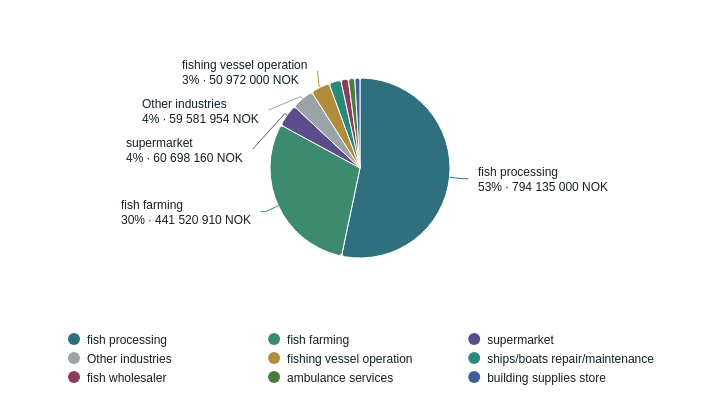
- Dominant Industrial Pillars: Fish processing (NOK 795.7 million) and fish farming (NOK 442.6 million) represent the vast majority of local commercial income.
- Geographic Concentration: Havøysund serves as the economic and administrative center with 883 employees, while Tufjord generates high turnover driven by large-scale seafood processing.
Economic Overview
Måsøy's overall business economy has shown extraordinary top-line sales expansion over the past decade. Following a temporary consolidation period around 2019–2020, revenue trajectory re-accelerated sharply, driven by strong global demand and high value realization in blue economy sectors.
The municipal labor market reflects notable stability. Employment surged from 857 workers in 2016 to over 1,000 workers by 2017, maintaining a steady level between 1,000 and 1,050 personnel through 2026.
| Year | Corporate Sales | YoY Sales Change | Local Employees | YoY Employment Change |
|---|---|---|---|---|
| 2016 | NOK 754.0M | — | 857 | — |
| 2017 | NOK 894.7M | +18.7% | 1,052 | +22.8% |
| 2018 | NOK 1,022.5M | +14.3% | 991 | -5.8% |
| 2019 | NOK 996.2M | -2.6% | 945 | -4.6% |
| 2020 | NOK 920.5M | -7.6% | 934 | -1.2% |
| 2021 | NOK 921.0M | +0.1% | 975 | +4.4% |
| 2022 | NOK 1,020.3M | +10.8% | 1,016 | +4.2% |
| 2023 | NOK 1,128.2M | +10.6% | 1,006 | -1.0% |
| 2024 | NOK 1,323.7M | +17.3% | 1,046 | +4.0% |
| 2025 | NOK 1,528.9M | +15.5% | 1,018 | -2.7% |
| 2026 | — | — | 1,018 | +0.0% |
Combined private sector revenue per employee in Måsøy's commercial entities is exceptionally high, particularly within capital-intensive marine farming and processing industries.
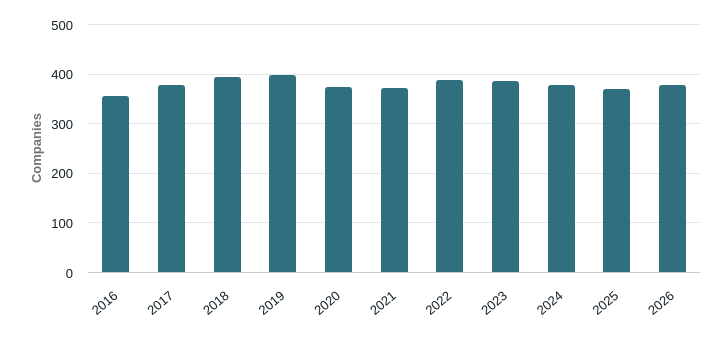
Industry Structure
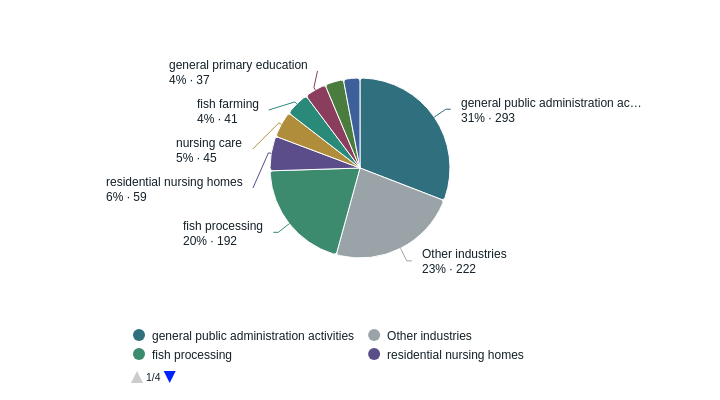
The industrial composition of Måsøy is heavily lean toward marine primary industries and value-added processing, complemented by essential public administration and health services.
Sector Highlights
- Fish Processing: Encompasses 3 registered enterprise setups with 192 total employees, generating NOK 795.7 million in operating income.
- Fish Farming: 2 active corporate units employing 41 people, delivering NOK 442.6 million in operating income with an EBITDA margin of 11% and high gross profitability.
- Fishing Vessel Operation: 8 active companies employing 21 fishermen, achieving NOK 58.7 million in revenue with an exceptional EBITDA margin of 42% and operating profit margin of 30%.
- Public Sector & Welfare: General public administration represents 293 employees across public entities, while healthcare and educational facilities employ over 180 public service staff.
- Maritime Support & Industry: Ship and boat repair/maintenance generates NOK 32.1 million (26 employees), supporting local and regional fleets.
Corporate Structure & Legal Forms
Private limited companies (AS) account for the vast majority of local business turnover and private employment.
| Legal Form | Entities Listed | Employees | Total Operating Income |
|---|---|---|---|
| Aksjeselskap (AS) | 46 | 403 | NOK 1,418.1M |
| Organisasjonsledd (ORGL) | 19 | 279 | NOK 0.0M (Public/Non-profit) |
| Kommune (KOMM) | 1 | 278 | NOK 0.0M (Municipal Admin) |
| Samvirkeforetak (SA) | 2 | 28 | NOK 61.7M |
| Særskilt Organ (SÆR) | 1 | 13 | NOK 17.4M |
Business Geography
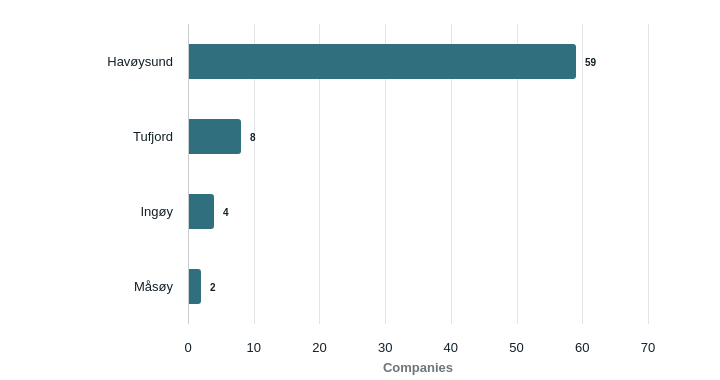
Economic activity in Måsøy municipality is concentrated across four principal geographical areas, each fulfilling distinct functional roles within the archipelago.
| Area / Settlement | Registered Companies | Total Employees | Operating Income | Sales Revenue | Key Economic Driver |
|---|---|---|---|---|---|
| Havøysund | 59 | 883 | NOK 820.9M | NOK 806.3M | Administrative center, shipyard, processing, retail, public services |
| Tufjord | 8 | 120 | NOK 680.1M | NOK 677.2M | Major seafood processing hub |
| Ingøy | 4 | 15 | NOK 6.2M | NOK 6.2M | Coastal fishing & local services |
| Måsøy (island) | 2 | 4 | NOK 1.1M | NOK 1.1M | Agriculture, local primary activity |
Havøysund acts as the primary service and infrastructure backbone for the municipality, housing retail stores, municipal offices, healthcare centers, and harbor repair facilities. Tufjord demonstrates exceptional revenue productivity per employee (NOK 6.9 million operating income per employee) due to concentrated fish processing operations.
Largest Employers
The employer landscape in Måsøy features a balanced combination of municipal institutions and heavy industrial seafood operators.
Major Public & Private Sector Employers
- Måsøy Kommune: Municipal primary administration employing 278 staff across civic, infrastructure, and technical roles.
- Tufjordbruket AS: Located in Tufjord, this fish processing leader employs 99 people and recorded NOK 672.9 million in operating income (+18% growth).
- Havøysund Helsesenter: Public healthcare facility employing 59 healthcare professionals.
- Havøysund Fisk AS: Major local fish processing enterprise employing 53 workers.
- Måsøy Kommune Hjemmebaserte Tjenester: Public home-based care unit with 45 employees.
- Tobø Fisk AS: Key seafood processor based in Havøysund employing 40 staff, generating NOK 122.8 million in operating income.
- SalMar Farming AS (Avd Måsøy): Modern aquaculture operation with 37 employees and NOK 441.1 million in turnover.
- Havøysund Skole & Høtten Barnehage: Educational institutions employing 32 workers each.
- Frydenbø Yards Havøysund AS: Specialized shipyard facility employing 26 workers with NOK 32.1 million in turnover (+18% revenue growth).
- Coop Havøysund SA (Avd 001): Primary local retail grocery provider employing 25 staff with NOK 61.7 million in sales.
Business Dynamism and Economic Stability
Måsøy exhibits high commercial stability rooted in resource-backed primary industries. Available business register metrics show zero corporate bankruptcies during recent reporting cycles, demonstrating significant resilience among core market players.
Financial Characteristics & Resilience
- High Revenue Productivity: Commercial limited liability companies (AS) achieve an average operating income of NOK 4.7 million per employee.
- Vessel Fleet Profitability: Local fishing vessel operators generate robust operational margins (30% operating margin), building strong corporate balance sheets.
- Capital Intensity: Large processing facilities and farming operations maintain significant debt-to-equity structures to fund vessels, pens, and automated processing lines (e.g., combined private debt across AS entities stands at NOK 1.19 billion against NOK 790.3 million in total equity).
- Margin Fluctuations: Profitability among fish processors varies depending on raw material prices and global supply cycles, requiring disciplined working capital management.
Opportunities for Founders
For prospective entrepreneurs and founding teams, Måsøy offers strategic entry points linked directly to its expanding maritime ecosystem.
Key Growth Sectors for Startups & Investors
- Maritime Logistics & Subsea Services: As aquaculture installations and fishing fleets expand, demand for specialized maintenance, net cleaning, logistics, and marine electronics repair continues to grow.
- Seafood Value-Addition & By-Product Utilization: Opportunities exist in converting fish offal, oils, and side-streams into high-value marine ingredients or specialized pet food.
- Tourism & Arctic Eco-Hospitality: Given Måsøy's dramatic landscape and rich fishing culture, niche adventure tourism, sea-angling charters, and specialized dining experiences present untapped potential.
- Commercial & Trades Services: Electrical, plumbing, industrial machinery servicing, and specialized construction support services are consistently required by local industrial plants.
Founders evaluating location options and sector data across Måsøy municipality can leverage tools like SmartGrunder to analyze real estate options, corporate demographics, and emerging business niches.
Conclusion
Måsøy municipality stands out as an economic power center within Troms og Finnmark's coastal region. Driven by an impressive NOK 1.53 billion corporate revenue base and anchored by stable employment across both municipal services and world-class seafood processors, Måsøy offers an attractive environment for industrial innovation and marine enterprise.
Continued investment in port infrastructure, sustainable aquaculture technology, and community services will ensure that Måsøy remains a vital hub for Arctic commercial creation.