Municipality
Melhus Business Economy: Market Analysis & Opportunities for Founders
An in-depth structural overview of industry, employment, regional hubs, and entrepreneurship in Melhus municipality
Executive Summary
Melhus municipality, located in Trøndelag immediately south of Trondheim, functions as a vital industrial, agricultural, and residential hub in the greater Trondheim region. Benefiting from major transport links like the E6 corridor and railway infrastructure, the municipality sustains a diverse commercial landscape balancing high-value manufacturing, public health and education services, regional banking, and construction.
Key structural highlights of the Melhus economy include:
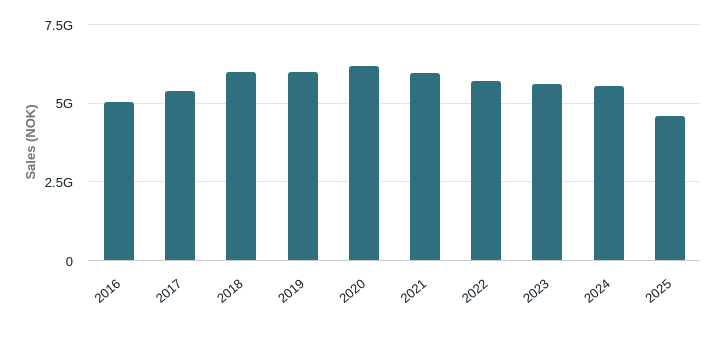
- Substantial Commercial Revenue: Total annual sales revenue across registered enterprises reached NOK 5.54 billion in 2024, supported by strong local financial institutions and specialized industrial producers.
- Substantial Employment Base: Local businesses and public institutions support roughly 6,000 to 6,500 active employment positions, led by commercial limited companies (AS) and municipal healthcare/education services.
- Key Specialized Clusters: High concentration of industrial activity in metal structures and steel production, food manufacturing, road transport, site preparation, and financial services.
- Multi-Node Geography: Commercial activity is concentrated in the municipal center of Melhus, complemented by key industrial and residential nodes in Lundamo, Kvål, Ler, Korsvegen, and Gimse.
Economic Performance & Macro Trends
Over the past decade, Melhus has demonstrated resilience while experiencing macro-economic adjustments reflecting broader shifts in construction, industrial supply chains, and public sector employment across Norway.
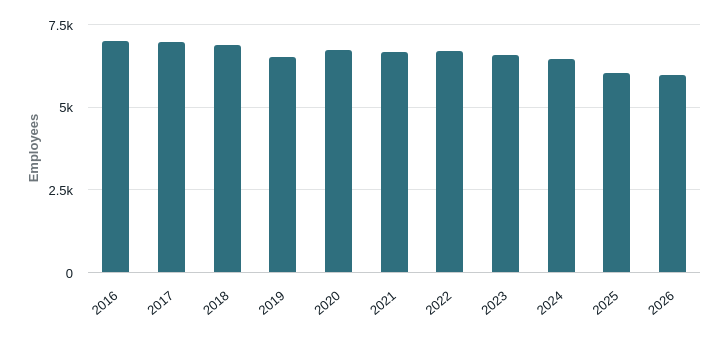
Aggregate sales revenue expanded rapidly from NOK 5.03 billion in 2016 to a peak of NOK 6.17 billion in 2020. Subsequent years saw a normalization of revenues to NOK 5.54 billion by 2024. Employment levels have gently shifted from 6,982 in 2016 down to 6,456 in 2024, reflecting efficiency gains in automated manufacturing and shifts in public service organization.
| Year | Total Sales Revenue (NOK) | YoY Sales Change | Registered Employees | YoY Employee Change |
|---|---|---|---|---|
| 2016 | 5.03 Billion | — | 6,982 | — |
| 2017 | 5.36 Billion | +6.6% | 6,948 | -0.5% |
| 2018 | 5.97 Billion | +11.3% | 6,855 | -1.3% |
| 2019 | 5.99 Billion | +0.3% | 6,516 | -4.9% |
| 2020 | 6.17 Billion | +3.0% | 6,726 | +3.2% |
| 2021 | 5.95 Billion | -3.6% | 6,643 | -1.2% |
| 2022 | 5.69 Billion | -4.3% | 6,681 | +0.6% |
| 2023 | 5.58 Billion | -1.9% | 6,557 | -1.9% |
| 2024 | 5.54 Billion | -0.9% | 6,456 | -1.5% |
| 2025 | 4.58 Billion | -17.3% | 6,021 | -6.7% |
Note: 2025 figures reflect partial accounting periods and registered updates.
Industry Structure & Legal Forms
Melhus possesses a balanced industrial structure featuring heavy manufacturing, specialized trade services, retail chains, and a broad public sector footprint.
Sectoral Highlights
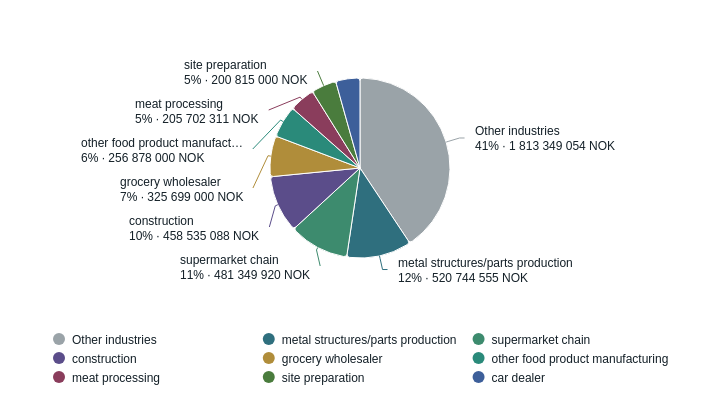
- Metal Structures & Steel Production: Generates over NOK 523.3 million in operating income across 3 key facilities, employing 171 workers.
- Food Manufacturing: Anchored by specialized food product producers, generating NOK 256.9 million in sales revenue.
- Monetary Intermediation & Banking: High financial strength, dominated by local banking services generating NOK 374.4 million in operating income with strong EBITDA margins (64%).
- Construction & Site Preparation: Comprises 49 companies employing over 460 workers, generating combined operating income exceeding NOK 665 million.
- Transport & Logistics: Road freight transport companies generate NOK 192.7 million in operating income, leveraging direct highway connections.
| Industry Sector | Companies | Employees | Operating Income (NOK) | EBITDA Margin |
|---|---|---|---|---|
| Metal Structures/Parts Production | 3 | 171 | 523.3M | 4% |
| Supermarket Chains | 8 | 152 | 495.6M | 3% |
| Construction (General) | 32 | 301 | 459.8M | 1% |
| Other Monetary Intermediation | 3 | 84 | 374.4M | 64% |
| Food Product Manufacturing | 1 | 86 | 256.9M | 7% |
| Site Preparation | 17 | 161 | 205.6M | 6% |
| Car Dealers | 9 | 92 | 203.3M | 10% |
| Road Freight Transport | 18 | 128 | 192.7M | 9% |
Organization Forms
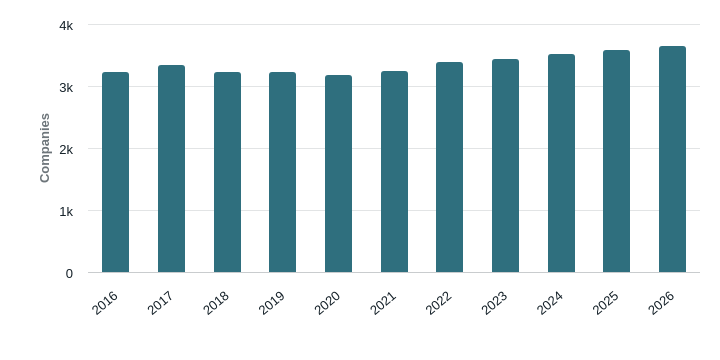
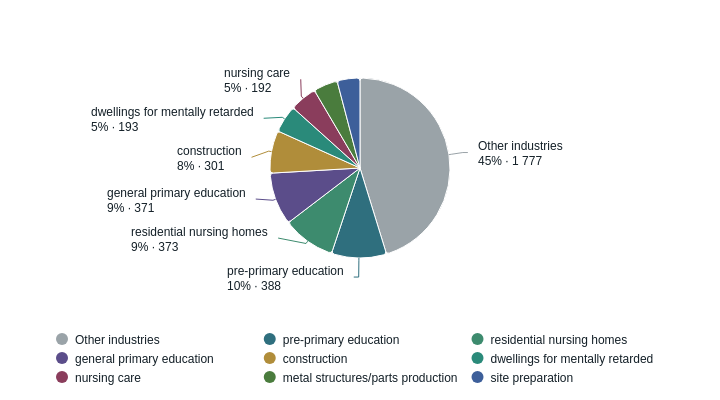
Standard private limited companies (AS) dominate commercial output, representing 336 companies, 2,879 employees, and NOK 4.91 billion in sales revenue. Municipal entities (KOMM) manage 71 organizational units employing 2,185 people across municipal services, healthcare, and infrastructure. Cooperatives (SA) and regional savings banks (SPA) play significant financial and structural roles.
Business Geography & Regional Hubs
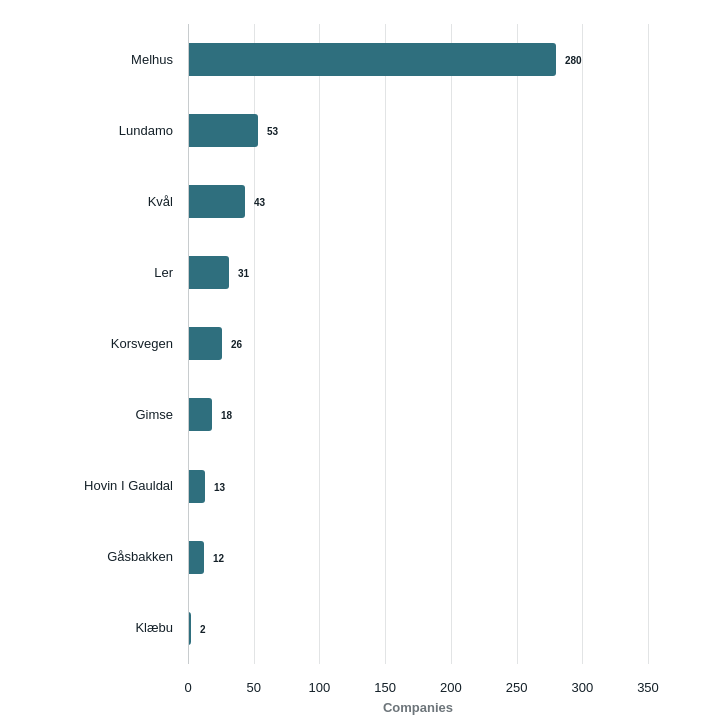
Commercial activity in Melhus is distributed across several distinct population centers along the Gaula river valley, each maintaining a specialized economic role.
| Location | Companies | Employees | Operating Income (NOK) | Sales Revenue (NOK) | Avg EBITDA Margin |
|---|---|---|---|---|---|
| Melhus (Center) | 280 | 4,041 | 4,975.0M | 4,364.4M | 9% |
| Kvål | 43 | 440 | 540.3M | 502.4M | 4% |
| Lundamo | 53 | 572 | 367.8M | 215.6M | 24% |
| Ler | 31 | 284 | 240.3M | 204.3M | 18% |
| Gimse | 18 | 235 | 82.3M | 51.2M | 10% |
| Korsvegen | 26 | 239 | 73.8M | 62.1M | 6% |
| Hovin I Gauldal | 13 | 81 | 59.9M | 45.6M | 7% |
| Gåsbakken | 12 | 131 | 32.8M | 26.5M | 4% |
Key Regional Features
- Melhus (Center): The economic heart of the municipality, housing retail centers, central municipal administration, corporate banking, and main transport hubs.
- Kvål: A key industrial node, generating NOK 502.4 million in sales revenue, driven by secondary educational institutions (Øya Videregående Skole) and industrial enterprises.
- Lundamo: Demonstrates strong profitability with a 24% average EBITDA margin, combining healthcare facilities (Horg Sykehjem) with timber, agriculture, and localized industrial services.
- Ler & Korsvegen: Strategic locations for localized technical services, transport, and community commerce.
Largest Employers & Key Corporate Players
Melhus hosts significant industrial manufacturing plants, major educational institutions, regional financial headquarters, and extensive public health facilities.
Major Industrial & Commercial Employers
- Matpartner AS: A premier food processing manufacturer operating out of Hofstadvegen in Melhus, employing 86 staff and generating NOK 256.9 million in sales revenue.
- Skanska Norge AS Avd Stålproduksjon: Located in Melhus, this major steel production facility employs 59 workers with annual sales revenue of NOK 289.1 million.
- Trondheim Stål AS: Located in Hofstadvegen, specializing in steel structure fabrication, employing 59 staff with sales of NOK 134.6 million.
- Melhus Sparebank Hovedkontor: Headquartered in Melhus, generating NOK 272.3 million in operating income with an EBITDA of NOK 165.6 million and 67 employees.
- Select Bemanning AS: Staffing and recruitment agency based in Karivollvegen, employing 68 people with NOK 49.0 million in revenue.
Major Educational & Public Institutions
- Buen Sykehjem: Municipal nursing facility employing 166 staff members.
- Øya Videregående Skole: Upper secondary school in Kvål employing 143 staff with NOK 77.1 million in operating income.
- Melhus Avlastningstjeneste: Care and support institution with 122 employees.
- Horg Sykehjem: Nursing home in Lundamo with 116 employees.
- Melhus Videregående Skole: Vocational and technical secondary school employing 107 staff.
Business Dynamism & Risk Factors
Business dynamism in Melhus reflects both strong capital retention and exposure to macroeconomic headwinds in heavy industries and construction.
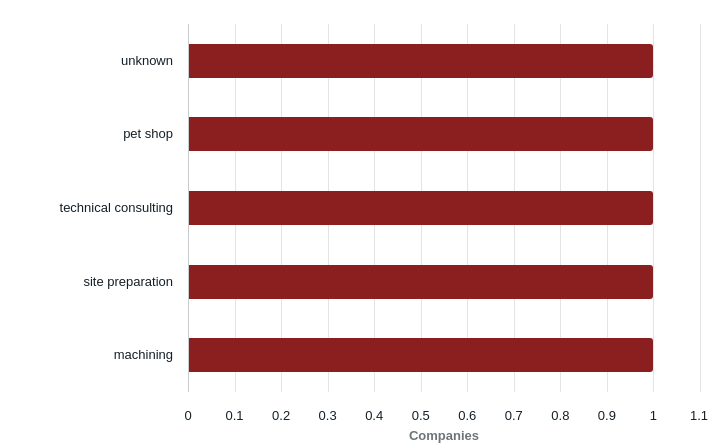
Recent bankruptcy data indicates concentrated friction in capital-intensive and cyclical sectors:
- Machining & Steel Fabrication: Insolvencies such as Dsl Stål AS (NOK 38.7M sales) highlight margin pressures in raw material costs and subcontracting demand.
- Plumbing & Site Preparation: Entries such as Haugnæss Rør AS (NOK 23.0M sales) and Totalmaskin AS (NOK 25.0M sales) reflect national downturns in building construction and excavation activity.
- Commercial Services: Smaller specialized service entities like Zoocare AS and Bl Future AS illustrate turnover among micro-enterprises.
Despite sector-specific insolvencies, core structural pillars—including regional banking balance sheets, agricultural supply chains, and municipal services—provide a stable economic backbone for the local business environment.
Opportunities for Founders & Entrepreneurs
Melhus presents strategic advantages for early-stage companies seeking proximity to Trondheim while benefiting from lower suburban operating costs and excellent transport links.
High-Potential Business Areas
- Industrial Subcontracting & Technical Consulting: Strong demand from local steel and manufacturing leaders for specialized engineering, maintenance, and green transition solutions.
- Logistics & Road Freight Services: Capitalizing on E6 highway connectivity to service Trøndelag’s freight distribution networks.
- Food Technology & Local Production: Leveraging Melhus' agricultural heritage and existing food production infrastructure (Matpartner AS).
- Craft & Specialized Trade Services: Meeting ongoing demand for electrical installation, specialized plumbing, and property maintenance.
Entrepreneurs evaluating commercial sites, industrial zoning, or demographic demand in Melhus can utilize tools like SmartGrunder to explore optimal business addresses, sector statistics, and competitive footprints across the municipality.
Conclusion & Strategic Outlook
Melhus municipality occupies a key position in Trøndelag’s economic topology. By combining a powerful industrial manufacturing base with strong local financial institutions, direct transit access to Trondheim, and robust public service infrastructure, Melhus offers a reliable environment for corporate expansion and prospective startups.
For municipal decision-makers and business leaders, maintaining support for industrial infrastructure along key corridors like Hofstadvegen and Kvål while fostering technology adoption in traditional manufacturing will remain essential to driving sustainable revenue growth in the coming decade.