Municipality
Economic Landscape and Business Insights for Moskenes Municipality
A data-driven analysis of local industry structure, revenue trends, commercial hubs, and founder opportunities in Moskenes
Executive Summary
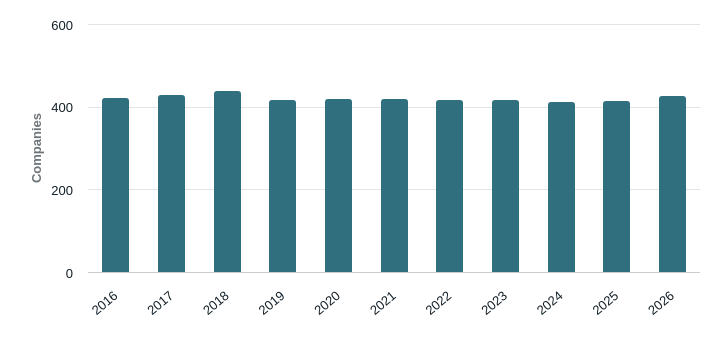
Moskenes municipality, situated at the southern tip of the Lofoten archipelago in Nordland, represents a unique commercial environment characterized by a high-performing tourism sector, deeply rooted maritime industries, and essential public administration services. With primary settlements centered in Reine and Sørvågen, Moskenes punch well above its weight in total revenue generation relative to its resident workforce.
Key structural highlights of the Moskenes business economy include:
- Maritime & Fishing Strength: Fishing vessel operations and fish processing generate combined operating revenues approaching NOK 264M, with offshore harvesting showing remarkable profitability (49% EBITDA margin).
- High-Density Hospitality Hub: Short-stay cabins, hotels, and restaurants collectively employ over 320 workers, driving substantial gross margins and international tourist spending.
- Geographic Concentration: Reine serves as the main economic anchor with 702 reported employees, while Sørvågen exhibits rapid financial expansion with a 54% revenue growth rate.
For entrepreneurs and prospective business owners, Moskenes offers strong seasonal demand, high tourist transaction values, and established supply chains, balanced by the need for strategic off-season revenue diversification.
Economic Overview: Sales & Employment Trends
Historical financial data reveals that Moskenes has experienced shifting economic cycles over the past decade, driven by fluctuations in fish stock quotas, export pricing, and international tourism waves.
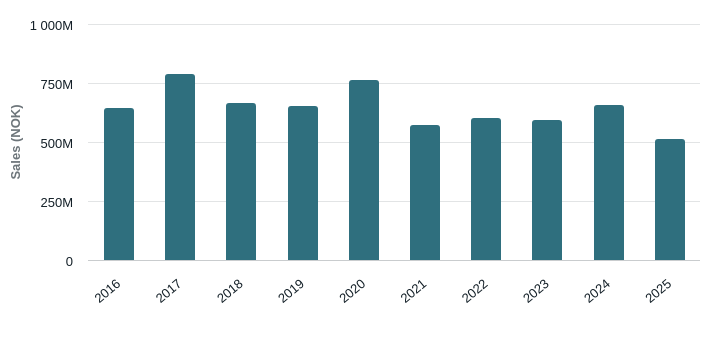
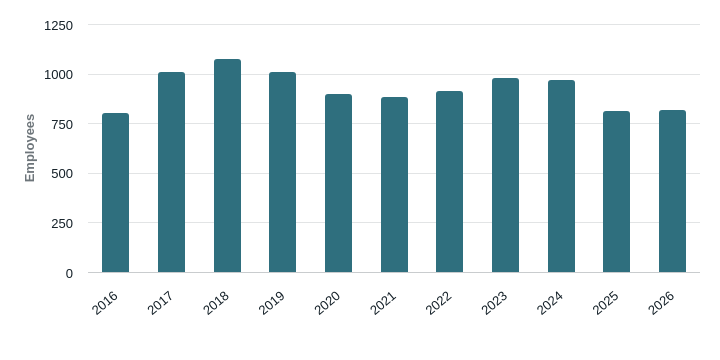
Total commercial sales reached peak levels in 2017 at NOK 788.7M before stabilizing around the NOK 600M to NOK 650M corridor in recent years. Total reported workforce numbers followed a similar pattern, expanding from 803 employees in 2016 to a peak of 1,075 in 2018, before settling near 815–820 employees in recent projections.
| Year | Commercial Sales (NOK) | Sales YoY Change | Employment | Employees YoY Change |
|---|---|---|---|---|
| 2016 | 644.2M | - | 803 | - |
| 2017 | 788.7M | +22.4% | 1,008 | +25.5% |
| 2018 | 666.6M | -15.5% | 1,075 | +6.6% |
| 2019 | 652.9M | -2.1% | 1,010 | -6.0% |
| 2020 | 764.6M | +17.1% | 898 | -11.1% |
| 2021 | 573.8M | -25.0% | 881 | -1.9% |
| 2022 | 600.7M | +4.7% | 912 | +3.5% |
| 2023 | 592.1M | -1.4% | 977 | +7.1% |
| 2024 | 658.6M | +11.2% | 966 | -1.1% |
| 2025 | 514.6M | -21.9% | 814 | -15.7% |
| 2026 | N/A | N/A | 819 | +0.6% |
Note: 2025 and 2026 figures represent recent corporate filings and normalized reporting estimates.
Industry Structure & Legal Organization
The commercial ecosystem of Moskenes is divided between high-margin resource extraction/maritime operations and visitor economy services.
Primary Industry Sectors
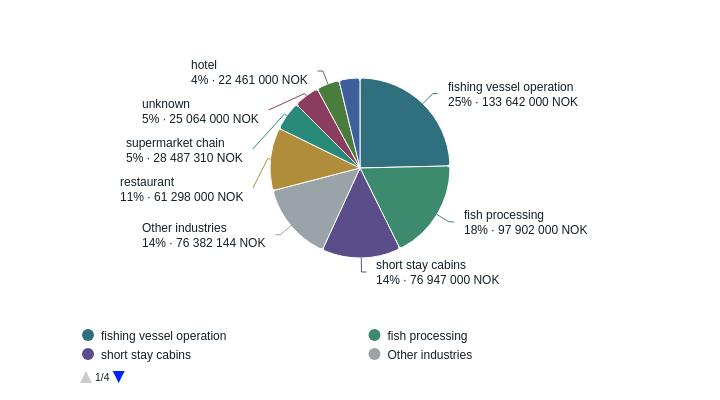
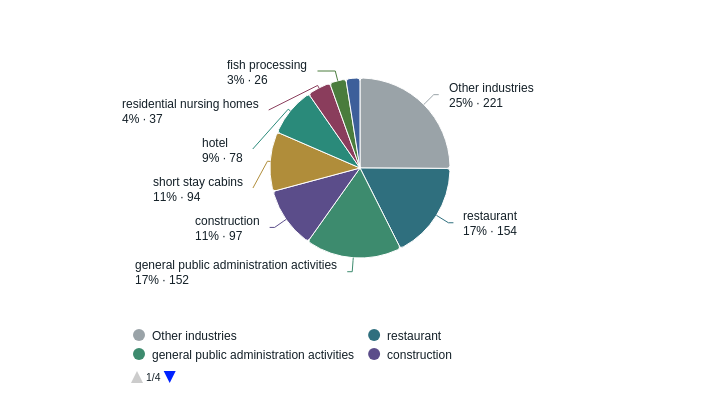
- Fishing Vessel Operation: While employing 12 registered personnel across 6 companies, this sector generates NOK 164.4M in operating income with an exceptional operating margin of 26% and an EBITDA margin of 49% (NOK 81.1M EBITDA).
- Fish Processing: Represented by 2 companies employing 26 workers, generating NOK 99.5M in operating income and NOK 97.9M in direct sales revenue.
- Short Stay Cabins & Accommodation: 5 companies employ 94 people, delivering NOK 77.2M in operating income with a strong 21% EBITDA margin.
- Hotels: 4 operations employ 78 workers, accounting for NOK 76.1M in revenue.
- Restaurants & Dining: 7 active establishments employ 154 workers, bringing in NOK 66.8M with a 30% revenue growth rate and a 17% EBITDA margin.
- Retail & Grocery: Supermarkets and local kiosks provide vital domestic services. Reine Kiosk alone achieves NOK 17.4M in operating income with a 17% EBITDA margin.
Legal Entity Distribution
Private limited liability companies (Aksjeselskap / AS) dominate the financial footprint of Moskenes:
- AS (Limited Companies): 48 active entities accounting for 588 employees, NOK 622.8M in operating income, and an overall EBITDA margin of 25%.
- ORGL / KOMM (Public & Municipal Units): 17 organizations employing 289 public service professionals across healthcare, education, and municipal governance.
- SA (Cooperatives): 2 companies employing 20 workers, including consumer retail cooperatives generating NOK 28.9M.
Business Geography: Reine vs. Sørvågen
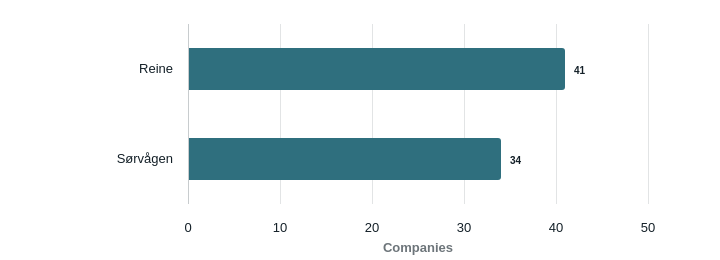
Commercial activity in Moskenes is tightly focused along the coastal road network, with Reine and Sørvågen forming the two principal business clusters.
| Area / Settlement | Active Companies | Reported Employees | Operating Income | Sales Revenue | Revenue Growth | EBITDA Margin |
|---|---|---|---|---|---|---|
| Reine | 41 | 702 | NOK 416.2M | NOK 344.1M | 18% | 16% |
| Sørvågen | 34 | 219 | NOK 239.8M | NOK 198.4M | 54% | 37% |
Local Dynamics
- Reine: Functions as the administrative, cultural, and primary tourism epicenter of the municipality. It holds over 70% of total reported municipal employment and hosts major tourist installations, food service providers, and municipal headquarters.
- Sørvågen: Demonstrates remarkable growth dynamics (+54% YoY) and superior overall EBITDA profitability (37%). Sørvågen's economy benefits from specialized marine harvesting, high-end culinary concepts, and expanding lodging operations.
Largest Local Employers & Key Enterprises
Employment in Moskenes is led by a combination of public institutions, major hospitality operators, and specialized marine processors.
Leading Municipal & Public Employers
- Moskenes Kommune: Municipal administrative core employing 143 workers in Reine.
- Moskenes Sykehjem: Local nursing facility employing 35 staff members.
- Moskenes Kommune Hjemmebaserte Tjenester: Home care service unit employing 22 staff members.
- Sørvågen Skole: Primary educational facility employing 17 staff members.
Key Commercial Companies
- Deco Norge AS (Valen, Reine): Construction contractor employing 86 workers.
- Anitas Sjømat AS (Sakrisøy, Reine): Iconic seafood and restaurant enterprise with 58 employees, generating NOK 37.5M in operating income at a 25% EBITDA margin.
- Reine Rorbuer Drift AS (Reine): Traditional rorbu cabin resort employing 33 workers with NOK 39.7M in operating income.
- Eliassen Rorbuer Drift AS (Hamnøy, Reine): Major accommodation provider employing 30 workers, generating NOK 57.6M in operating income.
- Å Rorbuer AS (Å, Sørvågen): Emerging rorbu destination employing 29 workers.
- Tapperiet Bistro AS (Reine): High-growth dining venue with 28 employees, recording NOK 19.4M in operating income (+79% revenue growth).
- H. Sverdrup (Reine): Prominent fish processing company employing 22 workers, with NOK 95.4M in operating income.
- Reine Kiosk & Prix Reine 1891: Essential commercial retail hubs generating NOK 17.4M and NOK 28.9M in operating income, respectively.
Business Dynamism & Financial Health
The commercial ecosystem in Moskenes demonstrates high financial resilience. No company bankruptcies were recorded in the provided dataset, signaling strong balance sheets among established operators in fishing and hospitality.
Capital Efficiency & Performance Indicators
- High Revenue Per Employee: Fishing vessel operators report an average operating income per employee of NOK 15.9M, highlighting extreme capital intensity and modern vessel technology.
- Hospitality Productivity: Short-stay cabin operators deliver NOK 1.8M operating income per employee and NOK 382.7K EBITDA per employee, showing strong profitability during peak season.
- Debt and Equity Structure: Moskenes limited companies maintain total equity of NOK 752.0M against NOK 838.8M in total debt, reflecting healthy corporate leverage ratios across mature tourist properties and maritime assets.
Opportunities for Founders & Business Concepts
Given Moskenes' world-famous landscape and high tourist footfall, entrepreneurs can tap into several high-margin market gaps:
- Year-Round Visitor Experiences: Current tourism peaks heavily in summer and winter aurora seasons. Concepts offering indoor culture, wellness, or shoulder-season activities can capture steady off-peak demand.
- Value-Added Seafood Logistics: With local landing of premium fish (demonstrated by H. Sverdrup's NOK 95.4M output), specialized direct-to-consumer seafood packaging, smoking, or boutique export models present high potential.
- Eco-Mobility & Transport Support: Passenger transport and local vessel excursions demonstrate solid profitability (32% operating margin). Electric boat rentals, guided sea services, and e-bike infrastructure align well with local sustainability goals.
- B2B Tourism Services: Property management, commercial cleaning, maintenance, and marketing services tailored to rorbu operators represent low-overhead entry points.
Founders evaluating specific locations, commercial properties, or industry dynamics within Moskenes can utilize SmartGrunder to analyze local address profiles, explore registered corporate activities, and build structured business plans.
Conclusion
Moskenes municipality combines an extraordinary natural backdrop with a highly lucrative local economy. Driven by a robust fishing industry and world-class accommodation and dining operators in Reine and Sørvågen, the municipality offers a dynamic micro-market for ambitious founders.
By leveraging existing supply chains, addressing off-season tourism capacity, and introducing modern service concepts, new enterprises can thrive in one of Nordland's most vibrant coastal economies.