Municipality
Moss Economic Analysis: Local Industry Structure and Growth Horizons
An in-depth economic report on corporate performance, employment trends, and entrepreneurship opportunities in Moss Municipality
Executive Summary
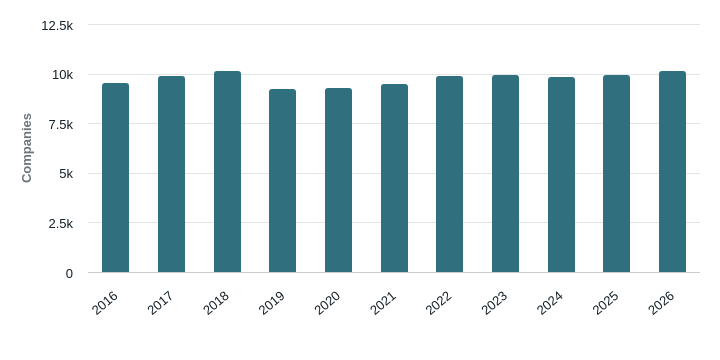
Moss serves as a key regional urban center in Viken (formerly Østfold county), combining a rich industrial heritage with a modern commercial, logistics, and public service ecosystem. With total corporate employment hovering between 26,000 and 27,000 workers across more than 10,000 registered business entities, the municipality provides a robust market base for both established enterprises and newly founded ventures.
Key economic characteristics of Moss include:
- Broad Employment Base: Public administration, healthcare, and specialized care institutions form a stable baseline, while private-sector strongholds in wholesale distribution, retail, and construction drive overall commercial revenue.
- Logistics Hub Capability: Major distribution operations, such as Europris AS's central warehouse, capitalize on Moss's strategic transit links along the E6 corridor and maritime access.
- Regional Financial Anchor: Moss hosts the headquarters of Sparebank 1 Østfold Akershus, providing deep local capital access and financial services.
- Geographic Diversification: While the central city of Moss accounts for over 90% of local employment and corporate revenue, peripheral commercial areas like Rygge and Dilling maintain specialized industrial and agricultural service nodes.
For entrepreneurs and investors, Moss offers a well-balanced local economy featuring high consumer density, strong infrastructure, and clear growth channels in professional services and logistics.
Economic Overview
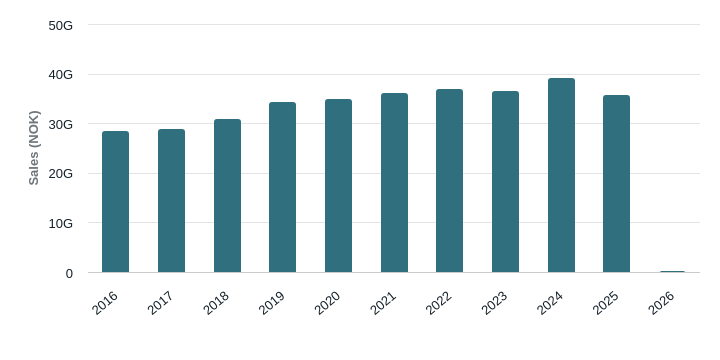
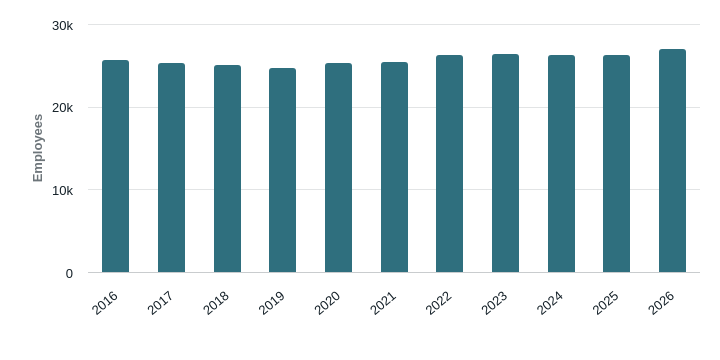
The commercial sector in Moss has experienced steady revenue expansion over the past decade. Between 2016 and 2024, total business turnover increased from NOK 28.37 billion to a peak of NOK 39.18 billion, reflecting an aggregate growth rate of approximately 38%. Employment figures have remained consistently resilient, rising from 25,622 employees in 2016 to nearly 27,000 projected in 2026.
| Year | Corporate Revenue (NOK M) | YoY Revenue Growth | Local Workforce | YoY Employee Growth |
|---|---|---|---|---|
| 2016 | 28,367.8 | - | 25,622 | - |
| 2017 | 28,871.9 | +1.8% | 25,255 | -1.4% |
| 2018 | 30,828.1 | +6.8% | 25,019 | -0.9% |
| 2019 | 34,362.4 | +11.5% | 24,697 | -1.3% |
| 2020 | 34,905.8 | +1.6% | 25,305 | +2.5% |
| 2021 | 36,168.4 | +3.6% | 25,357 | +0.2% |
| 2022 | 36,831.7 | +1.8% | 26,302 | +3.7% |
| 2023 | 36,575.6 | -0.7% | 26,364 | +0.2% |
| 2024 | 39,183.8 | +7.1% | 26,278 | -0.3% |
| 2025 | 35,590.3 | -9.2% | 26,282 | +0.0% |
| 2026 | 129.6* | -99.6%* | 26,950 | +2.5% |
*Note: Figures for 2026 represent incomplete year-to-date reporting and should be viewed as preliminary assumptions.
Revenue peaked in 2024 following strong performances in non-specialised wholesale and retail trade. The moderate revenue contraction in 2025 reflects wider macroeconomic headwinds across Norway, particularly affecting construction and discretionary retail, though baseline employment levels remained exceptionally stable.
Industry Structure
Moss's industrial landscape is defined by a heavy concentration of care and public infrastructure services paired with high-yield wholesale and commercial trade.
Sector Distribution
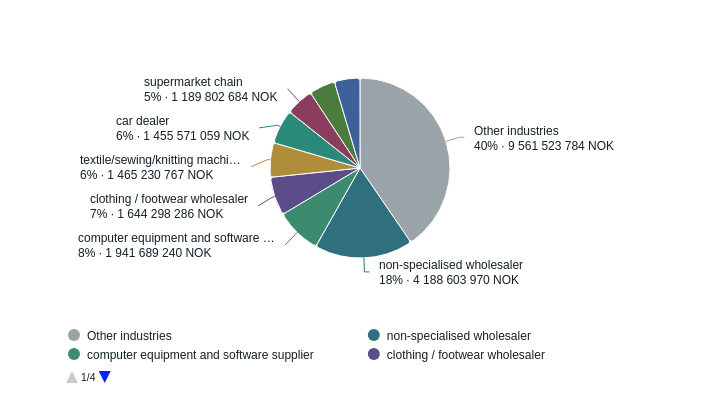
Private non-specialised wholesale generates the highest individual sector revenue in the municipality, yielding over NOK 4.36 billion across 8 companies, driven largely by central distribution hubs. Meanwhile, healthcare and municipal care services represent the single largest employment category.
| Industry Sector | Companies with Employees | Total Employees | Operating Income (NOK M) | EBITDA Margin |
|---|---|---|---|---|
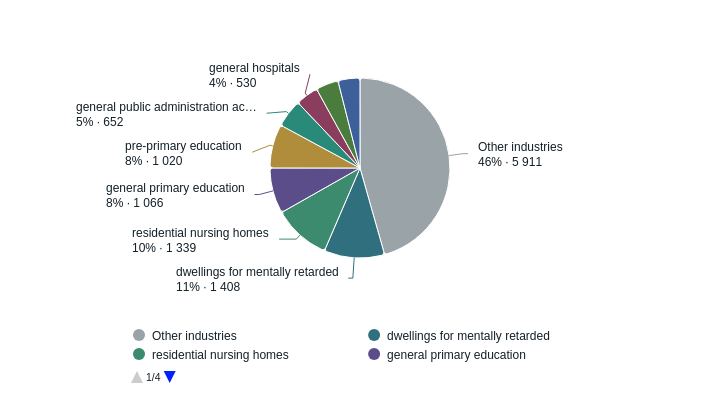
| Dwellings for mentally retarded | 12 | 1,408 | 11.8 | 2% |
| Residential nursing homes | 13 | 1,339 | 0.0 | 0% |
| General primary education | 20 | 1,066 | 129.5 | 4% |
| Pre-primary education | 35 | 1,020 | 264.6 | 6% |
| General public administration | 8 | 652 | 0.0 | 0% |
| General hospitals | 1 | 530 | 725.3 | 5% |
| Real estate & property management | 71 | 527 | 472.4 | 31% |
| Restaurants & dining | 34 | 510 | 115.5 | 5% |
| Supermarket chains | 20 | 482 | 1,222.0 | 2% |
| Hotels & lodging | 8 | 440 | 192.2 | 0% |
| Non-specialised wholesale | 8 | 323 | 4,364.6 | 15% |
| Technical consulting | 53 | 272 | 487.2 | 7% |
Legal Forms of Business
Limited liability companies (AS) dominate the commercial business structure in Moss, representing 1,364 active entities and employing 16,397 workers, generating NOK 37.96 billion in total operating income.
Public sector organ forms—including municipal entities (KOMM with 6,215 employees), state organizations (ORGL with 1,180 employees), and health trusts (SÆR with 1,020 employees)—provide structural stability to local employment. Sole proprietorships (ENK) count 95 active employer entities, maintaining an impressive aggregate EBITDA margin of 49%.
Business Geography
Following regional mergers and structural development, Moss municipality comprises several distinct economic zones. Activity remains heavily concentrated in the primary urban core, with specialized outer nodes supporting agricultural, commercial, and logistics functions.
| Area / City | Active Companies | Total Workforce | Sales Revenue (NOK M) | Operating Profit (NOK M) |
|---|---|---|---|---|
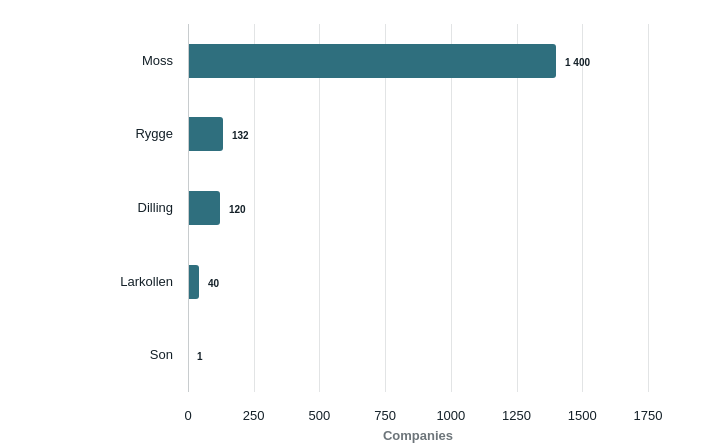
| Moss (City Center / Urban Core) | 1,400 | 24,536 | 35,336.6 | 2,631.4 |
| Rygge | 132 | 1,656 | 3,057.7 | 184.2 |
| Dilling | 120 | 1,202 | 1,164.8 | 43.7 |
| Larkollen | 40 | 373 | 195.8 | -2.3 |
| Son | 1 | 2 | 0.0 | 0.0 |
Area Characteristics
- Moss Central: The economic engine of the municipality, housing public administrative offices, main retail centers, hospital services, and the principal port and railway connections.
- Rygge: A major commercial and transit node featuring logistics parks, retail clusters near Solgaard Skog and Vanem, and industrial spaces along the primary transit arteries.
- Dilling & Larkollen: Dilling functions as an agricultural and light industrial district, while Larkollen features seasonal tourism, hospitality, and localized service businesses.
Largest Employers
Employment in Moss is balanced between large institutional health care providers, governmental administrative offices, and major regional retail and logistics operations.
Prominent Local Employers
- Aberia Omsorg & Assistanse AS / Aberia Ung AS: Leading private social services and care providers headquartered in Moss, together employing over 1,100 personnel across care and child welfare institutions.
- Sykehuset Østfold HF Moss Somatikk: Operating hospital facilities at Peer Gynts vei, employing 530 medical and administrative staff with annual sales revenue of NOK 700.5 million.
- Europris AS Avd Sentrallager Moss: The central logistics hub for Europris located at Vestre Vanemvei, employing 291 workers and generating NOK 4.13 billion in sales revenue with an EBITDA margin of 15%.
- Årvoll Konferansesenter AS: Key facility operator in real estate and events management, reporting 286 employees.
- Sparebank 1 Østfold Akershus: Regional banking headquarters located at Varnaveien, employing 172 professionals and managing significant local capital assets (operating income NOK 797.4 million; EBITDA margin 75%).
- Public Education & Care Institutions: Facilities such as Ekholt Sykehjem (276 employees), Malakoff Videregående Skole (261 employees), Kirkeparken Videregående Skole (254 employees), and Orkerød Sykehjem (211 employees) serve as major stable workforce hubs.
- Government Bodies: Regional administrative entities, including Statsforvalteren (172 employees) and Statens Vegvesen (170 employees), maintain key offices in Moss city.
Business Dynamism & Market Insolvencies
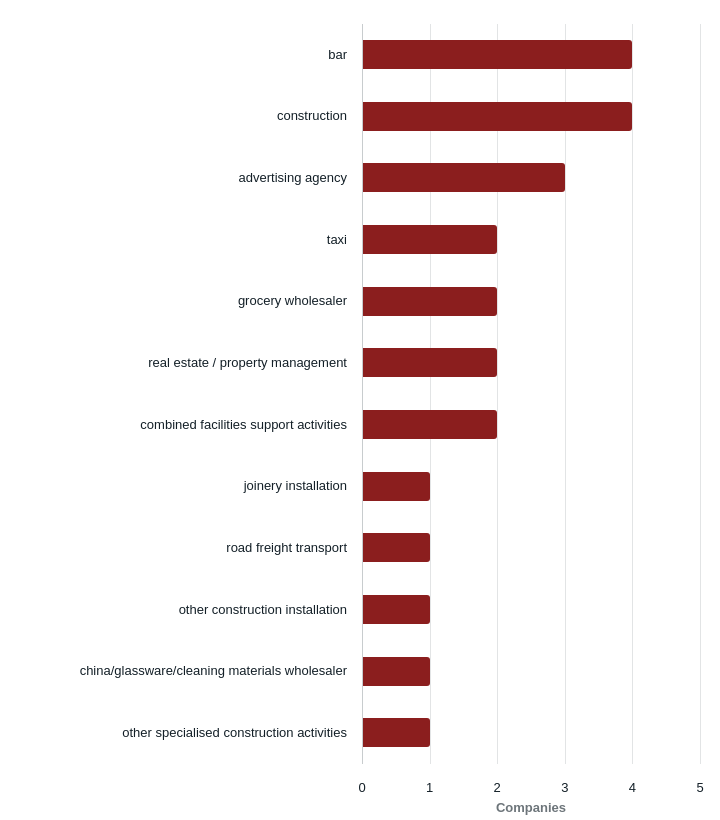
Market dynamics in Moss demonstrate high commercial rotation, characterized by healthy company creation alongside routine market corrections. Across the recorded period, 33 total bankruptcies occurred in the municipality, reflecting broader national macroeconomic pressures in construction, consumer retail, and specialized food services.
Sectoral Bankruptcy Breakdown
Recent bankruptcy data highlights clear distress patterns in capital-intensive or margin-sensitive sectors:
- Grocery Wholesale: Plateful AS recorded insolvency with NOK 118.3 million in revenue but a negative EBITDA of NOK -15.1 million, reflecting high inflation and supply chain volatility.
- Construction & Installation: Construction contractors and specialty trades (e.g., Langbråten Entreprenør AS with NOK 8.0M sales and NOK -8.1M EBITDA; Kostr AS with NOK 8.9M sales) faced severe margin pressure from increased material costs and reduced residential building activity.
- Advertising & Media: Markedsmateriell Og Reklameprodukter AS went into insolvency despite generating NOK 20.7 million in sales, pointing to tight cash-flow constraints.
- Hospitality & Recreation: Smaller food service and sports facility providers (such as Padelbaner AS and local bars/restaurants) recorded insolvencies following shifts in discretionary consumer spending.
These adjustments indicate that while demand in Moss remains strong, incoming businesses must maintain conservative leverage and precise working capital management.
Opportunities for Founders
Moss offers strategic advantages for entrepreneurs looking to serve both the local Viken market and the greater Oslofjord area. The combination of excellent transport links, high public-sector stability, and reasonable commercial property costs creates several prime founder opportunities:
- Logistics & B2B Supply Chain Services: Building on the presence of major logistics hubs like Europris, there is strong demand for third-party logistics (3PL), last-mile delivery technology, and fleet maintenance.
- Professional & Technical Consulting: With 53 active engineering and technical consulting firms generating stable revenues, B2B services specializing in software, environmental consulting, and automation have room to expand.
- HealthTech & Care Services: Given the municipality's high concentration of healthcare institutions (Aberia, Sykehuset Østfold, specialized nursing facilities), startups focusing on health tech, assisted living tools, and staffing solutions have an immediate target market.
- Niche Consumer Retail & Gastronomy: While standard supermarket chains dominate high-volume trade, urban revitalization in central Moss creates space for boutique food concepts, specialized hospitality, and experiential leisure.
Founders evaluating commercial locations and industry trends in Moss can leverage platform tools like SmartGrunder to analyze specific business addresses, local demography, and competitive density across Moss, Rygge, and Dilling.
Conclusion
Moss represents a resilient, well-positioned municipal economy with a strong balance between public sector stability and private commercial vitality. Generating over NOK 35 billion in annual turnover and supporting nearly 27,000 jobs, the region is far more than a commuter town—it is a self-sustaining regional hub.
While macroeconomic pressures have triggered necessary recalibrations in construction and high-debt retail segments, core sectors in wholesale, healthcare, banking, and technical services remain highly profitable. For prospective founders and municipal decision-makers, Moss provides a mature yet evolving marketplace with compelling long-term economic prospects.