Municipality
Orkland Business Economy Analysis: Key Trends, Industry Structure, and Founder Opportunities
An in-depth economic evaluation of Orkland's commercial drivers, geographic hubs, corporate dynamics, and growth prospects
Executive Summary
Orkland represents a vital industrial and agricultural center in Trøndelag, combining heavy process manufacturing, food processing, logistics, and regional public services. Centered around Orkanger, the municipality features a highly productive business sector alongside robust public sector employment driven by local administration and regional healthcare infrastructure.
Key highlights from the economic dataset include:
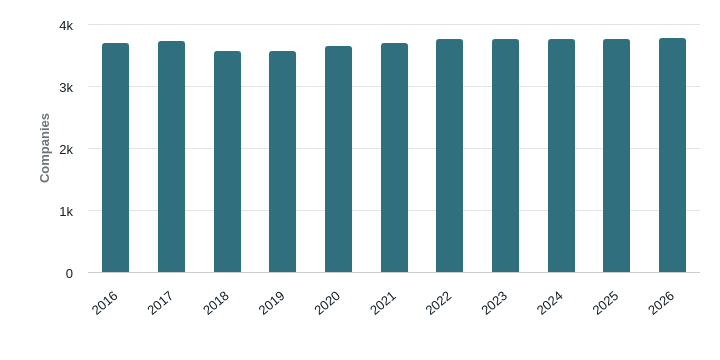
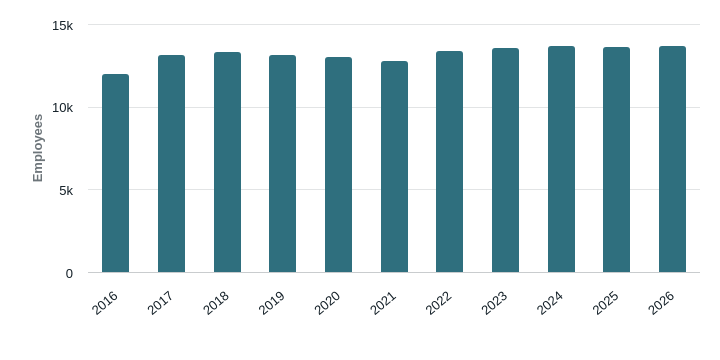
- Substantial Employment Base: Total employment in Orkland has maintained stable levels above 13,600 positions, supported by over 3,800 registered corporate and municipal entities.
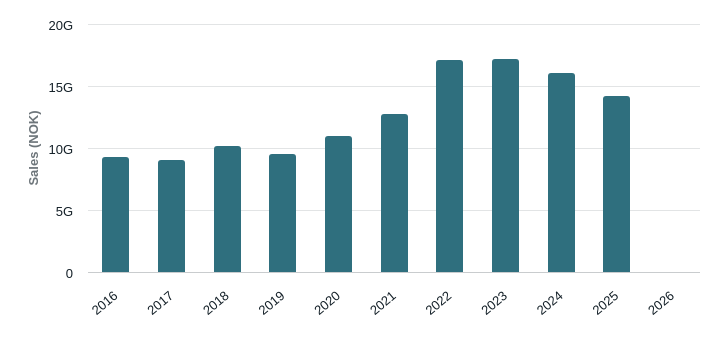
- Industrial Heavyweights: The commercial economy generated peak sales exceeding NOK 17.15 billion in 2023, anchored by primary processors such as Norsk Kylling AS, Elkem ASA Thamshavn, Isfjord Norway AS, and Washington Mills AS.
- Geographic Concentration: Orkanger serves as the economic powerhouse, accounting for 330 companies, 9,879 employees, and over NOK 13.4 billion in annual operating income.
- Stabilizing Commercial Dynamics: While sales volumes normalized down to NOK 14.21 billion in 2025 following commodity market peaks in 2022–2023, workforce levels remain resilient across core sectors.
Economic Overview
Orkland's local economy expanded rapidly between 2020 and 2022, driven by increased international demand and high valuation across industrial manufacturing and food production sectors. Total sales revenues jumped from NOK 10.94 billion in 2020 to a record NOK 17.07 billion in 2022, holding firm at NOK 17.15 billion in 2023.
Recent market cycles have brought a revenue normalization, with total sales declining to NOK 16.02 billion in 2024 and NOK 14.21 billion in 2025 (note: figures for 2026 represent incomplete year-to-date reporting). Despite top-line sales fluctuations, total employment has remained exceptionally steady, demonstrating local workforce retention.
| Year | Total Sales Revenue (NOK) | Total Employees | Sales YoY Growth | Employee YoY Growth |
|---|---|---|---|---|
| 2020 | 10.94 Billion | 13,027 | +15.2% | -0.5% |
| 2021 | 12.72 Billion | 12,760 | +16.3% | -2.0% |
| 2022 | 17.07 Billion | 13,381 | +34.2% | +4.9% |
| 2023 | 17.15 Billion | 13,574 | +0.5% | +1.4% |
| 2024 | 16.02 Billion | 13,674 | -6.6% | +0.7% |
| 2025 | 14.21 Billion | 13,635 | -11.3% | -0.3% |
| 2026 | Partial Data | 13,686 | N/A | +0.4% |
Industry Structure & Organizational Breakdown
Orkland's business structure is anchored by large-scale processing, chemical manufacturing, and logistics, balanced by extensive healthcare and public administration activities.
Core Industry Clusters
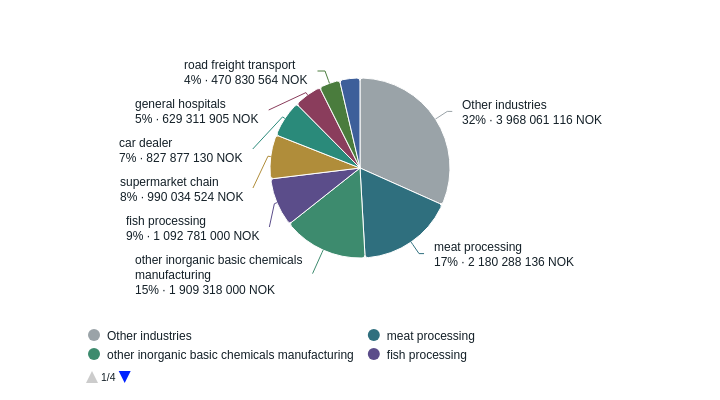
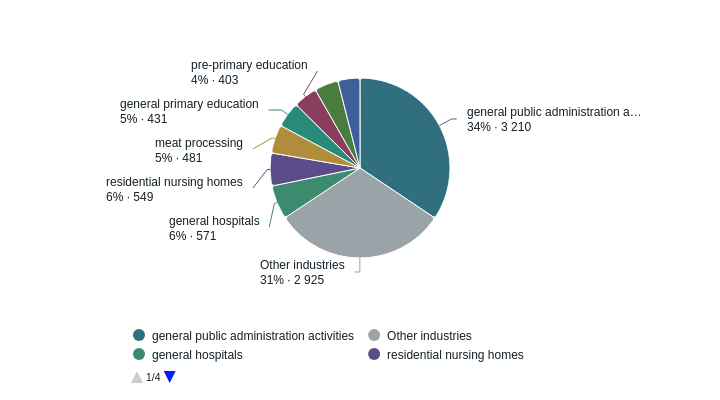
- Food & Aquaculture Processing: Meat processing (led by Norsk Kylling AS) generates NOK 2.19 billion across 481 employees with a strong 12% EBITDA margin. Fish processing adds NOK 1.10 billion in operating income and 275 employees.
- Chemicals & Process Industry: Other inorganic basic chemicals manufacturing (including Elkem ASA Thamshavn and Washington Mills AS) generates NOK 1.93 billion with 320 employees, achieving an 8% EBITDA margin.
- Logistics & Infrastructure: Road freight transport accounts for 23 companies employing 401 workers, generating NOK 485.3 million with a 10% EBITDA margin. Scheduled bus transport adds NOK 173.0 million across 155 employees.
- Public & Healthcare Services: Public administration employs over 3,200 people across Orkland Kommune, while St Olavs Hospital HF Orkdal Sjukehus and local nursing care facilities employ over 1,400 healthcare staff.
Legal Organization Mix
Limited liability companies (AS) dominate commercial revenue generation, while municipal entities (KOMM / ORGL) and health trusts (SÆR) form the backbone of local public employment.
- AS (Aksjeselskap): 425 active entities employing 5,438 people with NOK 12.31 billion in operating income and an overall 8% EBITDA margin.
- ORGL / KOMM / IKS: Public entities and municipal services employing over 6,400 staff members.
- SA (Samvirkeforetak): 26 cooperative entities generated NOK 1.97 billion in income, reflecting strong agricultural and cooperative presence.
Business Geography & Regional Hubs
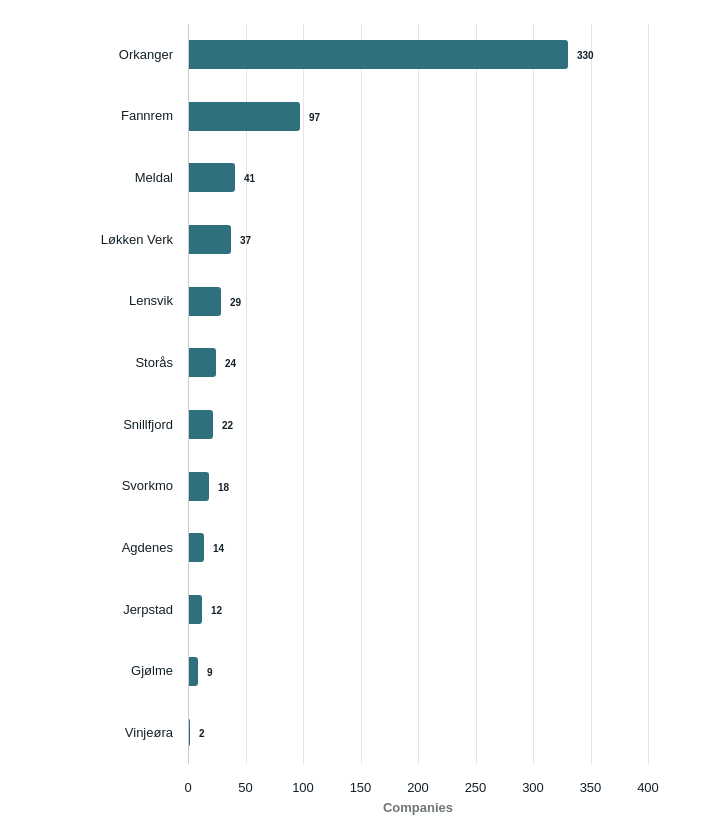
Orkland's economic geography features an industrial regional hub in Orkanger, supported by key industrial and agricultural satellites across Fannrem, Meldal, Løkken Verk, and Lensvik.
| Location | Active Companies | Employees | Operating Income (NOK) | Average Operating Margin |
|---|---|---|---|---|
| Orkanger | 330 | 9,879 | 13,421.4 Million | 5% |
| Fannrem | 97 | 1,471 | 1,296.8 Million | 2% |
| Løkken Verk | 37 | 465 | 854.0 Million | 7% |
| Meldal | 41 | 926 | 450.6 Million | 3% |
| Lensvik | 29 | 357 | 364.9 Million | 5% |
| Storås | 24 | 182 | 276.6 Million | 3% |
| Jerpstad | 12 | 143 | 197.5 Million | 7% |
| Agdenes | 14 | 102 | 137.4 Million | 0% |
| Snillfjord | 22 | 177 | 134.8 Million | 0% |
| Svorkmo | 18 | 125 | 82.0 Million | 4% |
Orkanger represents over 80% of total commercial output and private employment in the municipality, benefiting from deepwater harbor facilities at Grønøra and established industrial parks. Satellite hubs like Løkken Verk stand out for high-tech instrumentation manufacturing (Inission Løkken AS), achieving a healthy 7% operating margin.
Largest Employers
The largest employers in Orkland reflect a combination of municipal government, public hospital services, industrial manufacturing, and specialized technical supply chains.
- Orkland Kommune: 3,069 employees across municipal service facilities, central administration (113 employees), and local care hubs.
- St Olavs Hospital HF Orkdal Sjukehus: 571 employees providing regional hospital services, generating NOK 715.5 million in operating income.
- Norsk Kylling AS (Avd Orkdal): 481 employees; major poultry processing facility generating NOK 2.19 billion in income and NOK 279.8 million EBITDA.
- Isfjord Norway AS: 272 employees; primary seafood processing plant generating NOK 1.10 billion in revenue.
- Hob Gods AS (Avd Meldal): 226 employees; regional freight and logistics provider generating NOK 229.9 million in revenue.
- Elkem ASA Thamshavn: 204 employees; advanced silicon and inorganic chemical manufacturer generating NOK 1.31 billion in income.
- Vy Buss AS (Avd Orkanger): 151 employees; public transit operator generating NOK 173.0 million.
- Vigor Industrier AS: 133 employees; industrial staffing and maintenance supplier generating NOK 79.3 million.
- Shawcor Norway AS: 120 employees; pipeline coating and engineering facility generating NOK 471.2 million.
- Washington Mills AS: 116 employees; silicon carbide and abrasives manufacturer generating NOK 613.8 million.
- Inission Løkken AS: 112 employees; electronic instrumentation and contract manufacturing generating NOK 432.1 million with NOK 50.9 million EBITDA.
Business Dynamism & Bankruptcies
Commercial turn-over and bankruptcy figures in Orkland reflect macro-economic pressures in sub-sectors sensitive to interest rates, fuel costs, and consumer spending, such as micro-construction, local dining, and specialized craft services.
A total of 12 corporate insolvencies are recorded in the current dataset, including:
- Heavy Equipment & Transport: Sya Maskin AS (NOK 9.3M revenue, NOK -633.0K EBITDA) and Dag Øyvind Klungervik Transport.
- Local Services & Hospitality: Orkdal Grill & Pizza AS (NOK 5.1M revenue, NOK 170.0K EBITDA) and Kløppern AS (NOK 2.9M revenue, NOK -102.0K EBITDA).
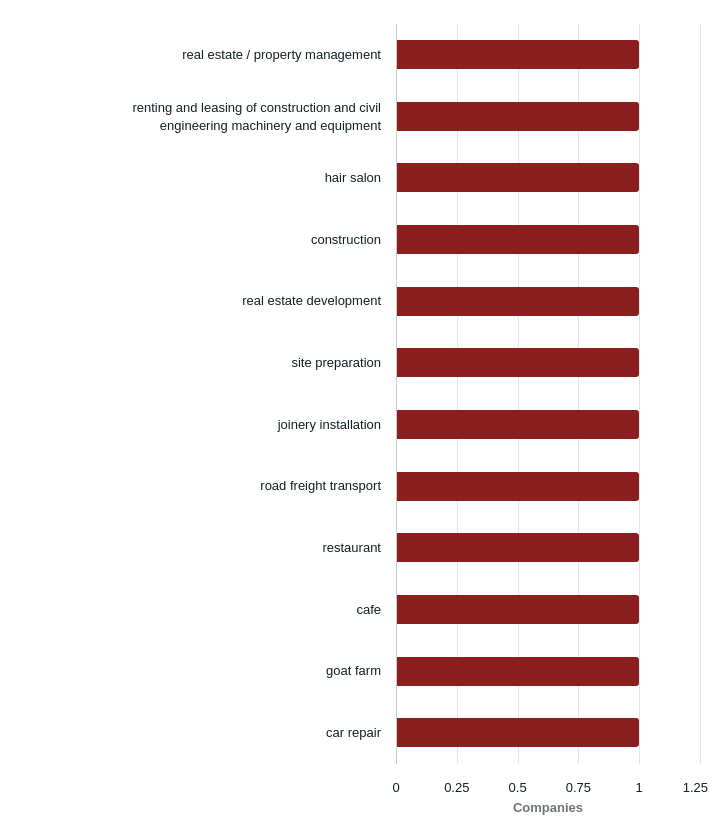
- Construction & Real Estate: Small craft firms including Et Tømrerteam AS, Hilstad Bygg AS, Steinshaug Maskin AS, and Stenset Bygg Og Eiendom AS.
The majority of insolvent entities were small-scale ventures with limited staff and zero-to-low debt carrying capacity, indicating that core industrial processing and logistics anchors remain stable.
Opportunities for Founders & Entrepreneurs
Orkland presents clear commercial opportunities for early-stage entrepreneurs capable of supplying existing supply chains or filling service gaps created by a large industrial workforce.
Strategic Expansion Areas
- Industrial Services & Technical Maintenance: With major industrial plants operating in chemical processing, metals, and electronics, founders providing specialized automation, maintenance, environmental compliance, and safety equipment will find strong local demand.
- B2B Logistics & Fleet Support: Orkland's 23 road freight companies and large distribution centers require specialized maintenance, tire services, EV heavy-transport charging infrastructure, and fleet software.
- Food Technology & Sub-contracting: Given Norsk Kylling AS and Isfjord Norway AS's combined revenue exceeding NOK 3.2 billion, opportunities exist around packaging, waste-stream valorization, and cold-chain logistics.
- Consumer & Professional Services in Orkanger: A growing workforce creates ongoing demand for quality food services, specialized retail, and health wellness offerings.
Entrepreneurs exploring site selection, commercial real estate, or sector-specific market entries in Orkland can leverage resources at SmartGrunder to evaluate prospective locations and industry data.
Conclusion
Orkland stands out as a robust industrial ecosystem within Trøndelag. Built on a foundation of heavy process industries, advanced manufacturing, and primary food processing, the municipality maintains strong economic output and stable employment around 13,600 positions.
While external market conditions have moderated top-line revenue from the record highs of 2022–2023, the core industrial infrastructure in Orkanger, Løkken Verk, and Meldal provides solid fundamentals. For decision-makers and founders, Orkland offers an established industrial network, a skilled technical workforce, and clear market openings across B2B supply chains and local service sectors.