Municipality
Ørland Business Economy: Strategic Insights for Founders and Decision-Makers
An in-depth analysis of industry structure, employment hubs, corporate performance, and entrepreneurship opportunities in Ørland
Executive Summary
Ørland municipality, situated at the entrance of the Trondheimsfjord in Trøndelag, represents a dynamic and multifaceted coastal economy. Following its municipal merger with Bjugn, Ørland combines strategic national defence infrastructure with high-volume export industries, advanced marine feed production, textile manufacturing, and regional financial services.
Key structural characteristics of the Ørland economy include:
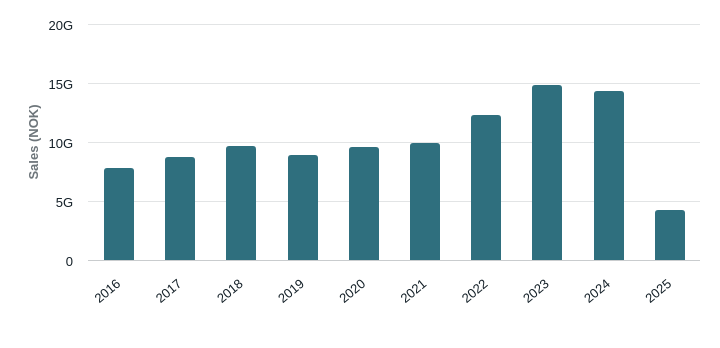
- High Enterprise Turnover: Local commercial revenues reached NOK 14.8 billion in 2023 and NOK 14.3 billion in 2024, anchored by heavy processing and commodity trades.
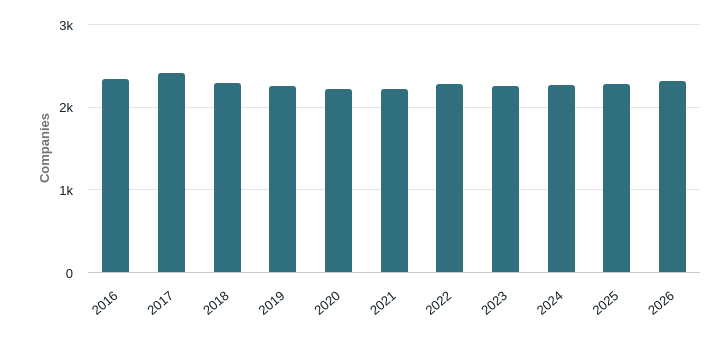
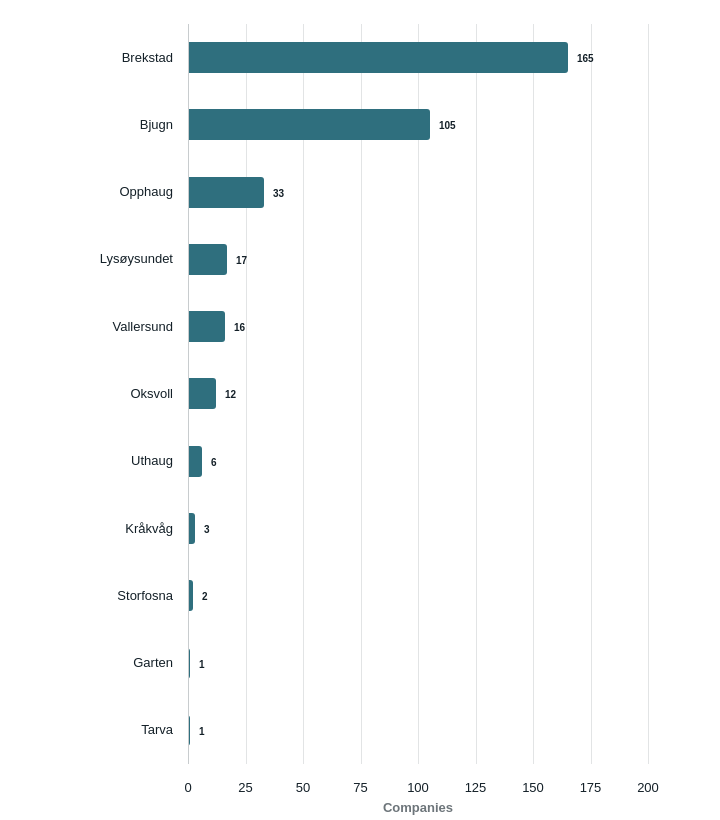
- Dual Geographic Anchors: Economic activity is heavily concentrated around Brekstad (2,763 employees across 165 registered companies) and Bjugn (1,838 employees across 105 companies), complemented by specialized industrial nodes like Uthaug and Oksvoll.
- Industrial Diversity: A rare combination of military defence activity (Ørland Main Air Station / Forsvarsbygg), major consumer manufacturing (Mascot Høie AS), aquaculture supply chain (Mowi Feed AS), pelagic processing (Grøntvedt Pelagic AS), and regional banking (Trøndelag Sparebank).
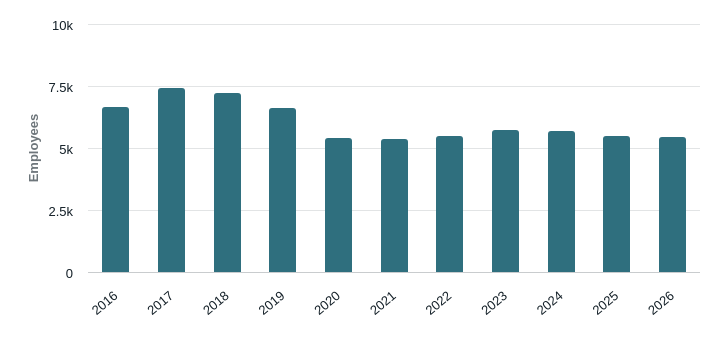
- Stabilized Labor Force: Local employment stands at approximately 5,685 personnel in registered enterprises, displaying resilience after historical restructuring.
For entrepreneurs and investors, Ørland offers a stable macroeconomic floor backed by public and defence expenditure, alongside high-yield opportunities in industrial sub-contracting, technical consulting, and consumer services.
Economic Overview
Ørland's corporate sector has demonstrated substantial expansion in revenue output over the past decade. Enterprise turnover expanded from NOK 7.83 billion in 2016 to a peak of NOK 14.82 billion in 2023, representing an overall revenue increase of nearly 90%. In 2024, total local sales remained robust at NOK 14.31 billion.
Note on 2025 Data: The reported 2025 turnover figure of NOK 4.28 billion reflects partial-year accounting filings at the time of reporting rather than an economic contraction...
Employment levels experienced structural realignments following regional municipal consolidations and industrial shifts. Workforces leveled from a high of 7,412 in 2017 to a steady baseline of 5,685 in 2024 and 5,492 in 2025.
| Year | Total Sales (NOK) | YoY Sales Change | Registered Employees | YoY Employee Change |
|---|---|---|---|---|
| 2016 | 7.83B | — | 6,657 | — |
| 2017 | 8.72B | +11.4% | 7,412 | +11.3% |
| 2018 | 9.62B | +10.3% | 7,221 | -2.6% |
| 2019 | 8.91B | -7.4% | 6,594 | -8.7% |
| 2020 | 9.60B | +7.8% | 5,404 | -18.0% |
| 2021 | 9.94B | +3.5% | 5,359 | -0.8% |
| 2022 | 12.31B | +23.8% | 5,471 | +2.1% |
| 2023 | 14.82B | +20.3% | 5,743 | +5.0% |
| 2024 | 14.31B | -3.4% | 5,685 | -1.0% |
| 2025 | 4.28B* | Partial | 5,492 | -3.4% |
Industry Structure
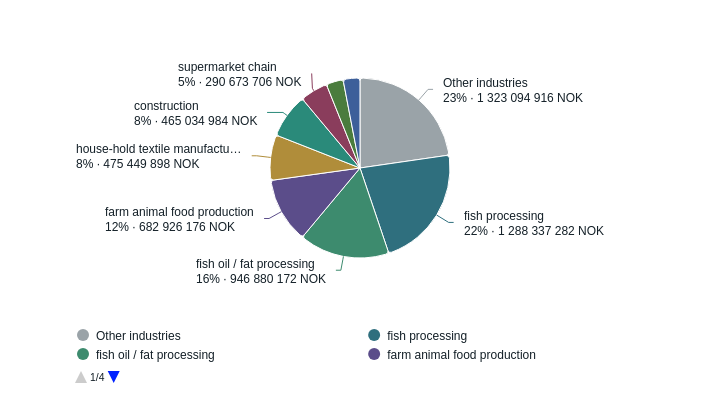
The enterprise landscape in Ørland exhibits significant sector depth across both primary, secondary, and tertiary industries. Major turnover drivers are seafood processing, farm animal food production, household textile manufacturing, and financial intermediation.
Sector Breakdown and Performance
- Fish Processing & Feed: Fish processing generates over NOK 1.29B in operating income, though global commodity price volatility caused sector margin compressions recently (-NOK 98.2M operating profit across sample firms). Meanwhile, farm animal food production (Mowi Feed AS) recorded NOK 682.9M in operating income with an EBITDA margin of 7%.
- Textile Manufacturing: Led by Mascot Høie AS, household textile manufacturing is an exceptional regional performer, delivering NOK 476.5M in operating income, 138 employees, and a healthy operating profit of NOK 41.5M (8% operating margin).
- Monetary Intermediation: Financial institutions, including Trøndelag Sparebank, generate NOK 511.4M in operating income with exceptional operating profitability (NOK 236.5M operating profit, 48% EBITDA margin).
- Construction & Technical Services: Construction and electrical installations employ over 330 personnel combined, generating over NOK 569M in revenue, supporting local infrastructure and defence builds.
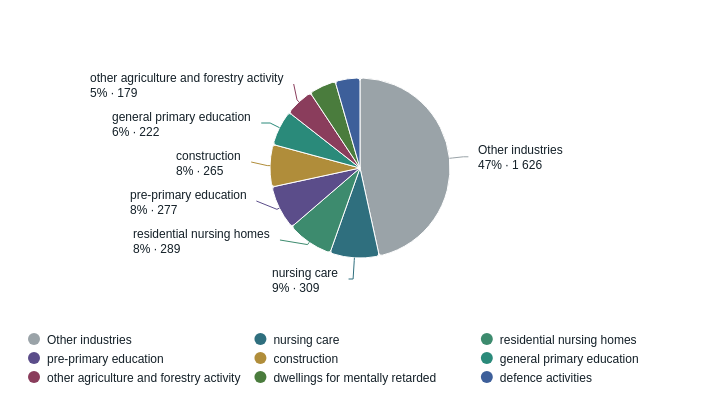
- Public & Healthcare Services: Nursing care, residential homes, and municipal services form the largest collective employer block, providing stable employment for over 900 healthcare professionals.
Legal Forms Distribution
Limited liability companies (A/S) account for the vast majority of commercial activity, comprising 244 registered firms, 2,442 employees, and NOK 6.08B in direct revenue. Municipal entities (KOMM) represent 50 registered units and 1,835 employees, reflecting a strong public sector foundation.
Business Geography
Ørland's commercial geography is spread across distinct urban and industrial nodes along the Fosen peninsula. Each area maintains a specialized economic role within the municipality.
Spatial Breakdown
- Brekstad: The administrative and commercial core of Ørland. Hosting 165 companies and 2,763 employees, Brekstad generates NOK 1.82B in sales revenue and NOK 263.4M in operating profit, with an average EBITDA margin of 14%.
- Bjugn: The second major population hub, housing 105 companies and 1,838 employees. Bjugn turns over NOK 1.80B in sales, driven heavily by civic institutions, healthcare, and secondary education.
- Uthaug: A highly productive maritime industrial hub with 6 registered companies turning over NOK 1.13B in sales, dominated by pelagic processing.
- Oksvoll: Home to major aquaculture supply operations (Mowi Feed), generating NOK 800.1M in sales across 12 companies.
- Opphaug & Vallersund: Smaller agricultural and commercial hubs generating NOK 255.2M and NOK 259.4M in sales revenue respectively.
| Location | Companies | Employees | Operating Income (NOK) | Sales Revenue (NOK) | Operating Margin |
|---|---|---|---|---|---|
| Brekstad | 165 | 2,763 | 2,301.2M | 1,823.8M | 11% |
| Bjugn | 105 | 1,838 | 1,980.2M | 1,800.4M | 1% |
| Opphaug | 33 | 273 | 257.0M | 255.2M | 3% |
| Oksvoll | 12 | 174 | 802.9M | 800.1M | 6% |
| Lysøysundet | 17 | 169 | 293.0M | 278.0M | -2% |
| Vallersund | 16 | 145 | 265.0M | 259.4M | 3% |
| Uthaug | 6 | 127 | 1,138.7M | 1,132.5M | -7% |
| Kråkvåg | 3 | 56 | 200.3M | 199.7M | 3% |
Largest Employers
Employment in Ørland is balanced between large municipal care facilities, national public sector entities, and privately owned industrial powerhouses.
Key Employers in Ørland
- Bjugn Sykehjem & Ørland Kommune Care Services: Municipal healthcare operations form the largest single employment provider in the region, with Bjugn Sykehjem employing 217 staff and Ørland Kommune Hjemmetjenesten employing over 290 staff across its units.
- Landbrukstjenester Fosen SA: A major agricultural cooperative headquartered in Brekstad, employing 175 workforce members.
- Forsvarsbygg Region Vest II: Manages defence infrastructure at Ørland Air Station, employing 155 specialized personnel.
- Mascot Høie AS (Avd Produksjon Og Adm.): A flagship textile manufacturer located in Brekstad with 138 employees, generating NOK 475.4M in sales revenue.
- Mowi Feed AS (Avd Valsneset): Key aquaculture feed production plant in Oksvoll, employing 93 staff with NOK 682.9M in operating turnover.
- Grøntvedt Pelagic AS (Avd Uthaug): Major fish processing facility employing 86 staff and generating over NOK 1.06B in revenue.
- Rædergård Entreprenør AS: Leading local civil contractor with 80 employees and NOK 194.0M in sales.
- Trøndelag Sparebank (Avd Brekstad): Regional financial services anchor employing 78 staff.
- St Olavs Hospital HF Ambulanse: Regional emergency services station based in Brekstad employing 77 medical staff.
| Company Name | Industry | Location | Employees | Reported Sales (NOK) |
|---|---|---|---|---|
| Bjugn Sykehjem | Residential Nursing | Bjugn | 217 | Public |
| Ørland Kommune Hjemmetjenesten | Nursing Care | Bjugn / Brekstad | 297 | Public |
| Landbrukstjenester Fosen SA | Agricultural Services | Brekstad | 175 | 17.7M |
| Forsvarsbygg Region Vest II | Defence Infrastructure | Brekstad | 155 | Public |
| Mascot Høie AS | Textile Manufacturing | Brekstad | 138 | 475.4M |
| Ørland Sykehjem | Specialised Nursing | Brekstad | 125 | Public |
| Mowi Feed AS | Animal Food Production | Oksvoll | 93 | 682.9M |
| Grøntvedt Pelagic AS | Fish Processing | Uthaug | 86 | 1,060.9M |
| Rædergård Entreprenør AS | Construction | Brekstad | 80 | 194.0M |
| Trøndelag Sparebank | Monetary Intermediation | Brekstad | 78 | 269.5M (Income) |
Business Dynamism & Market Stability
Ørland displays a highly stable corporate climate characterized by low default rates and strong institutional backing. Insolvencies in the municipality remain minimal, reflecting strong underlying demand across local service and supply networks.
Bankruptcy Dynamics
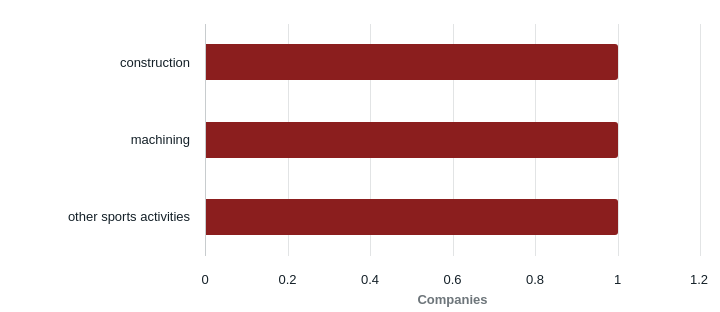
In recent statistical samples, only 3 insolvencies were registered across the municipality:
- FVS Entreprenør AS: Construction company based in Brekstad (28 employees prior to closure).
- R.S Stål AS: Machining firm in Brekstad (NOK 34.3M turnover, experiencing cost overruns before restructuring).
- Stall Austerli AS: Small sports/equestrian enterprise in Bjugn (NOK 661K turnover).
The low bankruptcy rate highlights the resilience of Ørland's commercial ecosystem. While industrial sub-contractors face cyclical pressure from raw material costs and interest rates, core primary and public sector activities maintain consistent economic circulation.
Opportunities for Founders
For new business creators, Ørland offers unique structural advantages derived from expanding defence projects, strong marine industries, and an established population base across Brekstad and Bjugn.
Key Growth Sectors for Entrepreneurs
- Defence Sub-contracting & Technical Services: With Ørland Main Air Station serving as a major military node, demand for specialized maintenance, logistics, cybersecurity, and facility management services continues to grow.
- Aquaculture & Marine Biotech Support: Proximity to Mowi Feed and Grøntvedt Pelagic creates room for niche technology providers, circular economy initiatives (waste processing, feed optimization), and specialized maritime equipment maintenance.
- Commercial Services & Food/Beverage: Brekstad’s status as a regional urban center creates steady consumer demand for high-end dining, specialized retail, and personal services catering to military personnel, municipal staff, and industry professionals.
- Green Construction & Craft Services: Energy retrofitting, residential building, and specialized electrical services remain in high demand across both Brekstad and coastal communities.
Founders interested in launching an enterprise in Ørland can leverage SmartGrunder to analyze street-level business presence, explore target industry statistics, and identify under-served commercial niches in Brekstad, Bjugn, and surrounding commercial zones.
Conclusion
Ørland municipality stands out as one of Trøndelag's most resilient coastal business environments. By combining steady public sector employment and national defence commitments with multi-billion NOK export industries in seafood, agriculture, and manufacturing, Ørland offers a well-balanced macro environment.
For local decision-makers and incoming entrepreneurs, the primary objective is capitalizing on Brekstad and Bjugn's commercial infrastructure while expanding technical and service supply chains around major industrial anchors. With high corporate turnover, strong financial services, and manageable operational risks, Ørland remains a highly attractive location for establishing new commercial ventures.