Municipality
Economic Landscape and Entrepreneurial Opportunities in Rana Municipality
An in-depth analysis of industry structure, employment trends, business geography, and startup potential in Nordland's industrial powerhouse.
Executive Summary
Rana municipality, located in Nordland county, serves as one of Northern Norway's leading industrial and public sector strongholds. Centered around the town of Mo I Rana, the local economy is anchored by heavy manufacturing, iron ore mining, industrial maintenance, national public administrative bodies, and a expanding specialized IT service cluster.
Key economic highlights include:
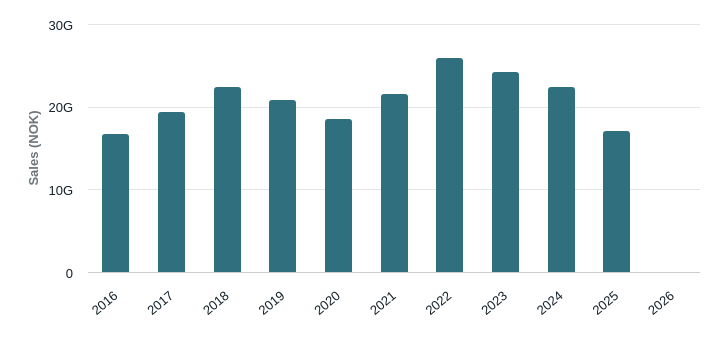
- High Industrial Volume: Total commercial sales revenue reached NOK 25.8 billion at its recent peak in 2022, stabilized around NOK 22.3 billion in 2024, driven by high-value export industries.
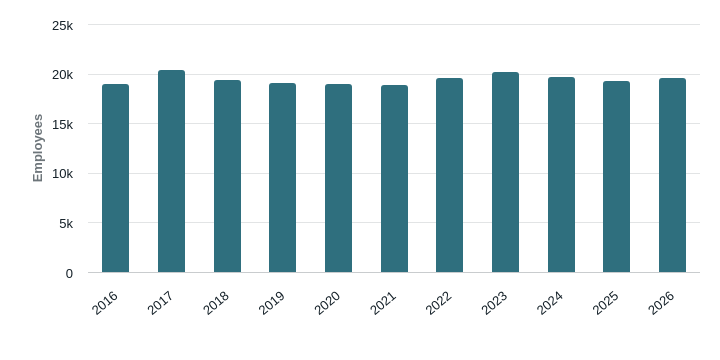
- Substantial Workforce: Rana supports roughly 19,200 to 20,100 active jobs, combining major industrial employers with significant public administration hubs.
- Geographic Centrality: Mo I Rana represents over 95% of all corporate revenue and employment within the municipality, while surrounding settlements like Utskarpen, Skonseng, and Storforsheia provide specialized local economic contributions.
- Entrepreneurial Readiness: Strong B2B industrial ecosystems, high average revenue per employee in core sectors, and expanding public-private technology investments create fertile ground for specialized service providers, green tech ventures, and local B2B suppliers.
Economic Overview
Rana's macroeconomic footprint exhibits strong top-line industrial production capabilities. Corporate revenues expanded rapidly between 2016 and 2022, reaching an all-time high of NOK 25.83 billion in 2022, before experiencing a moderate macroeconomic normalization in 2023–2024.
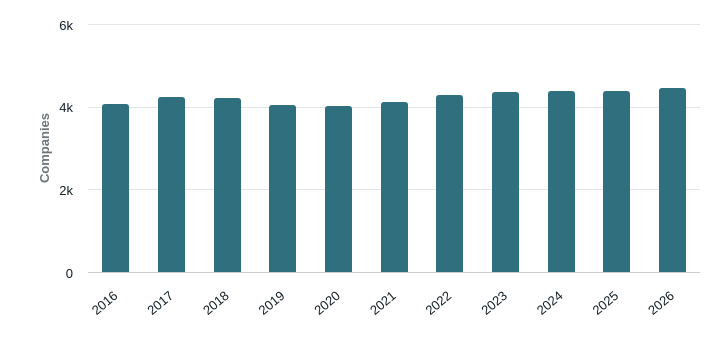
The workforce has remained consistent over the past decade, fluctuating between 18,800 and 20,180 employees. Note: Data for 2025–2026 reflects preliminary or incomplete tax reporting cycles rather than a structural collapse in physical output.
Historical Revenue & Employment Trends
| Year | Total Sales Revenue (NOK) | YoY Sales Change | Active Employees | YoY Employee Change |
|---|---|---|---|---|
| 2016 | 16.75 Billion | — | 18,998 | — |
| 2017 | 19.30 Billion | +15.2% | 20,390 | +7.3% |
| 2018 | 22.44 Billion | +16.2% | 19,402 | -4.8% |
| 2019 | 20.81 Billion | -7.2% | 19,086 | -1.6% |
| 2020 | 18.56 Billion | -10.9% | 18,940 | -0.8% |
| 2021 | 21.55 Billion | +16.1% | 18,849 | -0.5% |
| 2022 | 25.83 Billion | +19.9% | 19,556 | +3.8% |
| 2023 | 24.22 Billion | -6.2% | 20,180 | +3.2% |
| 2024 | 22.32 Billion | -7.8% | 19,701 | -2.4% |
| 2025 (Partial) | 17.06 Billion | -23.6% | 19,275 | -2.2% |
Note: Figures for 2025 are based on reported trailing 12-month returns as of mid-year reporting.
Industry Structure
Rana's economy features a powerful dual foundation: primary manufacturing/mining export drivers paired with large-scale public administration institutions.
Key Industry Sectors
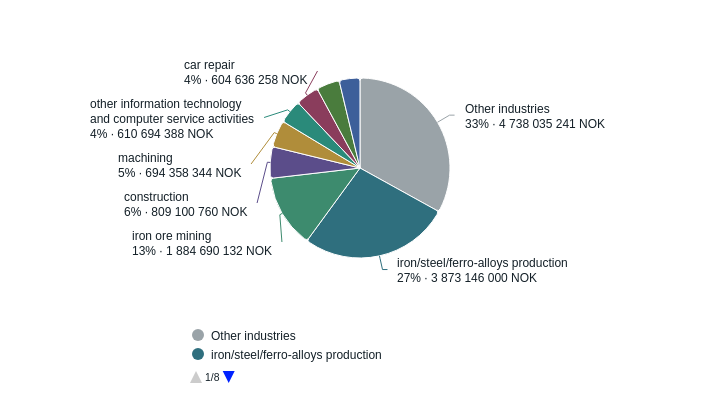
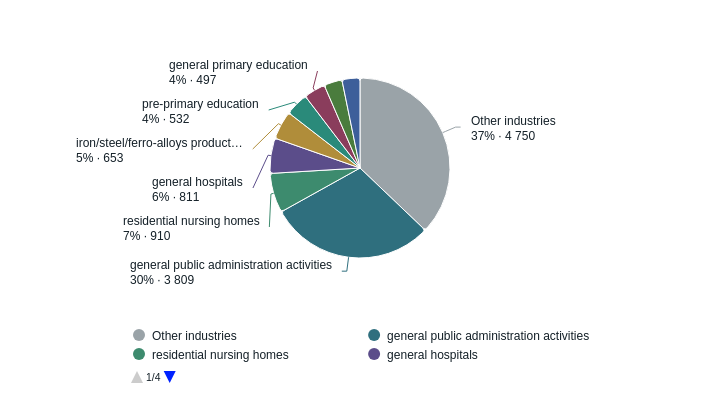
- Iron & Steel Manufacturing: Represented by major processing plants, generating NOK 5.13 billion in operating income across 653 employees, with an average operating income per employee of NOK 10.2 million.
- Mining & Extractive Industries: Iron ore mining generates NOK 1.88 billion in operating income with exceptional profitability (28% EBITDA margin, average NOK 1.2 million EBITDA per employee).
- Industrial Servicing & Machining: Machining and specialized equipment repair account for over NOK 1.23 billion combined revenue across 638 employees (e.g., Momek Services AS).
- Public Sector & State Institutions: Rana hosts major national public entities including the National Library of Norway (Nasjonalbiblioteket) and the Norwegian Tax Administration (Skatteetaten), employing thousands of civil servants alongside municipal services.
- Information Technology: Tech services yield NOK 629.9 million in revenue with strong profitability (18% EBITDA margin).
Sector Benchmark Table
| Industry Sector | Active Companies | Employees | Operating Income (NOK) | EBITDA Margin | Operating Income / Employee |
|---|---|---|---|---|---|
| Iron/Steel Production | 3 | 653 | 5,125.2M | 6% | 10.2M |
| Iron Ore Mining | 2 | 418 | 1,884.7M | 28% | 4.4M |
| Construction | 28 | 345 | 810.9M | 4% | 2.8M |
| Machining | 9 | 411 | 697.3M | 3% | 1.8M |
| IT & Computer Services | 8 | 270 | 629.9M | 18% | 2.0M |
| Site Preparation | 21 | 326 | 541.0M | 10% | 2.1M |
| General Hospitals | 2 | 811 | 992.9M | 0% | 1.3M |
Business Geography
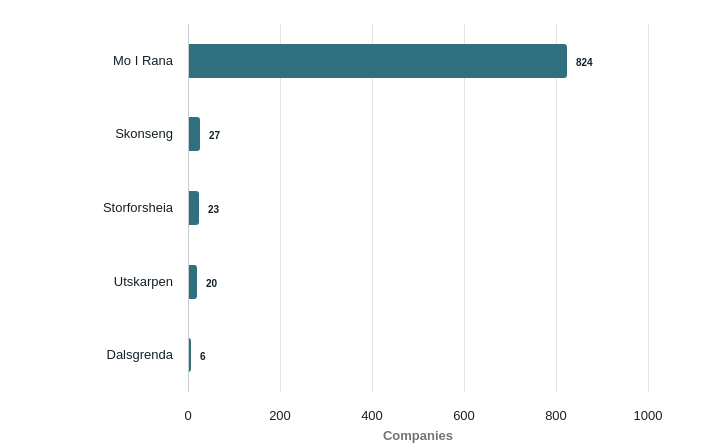
Economic activity in Rana is concentrated heavily in Mo I Rana, which houses the Mo Industrial Park (Mo Industripark) and primary municipal infrastructure. Secondary centers support rural industries, aquaculture, subsea servicing, and residential pockets.
Spatial Distribution of Business Activity
| City / Area | Companies | Active Employees | Operating Income (NOK) | Sales Revenue (NOK) | Revenue Growth |
|---|---|---|---|---|---|
| Mo I Rana | 824 | 19,495 | 23,405.4M | 19,589.2M | -1% |
| Utskarpen | 20 | 190 | 332.4M | 320.1M | -2% |
| Skonseng | 27 | 157 | 190.6M | 172.9M | +10% |
| Dalsgrenda | 6 | 76 | 87.2M | 86.7M | +49% |
| Storforsheia | 23 | 165 | 60.4M | 56.4M | +5% |
Area Profiles
- Mo I Rana: The commercial and logistics core. Houses large manufacturing sites, specialized B2B trade, hospital facilities, and state government divisions.
- Utskarpen: Demonstrates strong productivity (NOK 5.0 million operating income per employee), influenced by marine operations and specialized regional enterprises.
- Skonseng & Dalsgrenda: Key growth zones showing positive revenue growth (+10% and +49% respectively), supporting local transport, construction, and sub-contracting.
Largest Employers
Rana's employment structure balances public administration with private heavy industrial leaders.
Leading Municipal Employers
- Rana Kommune: The municipality's largest employer, managing 3,400 staff across administration, schools, and home care services (Rana Kommune Hjemmebaserte Tjenester).
- Helgelandssykehuset HF Mo I Rana Somatikk: Regional hospital provider employing 792 staff with operating revenues of NOK 992.9 million.
- Rana Gruber AS: Listed iron ore mining enterprise employing 410 workers, generating NOK 1.66 billion in sales and NOK 532.7 million in EBITDA (32% EBITDA margin).
- 7 Steel Nordic Manufacturing AS (Avd Produksjon Av Jern Og Stål): Major steel plant with 377 employees, yielding NOK 3.87 billion in sales revenue.
- Nasjonalbiblioteket (Avd Rana): The National Library's digital and archival storage unit, employing 337 civil servants.
- Skatteetaten Mo I Rana: Major national tax processing hub employing 328 staff.
- Momek Services AS (Avd Mekanisk Service): Key industrial maintenance and mechanical fabrication provider employing 311 people with NOK 556.5 million in sales.
- Evry Card Services AS (Avd Mo I Rana): Financial technology and card solutions hub employing 241 employees, generating NOK 589.4 million in sales with an 18% EBITDA margin.
- Meyergården Turisthotell AS: Leading hospitality player employing 177 staff with NOK 97.0 million in sales.
Business Dynamism & Market Adjustments
Market adjustments in Rana reflect broader national macro-trends, specifically in cost-sensitive sectors like civil construction, automotive services, and hospitality.
Bankruptcy Analysis
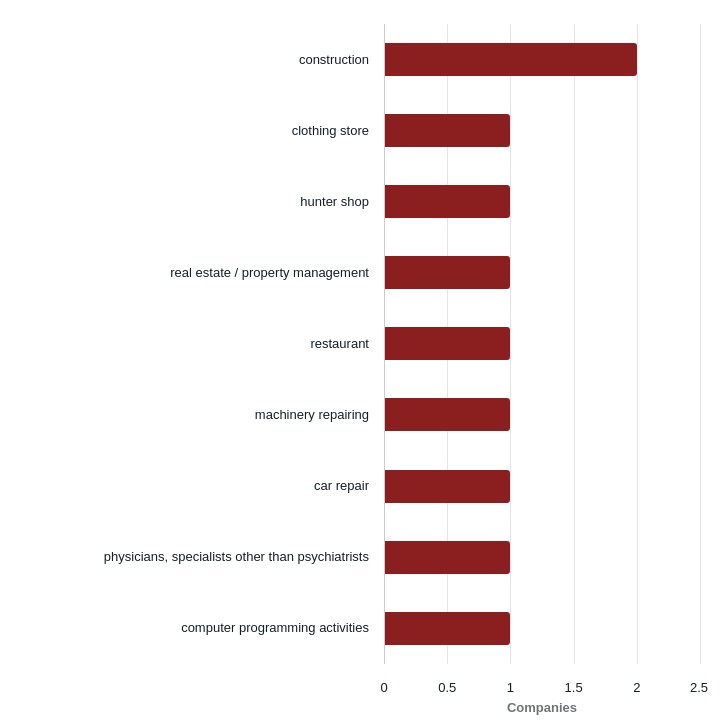
Recent bankruptcies remain contained, primarily affecting smaller operators facing margin compression from material inflation and wage pressure:
- Construction & Contracting: The largest structural loss was recorded by B G Entreprenør AS (sales revenue of NOK 91.7 million, EBITDA loss of NOK -15.8 million), reflecting sector-wide headwinds in sub-contracting and fixed-price contracts.
- Hospitality & Retail: Outlets such as VR Grill & Bar AS (NOK 10.9M sales, EBITDA NOK -1.4M) and Helgeland Villmarksenter AS (NOK 10.4M sales) suffered from consumer tightening and increased input costs.
- Specialized Services: Minor insolvencies occurred in small car repair shops, localized consulting firms, and holding companies without broader systemic disruption.
Overall, the corporate sector maintains a robust equity base, with limited systemic risk across the primary industrial processing and mining clusters.
Opportunities for Founders
For new business founders, Rana offers a high-volume B2B marketplace driven by heavy industry, circular economy initiatives, and a steady public sector workforce.
Strategic Business Opportunities
- Green Industrial Services & Circular Economy: With major industrial players like 7 Steel Nordic Manufacturing AS, Elkem ASA Rana, and Rana Gruber AS driving decarbonization, opportunities exist for waste processing, energy optimization, and byproduct utilization.
- B2B Engineering & Supply Logistics: High demand exists for specialized sub-contracting, non-destructive testing, automation, and specialized equipment repair for Momek Services AS and local industrial parks.
- Enterprise IT & Financial Tech: Building on the talent pool created by Evry Card Services AS and state digital archives, Rana offers skilled IT personnel for software development, cybersecurity, and data services.
- Niche Consumer & Hospitality Services: A stable base of over 19,000 workers supports demand for specialized dining, corporate hospitality, and fitness/lifestyle concepts.
When exploring commercial real estate or industry gaps in Rana, tools like SmartGrunder can help entrepreneurs analyze neighborhood-level demographic signals and registered firm structures to identify optimal launching grounds.
Conclusion
Rana combines a stable public administration presence with Northern Norway's largest industrial processing ecosystem. With annual sales revenues exceeding NOK 22 billion and over 19,000 active positions, the municipality represents a resilient regional market.
Founders who align their offerings with industrial B2B servicing, energy transition technologies, or specialized digital services will find a supportive market with strong capital flow and an established industrial skilled workforce.