Municipality
Rødøy Municipal Economy: Industry Analysis & Business Opportunities
An in-depth evaluation of economic performance, aquaculture dominance, geographic hubs, and founder opportunities in Rødøy
Executive Summary
Rødøy is a coastal municipality in Nordland county whose economy is defined by a powerful dual structure: high-margin maritime aquaculture operations alongside a vital public sector that maintains the municipal social infrastructure across islands and fjords.
Key economic highlights include:
- Aquaculture Dominance: Fish farming accounts for over NOK 571 million in operating income across local corporate units, generating exceptionally high value per employee (averaging NOK 10.8M per employee).
- Anchor Employment: Public administration, primary education, and residential nursing centers form the employment backbone, with Rødøy Kommune and municipal care centers employing over 400 people.
- Geographic Specialization: Business activity is concentrated across distinct coastal nodes. Rødøy island and Selsøyvik drive high-value aquaculture revenue, Vågaholmen serves as the municipal administrative center, while Myken and Øresvik excel in specialized hospitality and craft production.
- Capital Intensity: The private commercial sector is dominated by limited liability companies (A/S) holding substantial total equity (over NOK 1.58 billion across private enterprises).
Economic Overview & Historical Trends
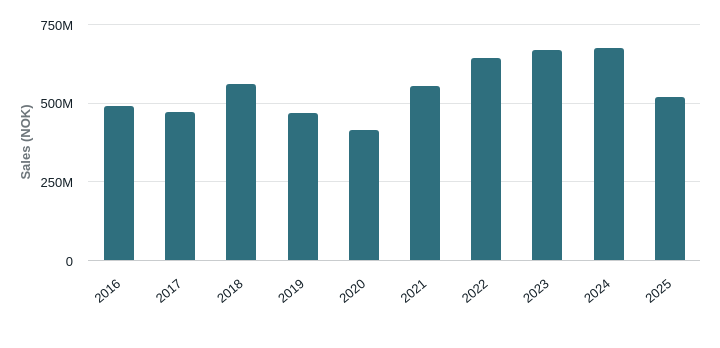
Over the past decade, corporate sales revenues in Rødøy have experienced fluctuations driven largely by global seafood price cycles, biological harvest timelines, and broader macroeconomic shifts. Total business revenues reached a peak of NOK 674.9 million in 2024 before tapering to NOK 519.0 million in 2025.
Historical Sales Revenue (2016–2025)
| Year | Operating Revenue (NOK) | Year-over-Year Growth |
|---|---|---|
| 2016 | 489.7M | — |
| 2017 | 469.6M | -4.1% |
| 2018 | 558.2M | +18.9% |
| 2019 | 467.9M | -16.2% |
| 2020 | 412.5M | -11.8% |
| 2021 | 551.6M | +33.7% |
| 2022 | 640.8M | +16.2% |
| 2023 | 668.9M | +4.4% |
| 2024 | 674.9M | +0.9% |
| 2025 | 519.0M | -23.1% |
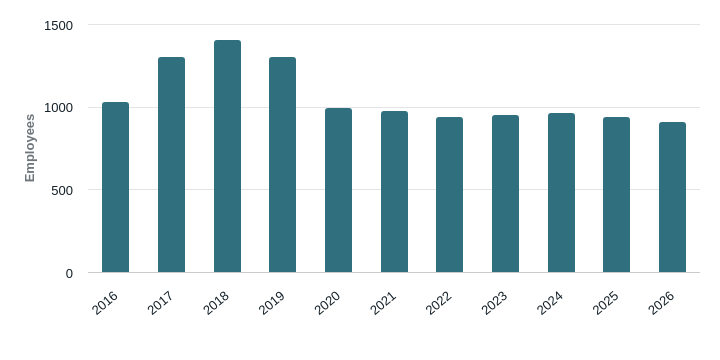
Total workforce numbers in the municipality expanded during 2017–2018 to over 1,400 employees before stabilizing in the 900–960 range in recent years. This workforce contraction reflects automation in primary industries and structural adjustments in coastal demographics.
Municipal Workforce Progression (2016–2026)
- 2016–2018: Rapid expansion from 1,028 to a peak of 1,406 employees (+36.8% total growth).
- 2019–2021: Normalization down to 972 employees during global market restructuring.
- 2022–2024: Stabilization around 939–962 employees, reflecting steady core municipal and aquaculture staffing.
- 2025–2026 (Projected/Reported): Transitioning toward 909–939 employees across public and private sectors.
Industry Structure & Legal Forms
Rødøy's commercial sector exhibits an exceptional concentration of revenue in primary aquaculture, backed by supporting service sectors in retail, coastal transport, tourism, and craft manufacturing.
Core Industry Clusters
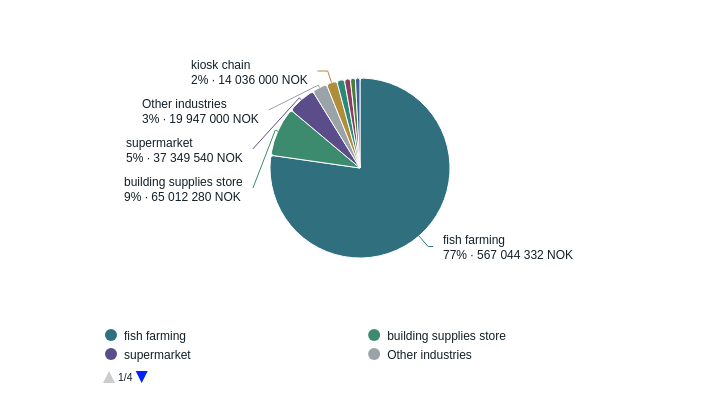
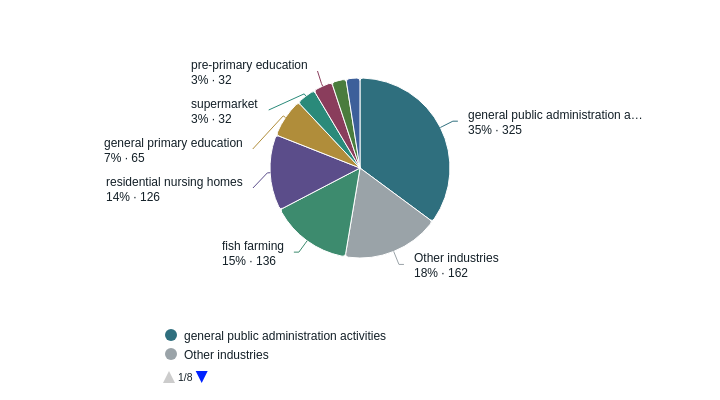
- Fish Farming & Smolt Production: With 6 registered operating entities and 136 employees, aquaculture delivers NOK 571.2M in operating income. The sector maintains an impressive 16% EBITDA margin (NOK 93.7M total EBITDA) and holds over NOK 1.50 billion in equity.
- Public Sector & Healthcare Services: Public administration (325 employees), residential care facilities (126 employees across Aldertun and Rødøya nursing homes), and primary education (65 employees) account for the vast majority of stable local employment.
- Retail & Building Supplies: Anchored by local merchants such as Arnulf Hansen Og Co As (NOK 65.3M turnover, 23 employees) and local supermarket outlets (NOK 37.8M combined turnover).
- Tourism, Hospitality & Craft Production: Camping facilities (e.g., Polarcamp at Øresvik with 22% EBITDA margin) and specialized producers such as spirits manufacturing on Myken (NOK 6.2M turnover with a 74% EBITDA margin) showcase high profitability in niche coastal tourism.
Corporate Form Analysis
The legal structure of businesses in Rødøy reflects a stark division between capital-intensive commercial firms and public institutions:
- Aktieselskap (AS): 30 active limited companies employ 232 people, generating NOK 739.5M in operating income with an average operating income per employee of NOK 4.7M and an overall EBITDA margin of 14%.
- Public/Organisational Bodies (ORGL / KOMM / ASA): Public sector entities and major corporate branches (including Mowi Avd Tjongsfjorden as an ASA unit) account for over 670 employees across municipal administration, schools, and health infrastructure.
- Enkeltpersonforetak (ENK): 11 sole proprietorships provide essential local services in agriculture, trade, and micro-services.
Business Geography & Local Hubs
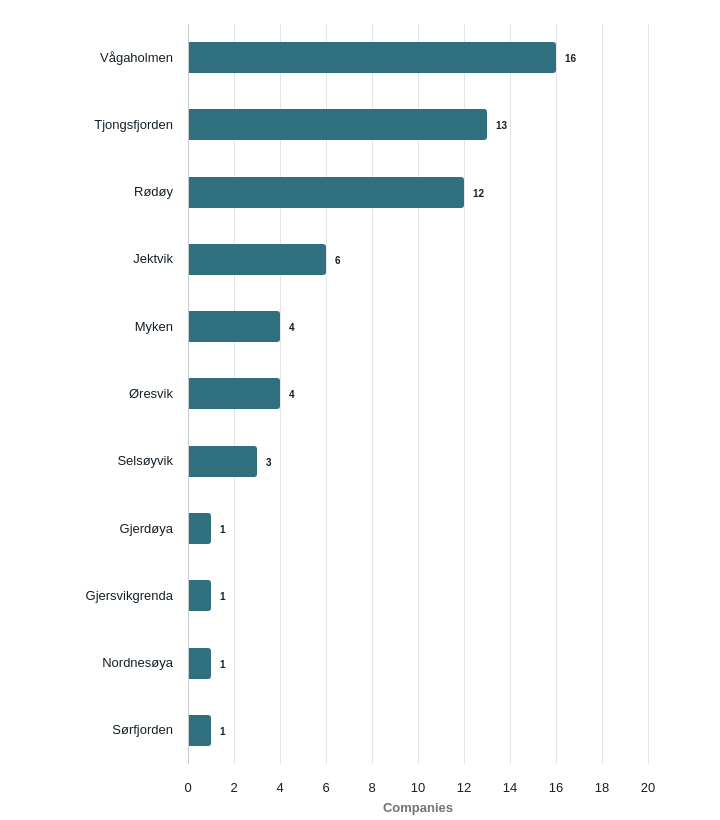
Economic activity in Rødøy is distributed across island communities and fjord settlements, each serving dedicated commercial functions.
| Geographic Hub | Active Companies | Employees | Operating Income (NOK) | Highlights & Key Drivers |
|---|---|---|---|---|
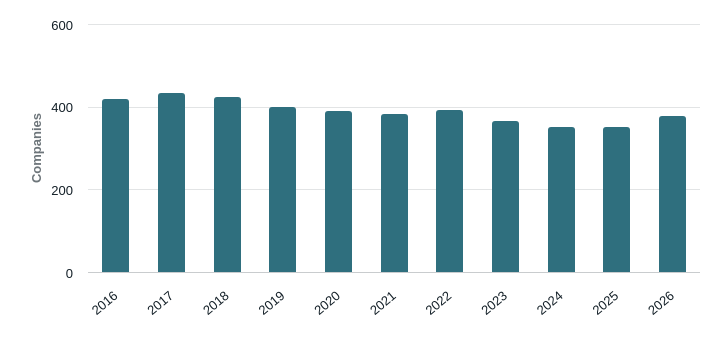
| Vågaholmen | 16 | 444 | 107.3M | Municipal administration, technical services, building supplies store |
| Rødøy (Island) | 12 | 149 | 311.0M | Major aquaculture base (Nova Sea, Gigante Salmon), 14% EBITDA margin |
| Selsøyvik | 3 | 33 | 278.8M | High-efficiency fish farming (Selsøyvik Havbruk) & passenger transport |
| Tjongsfjorden | 13 | 148 | 10.2M | Residential care (Aldertun), primary education, smolt production hub |
| Jektvik | 6 | 104 | 16.3M | Transport junction, Mowi aquaculture department, Jektvik Skole |
| Øresvik | 4 | 35 | 6.5M | Coastal tourism hub featuring Polarcamp (20% EBITDA margin) |
| Myken | 4 | 15 | 10.0M | Outport island tourism & world-renowned spirits production (50% EBITDA) |
Vågaholmen functions as the primary administrative core with 444 employees across municipal services and commercial trade. Rødøy island and Selsøyvik generate the vast majority of industrial revenue, combined yielding nearly NOK 590 million in operating income due to seafood processing and farming.
Largest Employers & Corporate Anchors
Employment in Rødøy is anchored by public institutions alongside global and regional aquaculture leaders.
Primary Public Sector Employers
- Rødøy Kommune: Central administration and municipal services at Vågaholmen employ 311 people.
- Aldertun Omsorgssenter: Located in Tjongsfjorden, employing 67 workers in nursing care.
- Rødøya Omsorgssenter: Located on Rødøy island, employing 59 healthcare staff.
- Local Schools & Kindergartens: Tjongsfjord Skole (21 employees), Jektvik Skole (17 employees), and Tjongsfjord Barnehage (14 employees).
Commercial & Industrial Leaders
- Mowi Avd Tjongsfjorden: Major fish farming unit employing 57 workers.
- Gigante Salmon Rødøy AS: Land-based/land-attached aquaculture developer located at Lille Indre Rosøya, employing 29 workers with NOK 71.6M in turnover and 22% EBITDA margin.
- Arnulf Hansen Og Co AS (Vågaholmen): Leading retail hardware and building supply firm employing 23 workers with NOK 65.3M in revenue.
- Helgeland Smolt AS (Avd Reppen): Key smolt supplier in Tjongsfjorden employing 21 staff.
- Nova Sea AS (Avd Rødøy): Major salmon producer employing 14 workers with NOK 227.3M in reported regional operating income.
- Selsøyvik Havbruk AS: High-yield aquaculture operator in Selsøyvik generating NOK 272.1M in revenue with 14 employees (NOK 21.1M operating income per employee).
- Polarcirkelen Båttransport AS: Coastal passenger transport operator employing 14 people with NOK 6.7M in operating revenue.
- Polarcamp (Øresvik): Primary camping and accommodation provider employing 16 workers.
Business Dynamism & Financial Stability
The commercial ecosystem in Rødøy demonstrates extreme capital stability within its core export industries, paired with lower turnover dynamics in traditional local services.
Key Financial Dynamics
- High Capital Intensity: Private limited companies in Rødøy carry NOK 1.58 billion in total equity against NOK 1.28 billion in total debt, indicating robust balance sheets backed by long-term aquaculture licenses and land assets.
- Profitability Margins: Average EBITDA margins among AS enterprises sit at 14%, with exceptional performance in niche manufacturing (spirits production on Myken reaching a 74% EBITDA margin) and seafood production (16-22% EBITDA margins).
- Low Bankruptcy Strain: The region exhibits high operational stability without persistent corporate insolvencies in major sectors, largely protected by strong global demand for seafood and fixed municipal employment bases.
- Revenue Efficiency: Commercial operations average NOK 4.7M in operating income per employee across all AS structures, placing Rødøy high in Nordland for per-capita business productivity.
Opportunities for Founders & Entrepreneurs
For prospective business founders, Rødøy offers distinct commercial niches tied to its marine geography, visitor economy, and industrial supply chains.
Promising Entrepreneurial Avenues
- Aquaculture Supply Chain & Technical Services: With fish farming generating over NOK 570M locally, there is ongoing demand for specialized maintenance, net cleaning support, marine electronics, subsea inspection, and environmental monitoring.
- Eco-Tourism & Coastal Experiences: Building on established destinations like Myken and Polarcamp in Øresvik, opportunities exist for guiding, kayak chartering, boat rentals, and year-round hospitality offerings focused on the Helgeland coastline.
- Local Food & Craft Beverage Production: Myken's success demonstrates that premium niche products crafted on outer islands can command high gross margins (up to 50%) and national distribution.
- Logistics & Maritime Support Services: Decentralized island infrastructure creates demand for freight consolidation, passenger transport, and vessel repair facilities.
Founders interested in exploring specific property options, commercial address availability, or industry-specific data across Rødøy can softly utilize platform tools like SmartGrunder to evaluate local business conditions and municipal mapping.
Conclusion
Rødøy municipality represents a resilient coastal economy driven by world-class aquaculture productivity, strong equity reserves, and reliable public anchor employment. While geographic dispersion poses transportation and recruitment considerations, the sheer volume of wealth generated by the seafood and maritime sectors creates fertile ground for service providers, suppliers, and tourism entrepreneurs.
By leveraging its geographic assets and strong financial baseline, Rødøy remains an attractive destination for capital-efficient, marine-focused ventures seeking long-term stability on the Helgeland coast.