Municipality
Sarpsborg Municipal Economy Analysis: Strategic Insights for Founders and Business Leaders
An in-depth evaluation of industrial strongholds, employment trends, geographic centers, and startup opportunities in Sarpsborg
Executive Summary
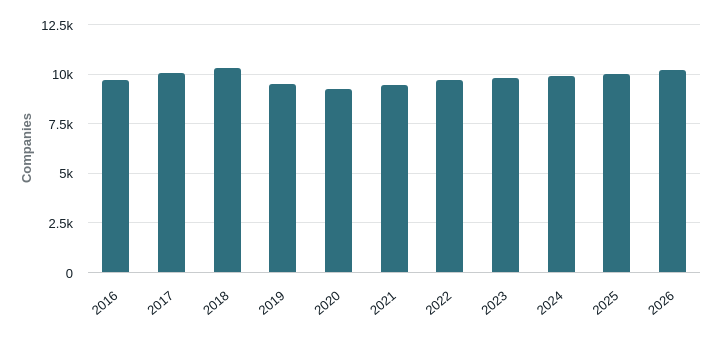
Sarpsborg stands as one of eastern Norway's premier industrial and public sector hubs within Viken county. Powered by a diverse local economy anchored by regional health services, advanced green chemistry, food processing, and specialized contracting, the municipality demonstrates both scale and industrial resilience. With a total workforce exceeding 43,000 employees and total corporate revenues surpassing NOK 55 billion peak levels, Sarpsborg provides a deep talent pool and established commercial infrastructure.
For entrepreneurs and prospective investors, Sarpsborg represents an attractive market characterized by heavy regional healthcare infrastructure around Kalnes, global industrial leadership led by Borregaard AS, and a well-developed logistics and construction supply chain. While macroeconomic headwinds in commercial real estate and construction have created localized stress, core industrial subsectors remain highly profitable, offering strategic opportunities for business founders across B2B services, specialized engineering, health technology, and green transition solutions.
Economic Overview
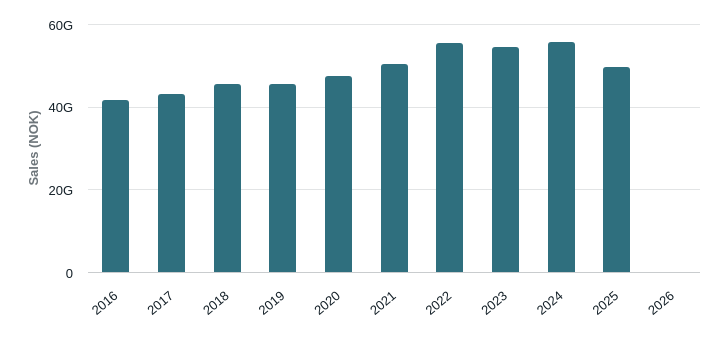
Sarpsborg’s corporate performance over the past decade reflects steady revenue growth and stable overall employment levels. Municipal aggregate sales expanded from NOK 41.7 billion in 2016 to a peak of NOK 55.7 billion in 2024, demonstrating consistent growth across key manufacturing, healthcare, and infrastructure sectors.
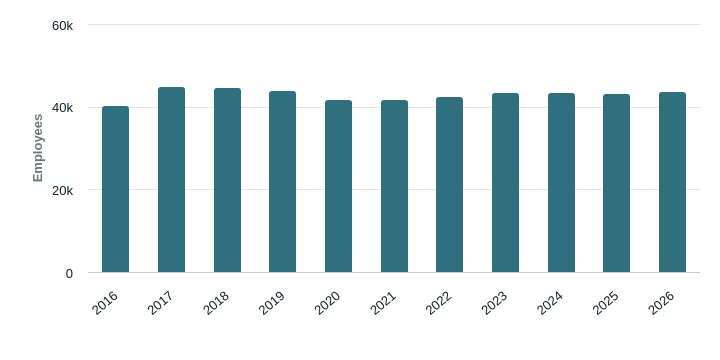
Employment numbers have remained consistently high. After expanding from 40,172 employees in 2016 to over 44,700 in 2017, workforce numbers stabilized around 43,000 to 43,500 employees through the 2020s.
Historical Revenue & Employment Performance
| Year | Total Sales Revenue (NOK) | YoY Sales Growth | Total Employees | YoY Employee Growth |
|---|---|---|---|---|
| 2016 | 41,685.1M | — | 40,172 | — |
| 2017 | 43,115.6M | +3.4% | 44,739 | +11.4% |
| 2018 | 45,563.5M | +5.7% | 44,411 | -0.7% |
| 2019 | 45,547.8M | -0.0% | 43,791 | -1.4% |
| 2020 | 47,398.5M | +4.1% | 41,662 | -4.9% |
| 2021 | 50,256.2M | +6.0% | 41,697 | +0.1% |
| 2022 | 55,469.9M | +10.4% | 42,339 | +1.5% |
| 2023 | 54,340.8M | -2.0% | 43,268 | +2.2% |
| 2024 | 55,737.4M | +2.6% | 43,227 | -0.1% |
| 2025 | 49,567.0M | -11.1% | 43,046 | -0.4% |
| 2026 | 9.8M | — | 43,504 | +1.1% |
Note: Figures for recent years (2025–2026) reflect partial public filing reporting windows rather than a permanent economic downturn.
Industry Structure
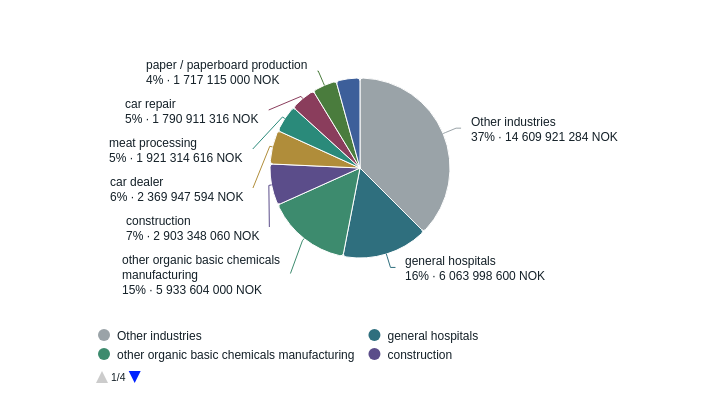
Sarpsborg possesses a bifurcated industry structure characterized by massive public sector institutions on one side and capital-intensive, highly profitable export industries on the other.
Key Industry Indicators
- Organic Basic Chemicals Manufacturing: Represents Sarpsborg's primary private export driver. Generating over NOK 6.10 billion in operating income across two active entities, this sector boasts an extraordinary 24% EBITDA margin and generates NOK 6.4 million in operating income per employee.
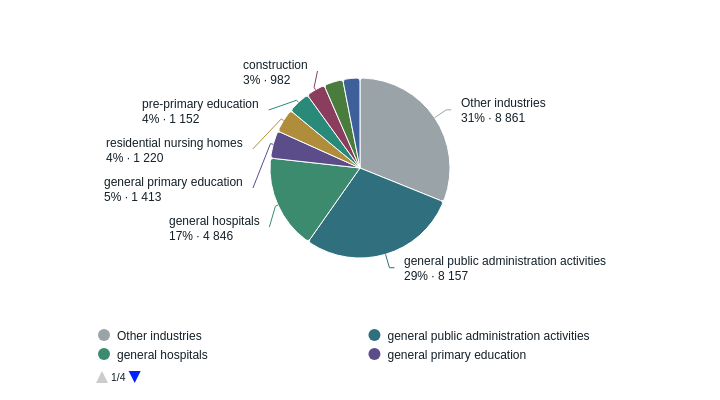
- General Hospitals & Health Services: Anchored by Sykehuset Østfold HF, healthcare accounts for over 6,000 direct employees across hospital care, psychiatric departments, and diagnostic laboratories, generating over NOK 6.28 billion in combined operating revenue.
- Construction & Contracting: With 75 registered companies employing 982 people, construction generates NOK 2.91 billion in revenue, supplemented by site preparation (33 companies, NOK 1.52 billion) and technical consulting (67 companies, NOK 1.66 billion).
- Retail & Trade: Supermarket chains generate NOK 1.15 billion across 21 locations, while automotive repair and vehicle sales add NOK 1.81 billion.
Legal Form Mix
Limited liability corporations (Aksjeselskap / AS) represent the vast majority of economic turnover, accounting for 1,355 companies, 17,193 employees, and NOK 40.0 billion in operating income. State-owned health enterprises (Sær), municipal entities (Komm), and county operations (Fylk) together account for more than 23,000 public and healthcare positions.
Business Geography
Economic activity in Sarpsborg is distributed across several well-defined commercial and industrial zones, each fulfilling a distinct role within the municipal economy.
Spatial Breakdown of Commercial Activity
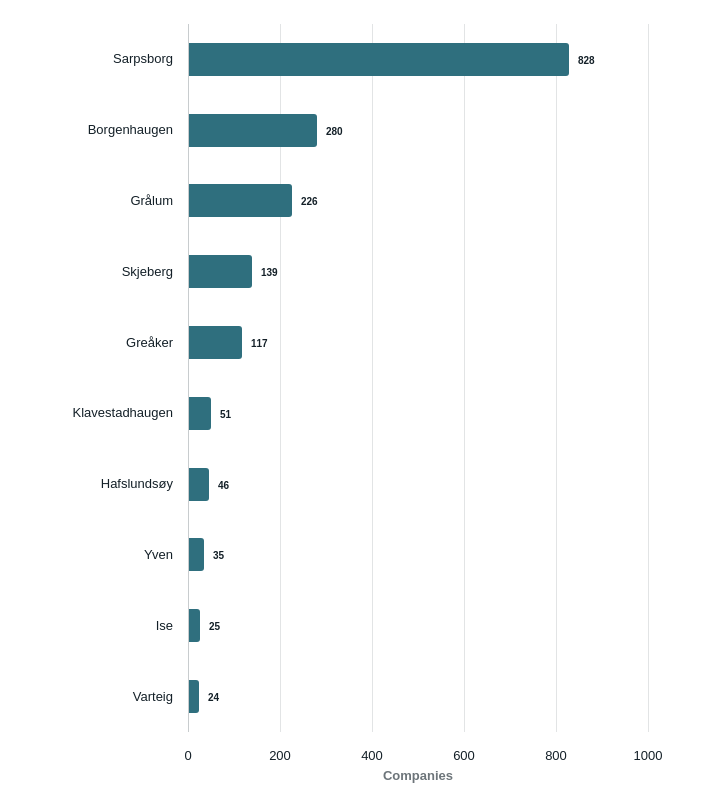
| Area / City | Companies | Employees | Operating Income (NOK) | Primary Character |
|---|---|---|---|---|
| Sarpsborg Central | 828 | 21,879 | 22,782.4M | Civic center, chemical industry, trade, retail |
| Grålum | 226 | 12,467 | 19,613.4M | Regional healthcare hub (Kalnes), office parks, transport |
| Borgenhaugen | 280 | 5,463 | 8,396.1M | Logistics, bus transport, heavy contracting, trade |
| Greåker | 117 | 1,815 | 2,555.4M | Secondary education, local service industries, light industry |
| Skjeberg | 139 | 988 | 840.3M | Agricultural services, local commerce, small contracting |
| Klavestadhaugen | 51 | 809 | 271.4M | Light industrial estates, logistics |
| Hafslundsøy | 46 | 394 | 470.2M | Local retail, service trades |
| Yven | 35 | 356 | 209.8M | Commercial services, specialized trades |
| Varteig | 24 | 207 | 72.1M | Rural commerce, forestry, small service companies |
| Ise | 25 | 171 | 40.2M | Local services, crafts |
Sarpsborg central and Grålum together account for over 80% of total municipal corporate turnover, making them the key landing areas for new commercial ventures.
Largest Employers
The employer landscape in Sarpsborg features significant public healthcare entities, municipal administrative bodies, and global industrial heavyweights.
Top Employers in Sarpsborg
- Sarpsborg Kommune: 7,679 employees providing public administration, primary education, and social care.
- Sykehuset Østfold HF Kalnes Somatikk: 4,780 employees operating the central hospital at Kalnes, generating NOK 6.20 billion in operating revenue.
- Borregaard AS (Avd Organisk Kjemi): 956 employees generating NOK 6.01 billion in operating income and NOK 1.49 billion in EBITDA, serving as the benchmark for sustainable biorefining.
- Sykehuset Østfold HF Psykiatriske Sykehusavdelinger: 713 employees dedicated to adult mental healthcare.
- Sykehuset Østfold HF Røntgen Og Laboratorie Kalnes: 561 employees in medical diagnostics.
- Personalhuset Staffing Group AS (Avd Sarpsborg): 424 employees providing regional staffing solutions.
- Hjemmesykepleien Tingvoll: 388 employees delivering specialized nursing care.
- Nobina AS (Avd Sarpsborg): 365 employees handling regional bus transport (NOK 412.8M turnover).
- Nortura SA (Avd Sarpsborg): 351 employees operating major meat processing facilities (NOK 1.94 billion operating income).
- Park & Anlegg AS (Avd Sarpsborg): 257 employees in civil engineering and site preparation, with NOK 1.18 billion in operating income.
Business Dynamism & Bankruptcy Trends
Business dynamism in Sarpsborg reflects broader national macroeconomic pressures, particularly within high-interest-rate sensitive sectors like residential development, specialized construction, and freight transportation.
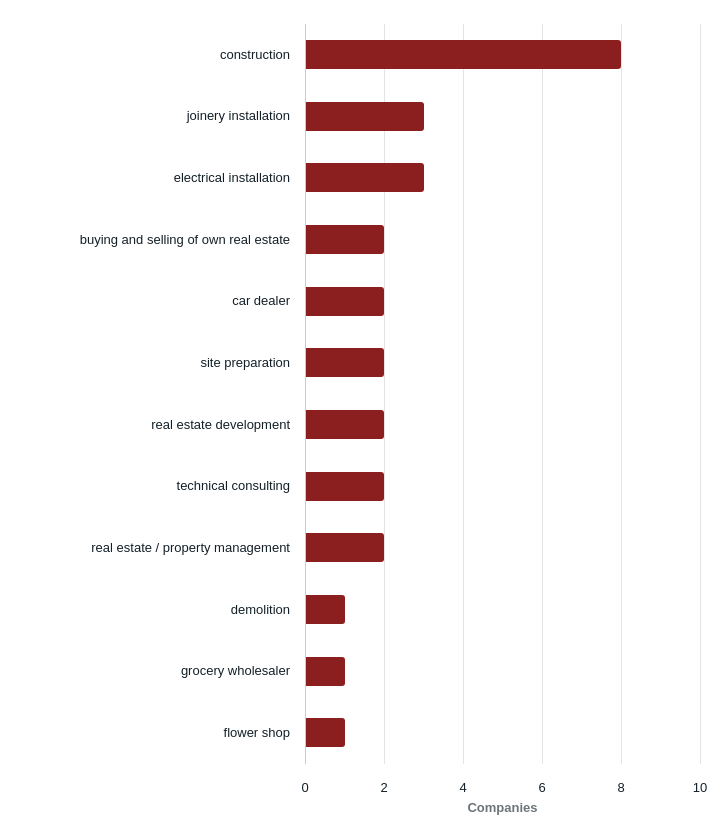
A total of 44 bankruptcies were recorded across the area in recent reporting cycles. While total bankruptcies remain low relative to the 1,355 active AS corporations in the municipality, specific subsectors have experienced notable turbulence:
- Construction & Building Trades: 8 construction firms and 3 electrical installation companies recorded insolvency. Combined construction bankruptcy operating losses reached NOK 13.0 million.
- Civil Engineering & Industrial Real Estate: Notable bankruptcies include Emgods AS (metal structures manufacturing, NOK 191.9M revenue prior to restructuring/insolvency) and Brick AS (civil engineering, NOK 153.8M revenue).
- Real Estate Development & Property: Real estate development firms accounted for NOK 31.2 million in operating losses among bankrupt entities, highlighting capital market friction.
Crucially, core export manufacturing, technical consultancy, and municipal infrastructure services exhibit strong resilience, ensuring overall market stability.
Opportunities for Founders
Sarpsborg offers compelling market dynamics for ambitious entrepreneurs seeking to build B2B services, technological solutions, or specialized industrial support operations.
Key Growth Sectors for Startups
- Health Technology & Clinical Support: With Sykehuset Østfold at Kalnes serving as a major regional medical hub, founders developing healthtech, logistics, and medical equipment services have immediate access to a dense customer ecosystem.
- Green Chemistry & Circular Economy Solutions: Borregaard’s leadership in sustainable bio-based chemicals creates fertile ground for suppliers in specialized laboratory services, environmental consulting, and industrial waste processing.
- Technical Engineering & B2B Services: Technical consulting in Sarpsborg generates NOK 1.66 billion with healthy 12% EBITDA margins. Specialized automation, software engineering, and structural design firms can capture significant market share.
- Subcontracting & Fleet Maintenance: Despite challenges in general construction, heavy civil engineering firms like Park & Anlegg AS require steady specialized trade partners.
For founders evaluating optimal commercial locations, site selection, or industry trends across Sarpsborg, tools like SmartGrunder can help analyze local demographic concentrations, address availability, and cluster density to minimize launch risks.
Conclusion
Sarpsborg represents a stable, high-output commercial center in Viken. Armed with a diverse economic foundation—spanning world-class biorefining at Borregaard, advanced regional healthcare facilities at Kalnes, and established B2B services—the municipality offers an ideal climate for scalable ventures.
While traditional real estate and general contracting sectors continue to adjust to broader macroeconomic shifts, Sarpsborg's high average worker productivity, vast public and industrial purchasing power, and well-integrated transport infrastructure ensure excellent long-term prospects for local entrepreneurs and strategic decision-makers.