Municipality
Sel Municipal Economy: Economic Analysis for Founders and Decision-Makers
An in-depth analysis of industry structure, regional hubs, employment trends, and commercial opportunities in Sel
Executive Summary
Sel municipality, situated in the heart of Gudbrandsdalen in Innlandet county, serves as a vital regional infrastructure, service, and industrial node. Anchored by the regional center of Otta, Sel balances a foundation of public administration and healthcare services with private sector strongholds in specialized manufacturing, commerce, transport, and mountain tourism.
Key structural observations include:
- Commercial Center: Otta acts as the primary economic hub, accounting for over 80% of local companies, the vast majority of employment, and nearly NOK 2.6 billion in sales revenue.
- Industrial Core: Specialized wood product manufacturing—led by Nordan AS—along with automotive repair, transport, and supermarket retail, drive the municipality's private sector turnover.
- Tourism & Outdoor Recreation: Strategic destinations such as Høvringen, Heidal, and Mysusæter leverage proximity to Rondane and the Sjoa river, achieving strong operating margins in hotel operations and outdoor adventure services.
- Evolving Workforce: Total municipal employment stands at approximately 3,379 workers (2026 projection), stabilizing after a period of contraction following peak workforce levels in 2018.
Economic Overview
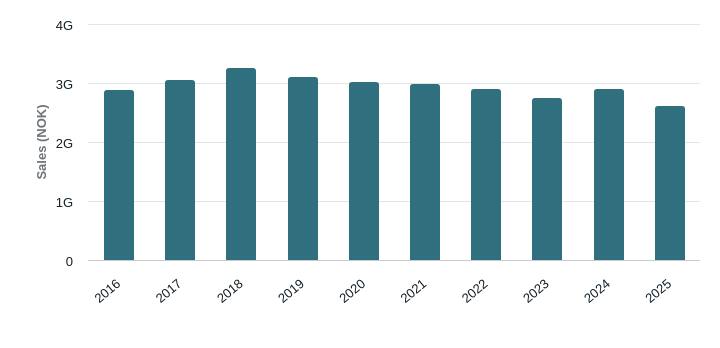
Sel's total corporate revenue experienced significant growth during the mid-2010s, reaching a peak of NOK 3,253.4M in 2018. Subsequent macroeconomic shifts, industrial realignments, and broader demographic trends led to a revenue contraction, settling at NOK 2,892.4M in 2024 and projected at NOK 2,618.2M in 2025.
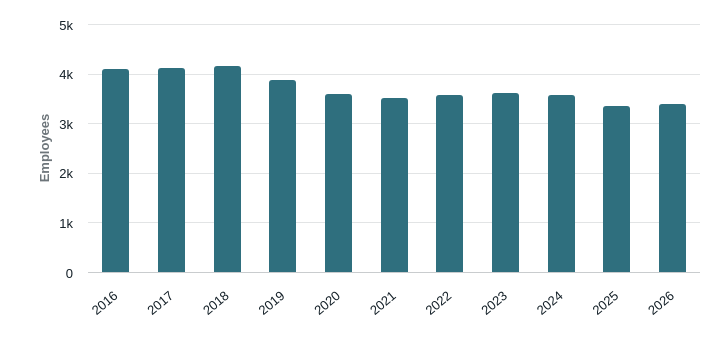
Employment patterns reflect a similar trajectory. Total registered workplace jobs peaked at 4,146 in 2018 before recalibrating to approximately 3,500–3,600 positions between 2020 and 2024. Projections indicate a baseline workforce of 3,379 employees in 2026, marking a modest +1.2% year-over-year recovery.
Historical Revenue & Employment Trends
| Year | Total Sales Revenue (NOK) | YoY Change | Total Employees | YoY Change |
|---|---|---|---|---|
| 2018 | 3,253.4M | +6.8% | 4,146 | +0.7% |
| 2019 | 3,095.6M | -4.9% | 3,866 | -6.8% |
| 2020 | 3,024.0M | -2.3% | 3,592 | -7.1% |
| 2021 | 2,988.3M | -1.2% | 3,502 | -2.5% |
| 2022 | 2,905.7M | -2.8% | 3,570 | +1.9% |
| 2023 | 2,748.3M | -5.4% | 3,608 | +1.1% |
| 2024 | 2,892.4M | +5.2% | 3,561 | -1.3% |
| 2025 | 2,618.2M | -9.5% | 3,338 | -6.3% |
| 2026 | N/A | N/A | 3,379 | +1.2% |
Corporate Structure by Legal Form
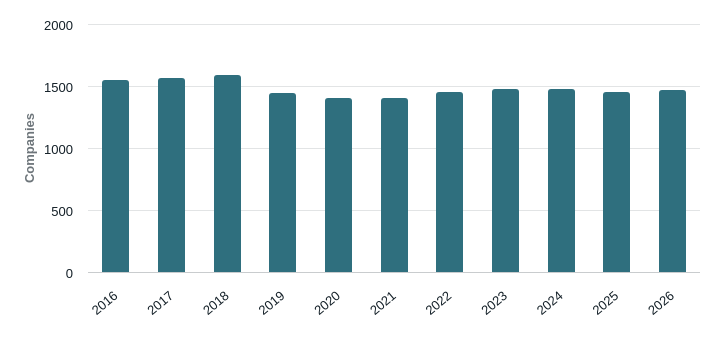
Limited liability companies (A/S) form the engine of commercial revenue, comprising 163 registered enterprises generating NOK 2,569.9M in operating income and employing 1,815 people. Public sector organizations (Kommune and District units) represent 1,169 employees across 43 organizational entities, underlining the substantial role of local public administration and health infrastructure in Sel's overall labor market.
Industry Structure
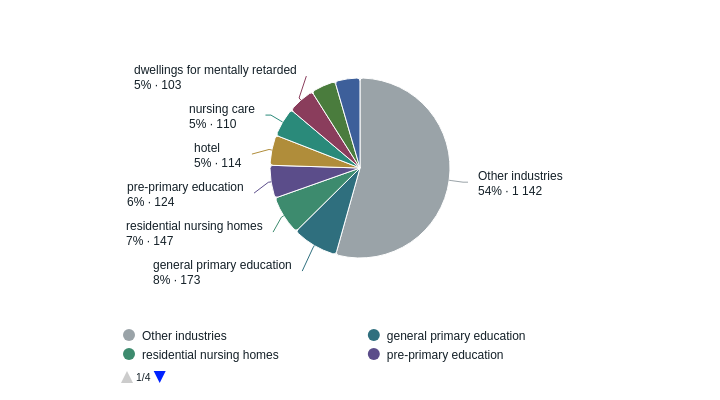
Sel's economy is characterized by a mix of heavy public healthcare and education services alongside focused private manufacturing, retail trade, logistics, and hospitality.
Sector Analysis
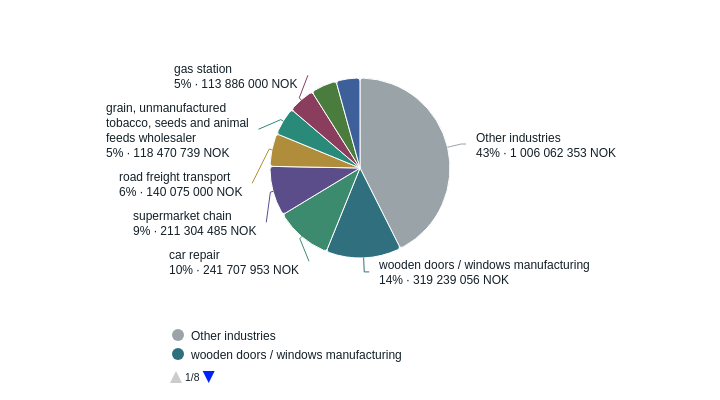
- Manufacturing & Construction: Wooden doors and windows manufacturing generates NOK 319.4M in operating income with 94 employees in a single major facility. Car repair (4 companies, NOK 243.7M revenue) and site preparation/construction (20 companies combined, NOK 149.3M revenue) reflect strong regional service demands.
- Retail & Logistics: Supermarkets (5 companies, NOK 219.9M revenue) and road freight transport (6 companies, NOK 152.1M revenue) underscore Otta's role as a logistical junction for Gudbrandsdalen.
- Hospitality & Tourism: Hotels and camping sites employ over 200 workers combined. The hotel sector reported NOK 53.4M in operating income with a solid 16% EBITDA margin, while camping businesses generated NOK 13.7M.
- Healthcare & Public Services: Primary education, nursing homes, specialized care, and general public administration represent over 800 local jobs, providing stable employment baseline across the municipality.
Key Industry Metrics
| Industry Sector | Companies | Employees | Operating Income (NOK) | EBITDA Margin |
|---|---|---|---|---|
| Wooden Doors / Windows Manufacturing | 1 | 94 | 319.4M | 5% |
| Car Repair | 4 | 63 | 243.7M | 2% |
| Supermarkets | 5 | 92 | 219.9M | 2% |
| Road Freight Transport | 6 | 89 | 152.1M | 2% |
| Site Preparation | 11 | 64 | 85.9M | 7% |
| Hotels | 7 | 114 | 53.4M | 16% |
| Camping | 6 | 94 | 13.7M | 7% |
Business Geography
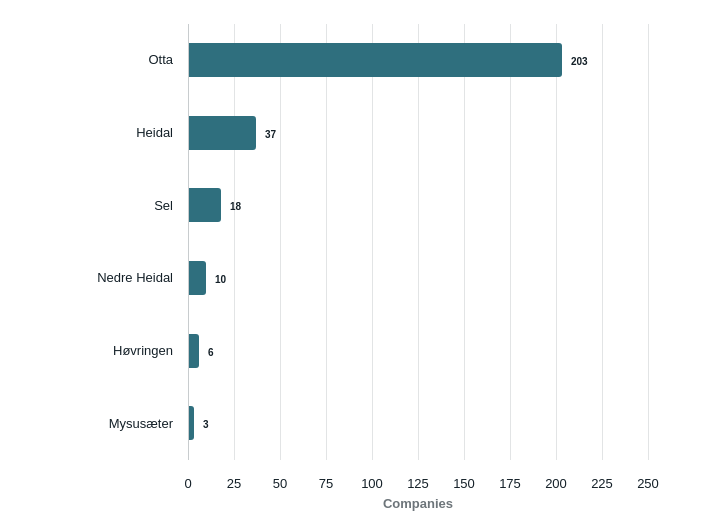
Economic activity in Sel is organized around six distinct commercial and geographical areas, each fulfilling a specific function within the municipal ecosystem.
Urban & Regional Hubs
- Otta: The dominant economic engine of Sel and surrounding valleys. Hosting 203 registered companies and 2,981 employees, Otta produces NOK 2,584.1M in sales revenue. It functions as the central transportation, administrative, retail, and industrial hub.
- Heidal & Nedre Heidal: Known for agriculture, craft manufacturing, and river sports along the Sjoa. Heidal hosts 37 companies employing 299 people (NOK 134.5M sales), while Nedre Heidal adds 10 companies and 85 employees.
- Sel: The area around the original parish core features 18 companies and 122 employees, generating NOK 98.8M in sales revenue across local trades and agricultural services.
- Høvringen: A premier mountain tourism location at the gateway to Rondane. While smaller in terms of headcount (6 companies, 71 employees), Høvringen exhibits impressive financial health, achieving a 22% EBITDA margin and 17% operating margin on NOK 26.7M in operating income.
- Mysusæter: A mountain cabin and recreational cluster with 3 companies and 12 employees, generating NOK 6.7M in operating income.
Breakdown by Location
| Location | Companies | Employees | Operating Income (NOK) | EBITDA Margin |
|---|---|---|---|---|
| Otta | 203 | 2,981 | 2,676.5M | 6% |
| Heidal | 37 | 299 | 141.8M | 6% |
| Sel | 18 | 122 | 101.5M | 3% |
| Nedre Heidal | 10 | 85 | 8.7M | 8% |
| Høvringen | 6 | 71 | 26.7M | 22% |
| Mysusæter | 3 | 12 | 6.7M | 1% |
Largest Employers
The employer landscape in Sel features a mix of major municipal healthcare/educational institutions and well-established private industrial and transport operators.
Leading Private Sector Employers
- Nordan AS Avd Otta: 94 employees in door and window manufacturing, reporting NOK 319.4M in operating income.
- Dalir Kjøtt AS: 57 employees in meat processing operating out of Otta.
- Otta Hotelldrift AS: 52 employees delivering full-service hotel accommodation with NOK 31.6M in revenue.
- Connect Bus Norge AS Avd Otta: 50 employees supporting scheduled public bus transportation.
- Sjoa Rafting AS: 48 employees delivering outdoor recreation and adventure tourism in Nedre Heidal.
Key Public & Municipal Employers
- Sel Sjukeheim: 110 employees (Residential nursing care in Otta).
- Otta Skole: 98 employees (General primary education).
- Sel Kommune Tilrettelagte Tjenester Otta Brygge: 82 employees (Specialized residential support).
- Sel Kommune Legetenesta: 80 employees (Primary health and GP services).
- Nord Gudbrandsdal Vidaregåande Skule: 67 employees (Upper secondary education).
- Selsro Bo Og Aktivitetssenter: 61 employees (Elderly care facilities).
- Tjenester Til Hjemmeboende Otta: 59 employees (Home nursing care).
Business Dynamism & Market Adjustments
Business turnover and corporate restructuring in Sel reflect broader national trends in traditional manufacturing, natural resource processing, and private welfare services.
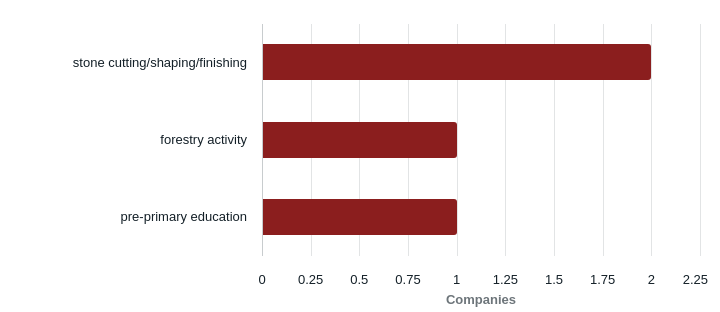
Recent market adjustments include four recorded bankruptcies:
- Otta Skifer AS & Ottaskifer Holding AS: Located at Otta, representing the historic slate cutting and stone processing industry. Otta Skifer AS previously generated NOK 33.8M in revenue with an EBITDA of NOK 2.3M prior to proceedings, highlighting challenges in raw material processing and capital-heavy extraction operations.
- Thoskogen Naturbarnehage AS: A private pre-primary education unit at Otta (NOK 442K revenue) reflecting operational pressure on small-scale private childcare providers.
- Jensen Maskindrift AS: A small forestry operation in Heidal.
Despite localized friction in legacy extraction sectors, core commercial sectors in Otta—such as site preparation (+13% revenue growth), supermarket retail (+6% growth), and automotive repair (+11% growth)—demonstrate active regional demand and stable operational volume.
Opportunities for Founders
Sel offers distinct strategic advantages for prospective business founders, particularly those capable of integrating into established regional supply chains or expanding the municipality's leisure economy.
Key Growth Areas
- Industrial & B2B Services: With heavy manufacturing (Nordan AS), transportation hubs, and active construction companies, there is clear demand for technical maintenance, industrial automation, logistics support, and specialized sub-contracting.
- High-Margin Hospitality & Experience Economy: Høvringen's strong financial margins (22% EBITDA) demonstrate that high-quality tourism concepts perform exceptionally well in Sel. Expanding eco-tourism, year-round activity packages, and boutique food services in Heidal and Otta presents high potential.
- Regional Commercial & Trade Services: As Otta serves a catchment area extending across several neighboring mountain valleys, specialized retail, digital services, and professional consultancy can leverage the town's position as a regional crossroads.
Founders evaluating opportunities in Sel can use SmartGrunder to explore available commercial addresses, map existing trade density across Otta and Heidal, and validate local competitive landscapes before launch.
Conclusion
Sel municipality remains a resilient and strategically important economic center in Innlandet. Otta's position as a regional transportation and service hub provides a stable foundation, complemented by specialized export manufacturing and profitable mountain tourism hubs like Høvringen.
For entrepreneurs and investors, Sel offers a balanced ecosystem with established infrastructure, an accessible regional customer base, and clear market openings in secondary tourism services, technical maintenance, and regional trade.