Municipality
Sirdal Economic Analysis: Energy, Infrastructure, and Mountain Tourism
A comprehensive overview of Sirdal's commercial structure, employment dynamics, and entrepreneurship opportunities
Executive Summary
Sirdal is a unique inland municipality in Agder county defined by robust energy production, extensive mountain tourism, and strong public sector activity. Anchored by major hydroelectric generation facilities and a thriving winter and summer recreation sector, Sirdal's economy generates nearly NOK 2 billion in commercial sales while supporting over 2,000 jobs across public and private sectors.
The commercial landscape is divided into two primary regional centers: Tonstad, the municipal administrative and industrial hub, and Tjørhom, the focal point for tourism, cabin infrastructure, and alpine activities. With strong corporate margins in power generation and a resilient local service ecosystem, Sirdal offers a stable economic backdrop for emerging enterprises, construction contractors, and hospitality founders.
Economic Overview
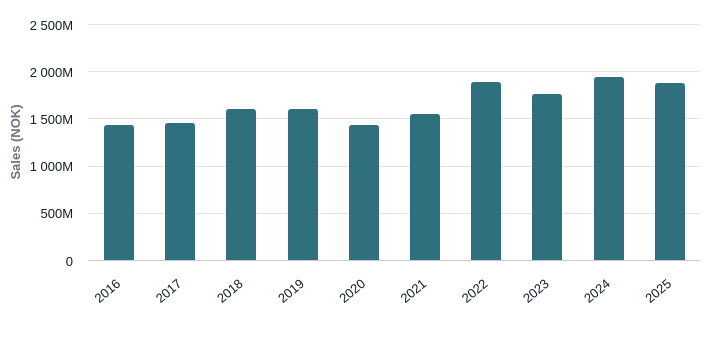
Sirdal's business sales have demonstrated substantial resilience over the past decade. Between 2016 and 2024, total annual commercial turnover expanded from NOK 1,429.7 million to NOK 1,933.7 million, peaking in 2024 before stabilizing at NOK 1,872.2 million in 2025. This performance highlights the impact of energy sector volatility and broader macroeconomic cycles on local revenue.
Historical Sales & Employee Development
| Year | Sales (NOK) | YoY Sales Change | Employees | YoY Employee Change |
|---|---|---|---|---|
| 2016 | 1,429.7M | — | 1,864 | — |
| 2017 | 1,447.2M | +1.2% | 2,143 | +15.0% |
| 2018 | 1,598.8M | +10.5% | 1,984 | -7.4% |
| 2019 | 1,598.9M | +0.0% | 1,954 | -1.5% |
| 2020 | 1,426.1M | -10.8% | 1,970 | +0.8% |
| 2021 | 1,550.1M | +8.7% | 2,020 | +2.5% |
| 2022 | 1,887.3M | +21.8% | 2,060 | +2.0% |
| 2023 | 1,757.1M | -6.9% | 1,986 | -3.6% |
| 2024 | 1,933.7M | +10.0% | 1,979 | -0.4% |
| 2025 | 1,872.2M | -3.2% | 2,050 | +3.6% |
| 2026 | — | — | 2,083 | +1.6% |
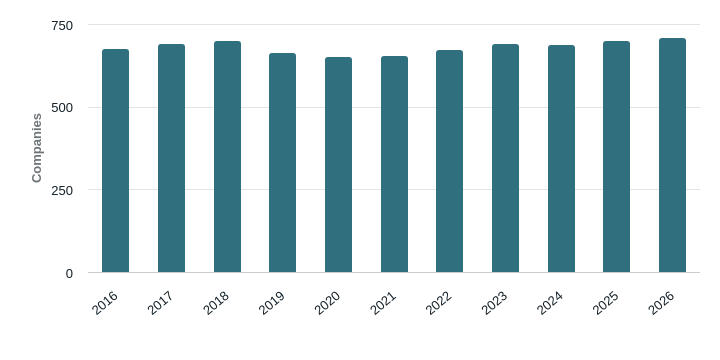
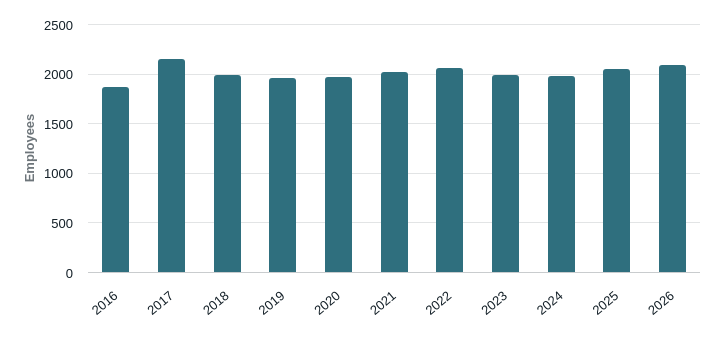
Local employment has maintained a steady trajectory around the 2,000-employee mark, with growth projected to reach 2,083 employees by 2026. This stability is underpinned by consistent municipal operations and long-term utility management.
Industry Structure & Legal Forms
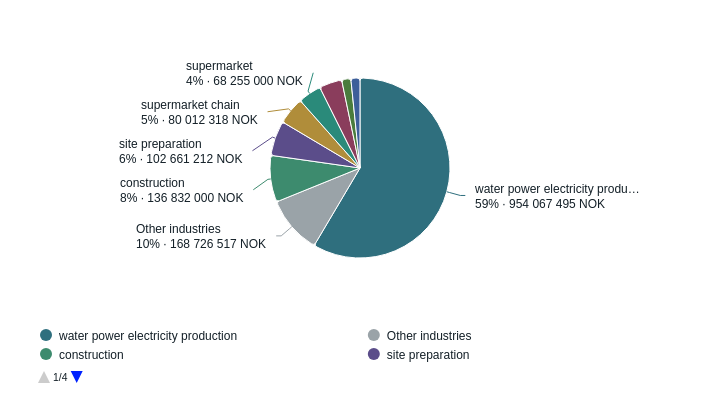
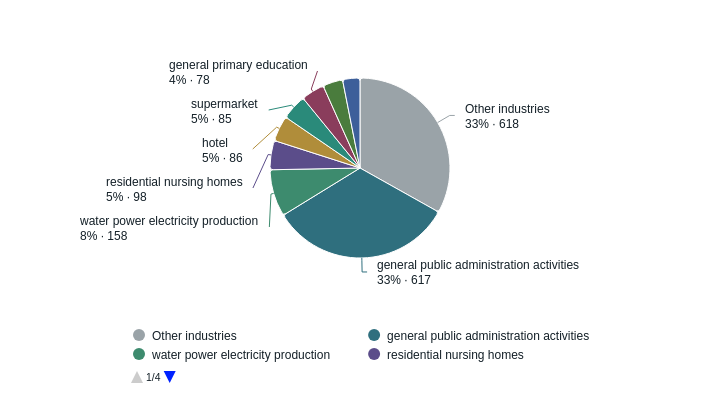
Hydroelectric power generation stands as Sirdal's economic superpower in terms of turnover and operating margins. Across 3 companies in water power electricity production, local businesses generated NOK 954.1 million in sales revenue with a strong 38% EBITDA margin and NOK 7.5 million operating income per employee.
Beyond power generation, Sirdal maintains a diverse industrial mix geared toward infrastructure development, civil engineering, and community services:
- Construction & Civil Engineering: Specialized sub-sectors such as general construction (12 companies, 67 employees, NOK 136.8M sales), site preparation (6 companies, 54 employees, NOK 102.7M sales), road/motorway construction (2 companies, 58 employees), and bridge/tunnel construction (1 company, 34 employees) play a crucial role in maintaining infrastructure and cabin developments.
- Tourism & Hospitality: Hotel operations (5 companies, 86 employees, NOK 26.6M sales) and sports facilities operations (4 companies, 27 employees, NOK 26.6M sales) anchor the regional visitor economy.
- Retail & Local Services: Supermarkets and supermarket chains account for NOK 148.3 million in combined sales across 5 companies employing over 110 people. Local manufacturing like pastry production (2 companies, 50 employees, NOK 11.3M sales) and mining/construction machinery manufacturing (1 company, 32 employees, NOK 66.9M sales) provide valuable secondary employment.
Legal Organisation Forms
| Legal Form | Companies | Employees | Total Sales (NOK) | EBITDA Margin |
|---|---|---|---|---|
| AS (Limited Company) | 94 | 850 | 782.0M | 13% |
| KOMM (Municipal Entity) | 1 | 523 | 0M | 0% |
| ORGL (Other Legal Person) | 18 | 522 | 0M | 0% |
| DA (General Partnership w/ Shared Liability) | 1 | 154 | 794.3M | 35% |
| ENK (Sole Proprietorship) | 22 | 37 | 0M | 0% |
| SA (Cooperative) | 2 | 20 | 70.4M | 5% |
Business Geography & Regional Clusters
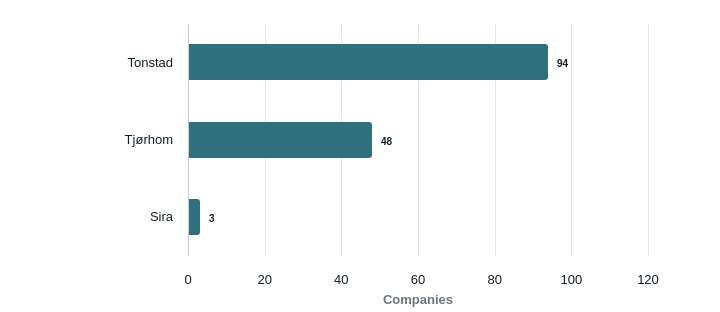
Commercial and municipal activity in Sirdal is geographically concentrated in two main locations, alongside minor activity in surrounding rural hamlets.
Municipal Breakdown
| Location | Companies | Employees | Operating Income (NOK) | Sales Revenue (NOK) | Operating Profit (NOK) |
|---|---|---|---|---|---|
| Tonstad | 94 | 1,803 | 1,398.0M | 1,385.9M | 278.7M |
| Tjørhom | 48 | 363 | 277.4M | 263.9M | -1.0M |
| Sira | 3 | 5 | 0M | 0M | 0M |
Tonstad
Tonstad serves as Sirdal's commercial and administrative capital. Housing 94 registered companies and over 1,800 employees, Tonstad generates NOK 1,385.9 million in sales. It hosts municipal administration headquarters, primary schools, mechanical workshops, and the operational center for regional power operations, reflecting an impressive overall EBITDA margin of 27%.
Tjørhom
Tjørhom is the primary gateway to Sirdal's mountain recreation areas. With 48 companies and 363 employees, it accounts for NOK 263.9 million in sales. Tjørhom's economic activity centers around retail, alpine ski facilities, hospitality, pub venues, and cabin maintenance services.
Largest Employers
Employment in Sirdal is anchored by public administration, health services, regional utilities, and specialized industrial manufacturing.
Top Employers in Sirdal
- Sirdal Kommune (Tonstad): 523 employees (General public administration activities).
- Sira Kvina Kraftselskap (Tonstad): 154 employees, NOK 794.3M sales revenue, 35% EBITDA margin (Hydroelectric power production).
- Sirdal Kommune Sentraladministrasjon (Tonstad): 94 employees (Central municipal administration).
- Sirdalheimen (Tonstad): 73 employees (Residential care and nursing home services).
- Tonstad Skule (Tonstad): 60 employees (Primary education).
- G P Tjørhom As (Tjørhom): 58 employees, NOK 51.7M sales revenue (Supermarket retail).
- Pleie Og Omsorgstjenesten I Sirdal (Tonstad): 58 employees (Home-based nursing care).
- Svb Gruppen As Avd Svb Veisikring (Tonstad): 53 employees (Road safety barrier manufacturing).
- Svb Gruppen As Avd Sirdal Veibetong (Tonstad): 37 employees (Road and motorway construction).
- Norhard As (Tonstad): 34 employees (Directional drilling, bridge, and tunnel construction).
- Steis Mekaniske Verksted As (Tonstad): 32 employees, NOK 66.9M sales revenue, NOK 4.8M EBITDA (Heavy machinery manufacturing for mining and construction).
- Fjellstuå As (Tjørhom): 32 employees (Pub and hospitality).
- Tonstad Bakeri As (Tonstad): 31 employees, NOK 11.3M sales revenue (Industrial bakery and pastry production).
- Tonstadli Hotell As (Tonstad): 28 employees, NOK 14.2M sales revenue, 28% EBITDA margin (Hotel and conference operations).
Business Dynamism & Market Insolvencies
Sirdal exhibits exceptional commercial stability. Corporate default rates remain minimal, reflecting strong financial backing across major local industries and reliable consumer demand driven by high second-home ownership and seasonal tourism.
Bankruptcy Profile
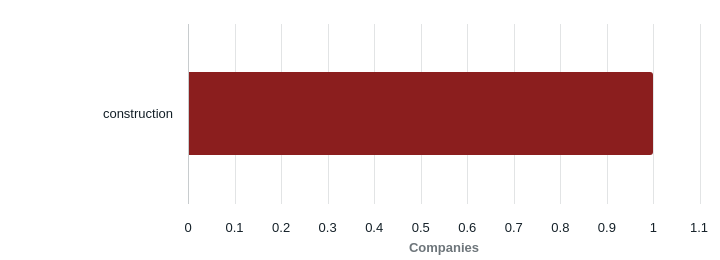
Official bankruptcy records show 1 registered bankruptcy in the municipality:
- Strandbergmyra Fjellgård As (Tonstad): Registered in construction/farming with 0 employees, reporting NOK 0 in sales revenue and an operating profit of NOK -518.0K.
The absence of widespread corporate insolvencies across key sectors like retail, hospitality, and civil engineering confirms that local businesses operate within a sustainable financial baseline. Steady municipal support and utility tax yields further insulate the local market from acute economic shocks.
Opportunities for Founders & Entrepreneurs
Sirdal presents tailored commercial opportunities for prospective business founders, particularly those aligned with energy technology, infrastructure maintenance, tourism services, and eco-friendly mountain solutions.
Key Growth Avenues
- Cabin & Property Services: With thousands of holiday cabins in Tjørhom and upper Sirdal, demand remains high for specialized maintenance, automated home technologies, craftsmanship, and local property management.
- Green Energy & Technology Services: Given Sira Kvina Kraftselskap's prominent role, suppliers offering specialized engineering, environmental consulting, and machinery maintenance have a direct local customer base.
- Niche Hospitality & Food Products: Tonstad Bakeri As and Tonstadli Hotell As demonstrate strong margins in local food production and hospitality. Culinary concepts catering to holidaymakers and outdoor enthusiasts present viable growth paths.
- Civil Engineering Contracting: Ongoing road safety and concrete construction requirements (e.g., Svb Gruppen) create subcontracting opportunities in transport logistics and site preparation.
Founders interested in establishing a presence in Sirdal can utilize tools like SmartGrunder to analyze available business addresses, track sector-specific growth trends, and identify optimal commercial locations across Tonstad and Tjørhom.
Conclusion
Sirdal municipality combines the financial backbone of an energy production power-house with the vibrant commercial dynamics of a premier mountain resort region. With annual commercial turnover nearing NOK 1.9 billion, a stable labor force of over 2,000 employees, and minimal market insolvency, Sirdal represents a solid economic environment for entrepreneurs and established enterprises alike.
By leveraging the distinct strengths of both Tonstad's industrial-administrative base and Tjørhom's tourism cluster, founders can find strategic entry points in civil services, specialized tourism, green technology, and artisan local manufacturing.