Municipality
Skjåk Municipal Business and Economic Analysis
An in-depth review of industrial structure, market dynamics, key employers, and founder opportunities in Skjåk
Executive Summary
Skjåk municipality, located in the northwestern corner of Innlandet county, presents a distinct rural economy characterized by high-value niche manufacturing, strong agricultural and food production traditions, active tourism, and a stable public sector base. Operating as a gateway between eastern mountain valleys and western fjords, Skjåk has developed an economic structure where specialized industry exists alongside primary production and hospitality.
Key structural highlights of the Skjåk business community include:
- Industrial Anchor: Niche manufacturing, led by HVAC/ventilation equipment maker Interfil AS, generates over NOK 219 million in annual revenue, proving that high-tech manufacturing can thrive in inland mountain communities.
- Agri-Food Sector: High density of agricultural enterprises, ranging from milk and meat production to specialized pig farming and industrial cheese production (generating nearly NOK 97 million in revenue).
- Hospitality & Outdoor Tourism: Well-established tourism hubs in Grotli, Nordberg, and Bismo leverage mountain infrastructure, hotels, and camping grounds to serve year-round traffic.
- Turnover & Employment Stability: Local corporate revenues exceed NOK 1.2 billion, supported by roughly 2,000 commercial and municipal jobs across the municipality.
Economic Overview & Revenue Trends
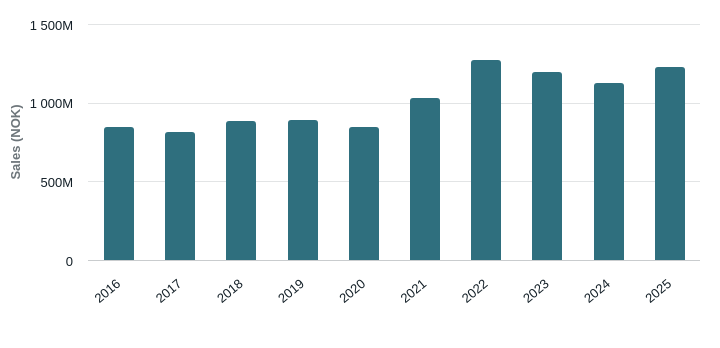
Skjåk's local economy experienced substantial top-line expansion between 2016 and 2022, followed by a brief period of normalization before returning to growth. Total commercial revenue rose from NOK 843.2 million in 2016 to a peak of NOK 1,269.3 million in 2022. Following minor contractions in 2023 (-5.9%) and 2024 (-5.6%), revenues are projected to rebound to NOK 1,228.5 million in 2025 (+8.9%).
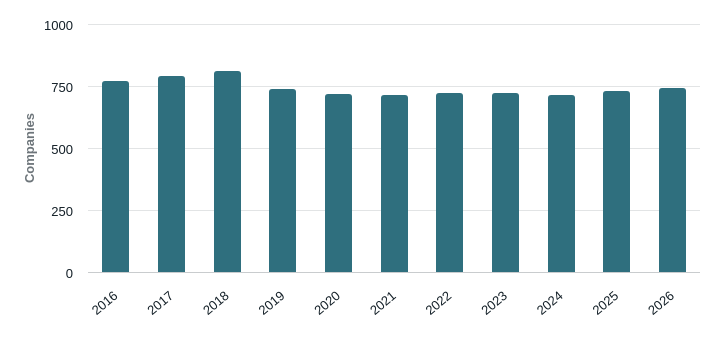
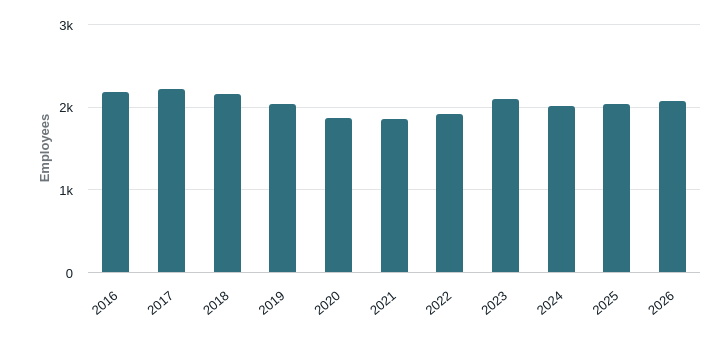
Employment figures have mirrored broader regional shifts. After peaking above 2,200 employees in 2017, workforce totals stabilized around 2,000 FTEs in 2023–2024, with modest positive momentum anticipated toward 2026.
| Year | Commercial Sales (NOK) | YoY Change | Workforce (Employees) | YoY Change |
|---|---|---|---|---|
| 2016 | 843.2M | - | 2,180 | - |
| 2017 | 813.9M | -3.5% | 2,216 | +1.7% |
| 2018 | 885.7M | +8.8% | 2,154 | -2.8% |
| 2019 | 892.3M | +0.7% | 2,038 | -5.4% |
| 2020 | 842.3M | -5.6% | 1,858 | -8.8% |
| 2021 | 1,031.7M | +22.5% | 1,848 | -0.5% |
| 2022 | 1,269.3M | +23.0% | 1,913 | +3.5% |
| 2023 | 1,195.0M | -5.9% | 2,096 | +9.6% |
| 2024 | 1,128.0M | -5.6% | 2,003 | -4.4% |
| 2025 | 1,228.5M | +8.9% | 2,035 | +1.6% |
The strong surge in 2021–2022 reflects robust post-pandemic demand across manufacturing, freight, and local food processing, establishing a firm baseline above NOK 1.1 billion for the municipality's private sector.
Industry Structure & Organizational Mix
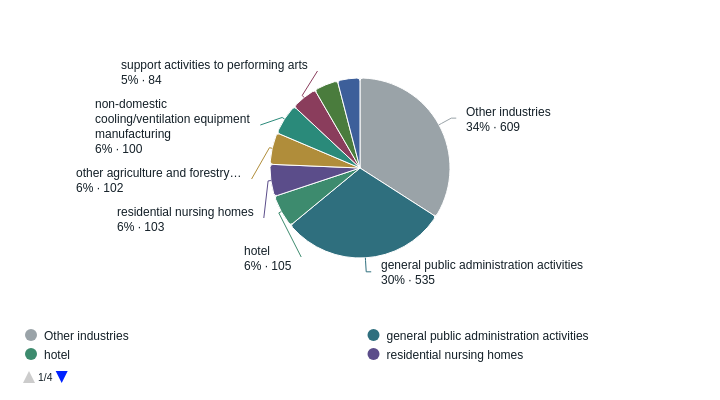
The commercial landscape of Skjåk is remarkably diversified for a rural municipality. While public administration and healthcare employ the largest share of personnel, the private sector generates the vast majority of operating income.
Primary Commercial Sectors
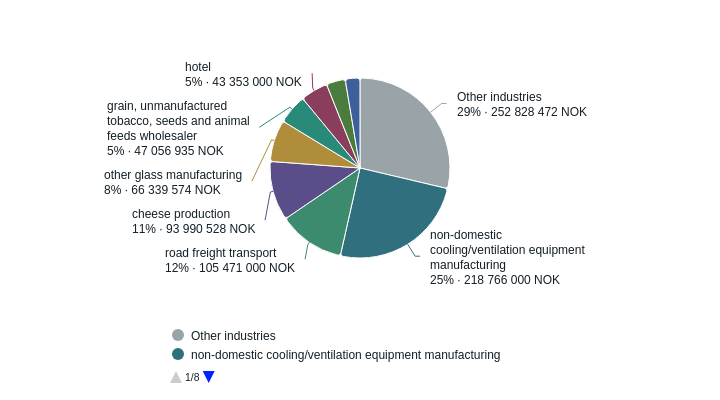
- Niche Equipment Manufacturing: Non-domestic cooling and ventilation manufacturing stands as the municipality's single largest revenue generator, producing NOK 219.0 million in revenue with strong profitability (EBITDA margin of 13%).
- Logistics & Road Freight: Road freight transport consists of 7 active companies generating NOK 106.9 million in sales and employing 72 people, serving local manufacturing and regional distribution routes.
- Cheese & Food Processing: Industrial cheese production accounts for NOK 96.9 million in revenue across 20 employees, demonstrating high value creation per capita (Operating income of NOK 4.6 million per employee).
- Agriculture & Livestock: Primary production remains a foundational pillar. Milk/meat production (10 companies, NOK 16.4M), pig farming (9 companies, NOK 18.8M), and agricultural support services (3 companies, 102 employees) form a tightly integrated rural ecosystem.
- Hospitality & Accommodation: Hotels (4 companies, NOK 43.4M revenue, 105 employees) and camping operations (4 companies, NOK 9.6M revenue, 77 employees) support the tourism sector.
Legal Forms & Business Structure
Limited liability companies (AS) represent the bulk of business volume, with 83 companies generating NOK 776.6 million in operating income and employing 851 workers. Cooperatives (SA) play a critical role with 7 entities generating NOK 174.9 million in revenue, underscoring the collaborative nature of local farming and support services. Sole proprietorships (ENK) account for 30 registered entities and 117 workers.
Business Geography & Local Clusters
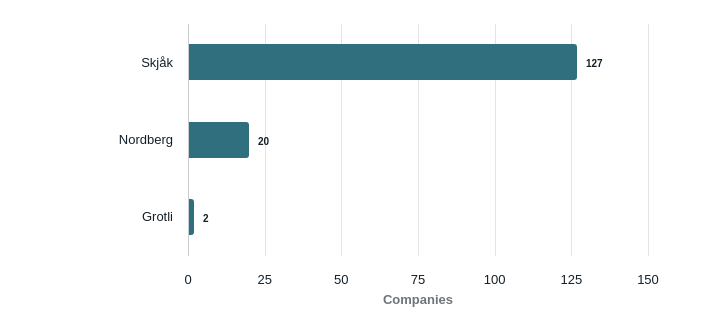
Economic activity within Skjåk is distributed across three main geographic nodes along the main highway corridors:
| Area / Place | Active Companies | Employees | Operating Income (NOK) | Revenue Growth |
|---|---|---|---|---|
| Skjåk (Center / Bismo) | 127 | 1,963 | 943.9M | +5% |
| Nordberg | 20 | 161 | 50.5M | +17% |
| Grotli | 2 | 58 | 20.0M | +5% |
Sub-Area Breakdown
- Bismo / Central Skjåk: The administrative and commercial core. Hosts the municipal municipal hall, Interfil AS, retail stores, local schools, and major healthcare facilities. It drives over 90% of total local revenue.
- Nordberg: A growing hub for agriculture, local outdoor accommodation (such as Sota Sæter and Dønfoss Drift), and specialized services, achieving 17% revenue growth in recent reporting.
- Grotli: Positioned high along the mountain pass toward Strynefjellet and Geiranger. Anchored by mountain hotel operations (Grotli Høyfjellshotell AS), focusing entirely on seasonal and outdoor tourism.
Largest Employers & Key Market Players
Employment in Skjåk is anchored by public sector health and administrative services, complemented by major private enterprise leaders.
Major Local Employers
- Skjåk Kommune: 516 employees (General public administration, infrastructure, and local services).
- Skjåkheimen Sjukeheim: 103 employees (Residential nursing care).
- Interfil AS: 100 employees, NOK 219.0M operating income (Ventilation and air filtration manufacturing).
- Skjåk Avløysarlag SA: 93 employees, NOK 5.4M operating income (Agricultural Relief and labor cooperative).
- Melego Musikk AS: 84 employees, NOK 5.1M operating income (Performing arts support services).
- Skjåk Barne Og Ungdomsskule: 62 employees (Primary and secondary education).
- Skjåk Kommune Heimebaserte Tjenester: 57 employees (Home care services).
- Grotli Høyfjellshotell AS: 50 employees, NOK 17.0M operating income (High-mountain hotel services).
- Bismotunet Bufellesskap: 47 employees (Care housing and assistance).
- Bismo Barnehage: 38 employees (Pre-primary education).
- Skjåk Turistheim Skeid Kro AS: 35 employees, NOK 23.6M operating income (Roadside hotel, restaurant, and catering).
- Dønfoss Drift AS & Sota Sæter AS: 29 employees each (Camping and mountain lodge tourism).
Business Dynamism & Market Stability
While specific bankruptcy counts are not recorded in the available dataset, financial metrics indicate high baseline stability among Skjåk's core commercial operators. Average operating margins in key segments remain healthy—real estate and facility management achieve operating margins above 25–30%, while manufacturing maintains stable 10% operating margins.
The organizational structure displays high resilience through cooperative models (SA) and well-capitalized limited companies (AS holding over NOK 411 million in total equity). The strong presence of long-standing family and cooperative enterprises fosters lower vulnerability to sudden macroeconomic fluctuations compared to urban startup markets.
Opportunities for Founders & Investors
Skjåk offers several promising niches for prospective entrepreneurs, local founders, and expanding businesses:
- Industrial Supply & Technical Services: With a major manufacturing firm (Interfil AS) operating locally, opportunities exist for specialized maintenance, automation support, packaging, and logistics suppliers.
- Value-Added Food & Agtech: Building upon Skjåk's established cheese production, pig farming, and livestock operations, founders can introduce direct-to-consumer artisanal food brands, agtech solutions, or bio-economy initiatives.
- Year-Round Eco-Tourism & Outdoor Services: Given the proximity to national parks and mountain passes (Grotli, Sota Sæter), there is room for tech-enabled outdoor activities, guiding services, equipment rental, and sustainable hospitality upgrades.
- Green Energy & Facility Services: Local real estate and combined facilities management demonstrate strong profit margins (31% EBITDA margin), opening space for energy efficiency consulting and specialized contracting.
Founders interested in establishing a business or scouting commercial properties in Skjåk can utilize SmartGrunder to analyze local addresses, evaluate competitive densities, and explore sector-specific economic data.
Conclusion
Skjåk demonstrates how a mountain valley municipality can build a balanced, resilient economy. Driven by world-class export manufacturing, a modernized agricultural sector, active tourism hubs, and a solid municipal base, Skjåk provides an attractive environment for founders seeking strong community support, lower operating costs, and steady regional demand.