Municipality
Economic Landscape and Entrepreneurial Opportunities in Smøla Municipality
An in-depth analysis of industry dynamics, maritime aquaculture strength, labor trends, and business growth potential
Executive Summary
Smøla municipality, located in the coastal archipelago of Møre og Romsdal, represents a highly specialized, ocean-driven economy. Driven by aquaculture, maritime freight transport, commercial shipbuilding, and marine support services, the island community produces remarkable revenue relative to its population size.
While municipal employment has remained stable around 1,600 to 1,700 workers over recent years, top-line revenues experience fluctuations tied closely to global salmon market dynamics, biomass cycles, and marine logistics demand. Key industrial players such as Salmar Farming AS, Trident Crew AS, and Promek AS anchor the local economy, demonstrating strong operating margins and heavy capital investment in specialized maritime infrastructure.
Economic Overview
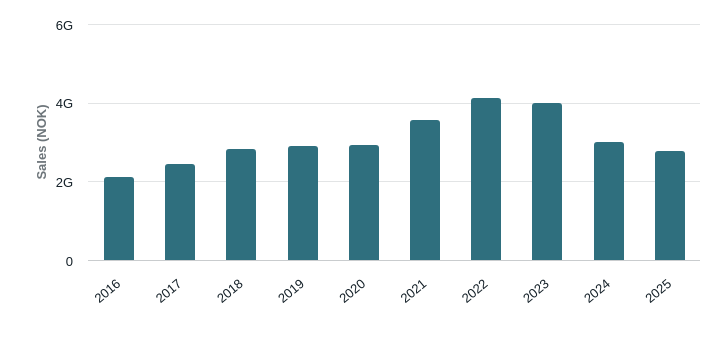
Smøla's corporate sector generated substantial top-line revenues over the past decade, reaching a historic peak of NOK 4,126.4 million in 2022. Following market adjustments and cyclical shifts in marine production, total corporate revenues settled at NOK 3,007.3 million in 2024 and NOK 2,769.6 million in 2025.
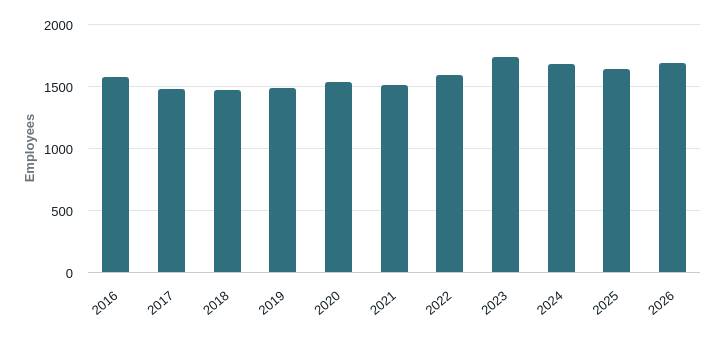
Despite shifts in aggregate sales, employment figures highlight a resilient and essential local workforce. Employment reached 1,733 in 2023 and projected at 1,685 by 2026, demonstrating sustained demand for skilled labor across maritime transport, aquaculture, and municipal healthcare.
Revenue and Employment Evolution
| Year | Corporate Sales (NOK) | YoY Sales Growth | Total Employment | YoY Employee Growth |
|---|---|---|---|---|
| 2016 | 2,103.2M | - | 1,573 | - |
| 2018 | 2,818.9M | +16.0% | 1,471 | -0.2% |
| 2020 | 2,915.9M | +0.4% | 1,536 | +3.6% |
| 2022 | 4,126.4M | +15.7% | 1,592 | +5.7% |
| 2023 | 3,980.5M | -3.5% | 1,733 | +8.9% |
| 2024 | 3,007.3M | -24.4% | 1,676 | -3.3% |
| 2025 | 2,769.6M | -7.9% | 1,639 | -2.2% |
| 2026 | - | - | 1,685 | +2.8% |
Industry Structure & Legal Forms
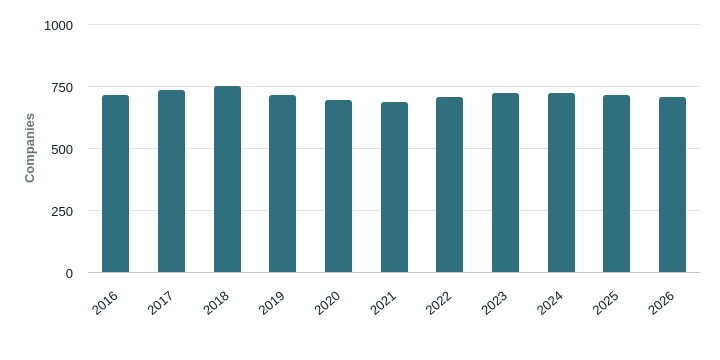
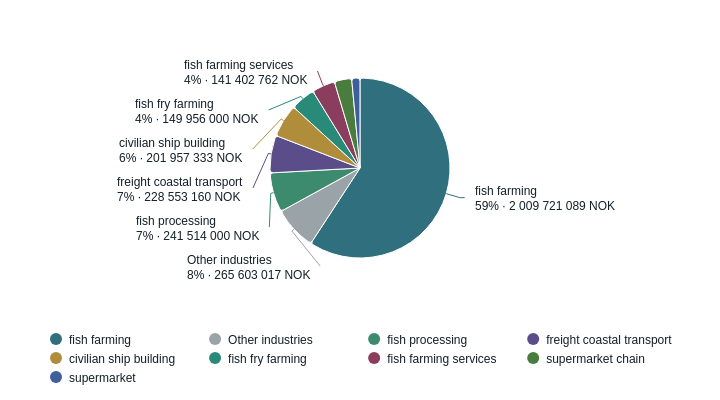
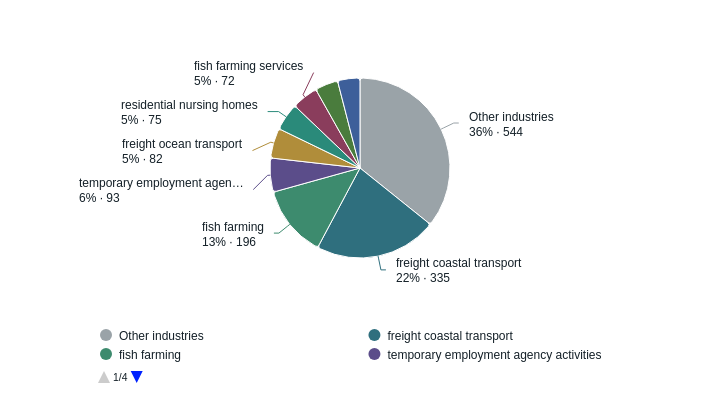
The commercial sector in Smøla is dominated by the blue economy. Fish farming generates the bulk of total operating income (NOK 2,014.3M across 4 active entities), yielding an average EBITDA margin of 11% and an impressive operating income per employee of NOK 15.6 million.
Complementing direct aquaculture are freight coastal transport (335 employees, NOK 231.6M income), civilian ship building (56 employees, NOK 202.0M income), fish farming services (72 employees, NOK 143.1M income with a 30% EBITDA margin), and fish fry farming (NOK 151.2M operating income). Service sectors such as professional accounting (NOK 32.0M operating income; 27% EBITDA margin) and local retail/supermarkets provide crucial support to residents and workers.
Industry Financial Highlights
| Industry Sector | Active Companies | Employees | Operating Income (NOK) | EBITDA Margin |
|---|---|---|---|---|
| Fish Farming | 4 | 196 | 2,014.3M | 11% |
| Freight Coastal Transport | 3 | 335 | 231.6M | 11% |
| Civilian Ship Building | 1 | 56 | 202.0M | 10% |
| Fish Fry Farming | 1 | 32 | 151.2M | 11% |
| Fish Farming Services | 4 | 72 | 143.1M | 30% |
| Freight Ocean Transport | 2 | 82 | 113.6M | 8% |
| Accounting Services | 2 | 28 | 32.0M | 27% |
Corporate Legal Structures
Limited liability companies (Aksjeselskap / AS) form the structural backbone of Smøla's commercial market, accounting for 73 enterprises, 1,268 employees, and NOK 3,458.7 million in operating income. Municipal organizations (Kommune / KOMM) account for 17 entities and 361 employees, maintaining public welfare, education, and healthcare infrastructure.
Business Geography
Smøla operates as a unified geographic economic hub. Commercial activities are heavily clustered around key harbor zones, industrial estates like Vikan, and municipal administrative centers at Hopen and Innsmøla.
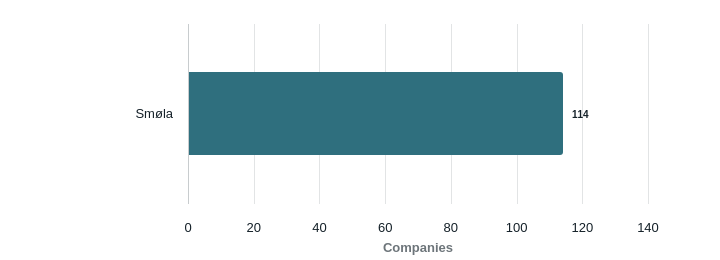
- Smøla Central Cluster: The primary economic district accounts for 114 companies, 1,776 employees, and NOK 3,540.0 million in combined operating income. The concentration of deepwater quay access, maritime service yards, and administrative offices enables effective collaboration across maritime crewing, vessel repair, and fish processing units.
Largest Employers
Smøla’s employment base features a blend of private maritime industrial leaders, specialized crew agencies, and public healthcare and educational institutions.
Top Employers in Smøla
| Company / Entity | Industry Sector | Employees | Revenue Growth |
|---|---|---|---|
| Trident Crew AS (Avd Smøla) | Freight Coastal Transport | 274 | +36% |
| Salmar Farming AS (Avd Smøla) | Fish Farming | 143 | +9% |
| FSV Crewing AS | Temporary Employment Agency | 91 | 0% |
| Smøla Kommune Hopen Bofellesskap | Disabled Care Facilities | 63 | Public |
| Aquaship Service AS | Freight Ocean Transport | 60 | -7% |
| Promek AS (Avd Smøla) | Civilian Ship Building | 56 | +27% |
| Smøla Sjukeheim | Residential Nursing Home | 52 | Public |
| Eines AS | Fish Farming Services | 42 | +68% |
| Mowi (Avd Smøla) | Fish Farming | 42 | Corporate |
| Norsk Sjøservice AS | Freight Coastal Transport | 35 | +41% |
| Smølamat AS | Supermarket Chain | 33 | +7% |
| Nekton Settefisk AS (Avd Aunvågen) | Fish Fry Farming | 32 | +20% |
In addition to corporate giants like Salmar and Mowi, specialized service providers exhibit rapid expansion. For instance, Eines AS experienced a 68% revenue growth with a 43% EBITDA margin, demonstrating high productivity in aquaculture service delivery.
Business Dynamism & Market Resiliency
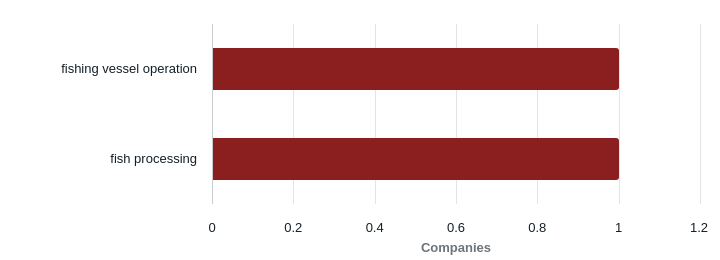
Business dynamism in Smøla reflects the high-capital, high-risk nature of seafood processing and maritime operations. Over recent reporting periods, bankruptcy rates have remained low in volume (2 recorded cases), but underscore structural challenges in value-added processing.
- Ocean Fresh Food AS (Fish Processing): Reported NOK 5.0M in sales revenue against operating losses, highlighting margin pressures and high capital costs inherent to standalone processing facilities.
- Betten Fisk AS (Fishing Vessel Operation): Minimal registered activity prior to insolvency.
Despite isolated distress in seafood processing, the broader marine equipment, crewing, and aquaculture production sectors demonstrate robust cash flow generation and solid balance sheets.
Opportunities for Founders & Entrepreneurs
Smøla offers attractive niches for founders equipped to support its core marine industrial ecosystem. Key opportunity areas include:
- Aquaculture Technology & Subsea Maintenance: With fish farming and aquaculture service providers generating strong margins (30% EBITDA in farming services), specialized tech in net cleaning, autonomous underwater robotics, and environmental monitoring has direct local buyers.
- Maritime Crewing & Logistics Support: Agencies like Trident Crew AS and FSV Crewing AS prove that Smøla is a strategic recruiting hub for maritime personnel. Related HR tech, safety training, and logistics consultancy can find immediate traction.
- Coastal Tourism & Eco-Hospitality: Smøla’s camping and hospitality sector demonstrated 50% revenue growth with strong EBITDA margins (34%), signaling potential for high-end eco-tourism, fishing charters, and nature-based experiential hospitality.
- B2B Professional & Technical Services: High profitability in accounting (27% EBITDA margin) shows a healthy appetite for technical business services, engineering support, and financial advisory for local vessel owners.
Entrepreneurs exploring potential business sites, industry trends, and local commercial real estate in Smøla can leverage platforms like SmartGrunder to gain valuable market insights and evaluate local trade dynamics.
Conclusion
Smøla municipality is a powerful coastal economic engine with world-class positioning in seafood production, shipbuilding, and ocean logistics. While top-line revenues fluctuate according to global seafood market conditions, the underlying labor market remains strong and resilient.
For entrepreneurs and investors, Smøla provides a mature industrial ecosystem with substantial supply-chain demand. Businesses that offer innovative solutions to local aquaculture leaders, maritime transport fleets, and growing tourism segments are well-positioned to thrive on the island.