Municipality
Sola Municipal Economy: Industrial Powerhouse and Innovation Engine
An in-depth economic analysis of Sola municipality for entrepreneurs, investors, and local decision-makers.
Executive Summary
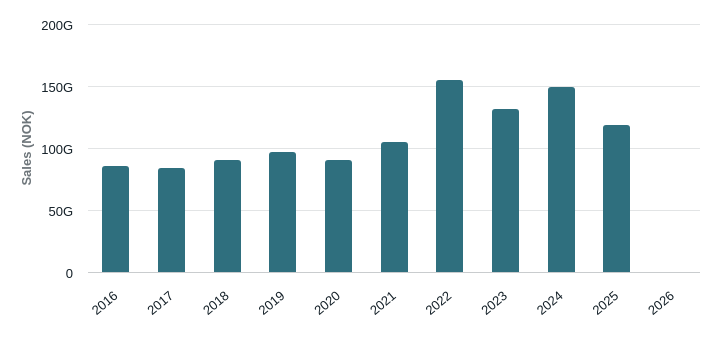
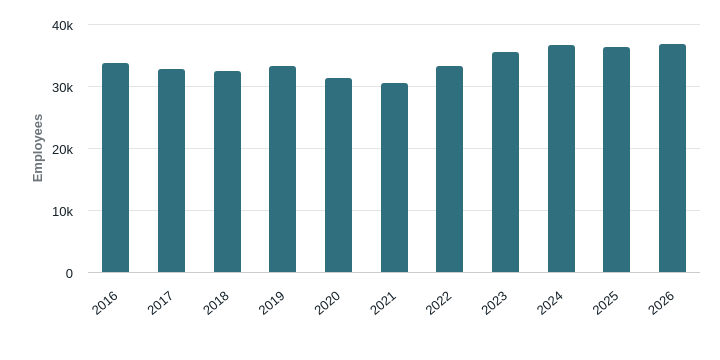
Sola municipality stands as one of Norway's most critical industrial hubs, playing a pivotal role in the national energy, offshore service, aviation, and maritime sectors. Situated in Rogaland adjacent to Stavanger and Sandnes, Sola hosts a workforce of over 36,000 employees and generates annual corporate revenues exceeding NOK 140 billion during peak activity periods.
Key structural highlights of Sola's economy include:
- Energy & Offshore Concentration: Dominance of oil and gas support services, subsea engineering, drilling services, and crude oil extraction headquarters.
- Aviation & Logistics Hub: Presence of Stavanger Airport, Sola, driving extensive aerospace maintenance, helicopter transportation, and air freight logistics.
- High Productivity: Exceptional revenue per employee metrics, particularly within technical consulting, aerospace, and energy extraction sub-sectors.
- Balanced Infrastructure: Complementary commercial hubs distributed across Tananger (port and energy hub), Sola center, and shared industrial parks adjoining Forus.
Economic Overview
Sola's macroeconomic trajectory is tightly coupled with global energy cycles and industrial capital expenditures. Corporate sales data illustrates significant expansion over the past decade, rising from NOK 85.2 billion in 2016 to a peak of NOK 155.1 billion in 2022, before settling around NOK 118.8 billion to NOK 148.9 billion in recent reporting cycles.
Employment figures exhibit robust recovery and long-term stability. After dipping to roughly 30,500 employees during the 2020–2021 downturn, the municipality rebounded to 36,640 employees in 2024 and maintains approximately 36,300 to 36,800 active positions in current projections.
| Year | Corporate Sales (NOK) | Sales YoY Growth | Total Employees | Employees YoY Growth |
|---|---|---|---|---|
| 2016 | 85.20B | - | 33,670 | - |
| 2018 | 90.72B | +8.0% | 32,365 | -1.3% |
| 2020 | 90.37B | -6.3% | 31,330 | -5.8% |
| 2022 | 155.10B | +48.5% | 33,287 | +9.1% |
| 2024 | 148.89B | +13.3% | 36,640 | +3.3% |
| 2025 | 118.75B | -20.2% | 36,322 | -0.9% |
Note: Data for 2026 represents partial reporting year figures.
Industry Structure
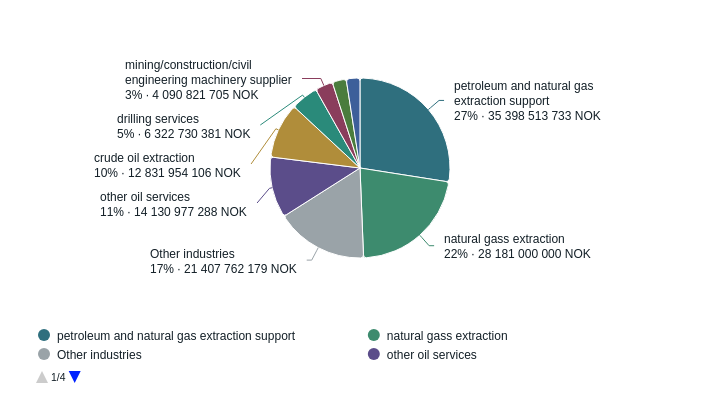
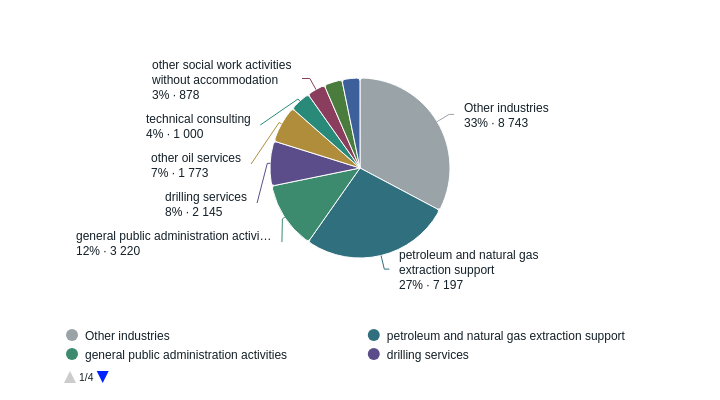
Sola's industry landscape is led by technical, energy, and heavy engineering services. Petroleum and natural gas extraction support alone accounts for over 7,100 employees and NOK 35.7 billion in operating income across 34 specialized enterprises.
Key Industry Clusters
- Offshore & Energy Support: Petroleum extraction support, drilling services (2,145 employees), and other oil services (1,773 employees) generate the vast majority of local economic value.
- Engineering & Technical Consulting: 97 technical consulting firms employ 1,000 specialists, yielding NOK 2.94 billion in income.
- Aerospace & Maintenance: Aircraft repair and service incidental to air transportation generate over NOK 4.1 billion combined, supported by nearly 1,100 employees.
- Civil Engineering & Construction: Site preparation and general construction employ over 1,350 workers, led by major regional contractors.
| Industry Sector | Companies | Employees | Operating Income (NOK) | EBITDA Margin |
|---|---|---|---|---|
| Petroleum & Gas Extraction Support | 34 | 7,197 | 35.71B | 12% |
| Drilling Services | 5 | 2,145 | 6.65B | 5% |
| Other Oil Services | 10 | 1,773 | 14.17B | 16% |
| Technical Consulting | 97 | 1,000 | 2.94B | 5% |
| Site Preparation | 12 | 870 | 2.01B | 7% |
| Crude Oil Extraction | 4 | 858 | 14.33B | 13% |
| Aircraft / Spacecraft Maintenance | 5 | 587 | 3.16B | 29% |
Corporate Legal Structures
Limited liability companies (Aksjeselskap / AS) form the backbone of Sola's business community, comprising 858 entities, 28,619 employees, and NOK 129.8 billion in turnover. Foreign branch registrations (NUF) and public limited companies (ASA) also play significant roles in multi-billion NOK operations.
Business Geography
Commercial activity in Sola is concentrated across distinct economic zones, each possessing specific infrastructure advantages:
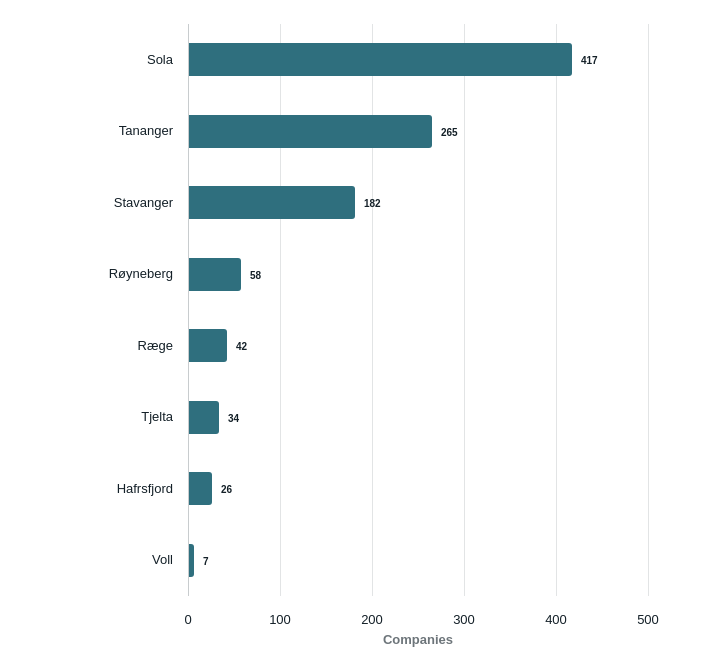
- Sola (Center / Airport District): The main administrative and aviation zone, housing 417 companies and nearly 16,000 employees. Focuses on aviation services, public administration, logistics, and retail.
- Tananger: The coastal industrial powerhouse and port district. Tananger hosts 265 companies and 10,337 employees, generating NOK 42.3 billion in revenue driven by subsea technology, supply bases, and international energy headquarters.
- Stavanger Postal District (Within Sola): Areas sharing postal codes with Stavanger (such as Kanalsletta and Forus borders inside Sola) host 182 companies with 9,374 employees, generating NOK 78.98 billion due to concentrated corporate headquarters.
- Røyneberg & Rural Centers: Røyneberg (1,057 employees) alongside Tjelta, Ræge, Hafrsfjord, and Voll provide local service hubs, light industry, and agricultural infrastructure.
| Area / District | Companies | Employees | Operating Income (NOK) | Total Debt (NOK) |
|---|---|---|---|---|
| Sola | 417 | 15,958 | 22.85B | 15.12B |
| Tananger | 265 | 10,337 | 42.31B | 33.76B |
| Stavanger (Sola borders) | 182 | 9,374 | 78.98B | 72.80B |
| Røyneberg | 58 | 1,057 | 3.12B | 6.26B |
| Tjelta | 34 | 372 | 277.1M | 66.2M |
| Ræge | 42 | 267 | 199.3M | 58.4M |
Largest Employers
The employment landscape in Sola is anchored by public administration alongside world-leading multinational energy services and infrastructure companies.
Public Sector Anchor
- Sola Kommune: The municipality itself is the single largest public employer with 3,140 employees dedicated to public administration, education, healthcare, and infrastructure.
Major Private Employers
- Halliburton AS (Sola & Offshore branches): Over 2,350 employees combined, operating in well construction, energy services, and offshore support with revenues over NOK 12.6 billion.
- Bilfinger ISP Offshore Norway AS (Stavanger/Sola branch): 1,190 employees specialized in insulation, scaffolding, and piping services for the energy sector.
- IKM Testing AS: 876 employees focused on mechanical completion, testing, and pipeline services.
- Rogaland Omsorg AS: 873 employees providing social care services.
- Schlumberger Norge AS (Offshore division): 818 employees delivering oilfield technologies and subsea equipment.
- Apply AS: 768 employees engaged in engineering, maintenance, and modification projects.
- Stangeland Maskin AS: 730 employees, representing one of Norway's largest civil engineering and earthmoving contractors.
- Subsea 7 Norway AS: 729 employees delivering subsea engineering, construction, and deepwater services.
- ConocoPhillips Norge: 681 employees managing major North Sea extraction operations from Tananger.
- Baker Hughes Norge AS: Over 1,100 employees across onshore and offshore branches in Tananger.
Business Dynamism & Bankruptcies
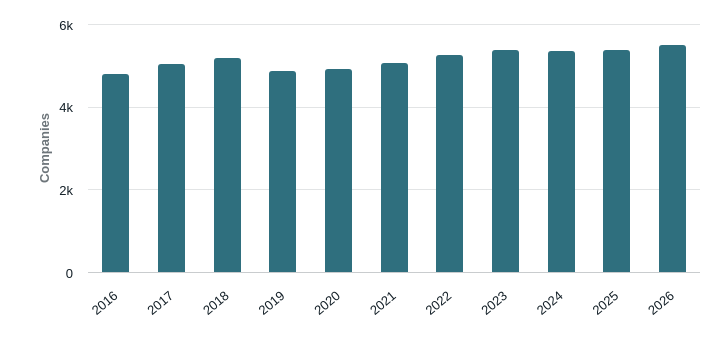
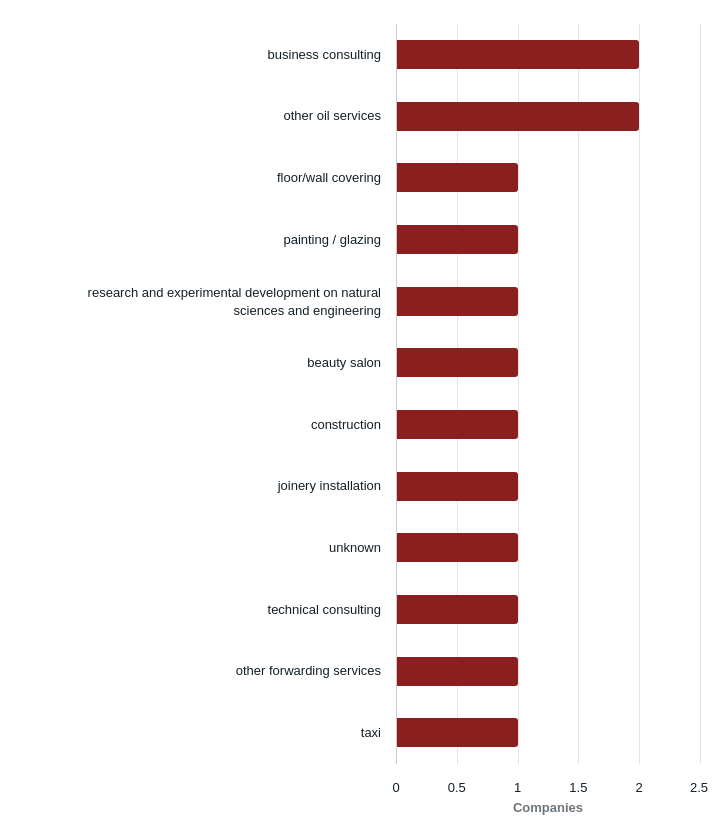
Sola maintains a resilient commercial ecosystem relative to its large active corporate base of over 5,500 registered units. Recent bankruptcy statistics show a total of 16 to 18 bankrupt companies, reflecting normal market churn and capital re-allocation rather than systemic fragility.
Insolvency Patterns
Insolvencies are primarily isolated to niche technical advisory firms, specialized sub-contractors, and small consumer services:
- Gunnar Haaland Gulvavretting: Floor/wall covering firm (NOK 16.8M sales).
- Petrolink: Oil service consulting firm (NOK 17.8M sales).
- European Simulation & Training Academy: Technical training facility (NOK 1.6M sales).
- Quest Executive Search: Recruitment consulting (NOK 3.7M sales).
- Microa / Microa Biopolymer: Biotechnology research ventures.
Overall, insolvency rates remain low across Sola's major industrial sectors, underscored by high equity reserves among established energy service providers.
Opportunities for Founders
For prospective entrepreneurs and scaling businesses, Sola provides a compelling value proposition characterized by high regional purchasing power and world-class industrial infrastructure.
Primary Growth Vectors
- Energy Transition & Clean Tech: Re-purposing subsea and offshore expertise into offshore wind, hydrogen logistics, carbon capture, and marine electrification.
- B2B Specialized Consulting: Providing technical, digital, and environmental compliance software/services to the 100+ engineering and consulting firms in the area.
- Aviation & Logistics Services: Leveraging proximity to Stavanger Airport, Sola for specialized cold-chain logistics, drone inspection technologies, and supply chain management.
- Commercial Support & Hospitality: Serving the high volume of international corporate travelers and technical workers visiting Tananger and Forus-Sola.
Founders evaluating specific commercial addresses or target industries in Sola can use SmartGrunder to explore real estate options, demographic patterns, and industry concentration across the municipality.
Conclusion
Sola municipality remains a central pillar of Western Norway's economy. Supported by high-revenue industrial bases in Tananger and Sola center, world-class aviation infrastructure, and an adaptable workforce of over 36,000 professionals, the municipality offers an exceptional environment for commercial ventures.
While macroeconomic exposure to energy industry cycles requires strategic foresight, Sola's diversification into green tech, aerospace, and specialized technical services ensures long-term industrial competitiveness and strong fundamentals for business founders.