Municipality
Sør Aurdal Business Economy and Entrepreneurial Outlook
An analytical overview of industry structure, revenue trends, and growth opportunities in Sør Aurdal municipality
Executive Summary
Sør Aurdal's business economy is heavily anchored in natural resource industries, specialized civil engineering, wood processing, and public health and care services. Positioned in the southern part of the Valdres region in Innlandet county, the municipality serves as a gateway to key regional corridors while maintaining strong local manufacturing and forestry operations.
In recent years, macro-level pressure on construction and wood products has impacted municipal sales and total commercial employment. Despite these headwinds, core competitive strengths persist across specialized sectors such as site preparation, forestry harvesting, and local utility distribution, alongside a resilient public sector footprint anchored in Bagn and Hedalen.
Key structural highlights include:
- Resource Base: Strong commercial cluster around forestry (Valdres Skog As) and primary wood conversion (Begna Bruk As).
- Civil Infrastructure: Major contractors in earthmoving and site preparation driving high turnover per employee.
- Geographic Anchor: Bagn serves as the principal economic center, generating NOK 572.3M in operating income across 68 companies.
For prospective business founders and local leaders, navigating current industry adjustments requires clear strategic positioning. Natural advantages in wood technology, infrastructure support, and localized services offer concrete foundations for new enterprise creation.
Economic Overview
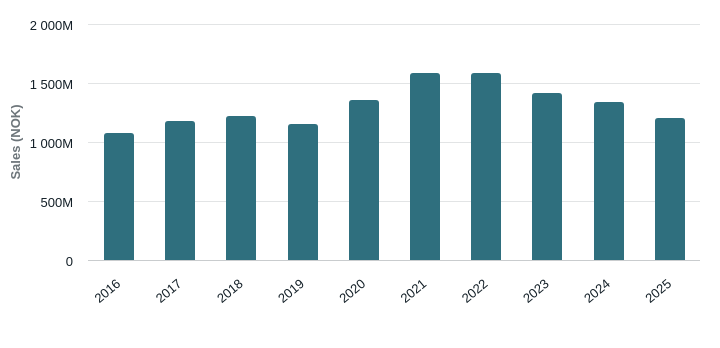
An analysis of year-over-year performance data reveals a strong expansion period between 2020 and 2022, followed by a cyclical contraction driven by nationwide macro trends in construction and timber demand.
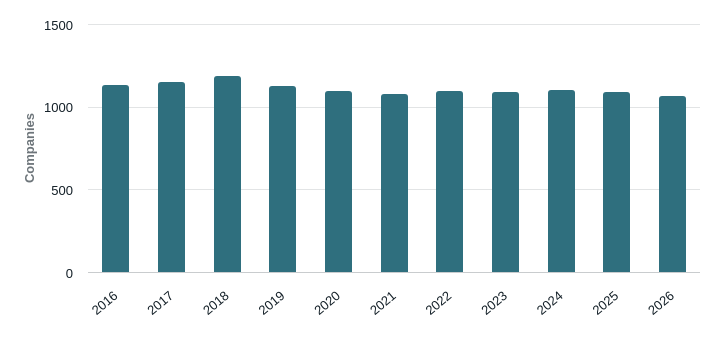
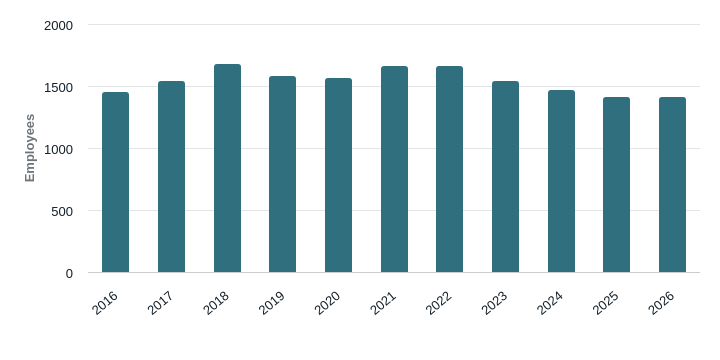
Total commercial sales reached a historical peak of NOK 1,581.5M in 2021 before shifting downward to NOK 1,418.6M in 2023 (-10.3%), NOK 1,340.8M in 2024 (-5.5%), and NOK 1,204.2M in 2025 (-10.2%). Parallelly, overall employment contracted from a high of 1,664 employees in 2021 down to 1,465 in 2024, and stabilized around 1,408 in 2026.
| Metric | 2018 | 2020 | 2022 | 2024 | 2025 | 2026 |
|---|---|---|---|---|---|---|
| Total Sales (NOK M) | 1,221.3 | 1,357.0 | 1,581.1 | 1,340.8 | 1,204.2 | N/A |
| Total Employees | 1,675 | 1,568 | 1,661 | 1,465 | 1,414 | 1,408 |
| YoY Sales Growth (%) | +3.6% | +17.7% | -0.0% | -5.5% | -10.2% | N/A |
| YoY Employee Change (%) | +8.9% | -0.7% | -0.2% | -5.1% | -3.5% | -0.4% |
The contraction in sales and employment reflects broader cyclical challenges within rural industrial segments. However, labor productivity remains robust in select niches, with high operating income per employee registered in heavy transport and forestry management.
Industry Structure & Organizational Forms
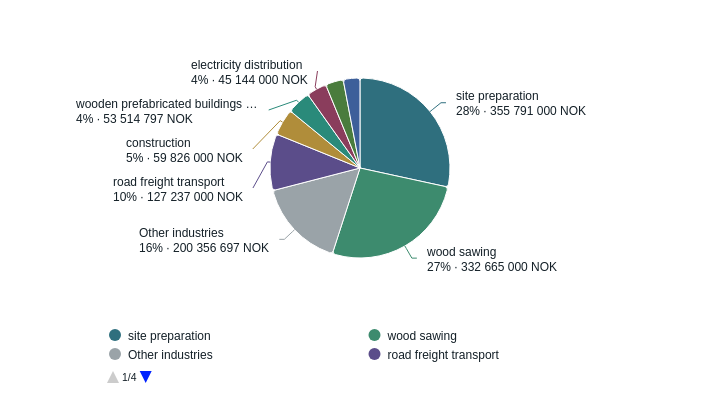
Sør Aurdal's commercial activity spans 71 distinct industry classifications, showing high structural concentration in civil engineering, wood processing, public healthcare, and transport.
Key Industry Sectors
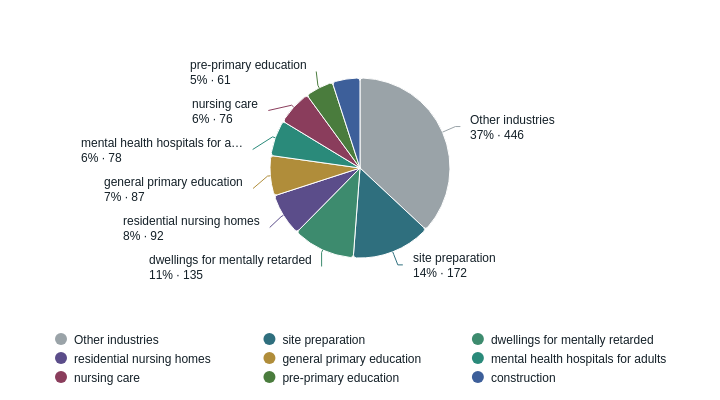
- Site Preparation & Infrastructure: Anchored by 11 companies employing 172 people, generating NOK 362.1M in operating income. Operating margins stand at 0% overall due to high capital intensity and rising equipment costs, though core leaders remain profitable.
- Wood Sawing & Forestry: Wood sawing generates NOK 334.7M in operating income across 47 employees at Begna Bruk As. Forest felling adds NOK 45.5M across 29 employees with high profitability (26% EBITDA margin).
- Road Freight Transport: 2 companies employing 38 staff generate NOK 127.4M with a solid 5% EBITDA margin.
- Construction & Prefabricated Wood Buildings: General construction comprises 18 companies (60 employees, NOK 61.1M revenue, 10% EBITDA margin). Prefabricated wooden building production accounts for 4 companies and 43 employees, facing margin pressure (-16% EBITDA margin).
- Public & Specialized Services: Dwellings for mentally retarded (135 employees), residential care (92 employees), primary education (87 employees), and mental healthcare (78 employees) represent major non-commercial stability.
Organizational Form Distribution
Limited liability companies (AS) generate nearly all commercial revenues in the municipality, while public and trust structures govern health and education.
- AS (Aksjeselskap): 96 companies, 736 employees, NOK 1,247.1M operating income.
- Komm (Kommunal enhet): 19 entities, 571 employees providing core public services.
- Sti (Stiftelse): 1 institution, 78 employees (Fekjær Psykiatriske Senter).
- Enk (Enkeltpersonforetak): 10 reported registered entities with employees.
Business Geography & Local Centers
Economic activity in Sør Aurdal is distributed across several distinct settlements along the E16 and valley corridors, with Bagn serving as the main administrative and commercial center.
| Place | Companies | Employees | Operating Income (NOK) | Sales Revenue (NOK) | Operating Margin |
|---|---|---|---|---|---|
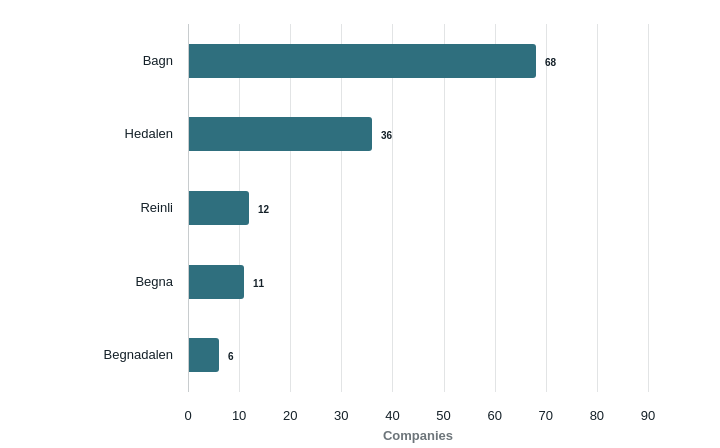
| Bagn | 68 | 898 | 572.3M | 560.3M | 4% |
| Hedalen | 36 | 305 | 218.3M | 214.4M | -2% |
| Begna | 11 | 111 | 378.4M | 375.5M | -4% |
| Reinli | 12 | 101 | 76.8M | 72.4M | -10% |
| Begnadalen | 6 | 38 | 50.3M | 49.8M | 17% |
Spatial Characteristics
- Bagn: Represents over half of total municipal commercial activity, hosting municipal headquarters, retail facilities, earthmoving contractors, and community health institutions.
- Hedalen: Blends healthcare institutions like Fekjær Psykiatriske Senter with transport companies, local trade, and agriculture-related services.
- Begna: High turnover per employee (NOK 3.7M/employee), driven predominantly by timber processor Begna Bruk As.
- Begnadalen: Highly efficient niche sector featuring power distribution (electricity distribution generating high EBITDA margins of 37%).
- Reinli: Local construction contractors, daycares, and rural services.
Largest Employers
The employer landscape in Sør Aurdal consists of strong municipal health and administrative units alongside established private enterprises in civil construction, forestry, transport, and manufacturing.
Primary Commercial & Public Organizations
- Sør Aurdal Kommune Miljøarbeidertjenesten Bagn: 120 employees, care and social services.
- Sør Aurdalsheimen: 92 employees, residential nursing facilities.
- Brødrene Dokken As: 81 employees, site preparation and heavy civil contracting (NOK 267.6M operating income, NOK 10.6M EBITDA).
- Fekjær Psykiatriske Senter Institusjon Psykisk Helsevern: 78 employees, specialized mental health treatment facility in Hedalen.
- Sør Aurdal Kommune Hjemmesykepleien: 76 employees, home healthcare services.
- Begna Bruk As: 47 employees, large-scale industrial wood sawing and timber processing (NOK 334.7M operating income).
- Bagn Skule: 39 employees, primary education.
- Elias Breivik As Avd Øst: 37 employees, heavy road freight transport (NOK 126.3M operating income, NOK 7.3M EBITDA).
- Dokken Bygg Og Anlegg As: 32 employees, site preparation and earthmoving (NOK 43.6M operating income).
- Valdres Skog As: 29 employees, mechanized forest felling and timber harvesting (NOK 45.5M operating income, 26% EBITDA margin).
- Thomas Maskin As: 28 employees, civil contractor based in Hedalen.
- Spar Bagn: 24 employees, local supermarket retail.
Business Dynamism & Insolvent Entities
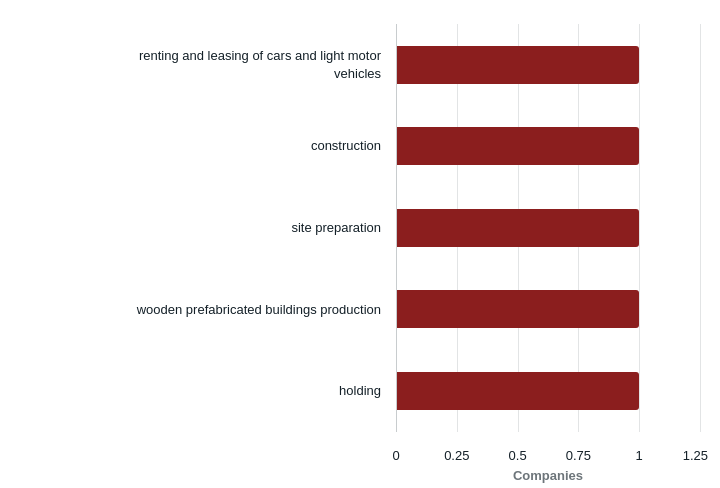
Business dynamic shifts in Sør Aurdal reflect the recent downturn in residential building and secondary construction markets across Norway. A total of 5 company bankruptcies were recorded in the municipal statistics sample.
Analysis of Bankruptcies by Industry
- Site Preparation: Nybråten Maskin As (Åsemyrvegen 665, Bagn) recorded NOK 7.3M in sales and an EBITDA of NOK -1.5M prior to liquidation, illustrating challenges in earthmoving project pricing.
| 2. Wooden Prefabricated Buildings: Solheim Trevare As (Sliperiet | Tellatn 30, Bagn) held NOK 8.0M in sales and NOK 300.0K EBITDA before entering bankruptcy due to severe drops in national cabin and home construction. |
|---|
- Holding Companies: Nybråten Holding As registered negative EBITDA (NOK -116.0K) associated with underlying operational write-downs.
- General Construction & Support: Verda Bygg As (Begna) and Allsolutions As (Bagn) represented smaller, low-revenue corporate closures.
While individual failures reflect national construction cycles, core primary industries—such as timber harvesting, grid utilities, and specialized transport—continue to show high underlying resilience and solvency.
Opportunities for Founders
Despite macroeconomic recalibrations, Sør Aurdal presents distinct structural advantages for entrepreneurial ventures in value-added resource industries, specialized business services, and tourism tech.
High-Potential Business Concepts
- Wood Value-Chain & Bio-Economy: With Begna Bruk As and Valdres Skog As handling vast raw timber volumes, opportunities exist for secondary wood refinement, mass timber components, or wood byproduct utilization.
- Craft Trades & Maintenance Support: As major contractors streamline core operations, specialized subcontractors in joinery installation, electrical integration, and equipment maintenance have strong local demand.
- Accounting & B2B Professional Services: Local accounting firms currently maintain steady performance (9% EBITDA margins across 20 employees). Higher automation and specialized CFO-for-hire services present clear growth potential.
- Ecotourism & Cabin Services: Short-stay cabin operators (21 employees, NOK 7.0M operating income) benefit from proximity to Oslo and Eastern Norway. High-end facility management and outdoor experience providers can capture emerging tourist demand.
Founders evaluating opportunities across Bagn, Hedalen, or Begna can utilize tools like SmartGrunder to explore specific commercial addresses, local industry concentrations, and startup prerequisites tailored to Sør Aurdal.
Conclusion
Sør Aurdal offers a solid economic foundation grounded in industrial forestry, heavy civil engineering, and steady public healthcare infrastructure. While cyclical shifts in construction have impacted top-line revenues in recent years, the underlying industrial base—led by market leaders like Brødrene Dokken As, Begna Bruk As, and Valdres Skog As—remains structurally intact.
For local decision-makers and incoming entrepreneurs, the primary strategic focus lies in diversifying value creation around local raw materials, enhancing service supply chains, and leveraging Sør Aurdal's geographic location between Valdres and the central Eastern Norway region. Strategic investments in new technology and specialized services will position the municipality well for the next economic cycle.