Municipality
Stavanger Business Economic Landscape: A Comprehensive Analysis for Entrepreneurs and Decision-Makers
Navigating Norway's Energy Capital: Industry Dynamics, Regional Geography, and Strategic Growth Pathways
Executive Summary
Stavanger stands as one of Norway's most robust economic engines, acting as the primary hub for energy, maritime technology, and specialized professional services. The municipality hosts a massive business ecosystem generated around high-value industrial operations, advanced technical consulting, public administration, and regional healthcare institutions.
Key economic highlights of Stavanger include:
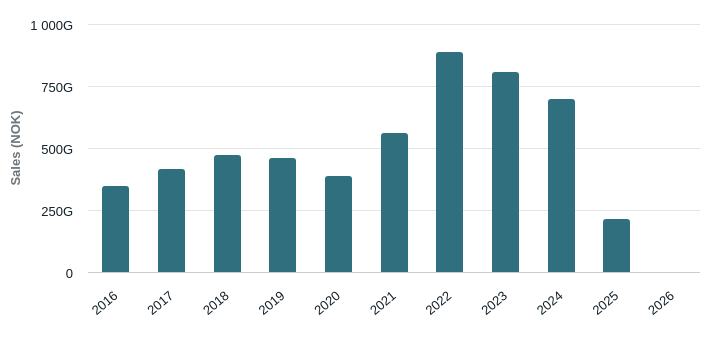
- High Revenue Base: Aggregate corporate revenues exceeded NOK 887.7 billion at their peak in 2022 and remained elevated at NOK 697.5 billion in 2024.
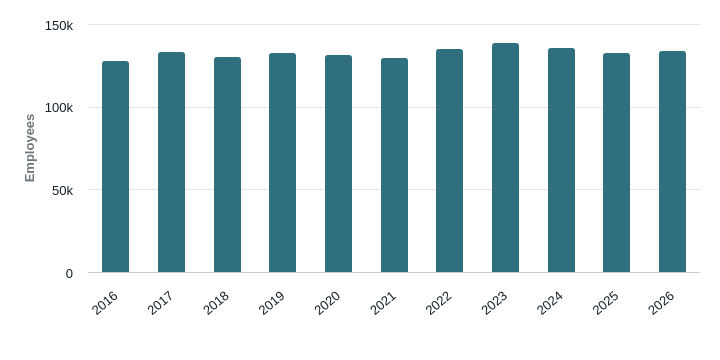
- Substantial Employment: A stable workforce of over 133,000 to 138,000 employees across municipal businesses and public bodies.
- Dominant Sectors: Energy extraction, oilfield services, technical consulting, IT solutions, and comprehensive public healthcare (headquartered around Stavanger Universitetssjukehus).
For founders and investors, Stavanger offers exceptional purchasing power, a highly educated workforce, and a dynamic market for both B2B technical solutions and high-end consumer services. Navigating this landscape requires an understanding of energy cycles, geographic sub-markets, and sector-specific talent demands.
Economic Overview
The economy of Stavanger displays both immense financial depth and sensitivity to global energy macro-cycles. Total company sales revenue in the municipality reached NOK 346.7 billion in 2016 and expanded substantially over the following decade, peaking at NOK 887.8 billion in 2022 during a period of surging commodity prices. In 2023 and 2024, revenues stabilized at NOK 808.2 billion and NOK 697.5 billion, respectively. (Note: Data for 2025 and 2026 reflect partial annual financial reporting cut-offs).
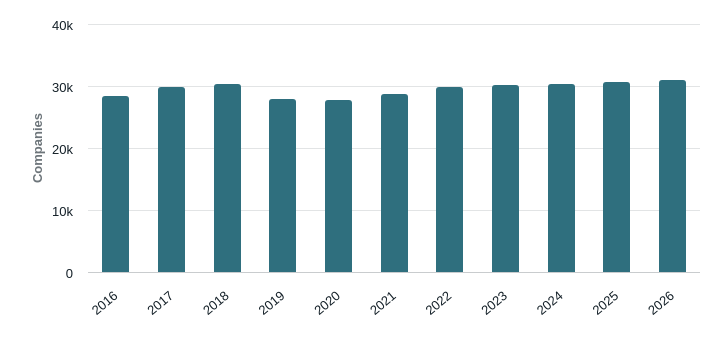
Employment levels have remained remarkably resilient, accommodating structural shifts across energy transitions and post-pandemic adjustments. The total registered workforce grew from 127,594 employees in 2016 to a high of 138,389 employees in 2023, settling at 135,524 employees in 2024 and 133,664 in recent reporting.
| Year | Total Sales Revenue (NOK M) | Total Employees | YoY Sales Growth | YoY Employee Growth |
|---|---|---|---|---|
| 2018 | 473,737.1 | 130,033 | +14.1% | -2.3% |
| 2019 | 458,984.4 | 132,569 | -3.1% | +2.0% |
| 2020 | 386,995.0 | 131,015 | -15.7% | -1.2% |
| 2021 | 559,098.3 | 129,664 | +44.5% | -1.0% |
| 2022 | 887,766.0 | 134,721 | +58.8% | +3.9% |
| 2023 | 808,191.4 | 138,389 | -9.0% | +2.7% |
| 2024 | 697,468.5 | 135,524 | -13.7% | -2.1% |
This capital-dense environment yields an extraordinary operating income per employee in key industries, providing strong liquidity across commercial banks and regional investment funds.
Industry Structure & Legal Forms
Stavanger's industrial mix is anchored by energy production and supported by deep clusters of healthcare, public administration, engineering, and IT services.
Primary Industry Pillars
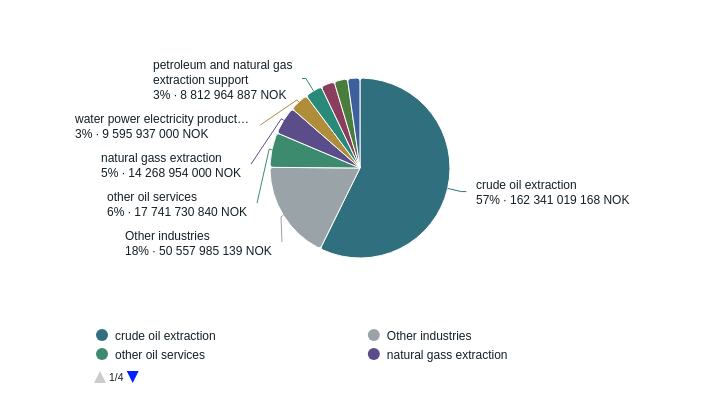
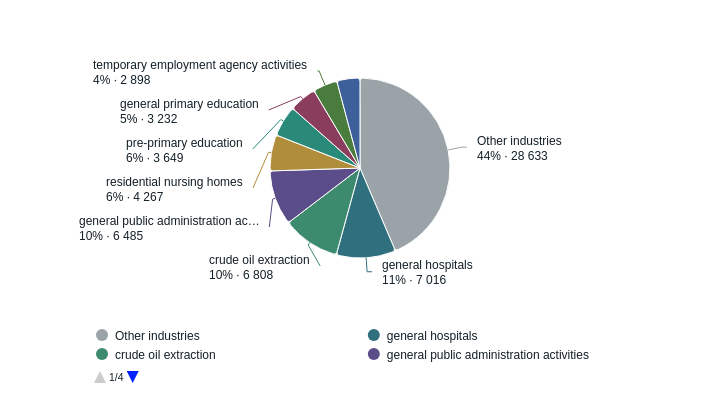
- Crude Oil Extraction & Offshore Services: Generating over NOK 183.3 billion in operating income across 10 primary extraction entities (employing 6,808 workers), oil extraction achieves an average operating income per employee of NOK 29.1 million. Related petroleum support, drilling, and oilfield service clusters collectively employ over 6,400 additional specialists, bringing in tens of billions in turnover.
- Healthcare & Public Sector: General hospitals represent the largest single employment sector with 12 entities employing 7,016 workers and generating NOK 7.5 billion in operating income. General public administration accounts for 6,485 employees across 12 entities.
- Technology & Technical Consulting: Technical consulting is a major sector with 295 companies employing 2,144 workers (NOK 4.7B revenue). Software, IT services, and computer programming account for over 3,480 combined employees generating more than NOK 6.2 billion.
Corporate Structure Distribution
Limited liability companies (Aksjeselskap / AS) form the structural backbone of private enterprise, while state enterprise (SÆR) and public joint-stock companies (ASA) handle massive industrial and public infrastructure revenues.
| Legal Form | Number of Entities | Total Employees | Total Operating Income (NOK M) | Average EBITDA Margin |
|---|---|---|---|---|
| AS (Aksjeselskap) | 3,686 | 61,305 | 200,639.1 | 26% |
| ORGL (Organisasjonsledd) | 389 | 25,291 | 0.0 | 0% |
| SÆR (Statforetak/Særskilt) | 43 | 9,439 | 54,092.5 | 1% |
| ASA (Allmennaksjeselskap) | 11 | 6,718 | 157,314.8 | 18% |
| SA (Samvirkelag) | 65 | 4,597 | 6,479.5 | 3% |
| ENK (Enkeltpersonforetak) | 161 | 577 | 5.6 | 59% |
Business Geography & Urban Hubs
Following municipal expansions, Stavanger encompasses urban commercial centers, industrial parks, suburban innovation hubs, and island communities.
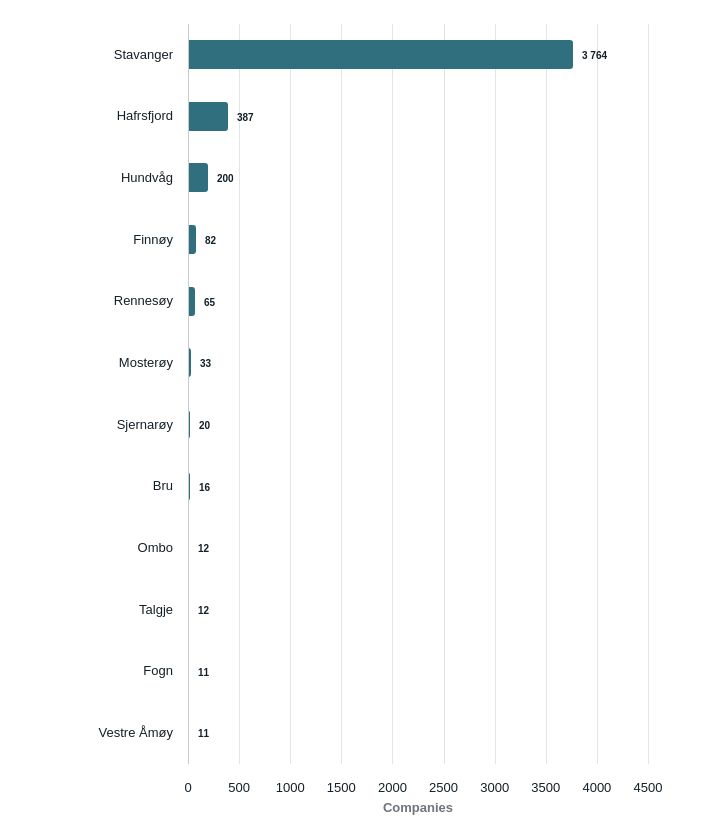
- Stavanger Central / Urban Core: Represents the overwhelming majority of economic output. Hosts 3,764 registered active business entities, employing 104,636 people and generating NOK 410.5 billion in operating income with an overall 19% EBITDA margin.
- Hafrsfjord: A critical sub-market hosting 387 companies and 5,475 employees, yielding NOK 4.2 billion in operating income.
- Hundvåg: A key maritime and industrial zone with 200 companies and 3,014 employees, responsible for NOK 7.5 billion in operating income, driven largely by heavy engineering and shipbuilding facilities.
- Finnøy & Rennesøy: Island communities featuring specialized agriculture, aquaculture services, and local trade. Finnøy accounts for 2,865 employees across 82 companies (generating NOK 1.0B), while Rennesøy hosts 65 companies employing 1,281 workers (NOK 954.3M operating income).
- Sjernarøy, Talgje & Skartveit: Smaller island clusters characterized by high revenue per employee in maritime transport and specialized marine activities. For instance, Skartveit's 5 companies generate NOK 399.2 million with just 47 employees (NOK 17.2M per employee).
| Location / City | Number of Companies | Total Employees | Operating Income (NOK M) | Operating Margin |
|---|---|---|---|---|
| Stavanger | 3,764 | 104,636 | 410,535.7 | 15% |
| Hafrsfjord | 387 | 5,475 | 4,196.6 | 7% |
| Hundvåg | 200 | 3,014 | 7,498.4 | 5% |
| Finnøy | 82 | 2,865 | 1,025.3 | 3% |
| Rennesøy | 65 | 1,281 | 954.3 | 15% |
| Sjernarøy | 20 | 381 | 1,624.3 | 13% |
Largest Employers & Anchor Enterprises
Stavanger's economic ecosystem is anchored by giant public employers, energy multinationals, and major maritime operators.
Major Employers in the Municipality
- Stavanger Kommune: The largest single employer in the municipality, maintaining 17,496 employees across local public services and municipal administration.
- Stavanger Universitetssjukehus (Ullandhaug & Våland sites): Employs over 7,300 healthcare professionals across regional health operations (Ullandhaug: 5,124 emp; Våland: 1,260 emp; Psychiatric adult care: 932 emp).
- Rogaland Fylkeskommune: Based in Stavanger, employing 4,723 personnel in county administration and regional public management.
- Equinor ASA (Avd Kontor Stavanger): Headquartered at Forusbeen, employing 4,257 workers locally and generating NOK 149.7 billion in operating income with an EBITDA margin of 15%.
- Universitetet i Stavanger (UiS): Employs 2,116 staff members, driving academic research, engineering innovation, and workforce development.
- Ryfylke Landbrukstenester SA (Finnøy): A massive agricultural and rural service cooperative employing 1,875 workers.
- Aker Solutions AS (Stavanger): Major engineering powerhouse employing 1,833 workers at Jåttåvågveien, generating NOK 16.6 billion in revenue.
- Kaefer Energy AS: Leading provider of offshore maintenance, insulation, and surface protection, employing 1,656 workers with NOK 3.5 billion in operating income.
- Aker BP ASA: Independent offshore exploration and production giant employing 1,586 staff, generating NOK 6.6 billion locally with an 85% EBITDA margin.
- Norled AS: Major maritime transportation company based at Børehaugen, employing 1,214 workers and generating NOK 3.0 billion in sales.
- Transocean Norway Operations AS: Offshore drilling services operator employing 1,063 staff with NOK 4.5 billion in revenue.
- Rosenberg Worley: Historic shipbuilding and offshore engineering yard in Hundvåg, employing 670 specialists and delivering NOK 6.1 billion in income.
Business Dynamism & Market Adjustments
Market dynamics in Stavanger demonstrate ongoing economic restructuring, particularly within real estate, specialized construction, and consumer services.
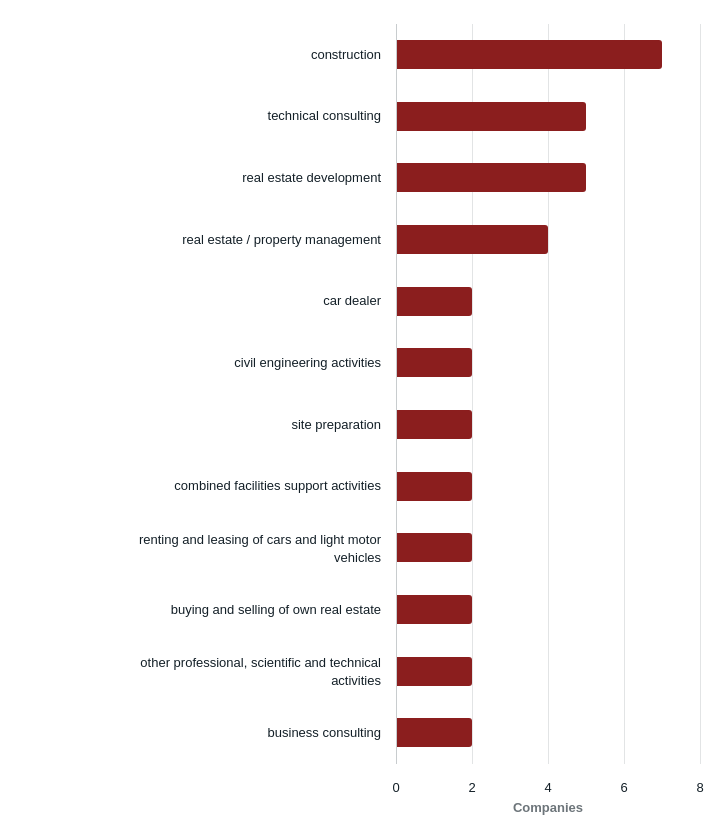
Across the municipality, 95 total bankruptcies were recorded in the area tracking dataset. An analysis of industry bankruptcy metrics reveals distinct patterns:
- Construction & Subcontracting: 7 construction companies defaulted, with combined recorded operating incomes of NOK 209.8 million. While high-level gross revenues were present, tight margins (8% gross margin) and high debt loads (NOK 267.8M total debt) created solvency pressures.
- Real Estate & Property Development: 9 combined entities across property management and real estate development experienced insolvencies, reflecting interest rate adjustments and macro real estate cyclicality. Real estate development insolvencies carried NOK 95.8 million in total debt.
- Technical & Business Consulting: 5 technical consulting firms and 2 business consulting firms underwent liquidation. Technical consulting bankruptcies showed high salary overheads relative to project revenue growth.
- Retail & Hospitality Samples: Select retail businesses faced market exits, including Blåveisen Blomster AS (NOK 4.1M revenue), Budbilsentralen AS (NOK 9.5M sales revenue before restructuring), and niche second-hand and toy retailers.
These market corrections represent a normal realignment of capital and labor, freeing up skilled technical workers and commercial space for new entrepreneurial ventures.
Opportunities for Founders & SmartGrunder Insights
The wealth generated by Stavanger's core export industries creates substantial opportunities for early-stage companies and innovative founders.
Strategic Niche Opportunities
- B2B Software & Green Energy Tech: With major buyers like Equinor, Aker Solutions, and Aker BP located in the municipality, software startups specializing in industrial automation, carbon management, and offshore logistics have immediate enterprise customers on their doorstep.
- Subcontracting & Specialized Engineering: Technical consulting remains a NOK 4.7 billion sector. High-end specialized engineering sub-consultants can leverage the area's top-tier technical rates.
- High-Value B2C & Premium Services: High disposable income among energy and tech employees creates sustainable demand for specialty food, health services, and leisure experiences.
- Maritime Clean-Tech: Companies working on vessel electrification or zero-emission fjord transport can plug directly into regional transport operators like Norled AS.
Founders evaluating where to register or locate their business can utilize platforms like SmartGrunder to analyze neighborhood-level commercial activity, examine local sector competition, and discover targeted address choices across Stavanger, Hafrsfjord, and Hundvåg.
Conclusion
Stavanger remains one of Europe's premier industrial and energy regions. Its combination of world-class public health infrastructure, world-leading energy companies, elite academic institutions, and high average purchasing power creates an exceptional environment for commercial ventures.
While cyclical fluctuations affect real estate and heavy construction from time to time, the fundamental strengths of the municipality—high technical competency, capital availability, and international connectivity—provide entrepreneurs with a powerful launchpad for long-term growth.