Municipality
Steinkjer Municipal Business & Economic Overview
An in-depth structural analysis of commerce, employment dynamics, and entrepreneurial opportunities in Steinkjer
Executive Summary
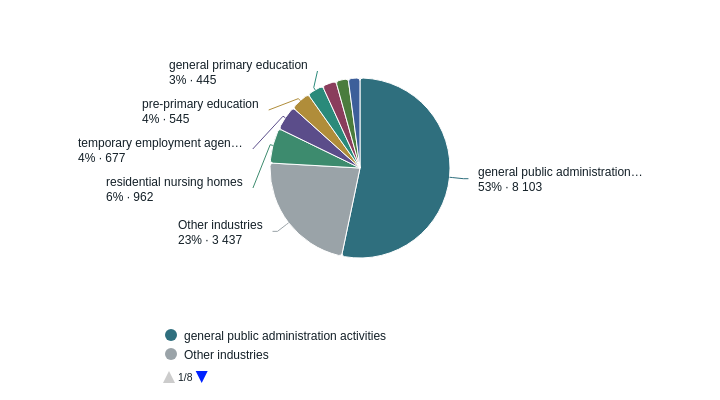
Steinkjer serves as a critical economic and administrative pillar in Trøndelag county. As the regional seat for county administration and state regional governance, the municipality combines a massive public-sector footprint with robust commercial sectors in renewable energy, food processing, technical consulting, and logistics.
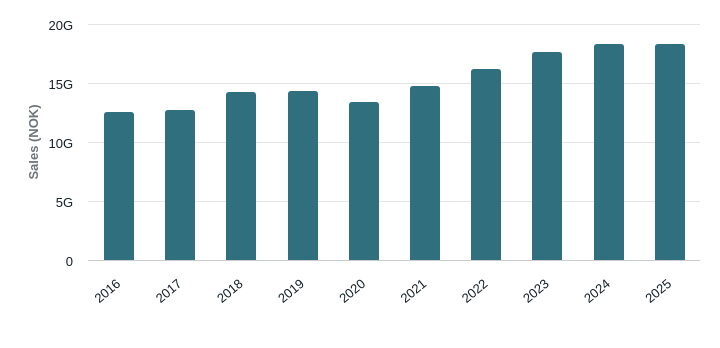
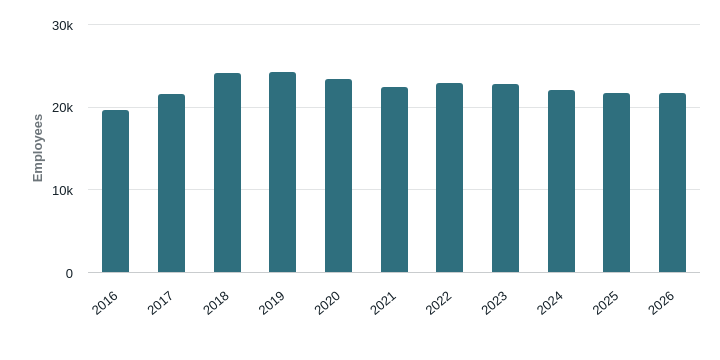
Over the past decade, total business revenue in Steinkjer has expanded significantly, reaching NOK 18.29 billion in 2025. While total employment has stabilized around 21,674 employees, the local economy exhibits high turnover productivity in key hubs such as Follafoss and central Steinkjer. For entrepreneurs and investors, Steinkjer presents a resilient commercial environment characterized by strong institutional demand, active industrial cooperatives, and strategic transport links across central Norway.
Economic Overview: Sales & Employment Dynamics
Steinkjer’s aggregate commercial performance shows persistent long-term top-line growth. Between 2016 and 2025, aggregate corporate revenue rose from NOK 12.56 billion to over NOK 18.29 billion, representing a cumulative increase of over 45%.
Historical Revenue & Workforce Trends
| Year | Aggregate Sales (NOK) | YoY Sales Change | Employee Count | YoY Workforce Change |
|---|---|---|---|---|
| 2016 | 12,556.4M | — | 19,565 | — |
| 2017 | 12,673.2M | +0.9% | 21,520 | +10.0% |
| 2018 | 14,236.2M | +12.3% | 24,124 | +12.1% |
| 2019 | 14,330.1M | +0.7% | 24,238 | +0.5% |
| 2020 | 13,423.5M | -6.3% | 23,321 | -3.8% |
| 2021 | 14,728.9M | +9.7% | 22,328 | -4.3% |
| 2022 | 16,211.7M | +10.1% | 22,804 | +2.1% |
| 2023 | 17,639.4M | +8.8% | 22,706 | -0.4% |
| 2024 | 18,267.2M | +3.6% | 22,015 | -3.0% |
| 2025 | 18,293.4M | +0.1% | 21,684 | -1.5% |
| 2026 | — | — | 21,674 | -0.0% |
Revenue growth posted strong double-digit rebounds following 2020, powered by rising energy prices, active industrial production, and expanded service operations. Workforce levels peaked in 2019 before stabilizing to around 21,670 employees in recent years, signaling efficiency gains across corporate and industrial employers.
Industry Structure & Organizational Landscape
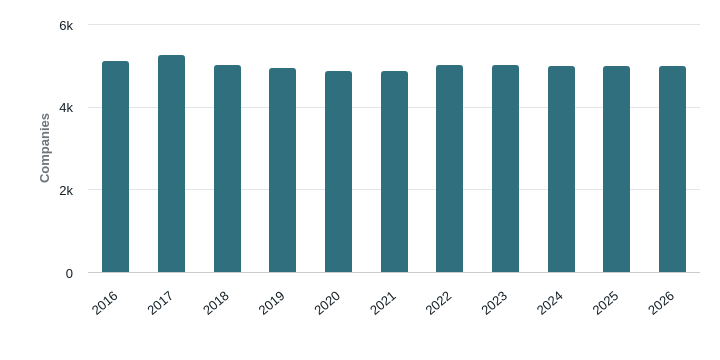
Steinkjer's industrial ecosystem is balanced between heavy institutional activity, power production, food processing, trade, and private technical services.
Key Industry Sectors
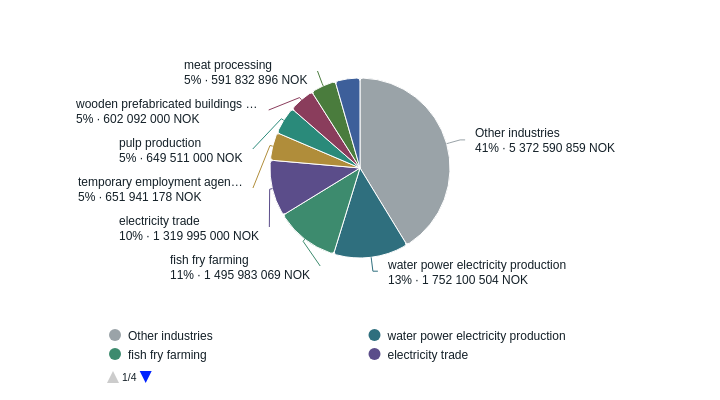
- Hydroelectric Power Generation: Generates NOK 1,955.5 million in operating income across 4 companies, maintaining an exceptional 20% EBITDA margin and producing NOK 11.4 million in income per employee.
- Meat Processing & Agro-Industries: Led by facilities like Nortura SA, meat processing records NOK 673.9 million in operating income with high volume output.
- Staffing & Temporary Employment: Represents NOK 652.1 million in operating income across 5 companies, growing by 38% year-over-year.
- Automotive & Technical Services: Car repair (NOK 532.8M) and technical consulting (NOK 259.2M) represent scalable private service sectors.
- Construction & Electrical Installation: Combined operating revenues exceed NOK 960 million, backed by active local infrastructure development.
Corporate & Organizational Structure
Private limited companies (AS) constitute the economic core of private enterprise in Steinkjer, while cooperatives (SA) play an indispensable role in agriculture and retail supply chains.
| Legal Form | Number of Entities | Total Employees | Operating Income (NOK) | Operating Margin |
|---|---|---|---|---|
| Aksjeselskap (AS) | 587 | 7,285 | 16,451.8M | 7% |
| Fylkeskommune (FYLK) | 1 | 4,829 | 0.0M* | — |
| Organisasjonsledd (ORGL) | 109 | 4,531 | 0.0M* | — |
| Kommune (KOMM) | 1 | 2,970 | 0.0M* | — |
| Samvirkeforetak (SA) | 33 | 953 | 1,559.1M | 1% |
| Enkeltpersonforetak (ENK) | 97 | 337 | 0.0M* | — |
| Sparebank (SPA) | 2 | 45 | 253.2M | 68% |
*Note: Public administration and public organizational units report zero commercial operating revenue in standardized corporate registries.
Business Geography & Regional Hubs
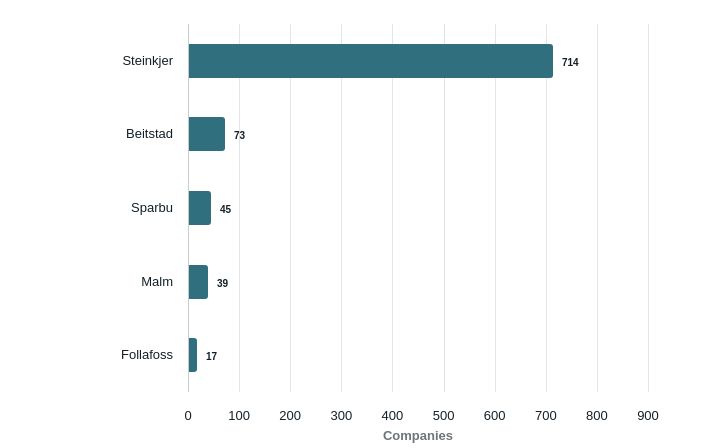
Commercial activity in Steinkjer municipality is spread across several distinct urban and industrial nodes, each maintaining a specialized role in the local economy.
Economic Breakdown by Place
| Area | Active Companies | Employees | Operating Income (NOK) | EBITDA Margin | Key Focus |
|---|---|---|---|---|---|
| Steinkjer (Center) | 714 | 19,887 | 15,623.9M | 9% | Administrative seat, retail, professional services, logistics |
| Follafoss | 17 | 279 | 2,506.1M | 23% | Heavy industrial processing & hydro power generation |
| Sparbu | 45 | 503 | 351.1M | 11% | Agricultural trade, manufacturing, fast-growing local commerce (+25% growth) |
| Beitstad | 73 | 385 | 193.0M | 5% | Farming services, local trades, small business |
| Malm | 39 | 526 | 112.0M | 11% | Local manufacturing, public facilities, healthcare services |
Steinkjer town core acts as the administrative and commercial anchor, holding nearly 90% of total local employment. Meanwhile, Follafoss demonstrates extraordinarily high capital intensity, generating over NOK 2.5 billion in turnover with just 279 employees thanks to industrial power generation assets.
Largest Local Employers
Steinkjer features a strong mix of large regional public institutions, public transport operators, agricultural cooperatives, and specialized industrial agencies.
Key Employers in Steinkjer
- Trøndelag Fylkeskommune (4,829 employees): County headquarters administering public infrastructure, transport, and regional development.
- Steinkjer Kommune (2,970 employees): Municipal municipal administration covering primary education, local health, and civic services.
- Fosdalen AS Avd Steinkjer (615 employees): Major provider of temporary employment and staffing services across Trøndelag, generating NOK 636.6M in turnover.
- Vy Buss AS Avd Trøndelag Midt (383 employees): Regional public transit operator reporting NOK 429.0M in sales and a 16% EBITDA margin.
- Innherred Landbrukstjenester SA (189 employees): Essential agricultural and forestry labor cooperative.
- Steinkjer Videregående Skole (183 employees): Upper secondary education center.
- Brannvesenet Midt IKS (150 employees): Inter-municipal fire and rescue service headquartered in Steinkjer.
- Steinkjer Sykehjem & Guldbergaunet Bosenter (145 & 116 employees): Senior healthcare and residential care facilities.
- Statsforvalteren i Trøndelag (138 employees): Main office for the County Governor of Trøndelag.
- Nortura SA Avd Steinkjer (130 employees): Key primary meat processing facility generating NOK 645.0M in operating revenue.
Business Dynamism & Bankruptcy Analysis
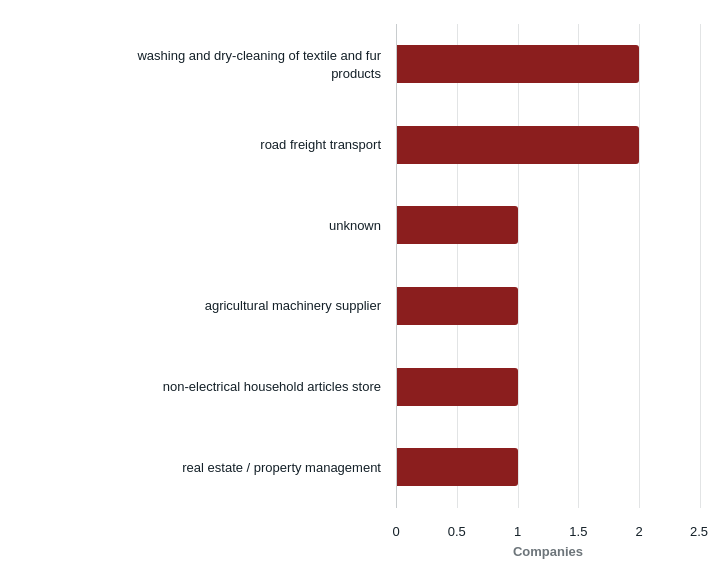
Corporate health in Steinkjer remains generally stable, with bankruptcies isolated to specific cost-sensitive and labor-intensive micro-sectors rather than indicating broad systemic distress.
Sectoral Bankruptcy Overview
Recent filings involve 8 registered companies spanning 6 distinct activity categories:
- Road Freight Transport: 2 companies (including Knuts Transport AS), totaling NOK 14.0M in combined operating income. Pressure from fuel cost fluctuations and tight margins contributed to restructuring in transport.
- Textile & Laundry Services: 2 companies (including Steinkjer Vaskeri AS, NOK 3.6M revenue), impacted by rising energy costs.
- Specialized Retail: 1 company in non-electrical household articles (Form & Farge AS, NOK 2.2M revenue).
- Real Estate / Property Management: 1 company (Kongensgata 18 AS, NOK 1.0M revenue).
- Agriculture Machinery & Holding: Isolated corporate liquidations with zero employee impact (Agritech AS, Evre AS, Jeanettes Holding AS).
The overall insolvency rate remains low relative to the municipality's 587 active AS corporations, underscoring solid balance sheets across construction, utilities, and professional services.
Opportunities for Founders & Business Leaders
For new founders and expanding business leaders, Steinkjer offers specific competitive advantages driven by its high density of public administration, strong agricultural backbone, and steady infrastructure investments.
Key Growth Windows for Entrepreneurs
- Agritech & Circular Bioeconomy: Steinkjer is an agricultural epicenter in Trøndelag. Solutions in biowaste processing, precision farming, and agtech hardware can plug directly into existing supply chains led by Nortura and local farm cooperatives.
- B2B Technical & Engineering Services: Technical consulting is growing (+7% revenue increase), supporting power generation, municipal construction, and industrial plants.
- Green Transportation & Logistics Tech: With major regional transport hubs in place (Vy Buss, road freight networks), demand is rising for fleet electrification, maintenance tech, and route optimization.
- Subcontracting in Construction & Electrical Trades: With electrical installation delivering NOK 486M in turnover and construction showing 13% growth, niche trade services find reliable pipeline demand.
Founders evaluating commercial address options, local industry dynamics, and demographic demand in Steinkjer can utilize analytical platforms such as SmartGrunder to explore optimal locations and market gaps.
Conclusion
Steinkjer stands as a balanced and economically resilient municipality in central Norway. Supported by its role as the administrative heart of Trøndelag, its steady NOK 18.29B commercial economy benefits from reliable public-sector stability alongside profitable private industries in hydro energy, agriculture, trade, and technical services.
For prospective entrepreneurs and corporate investors, Steinkjer provides low volatility, an established supplier network, and high institutional spending—creating a sound foundation for long-term commercial establishment.