Municipality
Stor Elvdal Economic Overview: Key Industry Drivers, Employment Trends, and Entrepreneurial Potential
An in-depth analysis of Stor Elvdal's business landscape, forestry cluster, public anchor institutions, and commercial geography for founders and regional decision-makers.
Executive Summary
Stor Elvdal is a resource-rich municipality situated along the Østerdalen valley in Innlandet county. Its local economy is defined by a strong foundation in forestry and timber processing, alongside a pronounced presence of public administration, health services, and higher education. The municipal commercial hub is centered in Koppang, which concentrates the vast majority of local business turnover, service infrastructure, and wage employment.
Key economic characteristics of Stor Elvdal include:
- Forestry and Wood Processing Dominance: Anchored by industrial leaders such as Moelven Østerdalsbruket As and specialized forestry firms like Linnea As, the forestry value chain generates the single largest share of private commercial revenue in the municipality.
- Strong Institutional Presence: Educational and public institutions—most notably the Universitetet I Innlandet (Evenstad campus) and local municipal administration—provide essential baseline employment and population stability.
- Centralized Hub: Over 90% of local enterprise activity and corporate revenue is concentrated in Koppang, with smaller rural settlements like Sollia and Atna supporting niche agriculture, tourism, and local transport services.
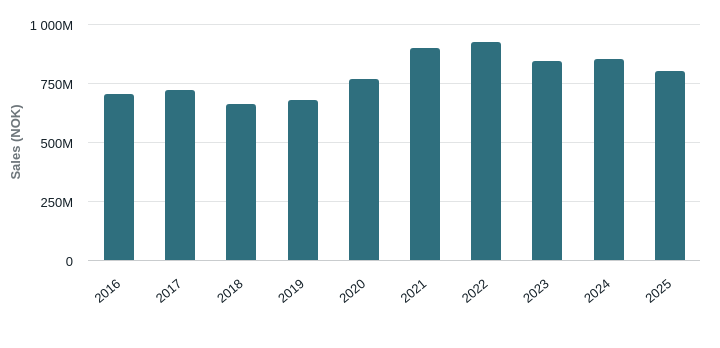
While corporate sales peaked above NOK 920 million in 2022 before adjusting downwards in line with macroeconomic construction trends, Stor Elvdal maintains low insolvency rates and steady operational margins across core transport, forestry, and trade segments.
Economic Overview: Revenue & Employment Trajectory
Tracking corporate revenue and workforce numbers reveals the structural resilience and cyclical sensitivities of Stor Elvdal's enterprise sector. Business revenues expanded rapidly between 2019 and 2022, fueled by strong demand and pricing in raw timber and processed lumber markets, before experiencing a moderate contraction in 2023–2025.
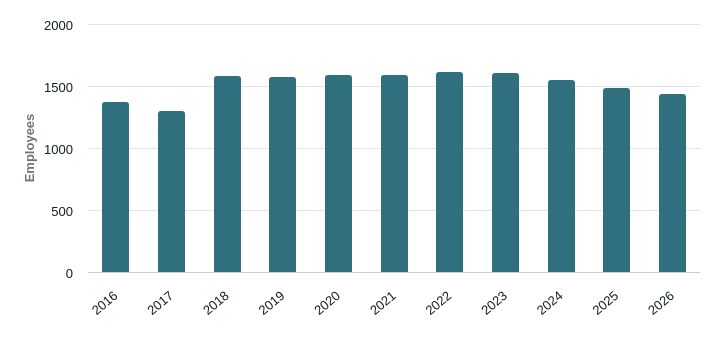
| Year | Corporate Sales (NOK) | YoY Sales Change | Local Employment | YoY Employment Change |
|---|---|---|---|---|
| 2018 | 661.2M | -8.3% | 1,577 | +21.6% |
| 2019 | 678.8M | +2.7% | 1,574 | -0.2% |
| 2020 | 767.7M | +13.1% | 1,585 | +0.7% |
| 2021 | 900.2M | +17.3% | 1,587 | +0.1% |
| 2022 | 924.2M | +2.7% | 1,616 | +1.8% |
| 2023 | 844.5M | -8.6% | 1,607 | -0.6% |
| 2024 | 851.9M | +0.9% | 1,550 | -3.5% |
| 2025 | 801.1M | -6.0% | 1,483 | -4.3% |
Total commercial sales expanded from NOK 703.2 million in 2016 to a peak of NOK 924.2 million in 2022, representing an increase of more than 31%. The subsequent softening in 2023–2025 reflects broader Nordic industrial trends, particularly within residential construction materials and timber exports.
Workforce figures mirrored this trajectory, cresting at 1,616 employees in 2022 before gradually adjusting downward to 1,483 employees in 2025. Despite the volume contraction, capital-intensive subsectors—such as transport and specialized forestry harvesting—have maintained steady profit margins and robust balance sheets.
Industry Structure & Sector Analysis
The industry mix in Stor Elvdal reflects a dual structure: a massive public and institutional service layer providing base employment, alongside a highly productive private sector focused on natural resources, logistics, and localized commercial trade.
Primary Commercial Clusters
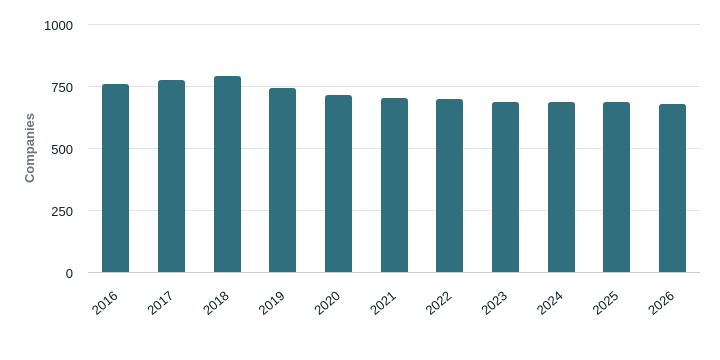
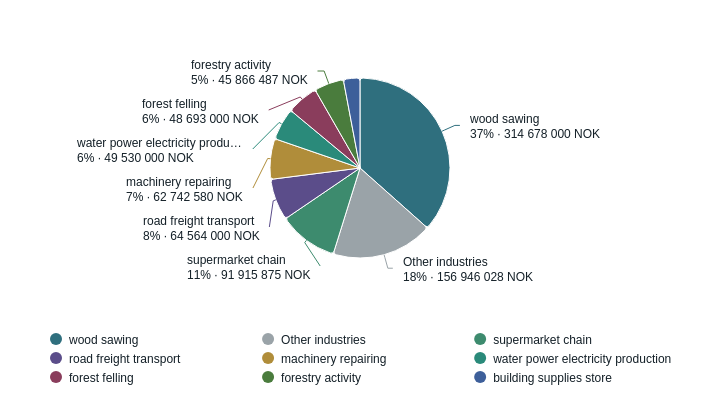
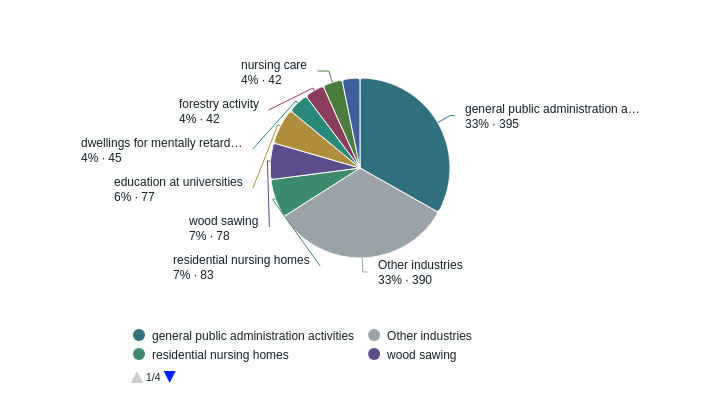
- Wood Sawing & Forestry: Wood sawing stands out as the single highest-revenue sector in the municipality, generating NOK 315.4 million in operating income across 78 employees at Moelven Østerdalsbruket As. Combined with forest felling (NOK 57.2M operating income across 7 companies) and general forestry activities (NOK 46.0M across 3 companies), the forest industry chain accounts for over NOK 418 million in top-line turnover.
- Road Freight & Logistics: Capitalizing on the RV3 transport corridor running through Østerdalen, road freight transport companies generate NOK 67.5 million in operating income across 5 enterprises and 32 employees, achieving strong average EBITDA margins of 17%.
- Retail & Consumer Services: Supermarket chains and local retail stores generate NOK 96.0 million in operating income, backed by gas stations (NOK 633K reported in specific corporate entries), car repair shops (NOK 16.9M), and electrical installation services (NOK 19.0M).
- Higher Education & Public Sector: The Universitetet i Innlandet campus at Evenstad focuses on forestry, wildlife management, and ecology, employing 77 personnel and acting as an innovation and research catalyst for the region.
Legal Forms & Business Structures
Limited liability companies (AS) generate NOK 777.0 million in operating income across 54 registered entities with 443 employees, yielding an average EBITDA margin of 9%. Public municipal entities (ORGL and KOMM) account for the majority of headcount, led by Stor Elvdal Kommune with 378 directly reported employees.
Business Geography: Commercial Nodes
Economic activity within Stor Elvdal is clustered around specific geographic nodes along the main transport arteries of the valley and rural sub-valleys.
| Area / Settlement | Registered Companies | Total Employees | Operating Income (NOK) | Key Economic Activity |
|---|---|---|---|---|
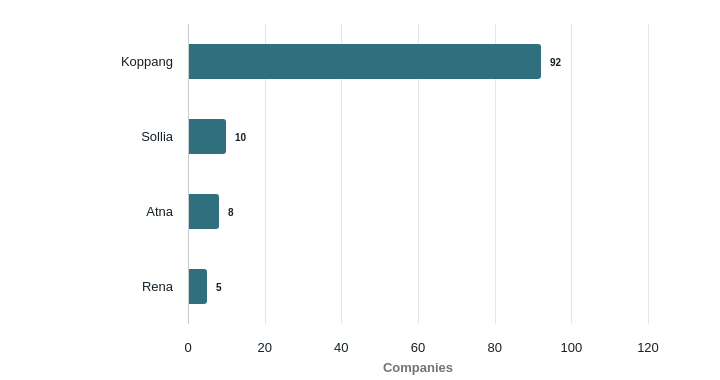
| Koppang | 92 | 1,348 | 934.2M | Municipal center, timber processing, retail, public administration |
| Rena (Stor Elvdal border area) | 5 | 20 | 35.0M | Specialized services, technical support |
| Atna | 8 | 31 | 25.7M | Local services, transport, micro-industry |
| Sollia | 10 | 42 | 12.3M | Agriculture, eco-tourism, local crafts |
Koppang functions as the undisputed economic heart of Stor Elvdal. Hosting 92 commercial entities and 1,348 employees, Koppang captures over 93% of all municipal business operating income (NOK 934.2M). It contains the industrial zone, the main shopping district, railway connections, and municipal offices.
Sollia and Atna play vital secondary roles. Sollia hosts 10 registered businesses generating NOK 12.3 million in operating income, primarily catering to tourism, nature management, and local agriculture. Atna maintains 8 businesses generating NOK 25.7 million in operating income with an impressive 21% operating margin, largely driven by niche manufacturing and transportation service providers.
Largest Local Employers
Employment in Stor Elvdal is anchored by major public authorities, educational bodies, and premier industrial processors. The list below highlights key employers actively operating in the municipality:
- Stor Elvdal Kommune: The primary employer in the municipality with 378 reported employees in general public administration, alongside specialized divisions such as Moratunet Sykehjem (83 employees), Tiltak For Funksjonshemmede (45 employees), and Hjemmebaserte Tjenester (42 employees).
- Moelven Østerdalsbruket As: Located at Industriveien in Koppang, this timber mill employs 78 workers and generates NOK 315.4 million in operating income (NOK 314.7M sales revenue). It recorded strong revenue growth (+29%) and an EBITDA of NOK 15.6 million.
- Universitetet I Innlandet (Campus Evenstad): Employing 77 academic and support staff, the campus is an international center for forestry, wildlife, and environmental research.
- Linnea As: A leading forestry management and operations enterprise employing 36 people in Koppang, generating NOK 38.2 million in operating income with an 11% EBITDA margin.
- Storsteigen Videregående Skole Avd Nordstumoen: Provides technical and vocational secondary education with 25 employees.
- Arne Olsbakk Transport As: A core regional transport and logistics operator with 19 employees, delivering NOK 39.9 million in operating income and a robust 24% EBITDA margin.
- Koppang Auto As: A long-established automotive repair facility employing 18 people, producing NOK 16.9 million in operating income.
- Stor Elvdal Hotell As: Operates local hospitality facilities with 18 employees, generating NOK 9.1 million in operating income.
Business Dynamism & Financial Health
Stor Elvdal exhibits a stable, low-volatility enterprise culture. Commercial failure rates are remarkably low compared to national urban averages, reflecting cautious balance sheet management and established supplier relationships.
Bankruptcy Record
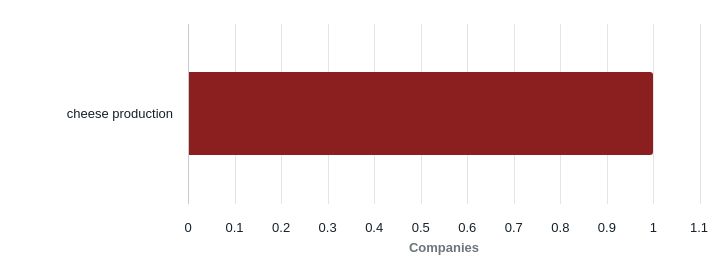
Over the analyzed period, municipal bankruptcy statistics record only 1 company closure: Solliaysteriet Sa, a artisanal cheese producer located in Sollia. The closure registered 0 active employees and 0 NOK in final sales revenue, representing an isolated micro-enterprise liquidation rather than systemic stress in the local food or agricultural economy.
Capital Efficiency & Margin Performance
Private enterprises (AS) demonstrate solid underlying profit metrics:
- Forest Felling: High profit density with operating margins reaching 16% and EBITDA per employee averaging NOK 600,000.
- Freight Transport: Strong asset utilization yielding an average EBITDA margin of 17% and NOK 361,700 EBITDA per employee.
- Sole Proprietorships (ENK): 14 registered ENK units with employees generated NOK 42.0 million in total income, achieving an average operating margin of 37% across specialized contracting and forestry niches.
Opportunities for Founders & Innovation
For prospective entrepreneurs and expanding SMEs, Stor Elvdal offers specific competitive advantages, particularly around natural resource technology, bioeconomy services, and logistics support along the busy RV3 corridor.
Key Market Openings
- Bio-Economy & Applied Forestry Tech: With Campus Evenstad generating top-tier research in forest ecology and Moelven Østerdalsbruket processing large volumes of timber, tech startups focusing on bio-mass utilization, drone forest monitoring, or wood waste upcycling have ideal pilot conditions.
- Logistics & Transport Servicing: The high volume of heavy transport passing through Koppang creates demand for commercial fleet servicing, green transport infrastructure (EV fast charging for heavy transport, biofuel distribution), and driver support facilities.
- Experiential & Eco-Tourism: Capitalizing on the natural landscape around Sollia and the Rondane border, there is room for boutique hospitality, outdoor adventure guiding, and regional food culture ventures.
- Subcontracting in Trades & Construction: Local electrical (NOK 19M turnover) and machinery repair firms (NOK 62.7M turnover) maintain high gross margins, pointing to sustained demand for skilled trade contractors.
Founders evaluating physical site locations, local zoning, and sector statistics across Koppang or surrounding valleys can leverage SmartGrunder to analyze real estate options and industry demographics across Stor Elvdal.
Conclusion & Strategic Outlook
Stor Elvdal provides a stable, resource-grounded business environment backed by major public institutions and a highly productive forestry cluster. While total corporate sales have moderated following the 2021–2022 timber peak, core industries maintain strong balance sheets and healthy operating margins.
For founders, decision-makers, and incoming businesses, Koppang offers established commercial infrastructure, reliable access to main transport corridors, and a supportive local ecosystem anchored by higher education and industrial leaders. By focusing on bio-economy innovation, specialized transport services, and regional tourism, new ventures can find a durable and low-risk home in Stor Elvdal.