Municipality
Economic Landscape and Growth Opportunities in Strand Municipality
An in-depth economic analysis for entrepreneurs, investors, and local decision-makers
Executive Summary
Strand municipality, located in Rogaland county, stands as a vital industrial and commercial hub in western Norway. Known historically for its manufacturing roots and proximity to major regional infrastructure, Strand combines heavy industrial processing with cutting-edge electronics, feed production, and service sectors.
Key highlights of the Strand economy include:
- Robust Revenue Growth: Total corporate sales revenue has grown consistently, reaching NOK 9.24 billion in 2025, driven by market leaders in communication electronics and agricultural feed manufacturing.
- Dual Economic Anchors: The municipality is anchored by two distinct commercial hubs: Jørpeland, the administrative and employment center with 3,452 employees across 222 companies, and Tau, the industrial turnover powerhouse generating NOK 7.05 billion in operating income.
- High Productivity & Margins: Key technology exporters achieve remarkable operating margins, exemplified by communication equipment manufacturing generating over NOK 1.07 billion in turnover with a 29% EBITDA margin.
- Stable Enterprise Dynamics: Bankruptcy rates remain exceptionally low, with only 4 isolated insolvency cases recorded in recent data, underscoring local corporate resilience.
Economic Overview
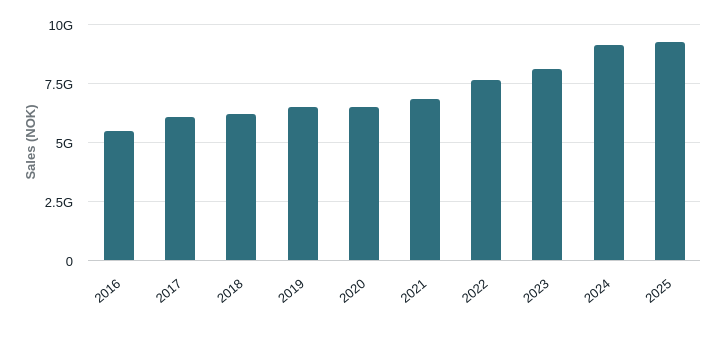
Strand's economic trajectory over the past decade reflects strong top-line revenue expansion alongside evolving workforce trends. Business turnover increased from NOK 5.46 billion in 2016 to over NOK 9.23 billion in 2025, representing a total revenue expansion of over 69%.
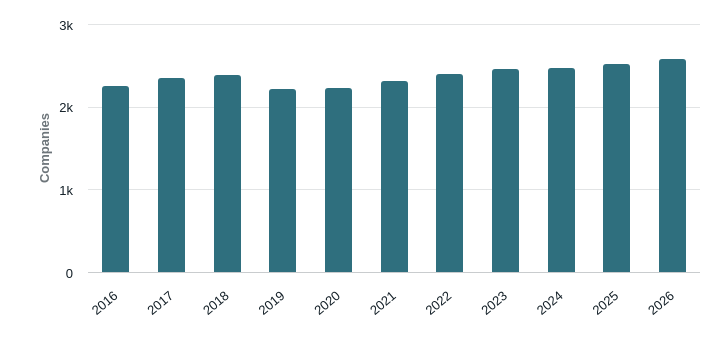
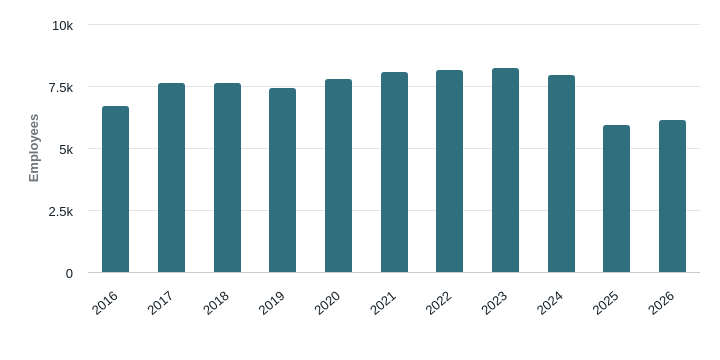
Revenue growth was particularly strong during 2022 (+11.5%) and 2024 (+12.4%), backed by strong performance in specialized manufacturing and agricultural processing. Total reported employment peaked in 2023 at 8,207 employees before stabilizing around 5,919 to 6,147 employees in the 2025–2026 reporting baseline.
Year-over-Year Revenue & Employment Performance
| Year | Sales Revenue (NOK) | Revenue YoY | Reported Employees | Employees YoY |
|---|---|---|---|---|
| 2016 | 5.46B | - | 6,712 | - |
| 2017 | 6.04B | +10.7% | 7,602 | +13.3% |
| 2018 | 6.17B | +2.2% | 7,612 | +0.1% |
| 2019 | 6.48B | +5.0% | 7,430 | -2.4% |
| 2020 | 6.50B | +0.2% | 7,779 | +4.7% |
| 2021 | 6.83B | +5.1% | 8,081 | +3.9% |
| 2022 | 7.61B | +11.5% | 8,150 | +0.9% |
| 2023 | 8.10B | +6.5% | 8,207 | +0.7% |
| 2024 | 9.11B | +12.4% | 7,963 | -3.0% |
| 2025 | 9.24B | +1.4% | 5,919 | -25.7% |
| 2026 | - | - | 6,147 | +3.9% |
Industry Structure & Legal Forms
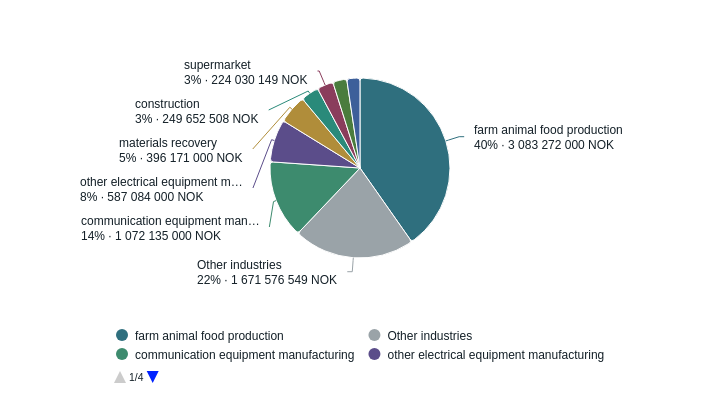
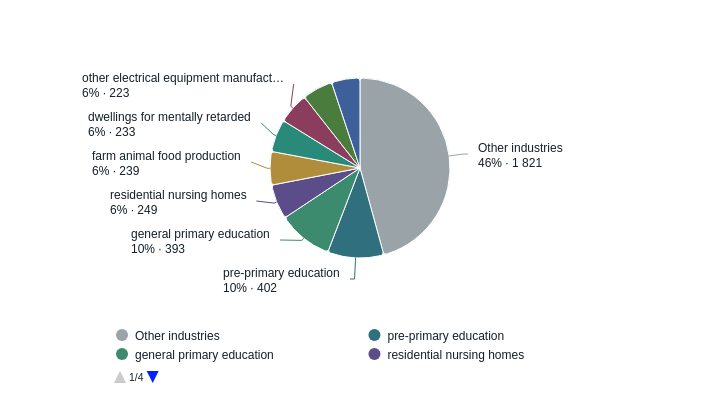
Strand features a concentrated industrial profile where high-value export industries generate the vast majority of local turnover, while health, education, and retail account for substantial employment volume.
Key Industry Sectors
- Farm Animal Food Production: Generating NOK 3.11 billion across 2 companies with 239 employees, boasting an average operating income per employee of NOK 12.3 million.
- Communication Equipment Manufacturing: Operating income of NOK 1.08 billion with 219 employees and an impressive EBITDA margin of 29% (NOK 1.7M EBITDA per employee).
- Other Electrical Equipment Manufacturing: Generating NOK 587.1 million in turnover across 223 employees.
- Construction & Earthworks: Construction and site preparation collectively employ over 264 people across 22 companies, yielding combined turnover above NOK 430 million.
- Retail & Hospitality: Supermarket chains and local supermarkets together deliver over NOK 429 million in operating income, complemented by hotels (NOK 50.5M income) and dining establishments.
Legal Form Distribution
The private sector is dominated by limited liability companies (Aksjeselskap - AS), which generate NOK 8.71 billion in operating income across 273 businesses.
| Legal Form | Number of Entities | Total Employees | Operating Income (NOK) |
|---|---|---|---|
| Limited Liability Companies (AS) | 273 | 3,641 | 8,711.2M |
| Municipal Entities (KOMM) | 49 | 2,003 | 0.0M |
| Cooperatives (SA) | 6 | 146 | 163.9M |
| Sole Proprietorships (ENK) | 40 | 140 | 0.0M |
| Inter-Municipal Companies (IKS) | 1 | 17 | 60.6M |
| Foundations & Non-profits (STI/FLI) | 10 | 107 | 33.3M |
Business Geography
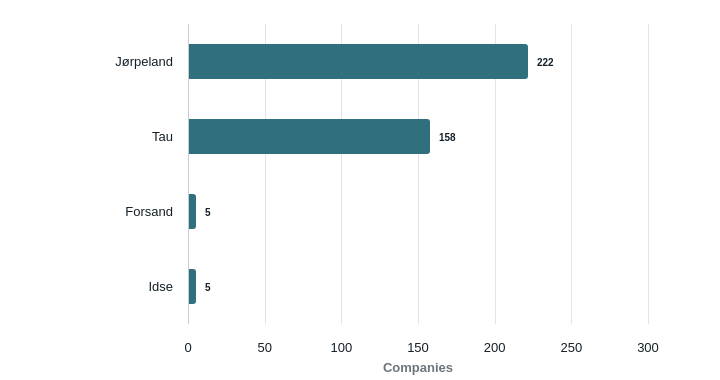
Economic activity in Strand is geographically concentrated along the Ryfylke coastline, primarily divided between Tau and Jørpeland, with smaller clusters in Idse and Forsand.
Geographic Breakdown
| Location | Companies | Employees | Operating Income (NOK) | Sales Revenue (NOK) | Operating Margin |
|---|---|---|---|---|---|
| Tau | 158 | 2,842 | 7,045.7M | 6,972.1M | 7% |
| Jørpeland | 222 | 3,452 | 1,836.4M | 1,740.9M | 6% |
| Idse | 5 | 38 | 106.2M | 106.0M | 6% |
| Forsand | 5 | 21 | 27.1M | 27.1M | 5% |
Location Dynamics
- Tau: Acts as the primary export engine of Strand. With heavy industrial infrastructure and port access, Tau hosts major industrial plants yielding NOK 4.4 million in operating income per employee.
- Jørpeland: Serves as the urban and civic core of the municipality, hosting 222 companies and 3,452 employees. Activity is dominated by local commerce, health services, administrative functions, and specialized trade services.
Largest Employers
Strand hosts several major industrial enterprises alongside key public sector health and educational institutions.
Leading Commercial & Public Employers
- Westcontrol AS (Tau): 223 employees. Electronics manufacturing partner generating NOK 587.1 million in sales.
- Comrod AS (Tau): 217 employees. World leader in communication equipment manufacturing with NOK 1.04 billion in sales revenue and NOK 293.8 million in operating profit.
- Strand Videregående Skole (Tau): 173 employees. Regional upper secondary educational institution.
- Fiskå Mølle AS Avd Tau (Tau): 171 employees. Key agricultural feed producer generating NOK 2.81 billion in sales revenue.
- Mibau Stema Norge AS Avd Tau (Tau): 141 employees. Major industrial operator in crushed stone, gravel, and sand extraction.
- Strand Kommune Fellestjenester (Jørpeland): 126 employees. Municipal central services and public administration.
- Fjelltun Skole (Jørpeland): 121 employees. Primary education facility.
- Heldøgnsdrift Jonsok & Hjemmetjeneste Strand (Jørpeland/Tau): Over 200 combined healthcare staff in nursing and home care services.
- Rennesøy Trafikk AS Avd Tau & Boreal Buss AS: Key regional freight and public bus transit providers employing nearly 200 drivers and logistics personnel.
Business Dynamism & Market Stability
Strand demonstrates remarkable financial stability across its established commercial community. The corporate landscape is defined by low debt-to-equity risk among top industrial firms and exceptionally low insolvency activity.
Insolvency Overview
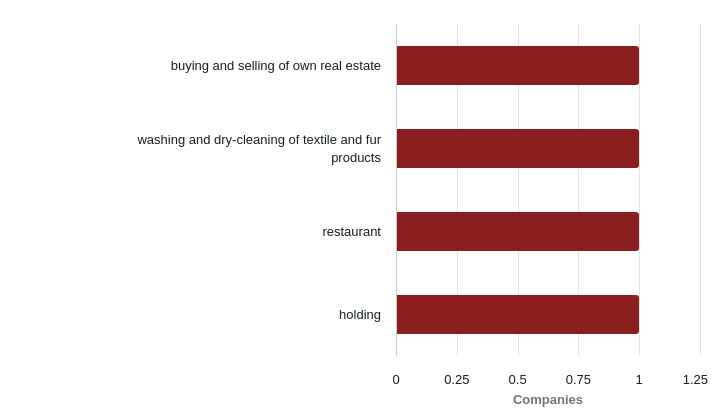
Recent data indicates only 4 bankruptcies recorded within the municipality:
- Meat & Eat AS (Restaurant sector, Tau)
- K&v Holding AS (Holding company, Tau)
- Breeze Sørvest AS (Textile cleaning/laundry, Jørpeland)
- Ds Eiendom AS (Real estate, Jørpeland)
All bankrupt entities had minimal or zero active headcount at the time of closure, indicating negligible impact on the local employment base. The low turnover in corporate failures highlights strong market retention and stable demand across both B2B and consumer sectors.
Opportunities for Founders
With solid baseline industrial turnover exceeding NOK 9 billion and strong transport links across Rogaland, Strand presents several promising avenues for new business creation:
Strategic Entrepreneurial Vectors
- Industrial Sub-contracting & Tech Support: With tech giants like Comrod and Westcontrol generating huge output, opportunities exist for specialized B2B services, component assembly, calibration, and automation maintenance.
- Logistics & Maritime Services: Given Tau's position in freight, aggregate processing (Mibau Stema), and feed distribution (Fiskå Mølle), specialized freight support and supply chain logistics are in high demand.
- Tourism & Hospitality Infrastructure: Proximity to world-class tourist destinations like Preikestolen creates space for premium boutique accommodation, food service, and experience-based tourism.
- Green Tech & Circular Economy: Sustainable solutions for aggregate mining waste, agricultural feed optimization, and industrial energy efficiency offer strong growth potential.
Founders evaluating site selection or looking to analyze industry competition across Jørpeland, Tau, or surrounding areas can utilize platforms like SmartGrunder to explore street-level commercial data, local demographics, and register trends.
Conclusion & Strategic Outlook
Strand municipality combines industrial scale with community stability, positioning itself as one of Rogaland's most resilient local economies. Driven by billion-kroner market leaders in industrial manufacturing, tech hardware, and agricultural milling, the area provides a dependable economic backbone.
For entrepreneurs and decision-makers, Strand offers strong local buying power, an skilled industrial workforce, and clear market niches across manufacturing support, trade services, and hospitality. Continued investment in regional transport and commercial infrastructure will further reinforce Strand's status as a premier location for enterprise growth.