Municipality
Surnadal Municipal Economy: Economic Analysis for Founders and Decision-Makers
An in-depth analysis of industrial strength, business geography, and entrepreneurial opportunities in Surnadal
Executive Summary
Surnadal serves as a vital industrial and commercial stronghold in the Nordmøre region of Møre og Romsdal. Defined by a powerful manufacturing heritage, the local economy is anchored by national export leaders in plastic piping and timber processing, alongside a resilient agricultural sector and a central public services infrastructure.
Key economic characteristics include:
- High Industrial Turnover: Peak municipal sales reached over NOK 6.8 billion in 2023, largely driven by advanced manufacturing flagships such as Pipelife Norge AS and Talgø Møretre AS.
- Concentrated Commercial Core: The central settlement of Surnadal dominates local employment and revenue, accounting for over 3,200 of the municipality's employees and NOK 4.38 billion in operating income.
- Low Bankruptcy Volatility: Insolvency rates remain exceptionally low, reflecting deep-rooted corporate stability and conservative financial management among local firms.
- Diverse Organizational Structure: A balanced mix of limited liability companies (AS), municipal bodies (KOMM), and agricultural co-operatives (SA) provides a stable employment foundation.
Economic Overview
The macro-economic performance of Surnadal over the past decade reflects both strong top-line industrial growth and cyclical readjustments in manufacturing and construction materials markets.
Sales Revenue Trends
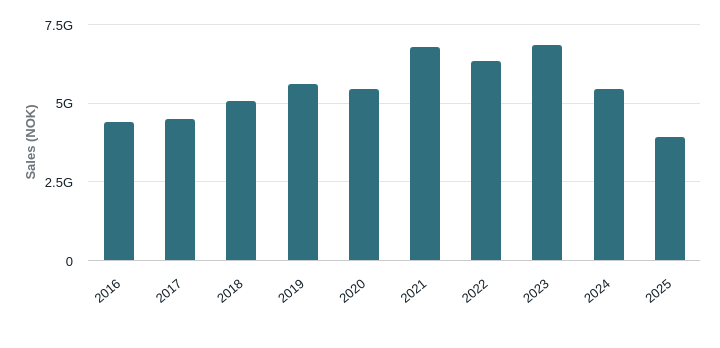
Between 2016 and 2023, Surnadal experienced substantial growth in overall business sales, expanding from NOK 4.39 billion in 2016 to a peak of NOK 6.84 billion in 2023. This expansion was punctuated by strong annual surges, such as +24.6% in 2021 and +8.1% in 2023. Recent data shows a sharp reduction in total recorded sales (NOK 5.44 billion in 2024 and NOK 3.91 billion in 2025), which reflects broader national headwinds in building supplies and industrial manufacturing, alongside potential lag in annual financial filings.
Employment Evolution
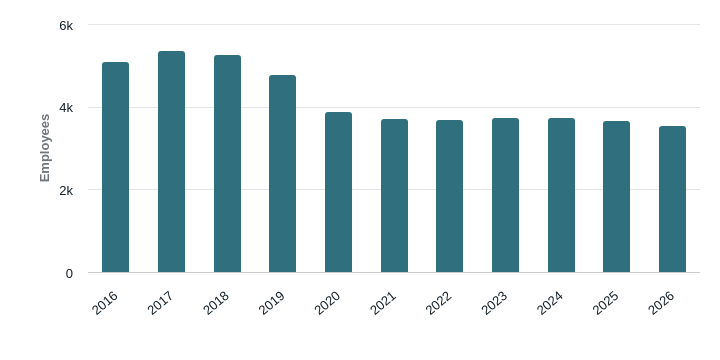
Total reported corporate and public-sector workforce in Surnadal has adjusted over the past decade. After reaching peak levels of over 5,300 workers in 2017, workforce numbers stabilized around 3,700 employees between 2021 and 2024, with recent projections indicating approximately 3,542 employees in 2026.
| Year | Total Sales Revenue | YoY Sales Growth | Total Employees |
|---|---|---|---|
| 2016 | NOK 4,388.1M | — | 5,070 |
| 2018 | NOK 5,057.3M | +13.0% | 5,244 |
| 2020 | NOK 5,431.8M | -3.0% | 3,863 |
| 2021 | NOK 6,766.5M | +24.6% | 3,691 |
| 2023 | NOK 6,836.1M | +8.1% | 3,720 |
| 2024 | NOK 5,442.9M | -20.4% | 3,732 |
| 2025 | NOK 3,907.6M | -28.2% | 3,660 |
Industry Structure
Surnadal's economic engine is driven by specialized manufacturing, timber production, real estate management, and telecommunications.
Key Commercial Sectors
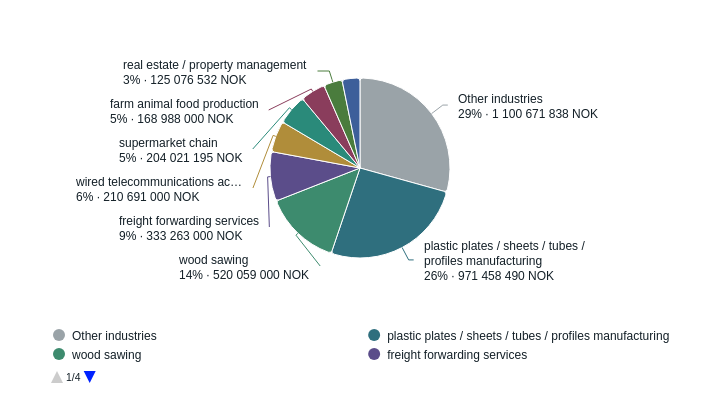
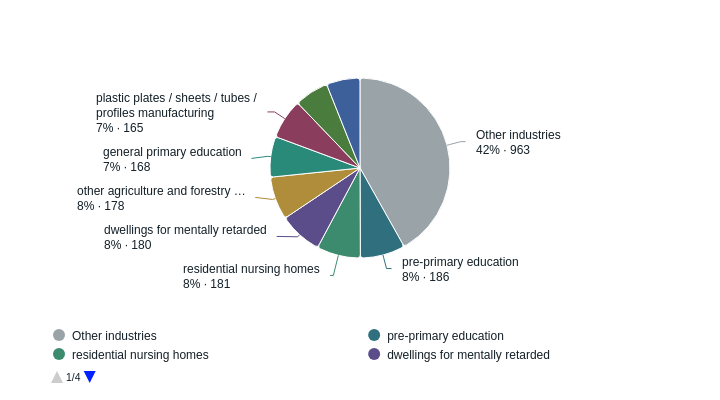
- Plastic Manufacturing: Dominated by Pipelife Norge AS, this single industry generates NOK 971.8 million in operating income with 165 direct employees, achieving a strong gross profit of NOK 581.5 million.
- Wood Sawing and Timber: Generates over NOK 521.8 million across 4 companies (led by Talgø Møretre AS), exhibiting strong profitability with EBITDA margins around 11% and 13% revenue growth.
- Real Estate & Property Management: Comprising 11 companies generating NOK 387.0 million in operating income and an exceptional EBITDA margin of 54% (NOK 210.4M EBITDA).
- Wired Telecommunications: Represents NOK 216.5 million in turnover with high operating margins (12%) and EBITDA per employee exceeding NOK 1.5 million.
- Transport & Logistics: Road freight transport accounts for NOK 106.2 million across 13 companies, providing critical logistics channels for local manufacturing output.
Legal Forms & Business Entities
Commercial enterprise in Surnadal is heavily structured around standard corporate and co-operative legal models:
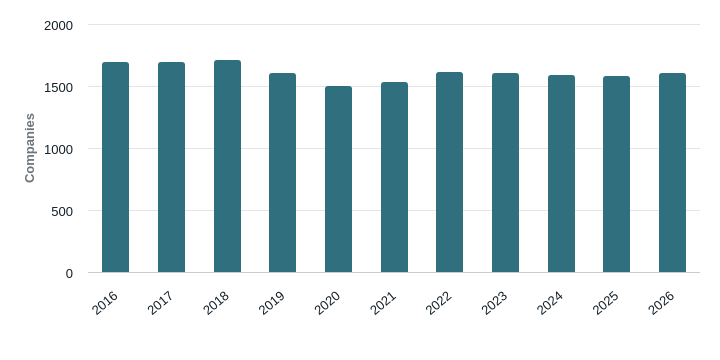
- Aksjeselskap (AS): 190 active firms employing 1,954 workers, responsible for NOK 4.33 billion in operating income.
- Kommune (KOMM): 31 municipal entities employing 1,130 workers across public healthcare, education, and administration.
- Samvirkeforetak (SA): 6 co-operatives employing 232 workers, generating NOK 313.2 million in turnover, primarily in agricultural support and labor services.
Business Geography
Commercial activity in Surnadal is centered in the main municipal core, supplemented by specialized industrial pockets across surrounding valleys and fjords.
Geographic Sub-Centers
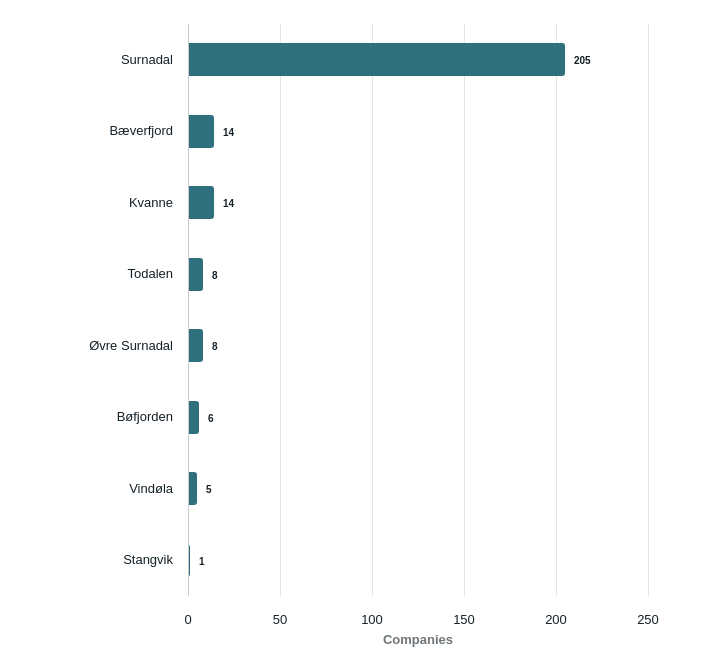
- Surnadal (Central Hub): Hosts 205 companies and 3,262 employees. With NOK 4.38 billion in operating income and NOK 373.9 million in operating profit, it is the clear administrative and commercial heart of the municipality.
- Vindøla: Highlights extreme revenue density, with 5 companies employing 54 workers but generating NOK 173.1 million in operating income (NOK 11.1M per employee).
- Kvanne: Represents 14 companies and 98 employees, recording NOK 46.0 million in operating income and rapid recent growth (+77%).
- Todalen: Houses 8 companies and 66 employees, producing NOK 42.5 million in revenue.
- Øvre Surnadal & Bøfjorden: Rural business nodes with strong timber and local service roots, contributing NOK 11.6M and NOK 28.1M in turnover respectively.
| Area | Active Companies | Employees | Operating Income | Operating Margin |
|---|---|---|---|---|
| Surnadal | 205 | 3,262 | NOK 4,375.4M | 8% |
| Vindøla | 5 | 54 | NOK 173.1M | 5% |
| Kvanne | 14 | 98 | NOK 46.0M | 4% |
| Todalen | 8 | 66 | NOK 42.5M | 0% |
| Bøfjorden | 6 | 33 | NOK 28.1M | 2% |
| Bæverfjord | 14 | 35 | NOK 16.6M | 7% |
| Øvre Surnadal | 8 | 54 | NOK 11.6M | 10% |
Largest Employers
Surnadal’s employment landscape is balanced between global industrial leaders, regional service firms, and municipal public health and education institutions.
Top Private Sector Employers
- NLT Indre Nordmøre SA: 176 employees in agricultural and forestry labor co-operatives, generating NOK 22.0 million in operating income.
- Pipelife Norge AS Hovedkontor: 165 employees producing plastic piping systems, generating NOK 971.8 million in turnover.
- Talgø Møretre AS: 98 employees in timber manufacturing and wood sawing, recording NOK 495.4 million in income and NOK 40.7 million operating profit.
- Alti Forvaltning AS (Alti Surnadal): 74 employees managing real estate and shopping center operations, generating NOK 42.2 million.
- Dalsegg Transport AS: 44 employees providing freight transport, generating NOK 51.2 million.
- Thon Holding Avd Surnadal & Frich's Hotel & Spiseri Surnadal AS: Key hospitality employers supporting regional travel and tourism.
Primary Public Sector Employers
- Surnadal Sjukeheim: 181 employees providing residential nursing care.
- Surnadal Barne- og Ungdomsskule: 135 employees in primary education.
- Surnadal Kommune Heimesjukepleia: 64 employees delivering home nursing services.
- Indre Nordmøre Barneverntjeneste: 63 employees managing child welfare services across the region.
Business Dynamism
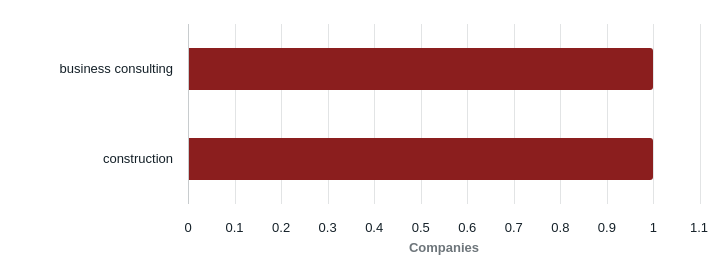
Corporate health in Surnadal is characterized by high operational stability and minimal corporate defaults. Total recorded insolvencies in the area are negligible, with only 2 bankruptcies listed in recent records:
- AS NLS Gruppen (Kvanne) — Business consulting
- Strengen AS (Surnadal) — Construction
This low level of insolvencies highlights a resilient commercial sector where established industrial firms maintain substantial equity cushions. For instance, limited liability companies (AS) across the municipality hold over NOK 3.0 billion in total equity against NOK 2.85 billion in total debt, reflecting conservative financial leverage and durable balance sheets.
Opportunities for Founders
The structural strengths of Surnadal create clear entry points for new ventures and expanding enterprises:
Strategic Business Opportunities
- Industrial Contracting & B2B Services: Major operators like Pipelife and Talgø require specialized technical maintenance, automation support, sustainable packaging, and logistics management.
- Green Transition & Circular Economy: Opportunities exist in wood waste utilization, plastic recycling technology, and energy efficiency consulting tailored for industrial processing plants.
- Commercial Services & Trade: With a high retail consolidation around Alti Surnadal, specialized retail, food service, and professional consulting can serve both local residents and regional visitors.
- Hospitality & Local Tourism: Expanding outdoor tourism along the fjords and valleys offers growth potential for specialized accommodation and experiential travel operators.
Founders evaluating business locations in Surnadal can utilize tools like SmartGrunder to explore commercial addresses, industry density, and demographic patterns across the municipality's sub-regions.
Conclusion
Surnadal presents a compelling economic profile for entrepreneurs, corporate investors, and municipal decision-makers. Anchored by world-class industrial manufacturing, robust timber operations, and a strong public infrastructure, the municipality offers rare stability and deep technical expertise.
While macroeconomic fluctuations in construction and manufacturing present ongoing cyclical shifts, Surnadal's solid equity foundations, skilled workforce, and collaborative industrial ecosystem ensure long-term viability for new commercial initiatives.