Municipality
Svalbard Economic Report: Industry Analysis, Growth Drivers, and Founder Opportunities
An in-depth analysis of Svalbard's Arctic business ecosystem, key commercial settlements, major employers, and emerging startup potential.
Executive Summary
Svalbard represents one of the world's most unique economic landscapes. Situated deep within the Arctic Circle, the archipelago's business ecosystem has undergone a significant structural shift—moving away from historical reliance on coal mining toward high-value scientific research, tourism, satellite communications, and specialized infrastructure services.
Key economic highlights for Svalbard include:
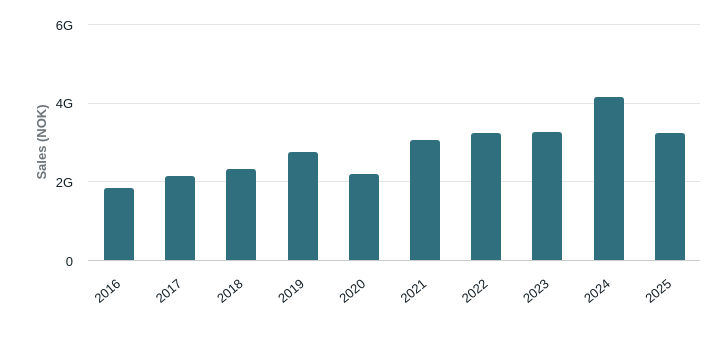
- Robust Commercial Output: Overall corporate sales revenue exceeded NOK 4.14 billion in 2024, stabilizing at NOK 3.22 billion in 2025.
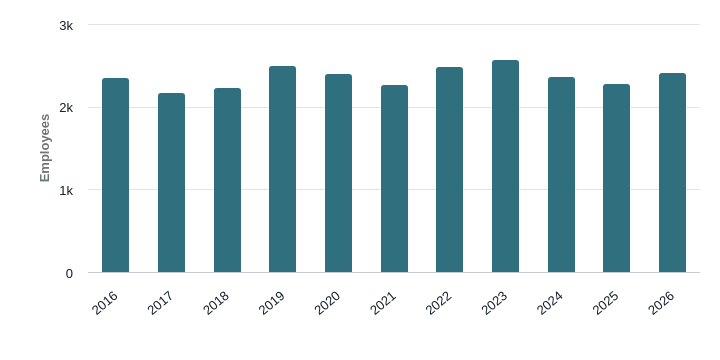
- Stable Employment Base: Total recorded employment remains strong between 2,270 and 2,560 workers, with a projected headcount of 2,407 employees in 2026.
- Tourism and Hospitality Leadership: The accommodation, food service, and tour operator sectors collectively employ over 600 workers, generating hundreds of millions in local operating income.
- High-Tech and Satellite Hub: Advanced wired telecommunications and satellite ground stations represent some of the highest-margin economic activities in the archipelago, driven by Svalbard's strategic geographic location for polar-orbiting satellites.
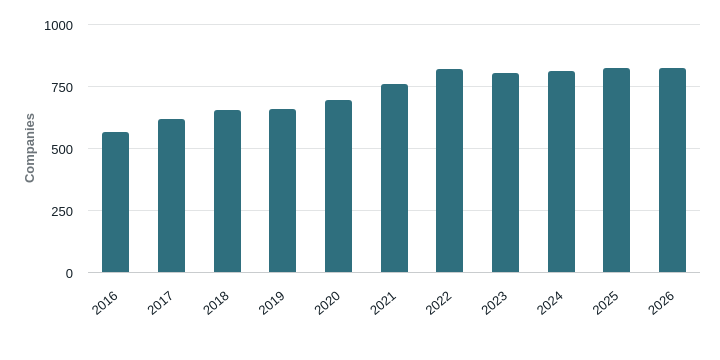
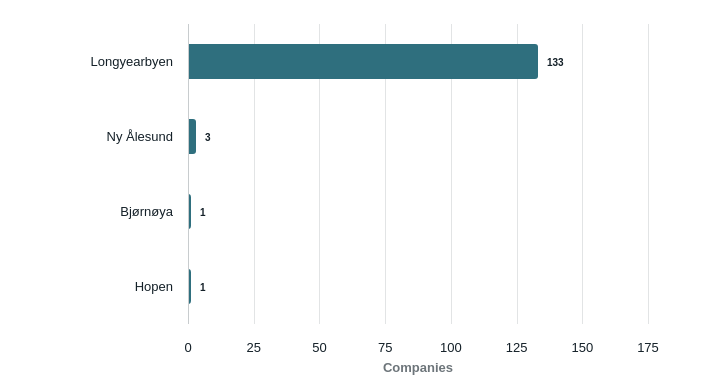
- Geographic Concentration: Commercial activity is heavily concentrated in Longyearbyen, which accounts for 133 of the recorded enterprises and 2,466 employees, followed by the research settlement at Ny-Ålesund.
For entrepreneurs and decision-makers, Svalbard offers distinct high-barrier, high-reward opportunities in Arctic logistics, green energy transitions, specialized hospitality, and technology, supported by exceptional structural stability.
Economic Overview
The economy of Svalbard has displayed strong long-term revenue growth alongside resilience to macroeconomic shifts. Corporate sales revenue grew from NOK 1.84 billion in 2016 to a peak of NOK 4.14 billion in 2024, representing an average annual baseline shift well above pre-pandemic levels.
Employment patterns reflect the seasonal and operational nature of Arctic industries. Total headcount expanded from 2,350 workers in 2016 to a high of 2,561 in 2023. Following a temporary normalization in 2024 and 2025, employment is projected to expand by +5.7% in 2026 to reach 2,407 workers.
| Year | Corporate Sales Revenue (NOK) | YoY Sales Change | Total Employees | YoY Employee Change |
|---|---|---|---|---|
| 2016 | 1,836.9M | — | 2,350 | — |
| 2017 | 2,132.0M | +16.1% | 2,165 | -7.9% |
| 2018 | 2,322.4M | +8.9% | 2,220 | +2.5% |
| 2019 | 2,744.3M | +18.2% | 2,495 | +12.4% |
| 2020 | 2,181.9M | -20.5% | 2,398 | -3.9% |
| 2021 | 3,049.1M | +39.7% | 2,258 | -5.8% |
| 2022 | 3,216.2M | +5.5% | 2,476 | +9.7% |
| 2023 | 3,258.8M | +1.3% | 2,561 | +3.4% |
| 2024 | 4,141.3M | +27.1% | 2,358 | -7.9% |
| 2025 | 3,220.4M | -22.2% | 2,277 | -3.4% |
| 2026 | — | — | 2,407 | +5.7% |
Revenue spikes in recent years are primarily linked to major infrastructure contracts, satellite tech expansions, and strong post-pandemic tourism rebounds. The local economy maintains high productivity per worker across primary service and technological sectors.
Industry Structure
Svalbard's corporate profile is dominated by four main pillars: Tourism & Hospitality, Higher Education & Research, Specialized Infrastructure & Construction, and Satellite Telecommunications.
Primary Industry Breakdown
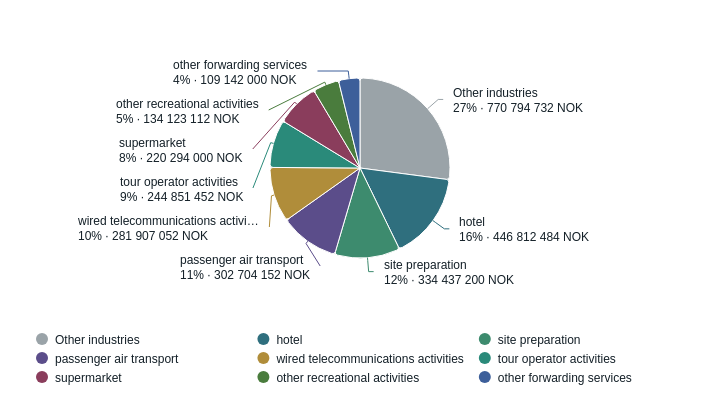
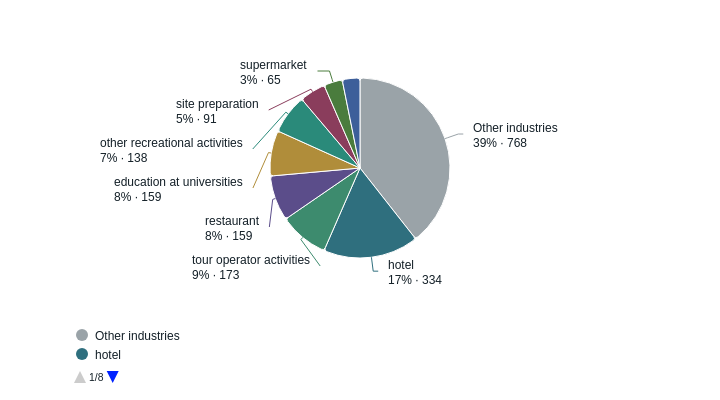
- Accommodation & Food Services: Hotels (10 companies, 334 employees, NOK 492.9M operating income) and tour operators (4 companies, 173 employees, NOK 247.8M operating income) form the backbone of the private service economy. Restaurants and bars add another 200+ employees.
- Telecommunications & Space Tech: Wired telecommunications activities demonstrate extraordinary profitability, delivering NOK 282.3M in operating income across 60 employees, with an impressive 37% EBITDA margin.
- Site Preparation & Contracting: Construction and civil engineering firms, led by site preparation (4 companies, 91 employees, NOK 349.7M operating income), support local infrastructure upgrades and polar building maintenance.
- Coal Mining in Transition: Traditional coal mining (2 companies, 40 employees) recorded NOK 117.9M operating income, reflecting a significant drop (-44% growth) as Svalbard shifts toward cleaner energy sources.
- Retail & Logistics: Supermarkets (NOK 236.6M operating income, 65 employees) and air transport services maintain critical supply lines for residents and visitors.
| Industry | Companies | Employees | Operating Income (NOK) | EBITDA Margin |
|---|---|---|---|---|
| Hotel | 10 | 334 | 492.9M | 13% |
| Site Preparation | 4 | 91 | 349.7M | 4% |
| Passenger Air Transport | 3 | 45 | 302.9M | 2% |
| Wired Telecommunications | 2 | 60 | 282.3M | 37% |
| Tour Operator Activities | 4 | 173 | 247.8M | 14% |
| University Education | 1 | 159 | 239.7M | 1% |
| Supermarket | 1 | 65 | 236.6M | 11% |
Corporate Legal Structures
Limited liability companies (Aksjeselskap - AS) account for the bulk of business activity on Svalbard, comprising 105 registered enterprises and employing 1,965 workers with total operating income of NOK 3.11 billion. Public sector bodies and administrative units (ORGL) employ 426 workers across 26 entities, while cooperatives (SA) and state enterprise structures (SÆR, SF) manage key retail, health, and logistical facilities.
Business Geography
Commercial and research activity on Svalbard is concentrated across a few distinct settlements and research outposts, each serving a specialized role in the archipelago's function.
| Settlement / Place | Registered Companies | Total Employees | Operating Income (NOK) | Sales Revenue (NOK) |
|---|---|---|---|---|
| Longyearbyen | 133 | 2,466 | 3,311.6M | 2,926.9M |
| Ny-Ålesund | 3 | 75 | 146.1M | 105.1M |
| Bjørnøya | 1 | 10 | 0.0M | 0.0M |
| Hopen | 1 | 4 | 0.0M | 0.0M |
Geographic Roles
- Longyearbyen: The administrative, economic, and cultural center of Svalbard. It hosts virtually all private businesses, retail hubs, hotels, tour operators, and primary local governance offices.
- Ny-Ålesund: Dedicated almost exclusively to international Arctic research and environmental monitoring, operated centrally through Kings Bay AS.
- Bjørnøya & Hopen: Remote meteorological and governmental stations ensuring continuous observation and sovereignty presence.
Largest Employers
Svalbard's top employers consist of educational institutions, major tourism operators, public administration entities, and specialized technical service providers.
Top Local Employers
- Universitetssenteret På Svalbard (UNIS): 159 employees. The world's northernmost university institution, providing Arctic research and education, generating NOK 239.7M in operating income.
- Hurtigruten Svalbard AS (Tour Operator Division): 124 employees. Leading Arctic excursion and expedition provider, reporting NOK 210.8M in operating income (+17% growth).
- Hurtigruten Svalbard AS (Radisson Blu Polar Hotell): 98 employees. Premier accommodation venue generating NOK 186.2M in operating income.
- LNS Spitsbergen AS (Longyearbyen): 81 employees. Main civil engineering and infrastructure maintenance contractor, with NOK 267.0M in operating income.
- Coop Svalbard SA: 65 employees. Operates Svalbardbutikken, generating NOK 236.6M in operating income and serving as the primary retail provider on the island.
- Longyearbyen Lokalstyre Administrasjon: 62 employees. Local democratic council managing municipal administration and public utilities.
- Sysselmesteren På Svalbard: 59 employees. The Governor's office responsible for law enforcement, judicial authority, and environmental control.
- Kings Bay AS: 56 employees. State-owned company managing infrastructure, accommodation, and scientific support in Ny-Ålesund (NOK 146.1M operating income).
- Longyearbyen Skole: 56 employees. Primary and lower secondary educational institution.
- Kongsberg Satellite Services AS (KSAT Svalbard): 49 employees. Major satellite download and tracking facility with high profitability (NOK 184.5M operating income, 26% EBITDA margin).
Business Dynamism & Market Stability
Svalbard exhibits exceptionally high enterprise stability compared to mainland Norway. Strict environmental regulations, high entry costs, and limited physical real estate create natural barriers to entry, resulting in low corporate volatility.
Bankruptcy Analysis
Over recent reporting periods, bankruptcy figures in Svalbard have remained negligible:
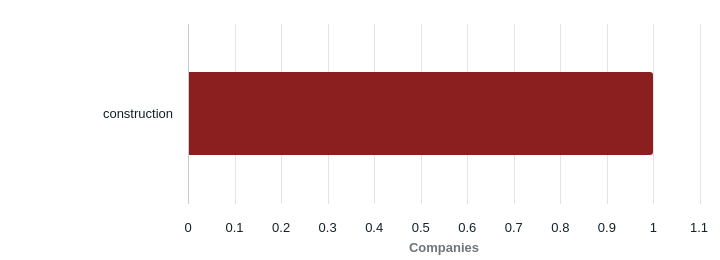
- Total Bankruptcies Recorded: 1 company (Holden Bygg AS in construction, reporting 0 employees and NOK 0 revenue).
- Impact on Local Economy: Virtually non-existent direct disruption to employment or municipal revenues.
This stability is largely attributed to the close integration of private businesses with institutional anchors such as UNIS, Kings Bay AS, and local government frameworks. Companies operating in Longyearbyen generally maintain strong capital reserves or operate as subsidiaries of established mainland corporate groups.
Opportunities for Founders & Innovation
While Svalbard's market requires careful navigation of environmental regulations and land-use policies, several high-value niches offer attractive prospects for prospective founders:
- Green Energy Transition & Arctic Tech: As Svalbard shifts from coal power to hybrid and renewable energy systems, startups specializing in microgrid management, energy storage in extreme cold, and remote monitoring have clear potential.
- Specialized Tourism & Cultural Experiences: High-end, low-impact Arctic travel experiences, guided scientific tours, and sustainable mobility solutions align well with local environmental goals.
- Logistics & Supply Chain Solutions: Specialized polar logistics, cold-chain storage technology, and efficient freight services remain crucial for local supply security.
- Data Analysis & Remote Sensing: Capitalizing on Svalbard's unrivaled satellite connectivity (KSAT) to offer localized data processing and climate analytics.
When evaluating business setups or exploring commercial addresses in Svalbard, platforms like SmartGrunder can softly support founders by providing clear insights into industry trends, corporate registration structures, and local market positioning.
Conclusion
Svalbard's economy is robust, highly specialized, and economically resilient. Backed by solid sales revenues exceeding NOK 3.2 billion and a stable workforce of over 2,400 professionals, the archipelago offers a secure framework for specialized commercial ventures.
Founders who succeed in Svalbard typically possess strong capital backing, deep operational understanding of Arctic conditions, and solutions that support the region's broader transition toward environmental sustainability, high-tech satellite research, and premium eco-tourism.