Municipality
Tromsø Business Economy: Market Analysis for Founders and Decision-Makers
An analytical overview of employment growth, industry structure, geographic hubs, and commercial opportunities in Northern Norway's central hub.
Executive Summary
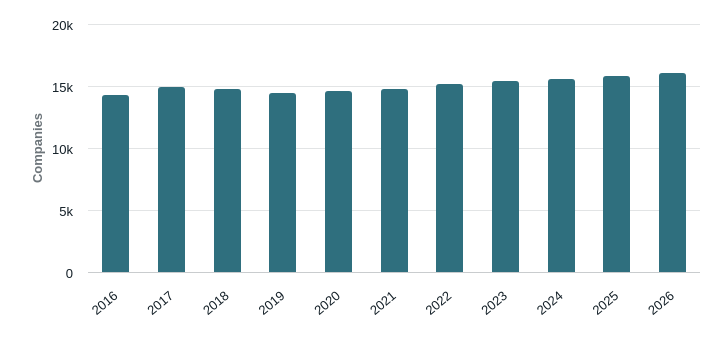
Tromsø serves as the indisputable economic, academic, and healthcare capital of Northern Norway. Positioned in Troms Og Finnmark county, the municipality features a diversified economic engine anchored by major public institutions and high-tech private enterprises. With a total employment base exceeding 62,000 workers and an enterprise landscape generating tens of billions of NOK in annual sales, Tromsø offers an expanding market for new ventures.
Key pillars of the local economy include:
- Public Administration & Healthcare: Home to Universitetssykehuset Nord-Norge (UNN) and Troms Fylkeskommune, providing foundational employment stability.
- Education & Applied Research: Led by Universitetet i Tromsø (UiT), driving innovation in natural sciences, biotechnology, and marine research.
- Commercial High-Tech & Services: Anchored by international niche leaders like Kongsberg Satellite Services AS and regional financial institutions such as Sparebank 1 Nord-Norge.
- Visitor & Local Economy: A vibrant hospitality and retail sector sustained by steady tourism and regional commercial activity.
For prospective founders and investors, Tromsø presents a deep talent pool, high purchasing power, and strong institutional infrastructure.
Economic Overview
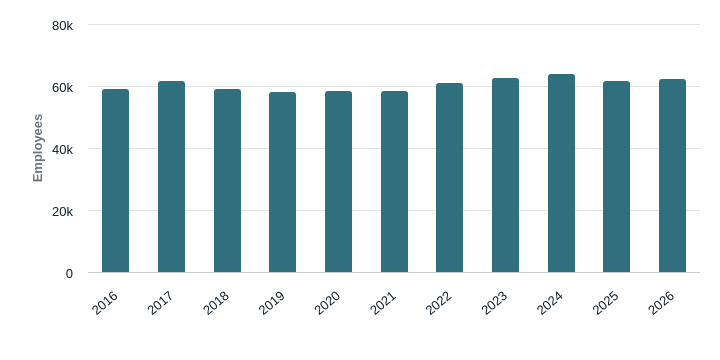
The macro-economic trajectory of Tromsø demonstrates sustained high employment alongside shifting revenue dynamics across major export and service sectors. The local labor force expanded steadily from 58,243 employees in 2021 to a peak of 64,003 in 2024, before stabilizing around 61,500 to 62,300 workers in recent reporting cycles.
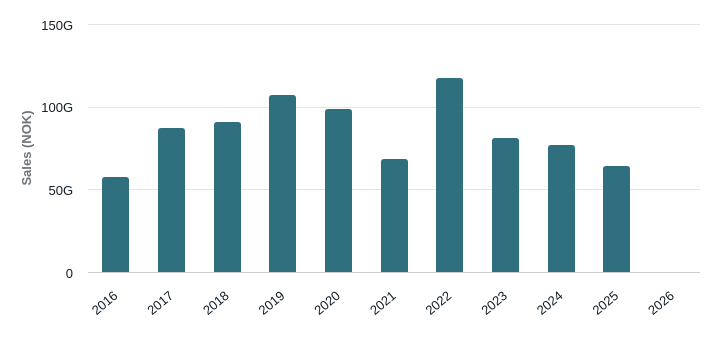
Annual sales revenues reflect significant market volatility driven by commodity prices, seafood export cycles, and broader macroeconomic conditions. Peak sales reached NOK 117.5 billion in 2022 before adjusting to NOK 76.7 billion in 2024 and NOK 64.0 billion in 2025.
| Year | Registered Employees | YoY Change | Total Sales Revenue (NOK) | YoY Change |
|---|---|---|---|---|
| 2021 | 58,243 | -0.4% | 68.23 B | -30.7% |
| 2022 | 60,933 | +4.6% | 117.51 B | +72.2% |
| 2023 | 62,554 | +2.7% | 81.21 B | -30.9% |
| 2024 | 64,003 | +2.3% | 76.66 B | -5.6% |
| 2025 | 61,582 | -3.8% | 64.00 B | -16.5% |
| 2026 | 62,369 | +1.3% | 111.3 M* | N/A |
*Note: 2026 data reflects early partial reporting.
Industry Structure & Legal Forms
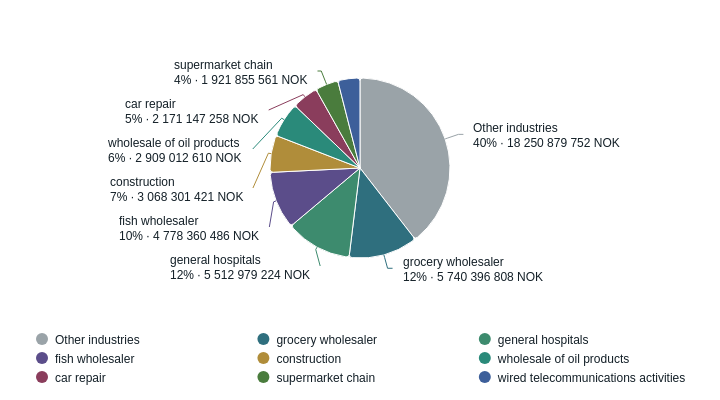
Tromsø’s industrial profile blends public sector health and educational institutions with commercial sectors in construction, logistics, real estate, and hospitality.
Key Industry Sectors
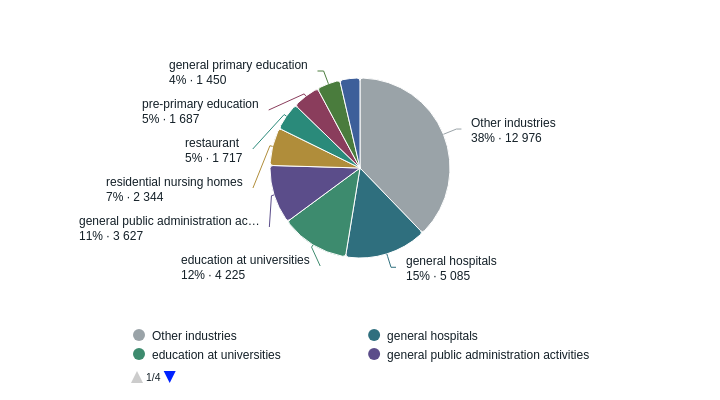
- Healthcare & Hospital Operations: General hospital facilities employ over 5,085 personnel across 10 registered operational entities, producing over NOK 5.96 billion in operating income.
- Higher Education & Research: UiT Campus Tromsø employs over 4,200 faculty and staff. In addition, 27 commercial research and experimental development firms operate in the municipality, generating NOK 680.8 million in top-line turnover.
- Hospitality & Tourism: The hotel and restaurant trade represents a significant employer. 18 hotel entities account for 1,092 employees and NOK 1.31 billion in income with a 16% EBITDA margin. 81 restaurant businesses employ 1,717 workers, generating NOK 726.3 million in revenue.
- Construction & Technical Trades: General construction (80 companies, 1,194 employees, NOK 3.09B turnover) and electrical installation (39 companies, 664 employees, NOK 1.01B turnover) represent essential local commercial trades.
- Property Management: Real estate activities (104 companies, 556 employees) deliver high margins, generating NOK 1.04 billion in operating income with an average EBITDA margin of 34%.
Business Structure by Legal Form
Limited liability companies (Aksjeselskap / AS) represent the dominant vehicle for commercial risk-taking, encompassing 2,215 entities, 30,954 employees, and NOK 66.6 billion in operating income. State and regional public enterprises (Sær, Komm, Orgl, and Fylk) hold the remaining large workforce blocks in health, education, and public management.
Business Geography & Local Micro-Markets
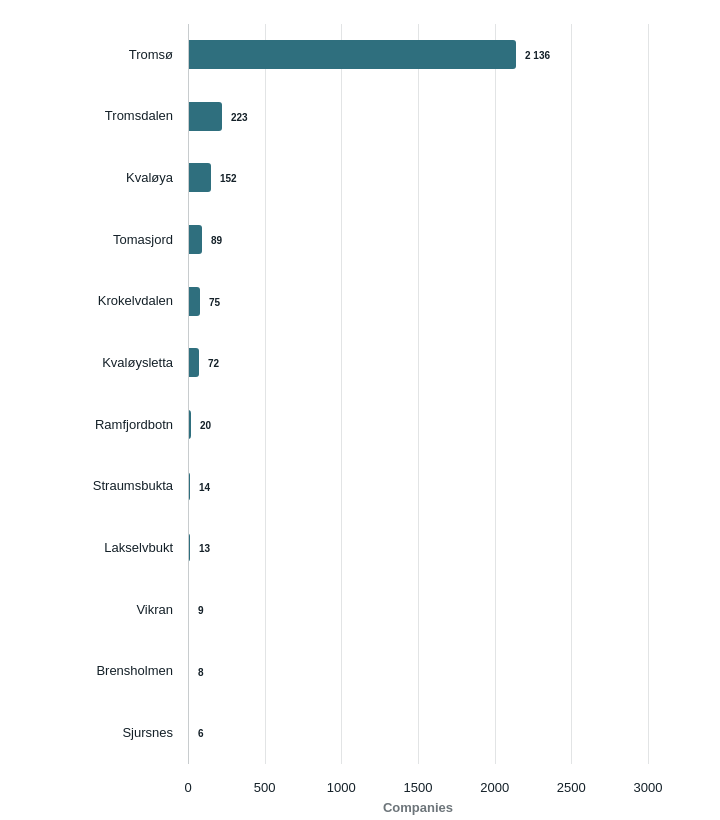
Economic activity in Tromsø is concentrated around the central island (Tromsøya), with major satellite clusters along the mainland and Kvaløya.
| Location / City Place | Companies | Employees | Operating Income (NOK) | Primary Commercial Characteristics |
|---|---|---|---|---|
| Tromsø | 2,136 | 54,167 | 77.87 B | Administrative core, university, main hospital, city center retail, regional finance |
| Tromsdalen | 223 | 3,172 | 8.11 B | Suburban retail, transport links, residential service hubs |
| Tomasjord | 89 | 1,251 | 3.91 B | High productivity zone, commercial trades, light industrial space |
| Kvaløya | 152 | 1,561 | 2.46 B | Maritime industries, local trade, residential construction |
| Krokelvdalen | 75 | 939 | 1.00 B | Commercial service hubs, local logistics |
| Kvaløysletta | 72 | 1,227 | 473.6 M | Local suburban commercial centers |
| Ramfjordbotn | 20 | 256 | 114.6 M | Logistics, highway services, specialized industrial services |
Micro-markets like Tomasjord stand out for exceptional income per employee (NOK 6.8 million), driven by corporate headquarters and logistics activity.
Largest Employers
The municipality hosts several large public and private employers that define the region's labor dynamics:
- Universitetet i Tromsø (UiT): 4,220 employees in higher education and research activities.
- Universitetssykehuset Nord-Norge HF (UNN): Operating across multiple clinical divisions in Tromsø, including Somatikk (3,624 employees), Røntgen Og Lab (674 employees), Administration & Support (665 employees), and Sikkerhet Og Alderpsykiatri (483 employees).
- Troms Fylkeskommune: 2,764 employees delivering county-level public services.
- Kongsberg Satellite Services AS (Tromsø Division): 443 employees generating NOK 1.76 billion in operating income with a strong 26% EBITDA margin in satellite data communications.
- Otium Bo Og Velferdssenter: 433 employees in municipal care services.
- Sparebank 1 Nord-Norge: 400 employees headquartered at Kaigata, driving regional commercial banking with NOK 3.36 billion in operating income.
- Tide Buss AS (Tromsø Division): 337 employees executing public transit services (NOK 431.9M operating income).
Business Dynamism & Risk Factors
Tromsø displays dynamic market churn typical of a regional growth city. Out of over 16,000 registered commercial registrations, 21 companies entered bankruptcy proceedings during the tracked period.
Key observations regarding recent market insolvencies:
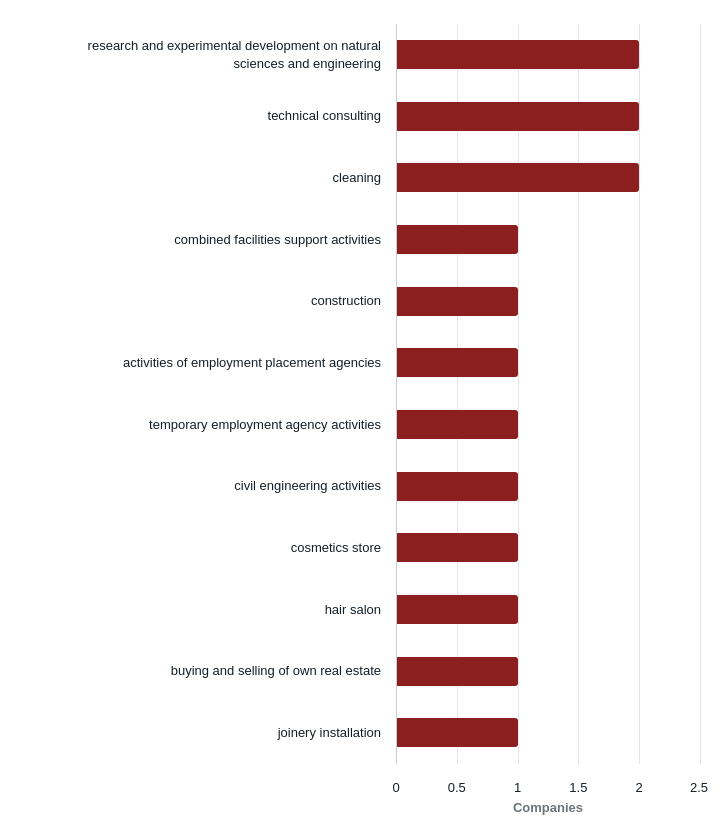
- Employment Agencies & Staffing: High-revenue staffing companies encountered cash flow pressures, notably Nordic Nurse AS (NOK 32.3M sales) and Industripersonell AS.
- Technical Consulting & VVS Trade: Technical trades faced market headwinds, including Langnes VVS Butikk AS (NOK 18.6M sales).
- High-R&D Startups: Capital-intensive science ventures such as Chip Nanoimaging AS (NOK 457K sales, NOK -8.2M EBITDA) illustrate the risk profile associated with long-horizon technological commercialization.
- Consumer Services: Minor insolvencies occurred in local personal care (Arctic Beauty AS, Bilpleiesenteret Tromsø AS) and specialized cleaning (Proff Renhold AS).
Overall insolvency rates remain low relative to total corporate volume, signaling healthy underlying structural resilience across core sectors.
Opportunities for Founders
Tromsø’s economic landscape presents distinct commercial gaps for innovative entrepreneurs:
- Space Technology & Ocean Data: Capitalizing on the satellite cluster spearheaded by Kongsberg Satellite Services to develop software applications, earth observation platforms, and Arctic data analytics.
- HealthTech & Life Sciences Spin-offs: Utilizing the intellectual property generated at UiT and UNN to build specialized medical diagnostics and digital health tools.
- Sustainable Tourism & Experiences: High hotel occupancy (NOK 1.31B sector revenue) creates demand for premium year-round activity providers, green mobility services, and digital booking technology.
- Business Services & Skilled Trades: High demand persists for specialized engineering consultants, IT services, and commercial property maintenance.
Entrepreneurs evaluating commercial space or industry positioning can leverage [SmartGrunder](https://smartgrunder.no) to explore location-specific statistics and target demographics across Tromsø.
Conclusion
Tromsø remains the premiere commercial and institutional engine of Northern Norway. Its rare combination of deep public-sector employment stability, world-class scientific infrastructure, and expanding high-tech industries provides founders with a fertile environment for long-term growth. By pairing innovative business models with the city's established industrial clusters, new enterprises are well-positioned to succeed in this dynamic Arctic hub.