Municipality
Trondheim Business Economy Analysis
An in-depth evaluation of industry structure, employment growth, geographic nodes, and entrepreneurial opportunities in Norway's technology capital.
Executive Summary
Trondheim serves as the primary economic and innovation engine of Trøndelag and Central Norway. Home to the Norwegian University of Science and Technology (NTNU), major healthcare institutions, and world-class research centers, the municipality hosts over 170,000 active employees and generated a peak annual corporate turnover exceeding NOK 341.8 billion in 2024.
The local business landscape is characterized by a powerful public institutional foundation paired with high-value private enterprise. Large public employers—led by Trondheim Kommune (21,670 employees), St. Olavs Hospital HF (6,000 employees at the university hospital level), and NTNU's academic faculties—provide long-term macroeconomic stability. Concurrently, major industrial and research facilities such as Equinor's Ranheim Research Center and Aker Solutions drive substantial commercial revenue.
Key structural highlights include:
- Robust Revenue Base: Total company sales expanded from NOK 209.9 billion in 2016 to NOK 341.8 billion in 2024.
- Diversified Urban Economy: Strong corporate presences across technical consulting, IT, construction, general hospital care, and retail distribution.
- Geographic Commercial Hubs: High economic concentration in Trondheim city center, supported by major secondary commercial and industrial hubs in Tiller, Heimdal, and Ranheim.
- Balanced Risk Profile: While macroeconomic adjustments have impacted real estate and construction, technology and professional services continue to demonstrate strong profitability and resilience.
Economic Overview
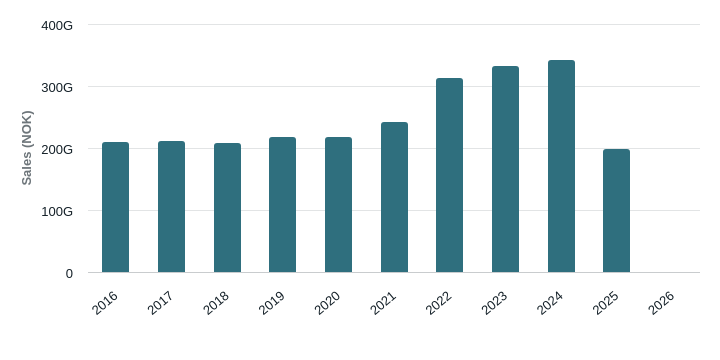
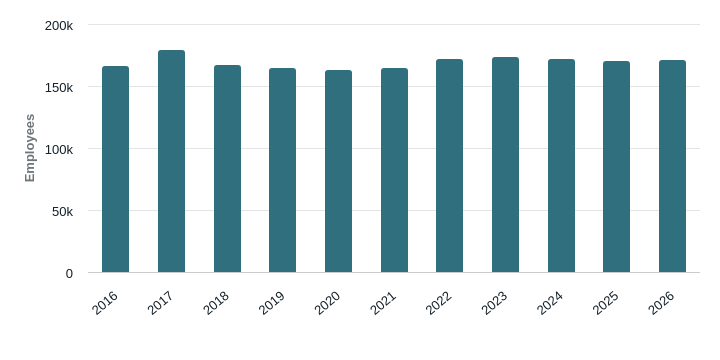
Trondheim's corporate sector has demonstrated continuous top-line expansion over the past decade. Between 2016 and 2024, annual business revenue grew by nearly 63%, accelerating noticeably during the 2021–2022 recovery period. Annual employment levels reached a peak of 173,116 in 2023 before stabilizing around 170,000 to 171,000 in recent years.
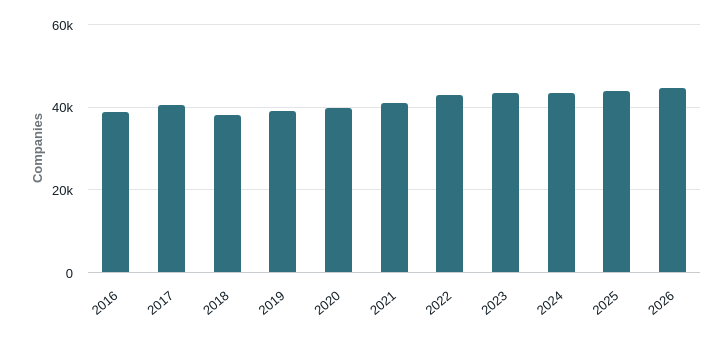
The table below details the year-over-year progression of corporate turnover and total employment across companies registered in Trondheim municipality. (Note: Figures for 2025 and 2026 reflect partial annual filing data available to date).
| Year | Total Sales (NOK) | Sales YoY Growth | Total Employees | Employment YoY Growth |
|---|---|---|---|---|
| 2016 | 209.86 B | — | 165,768 | — |
| 2017 | 211.22 B | +0.6% | 178,801 | +7.9% |
| 2018 | 208.52 B | -1.3% | 166,953 | -6.6% |
| 2019 | 217.37 B | +4.2% | 164,341 | -1.6% |
| 2020 | 218.02 B | +0.3% | 163,061 | -0.8% |
| 2021 | 242.03 B | +11.0% | 164,287 | +0.8% |
| 2022 | 312.82 B | +29.3% | 171,860 | +4.6% |
| 2023 | 332.39 B | +6.3% | 173,116 | +0.7% |
| 2024 | 341.80 B | +2.8% | 171,817 | -0.8% |
| 2025* | 198.76 B | -41.9%* | 170,155 | -1.0% |
| 2026* | 0.09 B | -100.0%* | 170,933 | +0.5% |
Trondheim's high gross revenue generation relative to its workforce reflects a knowledge-intensive economy with substantial high-margin output in finance, technical services, energy R&D, and engineering.
Industry Structure
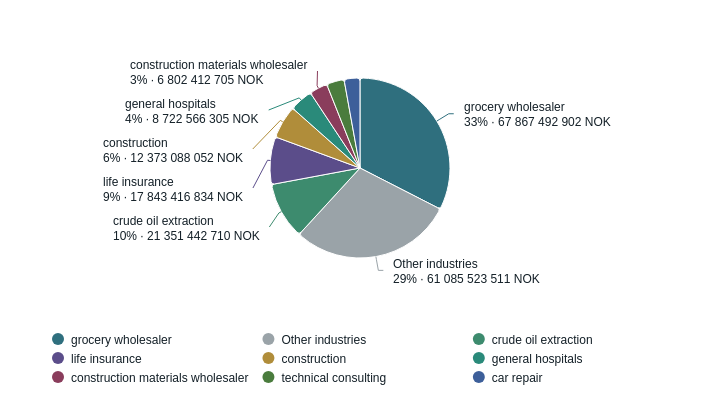
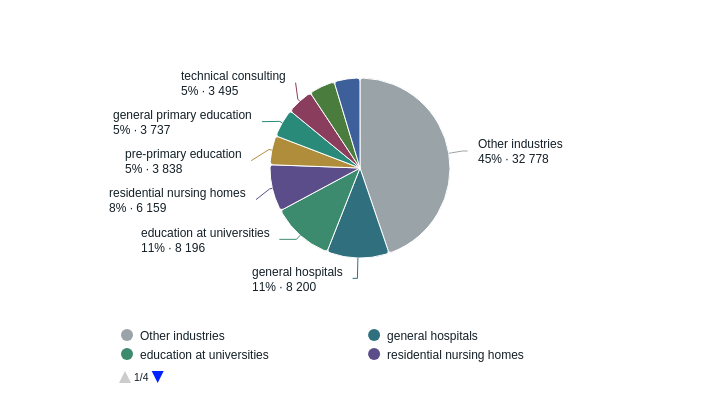
Trondheim's commercial engine combines public administration, higher education, specialized healthcare, and commercial technology services. The university and hospital sectors employ over 22,000 professionals combined, creating a stable platform for private sector suppliers, consultancy firms, and tech spin-offs.
Sector Distribution
The table below outlines key industry aggregates operating within the municipality:
| Industry Sector | Active Companies | Employees | Operating Income (NOK) | EBITDA Margin |
|---|---|---|---|---|
| General Hospitals | 17 | 8,200 | 9,885.3 M | 3% |
| University Education | 9 | 8,196 | — | — |
| Residential Nursing Homes | 90 | 6,159 | 228.2 M | 3% |
| Technical Consulting | 231 | 3,495 | 6,986.3 M | 9% |
| Temporary Employment Agencies | 53 | 3,415 | 1,620.2 M | 1% |
| Restaurants & Dining | 181 | 3,393 | 1,941.1 M | 14% |
| General Construction | 192 | 2,996 | 12,442.2 M | 4% |
| R&D in Natural Sciences & Engineering | 49 | 2,867 | 6,136.7 M | 4% |
| IT Services & Computer Consultancy | 120 | 2,546 | 5,137.1 M | 7% |
| Computer Programming Activities | 174 | 1,731 | 3,565.2 M | 15% |
| Supermarket Chains | 102 | 2,170 | 5,990.8 M | 3% |
| Other Monetary Intermediation (Banking) | 20 | 1,841 | 15,698.2 M | 65% |
Organization Forms
Private limited companies (Aksjeselskap / AS) represent the vast majority of commercial activity, counting 5,244 entities, 85,543 employees, and NOK 240.0 billion in operating income with an average EBITDA margin of 9%. State and regional public institutions (ORGL, SÆR, SF, IKS) account for over 50,000 additional jobs, reinforcing Trondheim's resilience against cyclical economic downturns.
Business Geography
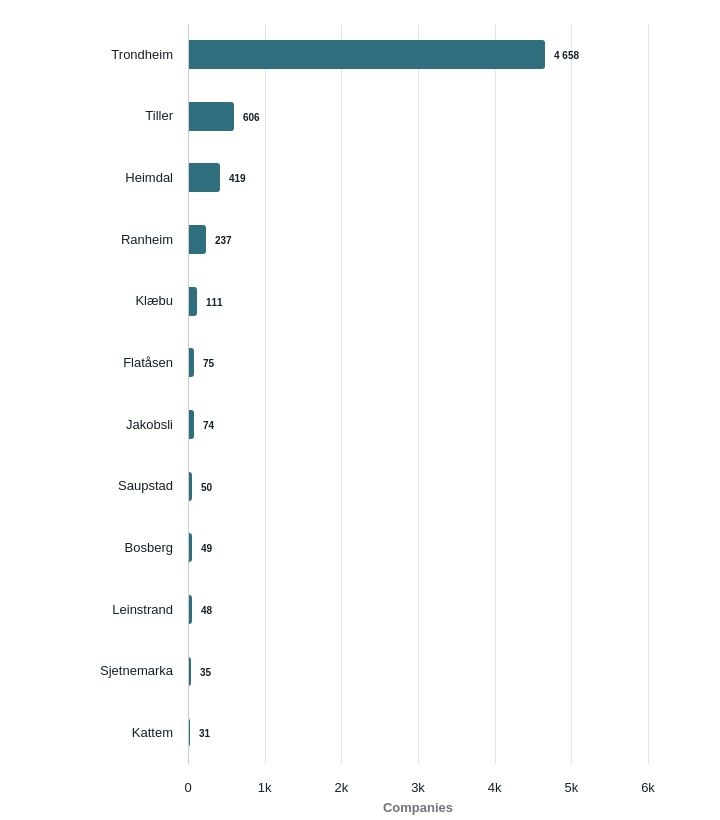
Economic activity in Trondheim municipality is structured around distinct urban and suburban sub-markets, ranging from dense knowledge clusters to expansive commercial logistics corridors.
| Location / Place | Companies | Employees | Operating Income (NOK) | EBITDA Margin |
|---|---|---|---|---|
| Trondheim (City Core / Gløshaugen / Øya) | 4,658 | 118,382 | 279,218.1 M | 11% |
| Tiller | 606 | 12,943 | 38,429.1 M | 6% |
| Heimdal | 419 | 6,263 | 15,666.4 M | 8% |
| Ranheim | 237 | 5,489 | 32,587.4 M | 15% |
| Saupstad | 50 | 1,433 | 441.4 M | 3% |
| Jakobsli | 74 | 1,212 | 423.6 M | 5% |
| Flatåsen | 75 | 1,140 | 2,885.8 M | 4% |
| Klæbu | 111 | 1,124 | 913.5 M | 6% |
| Leinstrand | 48 | 763 | 666.2 M | 4% |
| Tanem | 26 | 233 | 126.9 M | 10% |
Key Commercial Districts
- Trondheim City Core: Houses the municipality's administrative center, main university campuses (NTNU Gløshaugen/Dragvoll), St. Olavs Hospital (Øya), legal services, finance, and software technology firms.
- Tiller & Heimdal: Form the primary retail, logistics, light industry, and commercial trade axis south of the city center, accounting for nearly 20,000 total jobs.
- Ranheim: A specialized industrial and technological district east of the central city, exhibiting extremely high revenue productivity per employee (NOK 10.0 million per employee) due to research hubs like Equinor's R&D center and major engineering facilities.
Largest Employers
Trondheim's corporate landscape is anchored by large public sector organizations and major corporate enterprise units operating in health, education, energy, and transportation.
| Company Name | Industry / Entity Type | Employees | Operating Income (NOK) |
|---|---|---|---|
| Trondheim Kommune | General Public Administration | 21,670 | — |
| St Olavs Hospital HF Universitetssykehuset | General Hospitals | 6,000 | 7,505.0 M |
| NTNU (Fakultet for Medisin og Helsevitenskap) | University Education | 1,561 | — |
| NTNU (Sentraladministrasjonen) | University Education | 1,313 | — |
| NTNU (Fakultet for Ingeniørvitenskap) | University Education | 1,137 | — |
| NTNU (Fakultet for Samfunns- og Utdanningsvitenskap) | University Education | 1,047 | — |
| NTNU (Fakultet for Informasjonsteknologi og Elektronikk) | University Education | 1,030 | — |
| NTNU (Fakultet for Naturvitenskap) | University Education | 925 | — |
| St Olavs Hospital HF Driftsservice Øya | Hospital Support Services | 866 | 1,065.6 M |
| Trondheim Sentrum Politistasjon | Public Order & Safety | 732 | — |
| Equinor ASA Avd Forskningssenter Ranheim | Crude Oil Extraction / Energy R&D | 654 | 23,385.2 M |
| Trondheim Eiendom | Combined Facilities Support | 642 | — |
| Aker Solutions AS Lokasjon Trondheim | Oil & Energy Engineering Services | 634 | 5,800.7 M |
| Medvind Assistanse AS Avd Trøndelag | Home Health & Personal Care | 588 | 55.3 M |
| Pedagogisk Vikarsentral AS Avd Trondheim | Temporary Employment Services | 562 | 50.2 M |
| Vy Buss AS Avd Sandmoen | Scheduled Urban Bus Transport | 561 | 595.0 M |
These large establishments provide a deep candidate pool, high purchasing power, and consistent sub-contracting demand for regional smaller businesses.
Business Dynamism
Trondheim maintains a dynamic corporate market where new tech start-ups and service firms continuously form, while mature industries navigate macroeconomic shifts.
Bankruptcy Analysis
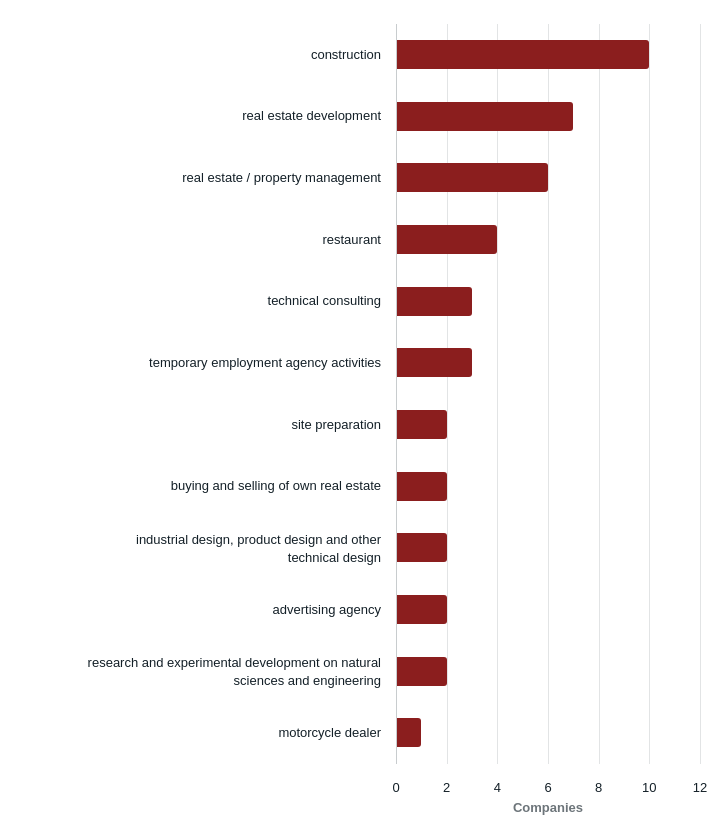
Over the recent monitoring period, 92 local insolvencies were recorded across the municipality, primarily concentrated in cyclical consumer-facing and real-estate-exposed sectors:
- General Construction & Building: 10 insolvencies, representing NOK 124.7 million in combined operating income and a collective EBITDA of NOK -16.0 million. Notable cases include Bc Bygg AS (NOK 39.5M sales prior to filing).
- Real Estate Development & Property Management: 13 insolvencies across property management (6) and development (7), driven by higher interest rate environments and stalled residential projects.
- Hospitality & Retail Services: 4 restaurant insolvencies (e.g. Bar Dus AS, NOK 28.5M turnover) and specialized automotive/retail closures (e.g. Autosport AS, NOK 64.9M turnover).
- High-Risk Technology & R&D Spin-offs: 2 experimental R&D firms filed for bankruptcy, exhibiting high cash burn (combined EBITDA loss of NOK 71.9M), reflecting the capital-intensive nature of deep-tech commercialization.
Despite these localized pressures, mainstream technology consultancy, software programming, and financial intermediation sectors maintain healthy operational margins, demonstrating the overall resilience of the local market.
Opportunities for Founders
Trondheim presents one of the most favorable environments in the Nordic region for tech-driven and specialized commercial ventures. Key growth avenues include:
- Deep Tech, AI & Software Solutions: Building upon NTNU's talent output (over 2,000 software and engineering professionals in active local IT companies) and existing market profitability (computer programming firms achieve an average 15% EBITDA margin).
- Health Tech & Life Sciences: Leveraging proximity to St. Olavs Hospital and NTNU’s Faculty of Medicine to develop clinical devices, digital health tools, and healthcare support services.
- Green Energy & Maritime Technology: Partnering with industrial leaders like Equinor R&D and Aker Solutions on energy transition, robotics, and subsea tech.
- B2B Professional Services: Providing high-value engineering, technical consulting, and specialized staffing solutions to support regional infrastructure projects.
- Consumer & Hospitality Innovations: Serving Trondheim's large student and professional workforce across key retail and dining corridors in Midtbyen, Tiller, and Heimdal.
Founders planning to establish operations in Trondheim can utilize tools like SmartGrunder to evaluate location demographics, local industry density, and commercial space across Trondheim's diverse urban zones.
Conclusion
Trondheim stands as a premier regional capital defined by institutional stability, strong technological innovation, and a highly skilled workforce. With corporate sales reaching NOK 341.8 billion and employment remaining steady above 170,000, the municipal economy offers exceptional market scale.
While traditional real estate and construction sectors face cyclical recalibration, Trondheim’s core competencies in software development, engineering, healthcare, and higher education ensure long-term stability and abundant opportunities for new enterprise creation.