Municipality
Trysil Municipal Business and Economic Analysis
An in-depth evaluation of Trysil's tourism-driven economy, industrial forestry, geography, and entrepreneurial opportunities
Executive Summary
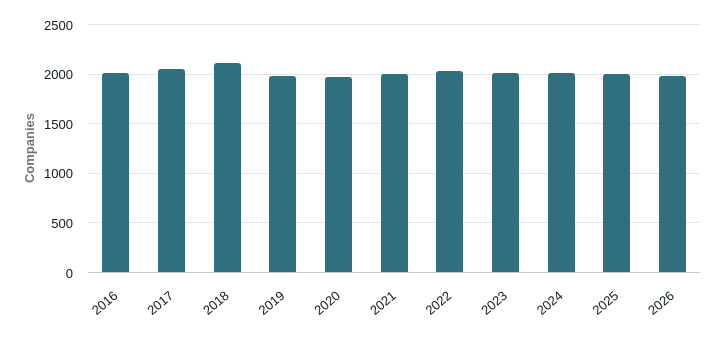
Trysil's economy is defined by a powerful dual engine: a premier national destination for winter sports and mountain tourism alongside a deep-rooted forestry and wood processing industrial base. Centered in Innlandet county, the municipality exhibits high revenue density focused around the mountain resort infrastructure and the municipal center of Trysil, complemented by regional forestry hubs such as Nybergsund, Søre Osen, and Ljørdalen.
While public sector healthcare and administration provide baseline employment stability, major commercial actors—led by mountain resort operator Skistar Norge AS and industrial timber manufacturer Moelven Trysil AS—drive local revenue generation. Entrepreneurial activity is heavily concentrated in hospitality, property management, specialized security, and construction support services.
Economic Overview
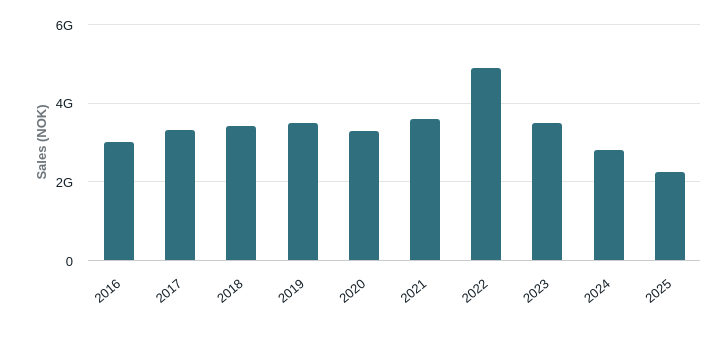
The macroeconomic trajectory of Trysil over the past decade highlights a period of post-pandemic expansion followed by broader economic recalibration. Total turnover across registered companies peaked in 2022 at NOK 4,885.1M, reflecting robust post-lockdown leisure travel and real estate activity. Subsequent years saw a decline in reported sales turnover to NOK 3,480.5M in 2023 and NOK 2,803.0M in 2024, reflecting tighter consumer spending and rising interest rates impacting cabin development.
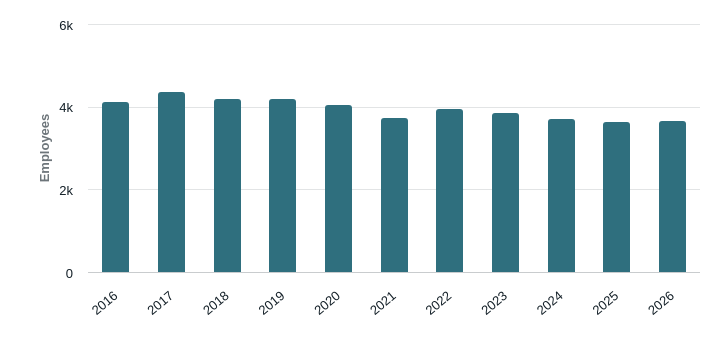
Employment trends have demonstrated relative resilience. Total corporate employment stood at 4,125 workers in 2016 and, despite cyclical shifts, stabilized near 3,690 in 2024 with projections indicating steady operational levels around 3,659 by 2026.
| Year | Corporate Sales (NOK) | YoY Sales Growth | Corporate Employees | YoY Employee Growth |
|---|---|---|---|---|
| 2016 | 3,001.5M | - | 4,125 | - |
| 2018 | 3,409.6M | +3.5% | 4,184 | -4.1% |
| 2020 | 3,290.4M | -5.8% | 4,029 | -3.8% |
| 2021 | 3,596.5M | +9.3% | 3,717 | -7.7% |
| 2022 | 4,885.1M | +35.8% | 3,946 | +6.2% |
| 2023 | 3,480.5M | -28.8% | 3,843 | -2.6% |
| 2024 | 2,803.0M | -19.5% | 3,690 | -4.0% |
| 2025 | 2,243.2M | -20.0% | 3,619 | -1.9% |
| 2026 | - | - | 3,659 | +1.1% |
Industry Structure
Trysil's private sector is structured around mountain recreation, timber production, retail trade, and property services:
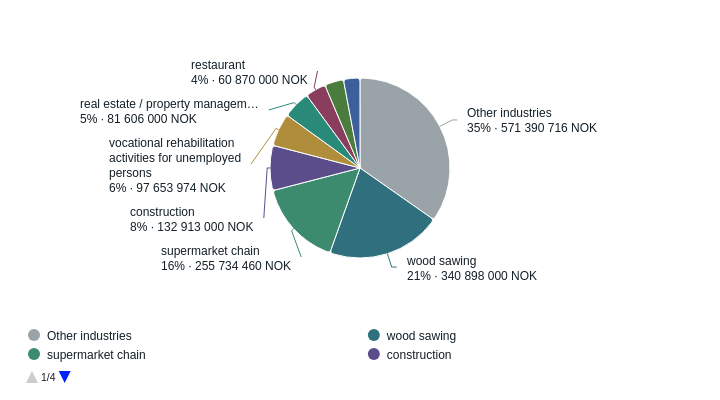
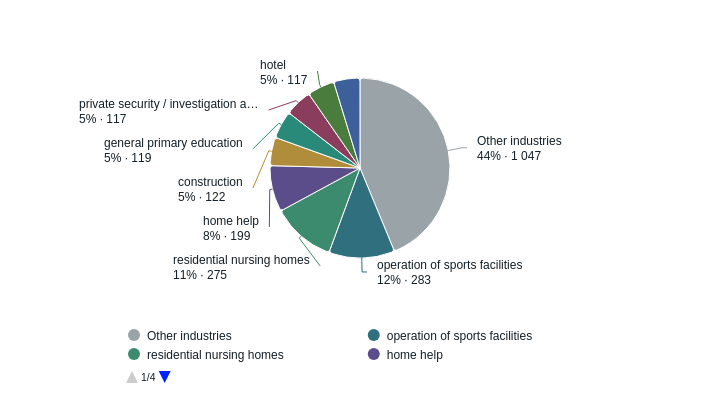
- Operation of Sports Facilities & Recreation: Represented by 4 specialized companies employing 283 people, generating NOK 1,136.2M in operating income with an impressive EBITDA margin of 23% (NOK 269.2M EBITDA).
- Wood Sawing & Forestry: Dominated by Moelven Trysil AS (NOK 342.5M operating income, 30% growth), wood sawing represents high value-add manufacturing. Additional forest felling and agricultural service entities generate over NOK 75M in revenue combined.
- Retail & Groceries: Supermarket chains and local food markets (10+ combined entities) generate over NOK 283M in operating income, supporting local residents and influxes of seasonal visitors.
- Real Estate & Construction: Property management entities generate NOK 107.0M with a 26% EBITDA margin. General construction encompasses 13 companies employing 122 workers, recording NOK 133.2M in operating income.
- Hospitality & Food Services: 15 restaurant companies generate NOK 63.0M (19% EBITDA margin), while hotels generate NOK 6.4M across independent operations.
Legal Organisation Types
An analysis of corporate legal forms shows that private limited companies (AS) dominate commercial output:
- Aksjeselskap (AS): 211 companies, 2,069 employees, NOK 2,962.3M operating income (13% EBITDA margin).
- Kommune (KOMM): 33 municipal operating units employing 1,037 health, social, and education workers.
- Samvirkeforetak (SA): 12 cooperative companies employing 135 people, generating NOK 248.4M operating income.
- Enkeltpersonforetak (ENK): 22 sole proprietorships employing 65 workers with strong profitability in localized services.
Business Geography
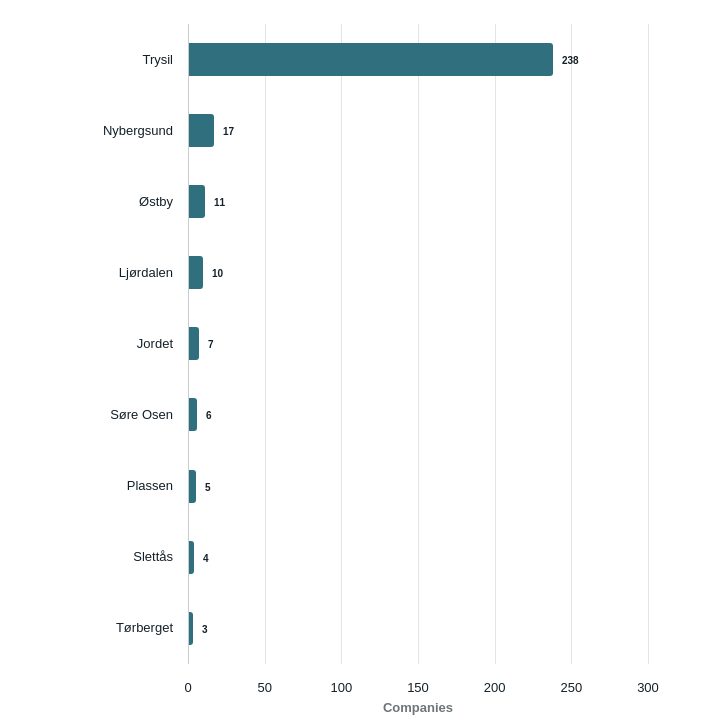
Economic activity within Trysil municipality is heavily concentrated in the commercial center, though rural nodes contribute significant specialized output.
| Location | Companies | Employees | Operating Income (NOK) | Dominant Character |
|---|---|---|---|---|
| Trysil (Town) | 238 | 3,160 | 3,163.0M | Commercial hub, resort operations, retail, municipal core |
| Nybergsund | 17 | 117 | 80.6M | Local industry, trades, service enterprises |
| Søre Osen | 6 | 102 | 37.4M | Specialized services, high margin (63% EBITDA) |
| Østby | 11 | 59 | 22.4M | Border region trade, local services |
| Ljørdalen | 10 | 42 | 55.1M | Forestry, local services (+36% revenue growth) |
| Jordet | 7 | 46 | 3.8M | Local crafts, timber support |
| Slettås | 4 | 26 | 19.2M | Forestry and local transport services |
| Plassen | 5 | 19 | 19.9M | Rural trade, high profit margin (28% EBITDA) |
| Tørberget | 3 | 10 | 5.5M | Rural services and agriculture support |
Trysil center acts as the primary economic gravity well, hosting over 85% of corporate workforce and total municipality income.
Largest Employers
Employment in Trysil is anchored by major resort operators, public healthcare institutions, and timber manufacturers.
Major Commercial Entities
| - Skistar Norge AS Avd Trysilfjellet: 255 employees | Industry: Operation of sports facilities | Operating Income: NOK 1,083.5M | EBITDA: NOK 266.1M |
|---|---|---|---|
| - Radisson Blu Resort: 83 employees | Industry: Hotel & lodging | ||
| - Raven Security AS: 75 employees | Industry: Private security & protection | ||
| - Moelven Trysil AS: 63 employees | Industry: Wood sawing & timber production | Operating Income: NOK 342.5M | EBITDA: NOK 24.3M |
| - Manngard Vakt & Sikkerhet AS: 42 employees | Industry: Private security services | Operating Income: NOK 9.1M | |
| - Tepas Kompetanse AS Avd Trysil: 37 employees | Industry: Vocational rehabilitation | Operating Income: NOK 12.9M | |
| - Landbrukstjenester Øst SA Avd Trysil: 36 employees | Industry: Agricultural & forestry services | Operating Income: NOK 34.3M |
Public Sector & Community Institutions
| - Trysil Sykehjem: 235 employees | Nursing home care | |
|---|---|---|
| - Trysil Kommune Hjemmebaserte Tjenester: 193 employees | Home care services | |
| - Sykehuset Innlandet HF Ambulanse Trysil: 61 employees | Emergency medical response | Operating Income: NOK 43.6M |
| - Trysil Kommune Sentraladministrasjonen: 61 employees | Municipal administration | |
| - Trysil Videregående Skole: 56 employees | Secondary education | |
| - Innbygda Skole: 54 employees | Primary education |
Business Dynamism & Bankruptcies
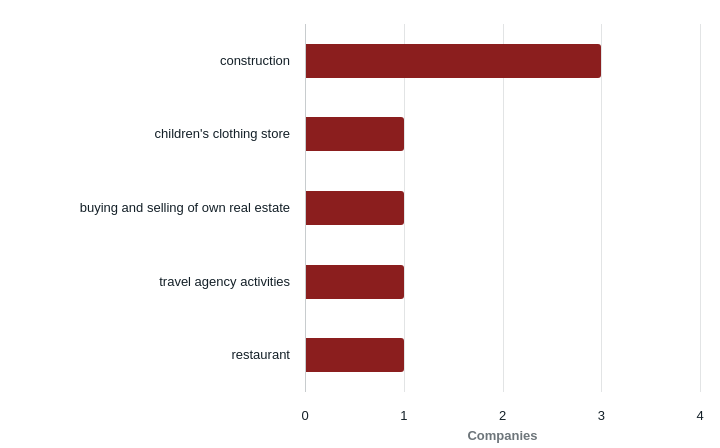
Business dynamism in Trysil reflects typical cyclical patterns seen across tourism- and construction-dependent regions. A sample of recent bankruptcies recorded across 5 main industry segments demonstrates pressure points in high-headwind sectors:
- Travel Agency Activities: 1 company (Booktrysilonline AS — NOK 22.7M reported revenue, NOK -2.3M EBITDA) experienced distress amid shifting booking channels and operational overheads.
- Construction & Building Trades: 3 companies affected (including Flendalen Snekkerservice AS and Tysland Bygg AS), generating a combined operating income of NOK 5.5M before restructuring. Rising material costs and reduced holiday home construction contributed to compressed margins (-5% sector EBITDA margin).
- Real Estate & Retail Niche: Individual insolvencies occurred in own-property development and specialized retail (children's clothing store), where total debt exposure reached NOK 16.4M in property trading.
These closures reflect macroeconomic stabilization following the peak cabin-building period rather than broad systemic decline, emphasizing the necessity for sound liquidity management in seasonal micro-markets.
Opportunities for Founders
Trysil's substantial seasonal influx creates targeted opportunities for new business creation beyond traditional winter skiing:
- Year-Round Eco-Tourism & Recreation: Capitalizing on summer trail biking, hiking, and outdoor adventure activities to smooth seasonal revenue spikes.
- Craft Wood & Bio-Economy: Leveraging the strong local timber presence established by players like Moelven Trysil AS to create high-value secondary wood products or sustainable building materials.
- Property Technology & Property Care: With thousands of vacation homes across Trysilfjellet, demand remains high for automated property management, energy retrofitting, and specialized security solutions.
- Specialized Food & Hospitality: Niche culinary concepts targeting high-spending visitors during peak winter and summer months.
Founders evaluating specific locations or industry metrics across Trysil's sub-regions can utilize tools like SmartGrunder to explore commercial addresses, legal structure comparisons, and local market gaps.
Conclusion
Trysil presents a mature resort and industrial economy characterized by strong anchor institutions, high tourism yields, and a robust timber processing heritage. While cyclical adjustments in second-home construction have normalized sales revenues from 2022 highs, core corporate employment remains solid.
For entrepreneurs and decision-makers, success in Trysil relies on developing resilient operational models that bridge seasonal fluctuations, tapping into destination visitor spending, and collaborating within Innlandet's strong regional business ecosystems.