Municipality
Tydal Business & Economic Profile: Strategic Market Insight for Founders and Investors
An in-depth analysis of energy production, digital infrastructure, tourism, and industrial employment in Tydal municipality
Executive Summary
Tydal is a mountain municipality in Trøndelag county known for its rich natural resource base, strong hydro-power legacy, and emerging digital infrastructure. Situated in Neadalen near the Swedish border, Tydal's local economy balances a significant public administration and health sector with energy generation, data hosting, specialized manufacturing, and mountain tourism.
Key takeaways for prospective founders and local policy makers include:
- Public Sector Anchor: Public administration, municipal health services (Tydal Helsehus), and local education represent the largest single employment block, providing economic stability to the municipality.
- High Value Per Employee in Infrastructure & Tech: Heavy industrial drivers such as Tydal Data Center AS (NOK 36.3M in operating income) and Statkraft Energi AS generate substantial top-line revenue relative to their physical headcount.
- Specialized Niche Industries: A well-established manufacturing base—highlighted by Tydal Trappefabrikk A/S (wooden prefabricated structures)—alongside site preparation (Fjellguiden Tydal AS) and automotive supply (Bil Og Landbruk AS) demonstrates local commercial diversity.
- Resilient Business Environment: Corporate distress remains remarkably low, with only a single bankruptcy recorded in recent municipal tracking, reflecting conservative financial management and local stability.
Economic Overview
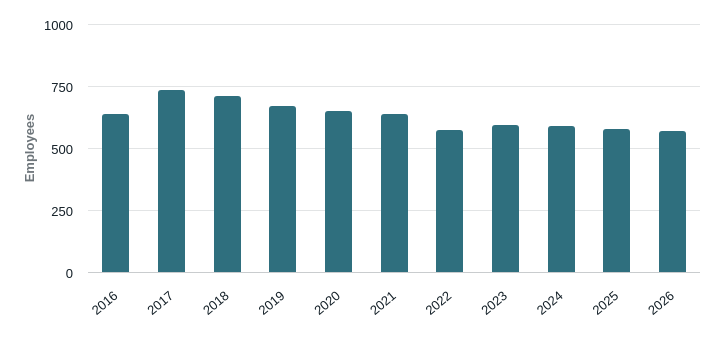
Tydal's macro-economic metrics exhibit structural stability in core employment paired with substantial revenue swings driven primarily by energy price fluctuations and large-scale industrial projects. The community supported an employee base peaking at 735 workers in 2017, settling around 570–590 employees in recent years.
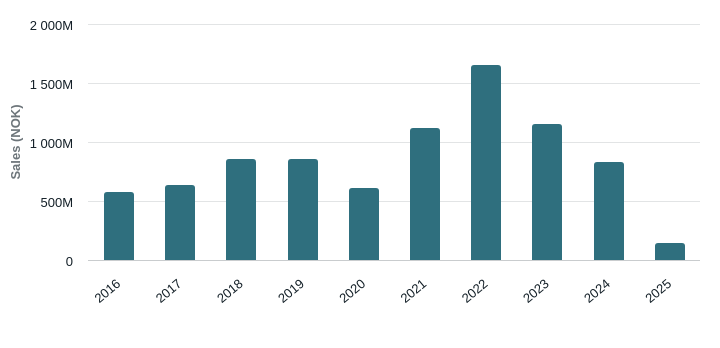
Corporate sales revenue inside the municipality peaked at NOK 1.65 billion in 2022 during the Nordic energy price surge, before normalizing to NOK 832.1 million in 2024. (Note: 2025 revenue figures reflect partial-year interim reporting).
Historical Revenue & Workforce Trends
| Year | Total Sales Revenue (NOK) | YoY Sales Change | Total Employees | YoY Employment Change |
|---|---|---|---|---|
| 2016 | 572.6M | — | 637 | — |
| 2017 | 634.5M | +10.8% | 735 | +15.4% |
| 2018 | 852.0M | +34.3% | 711 | -3.3% |
| 2019 | 858.0M | +0.7% | 669 | -5.9% |
| 2020 | 607.7M | -29.2% | 648 | -3.1% |
| 2021 | 1,122.6M | +84.7% | 636 | -1.9% |
| 2022 | 1,653.6M | +47.3% | 574 | -9.7% |
| 2023 | 1,151.3M | -30.4% | 591 | +3.0% |
| 2024 | 832.1M | -27.7% | 589 | -0.3% |
| 2025 | 145.6M (Partial) | -82.5% | 578 | -1.9% |
| 2026 | — | — | 569 (Est.) | -1.6% |
The sharp revenue expansion between 2021 and 2023 underscores Tydal's role as an energy exporter, while steady employee numbers indicate a stable workforce in rural Trøndelag.
Industry Structure & Legal Forms
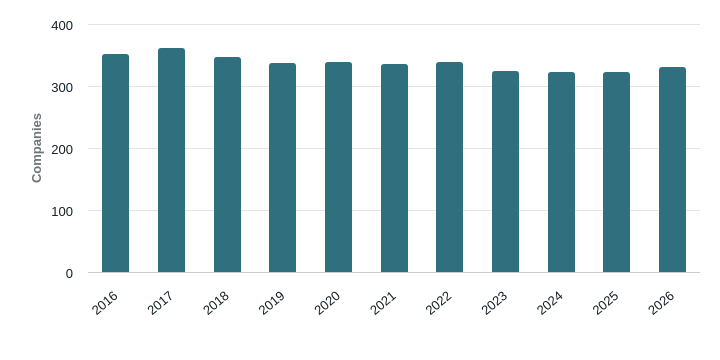
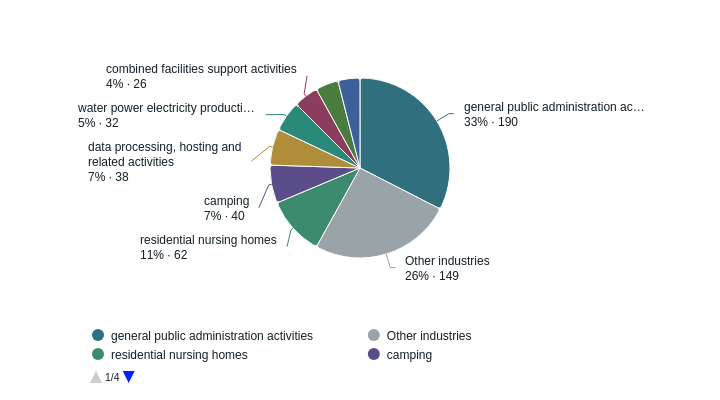
The commercial ecosystem in Tydal consists of 40 active industry sub-sectors. Public institutions dominate total headcounts, while private corporations (A/S) and co-operatives (S/A) generate the majority of commercial turnover.
Key Industry Sectors
- Public Services & Administration: General public administration accounts for 5 units and 190 employees, while residential nursing care (Tydal Helsehus) employs 62 people.
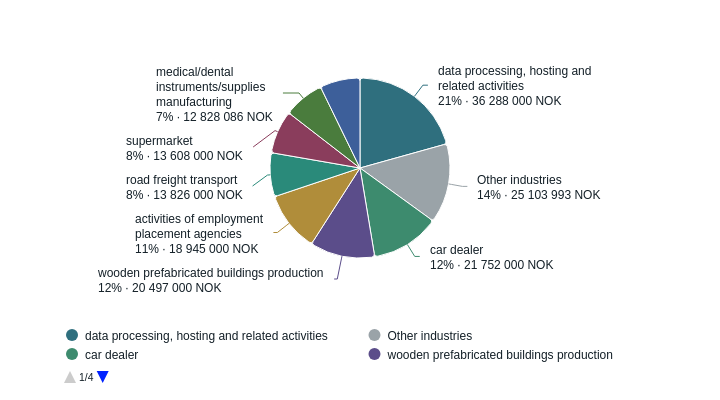
- Data Processing & Technology: Tydal Data Center AS represents a capital-intensive sector, producing NOK 36.3M in operating income with 38 employees.
- Hydropower & Energy Production: Statkraft Energi AS leads local power production, yielding high gross profit margins (56% EBITDA margin) on hydro assets.
- Manufacturing & Wood Processing: Tydal Trappefabrikk A/S generates NOK 21.0M in operating income with 13 employees, demonstrating strong profit margins (19% EBITDA margin, operating profit NOK 3.0M).
- Tourism & Camping: Mountain tourism is supported by 3 camping facilities employing 40 workers (including Moheim Camping AS and Nedalshytta TT), generating over NOK 6.0M in aggregate sales.
- Trade & Services: Vehicle dealership and agricultural supply (Bil Og Landbruk AS) delivers NOK 21.8M in turnover, while local labor services (Tydal Bygdeservice SA) provides flexible employment placement.
Breakdown by Legal Form
| Legal Form | Entities | Total Employees | Sales Revenue (NOK) | Equity (NOK) |
|---|---|---|---|---|
| A/S (Limited Liability) | 28 | 198 | 156.6M | 82.8M |
| KOMM (Municipal Entity) | 1 | 174 | 0.0M | 0.0M |
| ORGL (Other Public/Org) | 15 | 170 | 0.0M | 0.0M |
| S/A (Co-operative) | 3 | 37 | 18.9M | 4.6M |
| FLI / SÆR / ENK / DA | 8 | 28 | 0.0M | 0.0M |
Private limited companies (A/S) account for NOK 156.6M of reported sales and hold NOK 82.8M in equity, forming the financial core of Tydal's private commercial market.
Business Geography
Commercial and administrative activity in Tydal is concentrated around the central valley cluster in the town of Tydal and extending towards Stugudal and the Sylan mountain expanse.
Municipal Hub Breakdown
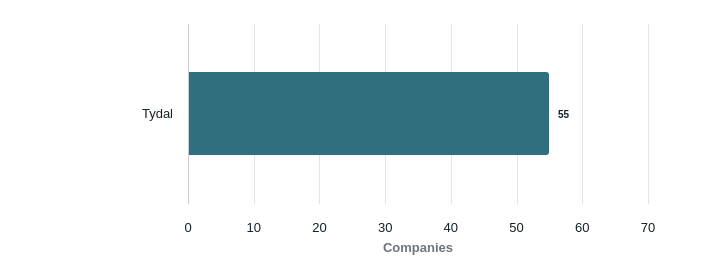
- Tydal Center & Valley: Encompasses 55 registered workplaces and 607 employees, capturing NOK 178.9M in operating income and NOK 175.5M in sales revenue. Key municipal offices, primary schools, medical clinics, commercial services, and workshop facilities line Tydalsvegen.
- Stugudal & High-Mountain Zone: Houses key tourism and recreational infrastructure, including cabin support services, camping sites, and data facility operations along Stugudalsvegen.
Because of Tydal's geographic location in southern Trøndelag, local businesses maintain transport connections via Highway 705 toward Røros and Selbu/Stjørdal, making efficient road transport and site preparation crucial local industries.
Largest Employers
The employer landscape in Tydal features a mix of municipal authorities, state-owned energy operations, high-tech infrastructure, and established private enterprises.
Major Employers in Tydal
| Company Name | Industry Sector | Employees | Operating Income |
|---|---|---|---|
| Tydal Kommune | General Public Administration | 174 | Public |
| Tydal Helsehus | Residential Nursing Homes | 62 | Public |
| Tydal Data Center AS | Data Processing & Hosting | 38 | NOK 36.3M |
| Statkraft Energi AS Avd Tydal | Water Power Electricity Production | 32 | NOK 625.5K |
| Moheim Camping AS | Camping & Recreation | 26 | NOK 6.0M |
| Tydal Kommune Vaktmestere Og Renholdere | Facilities Support | 25 | Public |
| Tydal Bygdeservice SA | Employment Placement / Services | 24 | NOK 19.0M |
| Tydal Barne Og Ungdomsskole | Primary Education | 23 | Public |
| Tydal Kommunale Barnehage | Pre-Primary Education | 16 | Public |
| Fjellguiden Tydal AS | Site Preparation | 14 | NOK 4.5M |
| Tydal Trappefabrikk A/S | Prefabricated Wood Production | 13 | NOK 21.0M |
| Coop Prix Tydal (Coop Midt Norge SA) | Supermarket Chain | 12 | Commercial Retail |
| Bil Og Landbruk AS | Car & Machinery Dealership | 10 | NOK 21.8M |
Industrial highlights include Tydal Trappefabrikk A/S, which maintains a healthy financial position with NOK 31.2M in equity, and Bil Og Landbruk AS, delivering over NOK 21.8M in annual sales.
Business Dynamism & Risk Factors
Business stability in Tydal is notably high compared to broader national averages. Corporate failure rates are minimal, pointing to robust balance sheets among established family-owned and co-operative businesses.
Bankruptcy Analysis
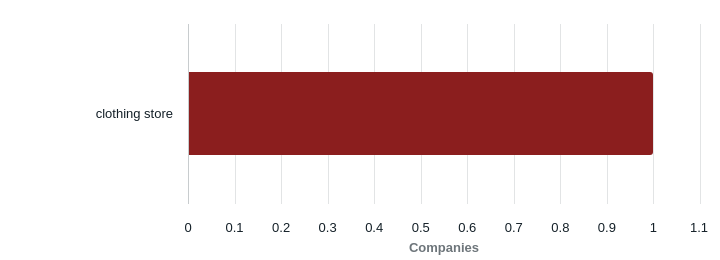
- Total Recorded Bankruptcies: 1 company (Quantum Enterprises AS, registered in the retail clothing sector with no active headcount or turnover).
- Sector Dynamics: The core productive sectors—energy, construction, manufacturing, and municipal services—show high capital retention and minimal insolvency risk.
- Financial Health: Local commercial entities maintain balanced leverage, with total equity in registered limited companies standing at NOK 82.8M against total debt of NOK 82.3M.
Opportunities for Founders
Tydal's distinct combination of abundant renewable power, land availability, and mountain tourism creates specific growth vectors for entrepreneurs:
- Tech & Green Energy Services: With established power production and data center operations (Tydal Data Center AS), opportunities exist in industrial cooling solutions, electrical maintenance, heat-reuse systems, and hardware servicing.
- Outdoor Tourism & Hospitality: Tydal serves as an entry point to Sylan. High demand for modern cabin maintenance, equipment rental, guiding, and year-round food services offers room for new hospitality ventures.
- Craft Manufacturing & Prefabrication: The success of Tydal Trappefabrikk A/S shows that high-value wood manufacturing can thrive in Tydal, utilizing regional timber and specialized logistics.
- Local Contracting & Earthworks: Ongoing cabin developments and municipal maintenance drive consistent demand for civil engineering, site preparation, and transport specialists.
Founders planning to launch or relocate a business in Trøndelag can utilize platforms like SmartGrunder to analyze local property locations, industrial zones, and sector metrics across Tydal.
Conclusion
Tydal presents a secure, resource-rich environment for targeted business development. Supported by reliable public infrastructure, high per-capita energy generation, and an emerging tech-industrial cluster, the municipality offers key advantages for specialized ventures.
For entrepreneurs seeking a stable mountain community with cheap access to green energy, low business risk, and a reliable local workforce, Tydal offers a compelling environment for long-term growth.